

|
Part of:
UK Fines and Appeals 2026
|
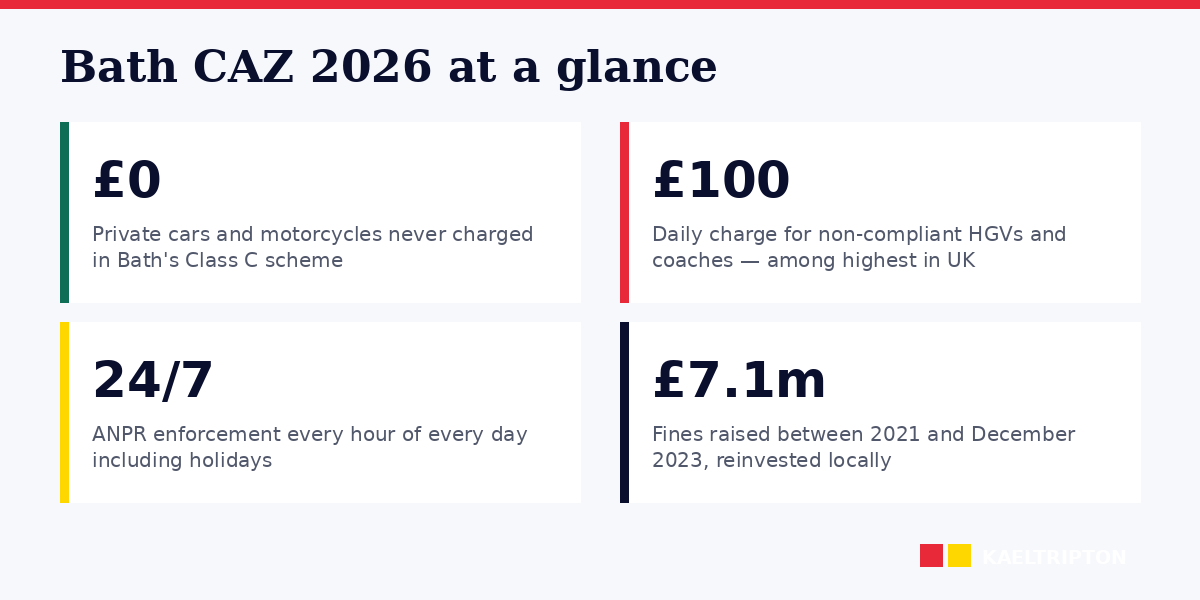
Bath's Clean Air Zone has run since March 2021 and is England's first CAZ outside London. It is a Class C zone, which means private cars and motorcycles are never charged regardless of age or emissions. Non-compliant taxis, vans, HGVs and coaches pay £9 to £100 a day. The zone covers the historic city centre and is enforced 24 hours a day, seven days a week, by ANPR cameras. This guide walks through exactly who pays what in 2026, which vehicles are exempt, how the boundary runs, and what to do if you get a Penalty Charge Notice.
| ★ EDITOR'S VERDICT Class C zone. Cars free forever, HGVs hit hardest. |
Bath's design is kinder to private motorists than Birmingham or Bristol and harder on commercial freight than anywhere outside London. A private car drives through free at any age, any fuel. An HGV pays £100 a day. The zone is ANPR-enforced around the clock including Royal Victoria Park and the A36 approach. Check the boundary before travel, pay any commercial charge within six days, and appeal a PCN only with evidence - 'I didn't see the sign' will not succeed. |
Who pays and who doesn't
Bath runs a Class C Clean Air Zone. The charges apply to commercial and passenger-service vehicles that fail the minimum Euro emission standard. Private cars, motorcycles and mopeds are outside the scheme.
The vehicles that never pay, regardless of age or engine:
- Private cars (except taxis and private hire vehicles)
- Motorcycles and mopeds
- Fully electric vehicles
- Hydrogen fuel cell vehicles
- Historic vehicles (built before 1 January 1986, rolling 40-year cut-off)
- Vehicles in the DVLA disabled or disabled-passenger tax class
- Retrofitted vehicles accredited under the Clean Vehicle Retrofit Accreditation Scheme (CVRAS)
The vehicles that pay if they miss the Euro standard:
| Vehicle type | Minimum standard to avoid charge | Daily charge if non-compliant |
|---|---|---|
| Taxis and private hire vehicles | Euro 4 petrol / Euro 6 diesel | £9 |
| Light goods vehicles (vans up to 3.5t) | Euro 4 petrol / Euro 6 diesel | £9 |
| Minibuses up to 5.0t | Euro 6 diesel / Euro 4 petrol | £9 |
| HGVs over 3.5t | Euro VI diesel | £100 |
| Buses and coaches | Euro VI diesel | £100 |
The £100 charge on HGVs and coaches is one of the highest CAZ rates in England, matched only by Bristol. The reasoning given in the council's 2021 scheme order was that Bath's narrow medieval streets cannot tolerate high volumes of heavy freight traffic, and that the price signal needed to be sharp enough to shift operations to compliant replacements.
The boundary in plain English
The CAZ boundary encloses the historic city centre plus Royal Victoria Park, Kingsmead, parts of Bathwick, Walcot, Widcombe and Beechen Cliff. It includes the A36 trunk road through the city centre, which was the single most contentious part of the scheme at consultation because the A36 is a major regional HGV route.
Landmarks inside the zone include Bath Abbey, the Roman Baths, the Royal Crescent, the Circus, Parade Gardens, Bath Spa railway station, and the Victoria Art Gallery. Bath Cricket Club is inside the zone; Bath Rugby Club at the Rec is outside. The River Avon forms much of the southern boundary.
The council's official map is at beta.bathnes.gov.uk/view-map-baths-clean-air-zone. Drivers unsure whether a specific address falls in the zone should use the postcode checker on that page before travelling. Satellite navigation systems do not always display the CAZ boundary reliably; the marked signage on the road is the authoritative guide.
How the charge works day by day
The charge runs from midnight to midnight, so a single day's travel within the zone incurs one £9 or £100 fee regardless of how many times the vehicle enters or leaves. Cross midnight with a non-compliant vehicle still inside the zone and two charges apply - one for each calendar day.
Payment is made at gov.uk/clean-air-zones, not directly to the council. The payment window is generous: you can pay from six days before travel to six days after. Miss the sixth-day deadline and a Penalty Charge Notice is issued automatically to the DVLA-registered keeper at £120, reduced to £60 if paid within 14 days.
Local exemptions and discounts are managed separately through the council's MiPermit service at mipermit.com/bath. A compliant vehicle never needs MiPermit; only drivers claiming a local discount or exemption register there.
Local exemptions and discounts in 2026
Several transitional exemptions that existed at launch have closed in the past three years. The current 2026 list, in approximate order of usage:
- Private Heavy Goods Vehicle (PHGV) discount. Larger motorhomes and horse transporters classified as PHGV and not used commercially pay £9 per day instead of £100. Application needed before travel; processing can take 14 days.
- Specialist and tax-class 12 emergency vehicles. Police, fire and ambulance vehicles are either nationally exempt under the disabled-passenger-vehicle tax class or are being retired and replaced; the transitional Bath emergency-vehicle exemption ended on 14 March 2025.
- Certain non-road-going vehicles. Tractors, snow ploughs, gritters and steam-powered vehicles that are not nationally exempt may apply for a local exemption on a case-by-case basis.
The Blue Badge exemption that ran at launch expired on 15 March 2023 and has not been reinstated. Blue Badge holders driving vehicles that are not already in the disabled tax class now pay the standard CAZ charge. The earlier Financial Assistance Scheme (grants of up to £4,500 for taxis and vans, up to £35,000 for HGVs and coaches) closed to new applications in 2023 after distributing approximately £9.4 million.
A real 2026 scenario: the self-employed plasterer from Warminster
A plasterer based in Warminster runs a 2013 Ford Transit Custom (Euro 5 diesel, non-compliant) and does roughly two jobs a week in central Bath. His route enters the zone on Wells Road in the morning and exits the same way each evening. Two entries a day count as one charge.
Cost analysis for 2026: 2 jobs × £9 × 48 weeks = £864 a year. A compliant Euro 6 replacement Transit Custom costs around £12,000 used. Pay-back on the replacement takes almost 14 years at this mileage - longer than the van will realistically last.
His three practical options: continue paying £864 a year and treat it as a business cost (claim it against tax), move to a compliant van through a business lease (roughly £280 a month plus VAT on a 36-month deal, so £10,080 net over three years - worse than the charge), or restructure the business to subcontract Bath work through a Bath-registered partner whose compliant van handles the zone crossings. Most small traders in his position default to the first option.
Penalty Charge Notice: what to do if you receive one
A Bath CAZ PCN is a civil enforcement notice under the Transport Act 2000. It arrives by post from the council's CAZ team at the DVLA-registered keeper's address, usually within three to six weeks of the violation. The amount is £120, reduced to £60 if paid within 14 days.
Representations (the first-stage challenge) go to the council through MiPermit within 28 days. Grounds that can succeed:
- The vehicle was compliant at the time (with evidence from the GOV.UK checker)
- A national or local exemption applied
- You sold or bought the vehicle on the relevant date (bill of sale required)
- The ANPR image shows a different vehicle (cloned plate, dashcam footage helps)
- A procedural error in the notice itself
Grounds that routinely fail: "I did not see the sign", "my satnav routed me in", "I was only in the zone for a minute", "I was visiting a patient at the Royal United Hospital". None of these are recognised legal grounds and the council will reject them. If the council rejects the representation, a 28-day window opens for appeal to the independent Traffic Penalty Tribunal at trafficpenaltytribunal.gov.uk.
Bath compared to other English CAZs
Bath's Class C design makes it one of the more forgiving CAZs for private motorists but one of the harshest for commercial operators. Here is how the HGV day rate compares in 2026:
| City | Class | HGV daily charge | Car daily charge |
|---|---|---|---|
| Bath | C | £100 | £0 |
| Birmingham | D | £50 | £8 |
| Bradford | C | £50 | £0 |
| Bristol | D | £100 | £9 |
| Portsmouth | B | £50 | £0 |
| Sheffield | C | £50 | £0 |
| Tyneside | C | £50 | £0 |
The £100 HGV rate in Bath and Bristol is twice the standard elsewhere. Freight operators routing through the south-west have reorganised supply chains to avoid both cities where possible; the A46 via Stroud and the M5 around Bristol both carry more HGV traffic post-2022 as a direct result.
Results so far
The council's own air quality monitoring reported an average 22 percent fall in nitrogen dioxide at 121 monitoring sites in the city between 2020 and 2021. Between launch and December 2023, the scheme issued over 174,000 Penalty Charge Notices and raised around £7.1 million in fines, reinvested into local air quality and sustainable transport measures. Approximately 30,000 to 40,000 vehicles enter the zone each day in 2026, of which fewer than 5 percent are non-compliant.
Critics argue that traffic displacement has increased congestion on the A36, A363, B3105, A361 and A350 surrounding Bath, and that Wiltshire villages near those routes absorb knock-on air quality impacts. The council acknowledges the displacement but maintains the net public health benefit is positive.
Frequently asked questions
Do I need to pay if I am driving a private car through Bath?
No. Bath is a Class C zone and private cars are never charged regardless of age, fuel type or emissions. The same applies to motorcycles and mopeds. Charges only affect taxis, private hire vehicles, vans, HGVs, buses and coaches that fail the relevant Euro standard.
Can I avoid the Bath CAZ using satellite navigation?
Not reliably. Google Maps and most other navigation apps do not show the Bath CAZ boundary explicitly. The best approach is the council's postcode checker on the Bath and North East Somerset Council website. Signs at the boundary itself (white cloud in a green circle, text "Clean Air Zone") are the legal marker.
How do I know if my van is Euro 6?
Enter the registration into the free GOV.UK vehicle checker at vehiclecheck.drive-clean-air-zone.service.gov.uk. Broadly, diesel vans registered from 1 September 2016 are Euro 6. Diesel vans registered before that date are typically Euro 5 or earlier and will be charged. The checker gives the definitive answer in about ten seconds.
What if I forget to pay within the six-day window?
You cannot make a late charge payment - the system closes after six days and a £120 PCN is generated automatically. The PCN is reduced to £60 if paid within 14 days of issue. The additional £51 cost over the original £9 daily charge is the incentive to pay on time.
Is there any way to pay the £9 charge in advance for a whole week?
No. Each day is charged separately. However, you can pay for multiple days in a single transaction through the GOV.UK payment system up to six days before travel. Businesses with two or more vehicles can set up a business account to pay in bulk.
Can tourists get a temporary exemption?
No. The Bath scheme has no tourist category. Visitors driving non-compliant vans or motorhomes are charged on the same basis as residents. Visitors driving private cars or motorcycles pay nothing.
What happens to the money Bath raises?
Under the Transport Act 2000 and the scheme order, all CAZ revenue (net of operating costs) must be spent on local transport and air quality improvements. Bath has published annual updates showing the funds allocated to bus route enhancements, cycling infrastructure, electric vehicle charging points and retrofit grants for local businesses.
Sources
- Bath and North East Somerset Council, Find out about charges in Bath's Clean Air Zone and Get an exemption or discount in Bath's Clean Air Zone
- DEFRA and DfT, Clean Air Zone Framework for England, updated 6 October 2022
- GOV.UK, Driving in a Clean Air Zone and the Clean Air Zone vehicle checker
- Transport Act 2000, Part III (Road User Charging)
- Road User Charging Schemes (Penalty Charges, Adjudication and Enforcement) (England) Regulations 2013
- Traffic Penalty Tribunal, Bath Clean Air Zone appeals process
- Wikipedia, Bath Clean Air Zone (used as a cross-reference to council-reported data)
|
Related guides
More fines and appeals guides
|


