

|
Part of:
UK Fines and Appeals 2026
|
The UK has four legal classes of Clean Air Zone - A, B, C and D - defined by DEFRA and DfT in the Clean Air Zone Framework for England. Each class covers a different set of vehicles: Class A is the lightest, catching only buses, coaches, taxis and private hire vehicles, and Class D is the heaviest, catching everything down to private cars and motorcycles. This guide unpacks exactly which vehicles are charged under each class, what each of the seven live English CAZs charges in 2026, and how to predict which zones your vehicle faces.
| ★ EDITOR'S VERDICT Only Birmingham and Bristol charge cars. |
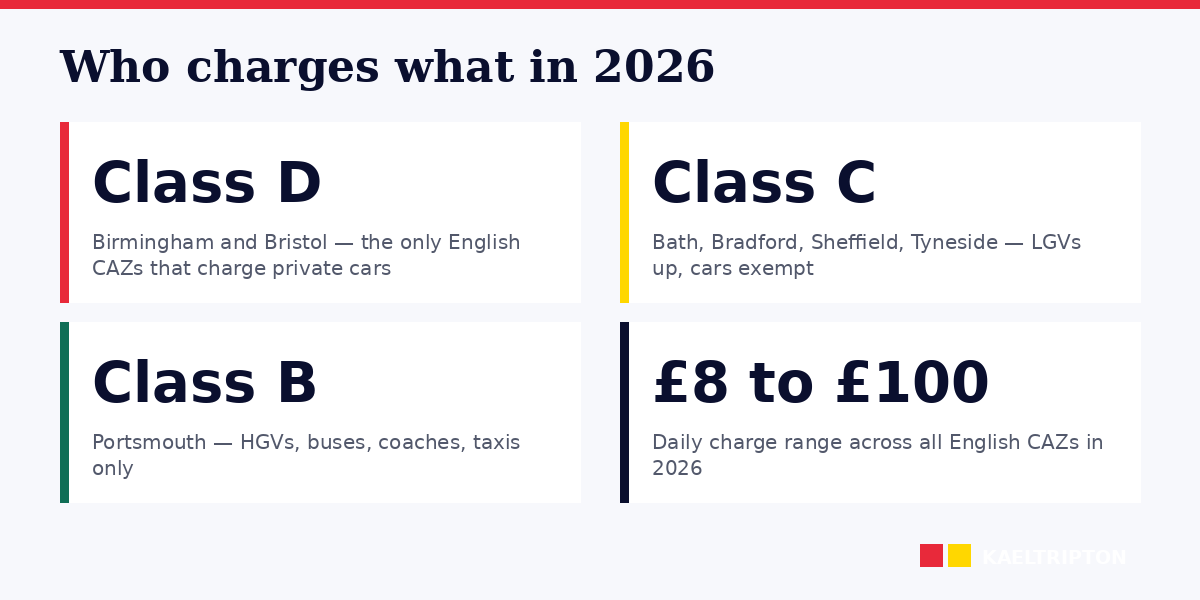
Class A to D is a cumulative framework, not a menu. Class D (Birmingham and Bristol) is the only configuration that charges private cars in 2026 - everywhere else, cars drive free and the zone targets commercial fleets. London's ULEZ is operationally equivalent to Class D but legally separate. Predict your exposure by matching vehicle type to the relevant class, then cross-check with the GOV.UK tool. |
The four classes in one table
| Class | Vehicles covered | Example cities |
|---|---|---|
| A | Buses, coaches, taxis, private hire vehicles | No English city currently runs a pure Class A |
| B | Class A vehicles plus heavy goods vehicles | Portsmouth |
| C | Class B vehicles plus light goods vehicles (vans under 3.5t) and minibuses | Bath, Bradford, Sheffield, Tyneside |
| D | Class C vehicles plus cars, and (at council discretion) motorcycles | Birmingham, Bristol |
The key rule: classes are cumulative. A Class C zone charges everything a Class B zone charges, plus LGVs and minibuses. A Class D zone charges everything a Class C zone charges, plus cars. A local authority cannot "mix and match" - it cannot design a zone that charges coaches and cars but not LGVs, because that would breach the national framework's rule of cumulative coverage.
Class A: buses, coaches, taxis and private hire
Class A is the narrowest zone. It was designed for city centres where air pollution is driven almost entirely by commercial passenger transport - diesel buses, coaches stopping at long-distance terminals, and high-mileage taxis and PHVs circulating the same streets all day.
No English city currently operates a pure Class A zone. Leeds was the original test case but abandoned the scheme in 2020 after its commercial fleet achieved voluntary Euro VI compliance. A Class A configuration remains on the statute books and is available to any local authority that determines a Class A response is proportionate to its local NOx problem.
The minimum emission standards for Class A are:
- Buses and coaches: Euro VI diesel (roughly 2014 onwards)
- Taxis and PHVs: Euro 6 diesel or Euro 4 petrol
Class B: Class A plus HGVs
Class B adds heavy goods vehicles - lorries over 3.5 tonnes. This is the right tool for corridor cities where freight traffic is the dominant pollution source.
Portsmouth is the only English Class B zone in 2026. Charges are £10 per day for non-compliant taxis and private hire vehicles, and £50 per day for non-compliant HGVs, buses and coaches. Portsmouth's zone was designed specifically around the A3 corridor into the city centre and the commercial port traffic, neither of which implicates private cars in a meaningful way.
Class B emission standards:
- HGVs: Euro VI diesel
- Buses, coaches, taxis, PHVs: as Class A
Class C: Class B plus LGVs and minibuses
Class C adds light goods vehicles up to 3.5 tonnes and minibuses. This is where the framework starts to bite the self-employed - the plumber's Transit, the courier's Vivaro, the independent builder's Master. Private cars remain exempt under Class C.
Four English cities run Class C schemes in 2026:
- Bath - Class C, £9 per day for non-compliant LGVs and taxis, £100 per day for HGVs, buses and coaches
- Bradford - Class C+ (Class C plus hackney carriages), £9 per day for LGVs and taxis, £50 per day for heavier vehicles
- Sheffield - Class C, £10 per day for LGVs, taxis and PHVs, £50 per day for HGVs and buses
- Tyneside (Newcastle and Gateshead) - Class C, £12.50 per day for LGVs and taxis, £50 per day for heavier vehicles
Class C emission standards match Class B plus:
- LGVs (vans up to 3.5t): Euro 6 diesel or Euro 4 petrol
- Minibuses: Euro 6 diesel or Euro 4 petrol
Class D: Class C plus cars and motorcycles
Class D is the full zone - everything that moves. Cars pay, vans pay, motorcycles may pay if the council opts in, commercial traffic pays.
Two English cities run Class D schemes in 2026:
- Birmingham - Class D, £8 per day for non-compliant cars, LGVs and taxis, £50 per day for HGVs, buses and coaches. Motorcycles are not charged by Birmingham's local design choice.
- Bristol - Class D, £9 per day for cars, LGVs and taxis, £100 per day for HGVs, buses and coaches. Motorcycles are not charged.
London's Ultra Low Emission Zone is operationally equivalent to Class D but is not legally a Clean Air Zone - it was created under the Greater London Authority Act 1999 rather than the Transport Act 2000, and its charge (£12.50 per day) is set by the Mayor of London rather than the local authority. Glasgow's Low Emission Zone is Scotland's Class D equivalent and operates under devolved legislation.
Class D emission standards add:
- Cars: Euro 6 diesel or Euro 4 petrol
- Motorcycles (if included): Euro 3
Why is Birmingham the only Class D that charges cars in England outside London?
The Class D label suggests every city could charge cars, but only Birmingham has done so without local controversy forcing a rollback. Bristol, the only other Class D city, went through a similar design phase but introduced exemptions and grants that soften the impact. The reason lies in how the framework constrains local discretion: a Class D zone can only be proposed when air quality modelling shows that no lower class would deliver NO2 compliance.
Manchester originally proposed a Class C zone in 2020, abandoned it, and submitted a non-charging Clean Air Plan in 2024. Leeds modelled both Class C and Class D options and ultimately introduced neither. Newcastle and Sheffield both chose Class C. Bath, despite being the most air-pollution-challenged small city in England, consciously chose not to charge private cars. The political economics of charging private drivers is harsh enough that authorities only reach for Class D when the air quality challenge leaves no alternative.
What your vehicle pays in each live zone (2026)
The most common question in 2026: "If my vehicle is non-compliant, what will it cost me?" Here is the 2026 table for a non-compliant petrol car that fails Euro 4, or a non-compliant diesel car that fails Euro 6:
| City | Class | Daily charge for non-compliant car |
|---|---|---|
| Bath | C | £0 (cars not charged) |
| Birmingham | D | £8 |
| Bradford | C | £0 (cars not charged) |
| Bristol | D | £9 |
| Portsmouth | B | £0 (cars not charged) |
| Sheffield | C | £0 (cars not charged) |
| Tyneside | C | £0 (cars not charged) |
| London (ULEZ) | Equivalent to D | £12.50 |
For a non-compliant LGV (van up to 3.5t) the picture is much harsher - every English CAZ charges them, with daily rates ranging from £8 (Birmingham) to £12.50 (Tyneside and London):
| City | Class | Daily charge for non-compliant LGV |
|---|---|---|
| Bath | C | £9 |
| Birmingham | D | £8 |
| Bradford | C | £9 |
| Bristol | D | £9 |
| Portsmouth | B | £0 (LGVs not charged) |
| Sheffield | C | £10 |
| Tyneside | C | £12.50 |
| London (ULEZ) | Equivalent to D | £12.50 |
For non-compliant HGVs, buses and coaches, every English CAZ charges them, and the rates are much higher - £50 per day in most zones, £100 per day in Bath and Bristol.
Case study: the national courier crossing three zones
A courier based in Swindon runs a 2012 Mercedes Sprinter (Euro 5 diesel, non-compliant) on a route that crosses Bath in the morning, Birmingham at lunchtime, and Bristol on the return leg. Three zones, three charges:
- Bath (Class C, LGV non-compliant): £9
- Birmingham (Class D, LGV non-compliant): £8
- Bristol (Class D, LGV non-compliant): £9
- Total daily cost: £26
On a five-day route this is £130 per week, £6,240 per year. A Euro 6 compliant replacement Sprinter costs roughly £14,000 used. Pay-back under this usage pattern is just over two years - and the courier is better off leasing or financing a compliant van than continuing to pay the daily charges. The framework is designed to force exactly this calculation.
The 3.5-tonne boundary: the single most contested line
The legal boundary between LGV (charged under Class C and above) and HGV (charged under Class B and above) sits at 3.5 tonnes gross vehicle weight, shown in field F.1 of the V5C. A vehicle plated at exactly 3,500 kg is an LGV. A vehicle plated at 3,501 kg is an HGV. The practical consequences of this single kilogram are significant - HGV charges are five to ten times higher than LGV charges.
Two real scenarios in 2026 illustrate the stakes. A self-employed glazier's long-wheelbase Transit plated at 3,500 kg is an LGV in every CAZ and pays the LGV rate. The same Transit plated at 3,700 kg (common on heavy-duty variants) is an HGV - £50 a day in Sheffield, £100 in Bath. Small businesses buying second-hand vans rarely check the plated weight, and rarely realise the Class C rate they budgeted for is actually the Class B rate.
The second scenario: converted campervans. A 3.2-tonne panel van converted to a motorhome and re-registered as "Motor Caravan" drops out of the LGV rules entirely and into the car rules - typically a far cheaper outcome. The conversion must be declared to DVLA with evidence before the V5C is updated, and the saving on CAZ charges often pays for the conversion paperwork many times over for heavy users.
How zone classes change in 2026
Class changes are procedurally expensive. A local authority cannot simply upgrade a Class C to Class D on a whim - it must commission fresh air quality modelling, run a formal public consultation, amend its Road User Charging Scheme Order, and receive Secretary of State sign-off. No English CAZ is scheduled for a class upgrade in 2026.
Downgrades are equally rare. Bath's council has reviewed its Class C status twice since launch and retained it. Portsmouth's Class B has been reviewed and retained. The political cost of removing a charging scheme is almost as high as the cost of introducing one, because DEFRA requires evidence that NO2 compliance will be achieved through alternative means before authorising a downgrade.
What is likely in 2026 is incremental tightening of local exemptions as the initial transition phase closes. Bath, Sheffield and Tyneside have all wound down launch-period exemptions for LGVs. Birmingham has tightened the Queen Elizabeth Hospital exemption. Drivers should expect the base Euro standards and charge rates to remain stable, but the local "soft edges" to continue hardening.
Frequently asked questions
Can a local authority invent a new class?
No. The four classes A to D are set in the national Clean Air Zone Framework and cannot be varied locally. A local authority can choose whether to include motorcycles in a Class D scheme (Birmingham and Bristol both chose not to), but it cannot create a "Class E" or design a zone that charges, say, only SUVs.
Does a Class D zone always charge cars?
Yes. A Class D zone by definition includes private cars. If cars are not being charged, the zone cannot be Class D. Birmingham and Bristol both charge cars and both are Class D. If a city chooses a zone that excludes cars, it is by definition a Class C or narrower.
Why is London's ULEZ not labelled as a CAZ class?
London's ULEZ was created under different legislation - the Greater London Authority Act 1999 - and the Mayor of London has powers that other local authorities do not have. Operationally the ULEZ behaves like a Class D CAZ, but its legal identity is distinct and its charge (£12.50) is set independently of the DEFRA framework.
Can I predict whether a new city will adopt Class A, B, C or D?
Yes, broadly. The framework requires cities to model the minimum class that would deliver NO2 compliance. Cities with high freight traffic but modest commuter car volume tend to land on Class B (Portsmouth). Cities with diverse commercial fleets but limited private car penetration of the centre land on Class C (Sheffield, Bradford). Only cities where car traffic is a genuine majority contributor to NOx end up at Class D.
If my vehicle is compliant, can I still be charged?
No. If the GOV.UK checker shows "You do not need to pay" for a zone, that is the authoritative status. If an ANPR system mistakenly issues a PCN to a compliant vehicle, the grounds of appeal at the Traffic Penalty Tribunal explicitly cover "the alleged contravention did not occur" - compliance evidence overrides the PCN.
Do Class A to D rules apply to Scotland and Wales?
No. Scotland uses the Low Emission Zone framework under the Transport (Scotland) Act 2019 - there are no classes A to D. Wales currently has no charging zones and would need its own legislative framework to introduce any. The CAZ class system is an England-only construct.
Does Class D cover caravans, horseboxes and motorhomes?
It depends on how the V5C classifies the vehicle. A motorhome registered as "Motor Caravan" follows car rules (Euro 4 petrol / Euro 6 diesel for Class C and D). A horsebox over 3.5 tonnes is classified as a heavy goods vehicle and follows Euro VI rules in any Class B or higher zone. A caravan is not self-propelled - only the towing vehicle's Euro standard is assessed.
Sources
- DEFRA and DfT, Clean Air Zone Framework for England, updated 6 October 2022
- Transport Act 2000, Part III - Road User Charging and Workplace Parking Levy
- GOV.UK, Driving in a Clean Air Zone and city-specific scheme guidance
- Birmingham City Council, Clean Air Zone - charges and exemptions
- Bristol City Council, Bristol's Clean Air Zone charges and vehicle checker
- Portsmouth City Council, Portsmouth Clean Air Zone
- Sheffield City Council, Sheffield Clean Air Zone
- Bradford Council, Breathe Better Bradford
- Tyneside Breathe Clean Air partnership, Scheme details
- Transport for London, Ultra Low Emission Zone (for comparison only)
|
Related guides
More fines and appeals guides
|


