

|
Part of:
UK Fines and Appeals 2026
|
A CAZ Penalty Charge Notice starts at £120 and doubles if ignored. You have 28 days to pay at the discounted £60 rate, 28 days to make formal representations to the council, and a final 28 days to appeal to the independent Traffic Penalty Tribunal if the council rejects your representations. This guide walks through every stage - when it is worth paying, when it is worth fighting, and the six specific grounds on which an independent adjudicator can cancel a CAZ PCN.
| ★ EDITOR'S VERDICT Evidence wins. Explanation loses. |
Pay within 14 days and the PCN halves to £60. Miss 28 days and it rises to £180. Appeals succeed on six legal grounds - compliance proof, keeper change, exemption, wrong amount, procedural error, or invalid scheme - plus a narrow 'compelling reasons' door. Dashcam footage beats every other piece of evidence. "I didn't see the signs" is not a ground and will fail at council and tribunal level. |
What a CAZ PCN actually is
A Penalty Charge Notice is a civil enforcement document issued under the Transport Act 2000 and the Road User Charging Schemes (Penalty Charges, Adjudication and Enforcement) (England) Regulations 2013. It is not a criminal fine - it does not go on a driving record, it does not affect insurance, and it is not enforced by the police.
You receive a CAZ PCN when:
- An ANPR camera records your registration entering a zone
- The vehicle is non-compliant according to the DVLA database
- No daily charge was paid within the six-day payment window (midnight to midnight on the day of entry, plus six further days)
- No national or local exemption applies
The PCN is posted to the registered keeper at the address shown on the DVLA record. It arrives in a brown envelope labelled with the issuing council's name, and typically within three to six weeks of the alleged contravention. The PCN shows the date and time of the camera capture, the ANPR image, the outstanding amount, and - crucially - the deadlines for payment and challenge.
The £60 versus £120 decision: the 14-day question
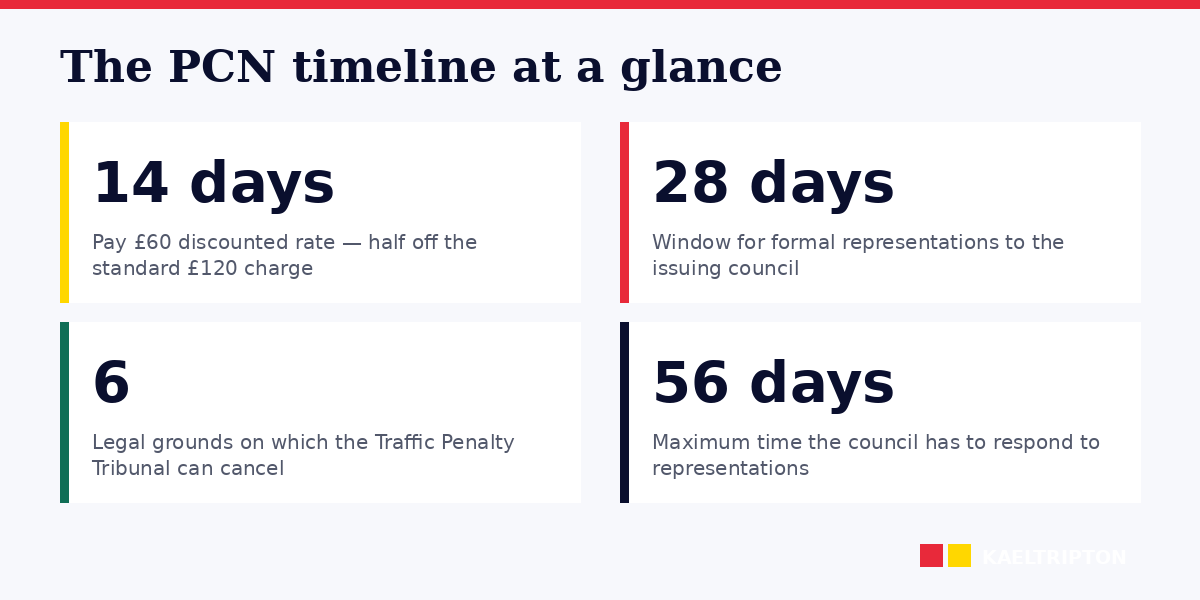
Every CAZ PCN gives an immediate discount window. The full PCN charge is £120. Pay within 14 days and it reduces to £60. Pay within 28 days and it stays at £120. Wait longer than 28 days and a Charge Certificate is issued, increasing the amount by a further 50% to £180. Ignore the Charge Certificate and an Order for Recovery is registered at the Traffic Enforcement Centre, adding a further £10 court fee and opening the door to enforcement agents.
The £60 discount is not contingent on accepting liability. A driver who pays within 14 days to secure the discount does not lose the right to challenge the PCN - but in practice, once the reduced amount is paid, the council considers the matter closed and representations are rarely accepted. The practical choice is usually binary: pay £60 and move on, or challenge and risk £120 if the challenge fails.
Stage 1: informal challenge and formal representations (28 days)
The first route to challenge a CAZ PCN is to make formal representations to the council that issued it. This must be done within 28 days of the PCN's Date of Service (usually two working days after the date of posting).
Every English CAZ authority operates an online portal for representations. The portal requires:
- The PCN reference number (starts with a council-specific prefix: "BA" for Bath, "BB" for Birmingham, "BR" for Bristol, "NA" for Newcastle/Tyneside, "SH" for Sheffield, "BD" for Bradford, "PO" for Portsmouth)
- The vehicle registration number
- A written statement of the grounds for challenge, with any supporting evidence
The council has up to 56 days to respond. Two outcomes are possible:
- Notice of Acceptance - the PCN is cancelled and no payment is due
- Notice of Rejection of Representations (NoR) - the PCN stands, and a 28-day window opens for appeal to the Traffic Penalty Tribunal
The quality of the representation matters enormously. Councils reject around 70% of CAZ representations at this stage, frequently because the driver cited reasons that are not recognised grounds. Birmingham and Newcastle both publish lists of reasons that "will not normally be accepted": satnav directed me into the zone, I was only in the zone briefly, I was lost, I did not see the signs, I was visiting someone inside the zone. None of these are legal grounds for cancellation and none will succeed even at tribunal level.
The six legal grounds of appeal
The Traffic Penalty Tribunal - the independent adjudicating body for CAZ appeals in England outside London - can only cancel a PCN on specific statutory grounds. The 2013 Regulations set out six, which are consistent across every English CAZ:
- The alleged contravention did not occur. The vehicle was not in the zone at the time stated, or it was compliant at the time, or the daily charge was in fact paid. Evidence includes compliance proof from DVLA, GPS tracking data, or a payment receipt.
- The recipient was not the keeper of the vehicle at the time. You sold the vehicle before, or bought it after, the contravention. Evidence is the V5C keeper change confirmation and/or the bill of sale.
- The vehicle or alleged contravention was covered by an exemption. A national exemption applied but was not recognised by ANPR, or a granted local exemption was wrongly excluded. Evidence is the V5C, exemption approval letter, or CVRAS retrofit certificate.
- The penalty charge exceeded the amount applicable in the circumstances. The council applied the HGV rate when the vehicle is an LGV, or billed at the full rate when the 14-day discount had not yet expired.
- There has been a procedural impropriety by the council. The PCN was served late, served to the wrong address, fails to include required information, or the underlying Road User Charging Scheme Order is invalid.
- The charging scheme order itself is invalid. Rarely succeeds and requires evidence that the local authority exceeded its powers under the Transport Act 2000.
A seventh category - compelling reasons - allows adjudicators to apply discretion where strict application of the rules would be unjust. This is the narrow door for genuine mitigating circumstances: medical emergency, mechanical breakdown forcing an entry, newly registered keeper whose DVLA record had not yet flowed to ANPR. Compelling-reason appeals succeed more often than mitigation-based challenges at council level, because the tribunal has explicit statutory power to cancel on discretionary grounds.
Stage 2: appeal to the Traffic Penalty Tribunal
If the council rejects your representations, you have 28 days from the Notice of Rejection to appeal to the Traffic Penalty Tribunal. The appeal is free. There is no court fee, no legal representation requirement, and no cost exposure if you lose (apart from the original PCN amount).
Appeals are lodged online at trafficpenaltytribunal.gov.uk. You will need:
- The PCN reference and copy of the NoR letter
- A clear statement of which of the six grounds (or "compelling reasons") you rely on
- Supporting evidence - documents, photographs, correspondence, receipts
- A preference for how the appeal is heard: on the papers (fastest), by telephone, by video, or in person at a tribunal venue
The tribunal is operated by independent adjudicators who are qualified lawyers with at least five years' experience, appointed by the Lord Chancellor. They are entirely independent of the council that issued the PCN. Typical decision time is four to eight weeks from lodging the appeal. Success rates at tribunal hover around 40% across all PCN types, but for CAZ appeals specifically where the driver relies on documented evidence of compliance or exemption, success rates are higher.
When to pay and when to fight: a real 2026 decision framework
A useful rubric for deciding:
Pay the £60 discount if:
- You drove into the zone and genuinely did not realise the vehicle was non-compliant
- You forgot to pay within the six-day window and have no evidence of compliance or exemption
- The ANPR image clearly shows your vehicle and your defence is purely "I did not know"
Challenge the PCN if:
- Your vehicle is compliant and the DVLA record is correct - run the GOV.UK checker and save a screenshot as evidence
- You were not the keeper at the time - you have the V5C change confirmation
- A national or local exemption applied - you have the V5C tax class or exemption letter
- There is a procedural error - the PCN arrived more than six weeks after the contravention date, or it has incorrect details
- The ANPR image does not show your vehicle (cloned plates are a real but small category)
The key question is evidence. Appeals supported by documents succeed; appeals supported by explanation alone usually fail.
A real 2026 scenario: the cloned plate
A retired accountant in the Borders receives a Newcastle/Tyneside CAZ PCN for a contravention on a date when his Volvo V70 was parked outside his house in Jedburgh, 65 miles north of the zone. The ANPR image shows his registration on a completely different Volvo estate - same model but a different colour and with a damaged front bumper his car does not have.
This is a classic cloned plate case. His grounds of appeal are clear: the alleged contravention did not occur (his vehicle was not there). The evidence: dashcam footage from his car showing the date and location in Jedburgh, a statement from a neighbour confirming the vehicle was parked at home, and a comparison photograph showing the colour and condition difference from the ANPR image. Newcastle City Council accepts the representation at stage 1 and cancels the PCN. The case never needs to go to tribunal.
The practical lesson: dashcam footage is the single most useful piece of evidence a driver can accumulate for PCN defence. The routine practice of keeping a rolling seven-day dashcam archive, downloaded to a laptop each Sunday evening, has saved more PCN appeals in 2026 than any other single habit.
What happens if you ignore the PCN
Ignoring a CAZ PCN is the worst possible strategy. The timeline:
- Day 28 without payment or representation: Charge Certificate issued, amount rises 50% to £180
- Day 42: If still unpaid, the council may register the debt at the Traffic Enforcement Centre - adds £10 court fee
- Day 63: Warrant may be issued, passing the debt to civil enforcement agents (bailiffs)
- After warrant: Enforcement agent compliance fee of £75 is added automatically under the Taking Control of Goods (Fees) Regulations 2014
An ignored £120 PCN typically grows to £265 within 90 days and can exceed £400 once further enforcement steps are taken. If all stages of challenge were missed, the final route is a Witness Statement (form TE9) to the Traffic Enforcement Centre, available only on specific grounds: you never received the PCN, you submitted representations and got no response, or you paid the PCN in full before the Charge Certificate was issued.
Frequently asked questions
How long do I have to pay a CAZ PCN?
The PCN is due within 28 days of the Date of Service. Pay within the first 14 days and you get a 50% discount - £60 instead of £120. After 28 days the amount increases by 50% to £180 via Charge Certificate. Acting within the first 14 days is cheapest; acting within 28 days preserves full challenge rights.
Can I appeal a CAZ PCN on the grounds that I did not see the signs?
No, not as a statutory ground. "I did not see the signs" is not one of the six legal grounds of appeal. It can occasionally be accepted as a compelling reason at tribunal level, but only if the driver shows that signage was missing, obscured or inadequate at the point of entry - which in 2026 is extremely rare given the extensive pre-launch signage audits each authority conducted.
Does a CAZ PCN affect my driving licence or insurance?
No. CAZ PCNs are civil penalties, not criminal offences. They do not attach to your driving record, they do not generate penalty points, and you are not legally required to disclose them on insurance applications. Unpaid PCNs that reach court recovery stage can affect your credit file, but the PCN itself does not.
What if the PCN arrives more than six weeks after the alleged contravention?
The Road User Charging Schemes Regulations require the PCN to be served within six months of the contravention. Service significantly later than the usual three-to-six-week window is not itself grounds for cancellation, but if it is so delayed that it prejudices your ability to gather evidence in defence, that can be a procedural ground at tribunal.
Can I transfer a PCN to a driver who was not the keeper?
No. CAZ PCNs attach to the registered keeper, not the driver. If someone else was driving your vehicle at the time (a family member, a named hire) the keeper remains liable to the council - any arrangement to recover the money from the driver is a private matter between keeper and driver.
Does the Traffic Penalty Tribunal hear CAZ appeals for all English cities?
Yes, for all English CAZs outside London. The tribunal covers Bath, Birmingham, Bradford, Bristol, Portsmouth, Sheffield and Tyneside. London ULEZ appeals go to London Tribunals (operated by the Greater London Authority) under different legislation. Scottish LEZ appeals follow Scottish procedure under the Transport (Scotland) Act 2019.
If I win at tribunal, do I get anything back?
The PCN is cancelled and any amount already paid is refunded. There are no costs awards and no compensation for time taken to prepare the appeal. Success at tribunal resets the position to "PCN never issued". Bailiff or enforcement fees added after the PCN must also be refunded if the underlying PCN is cancelled.
Sources
- Transport Act 2000, Part III - Road User Charging and Workplace Parking Levy
- Road User Charging Schemes (Penalty Charges, Adjudication and Enforcement) (England) Regulations 2013
- Traffic Management Act 2004 - enforcement provisions
- Traffic Penalty Tribunal, CAZ appeals process and Grounds of Appeal pages for each CAZ city
- GOV.UK, Driving in a Clean Air Zone and How to pay a CAZ Penalty Charge Notice
- Taking Control of Goods (Fees) Regulations 2014 - enforcement agent fee schedule
- Newcastle City Council, Clean Air Zone - pay or appeal a PCN
- Birmingham City Council, Clean Air Zone Penalty Charge Notices
- Traffic Enforcement Centre, TE7 and TE9 forms for out-of-time challenges
|
Related guides
More fines and appeals guides
|
For penalty charge notices issued by councils for parking rather than zone contraventions, the appeal routes are covered city by city in the council PCN appeal guides.


