

|
Part of:
UK Fines and Appeals 2026
|
Bristol Clean Air Zone key figures (checked 24 September 2026)
| Item | Figure |
|---|---|
| Zone type | Class D: charges apply to non-compliant cars as well as larger vehicles |
| Hours | 24 hours a day, every day; the charging day runs midnight to midnight |
| Cars, taxis and light goods vehicles (non-compliant) | £9 a day |
| HGVs, buses and coaches (non-compliant) | £100 a day |
| When to pay | Up to 6 days before, on the day, or up to 6 days after |
| How to pay | Online on GOV.UK or by phone on 0300 029 8888 |
| Penalty if unpaid | £120 plus the daily charge, reduced to £60 if paid within 14 days |
Sources: Bristol City Council, pay the Clean Air Zone charge
Bristol has operated a Class D Clean Air Zone since 28 November 2022. Unlike Newcastle’s Class C scheme, Bristol charges all vehicle types - including private cars. £9 per day for cars, taxis and vans; £100 for HGVs, coaches and buses. This guide covers the boundary, charges, exemptions, and the common mistakes Bristol drivers make.
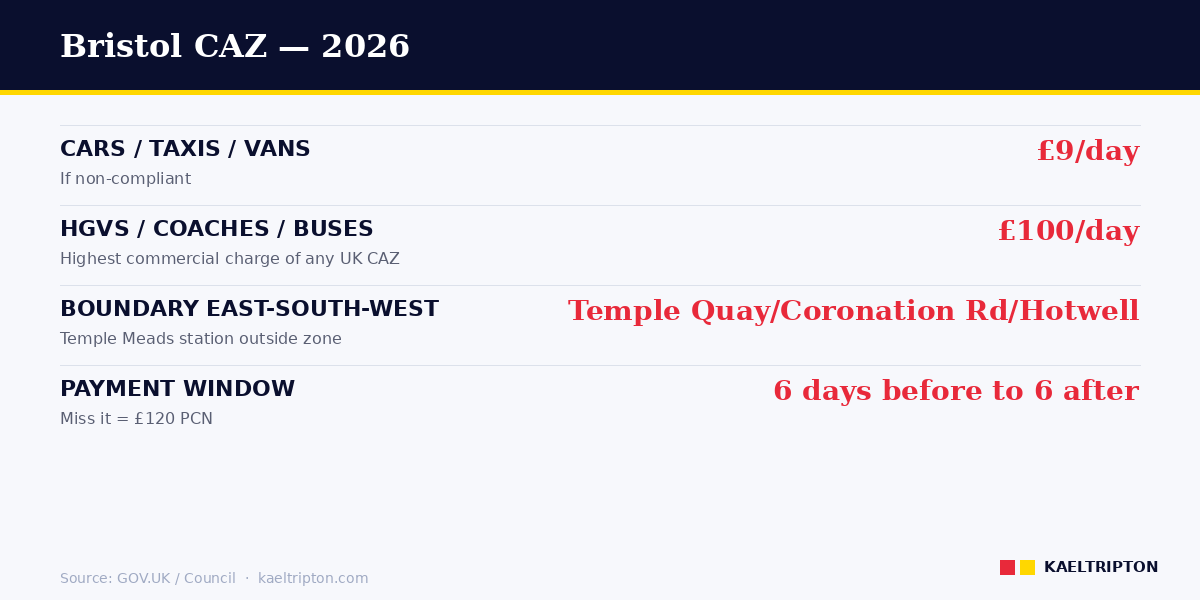
Bristol’s Class D CAZ: £9/day for cars, taxis and vans; £100/day for HGVs, coaches and buses. Boundary: Temple Quay east, St James Park north, Coronation Road south, Hotwell Road and Brunel Way west. Temple Meads station is outside the zone. 6-day payment window; £120 PCN (halved to £60) for non-payment. |
Bristol CAZ in one paragraph
Bristol operates a Class D Clean Air Zone covering the city centre. Non-compliant cars, taxis and vans pay £9 per day; non-compliant HGVs, coaches and buses pay £100 per day. The zone runs 24 hours a day, 7 days a week, with charges midnight to midnight. Enforcement is by ANPR. Motorcycles are not charged. Approximately 71% of vehicles entering the zone are already compliant, according to Bristol City Council data.
The scheme was introduced in response to government directives over persistent nitrogen dioxide exceedances. Bristol is a Class D scheme like Birmingham - the most restrictive UK CAZ category. Charges are slightly higher than Birmingham’s (£9 vs £8 for cars; £100 vs £50 for HGVs).
Emissions standards
To avoid the charge, your vehicle must meet these minimum standards (the same as all UK CAZs):
- Petrol cars and vans: Euro 4 (roughly 2006 onwards).
- Diesel cars and vans: Euro 6 (roughly September 2015 onwards).
- HGVs, buses and coaches: Euro VI (roughly 2014 onwards).
- Hybrid vehicles: compliance based on internal combustion engine.
- Electric vehicles: exempt.
- Motorcycles and mopeds: not charged.
Check your specific vehicle at vehiclecheck.drive-clean-air-zone.service.gov.uk. The tool is authoritative and covers all UK CAZ schemes.
The Bristol CAZ boundary
Bristol’s CAZ boundaries run:
- East: Temple Quay (excluding the train station itself).
- North: St James Park.
- South: Coronation Road.
- West: Brunel Way and Hotwell Road.
Inside the zone: Cabot Circus, Broadmead, College Green, Queen Square, the harbour area, the SS Great Britain, and most of the central business district. Bristol Temple Meads station is technically outside the zone - the CAZ stops at Temple Quay. Clifton, Montpelier and Stokes Croft are outside the CAZ.
Official boundary map at cleanairforbristol.org. Road signs mark the boundary at all major approaches.
How to pay
Pay at gov.uk/clean-air-zones. Payment window: up to 6 days before travel, on the day, or up to 6 days after leaving the zone (by 11:59pm on the sixth day). A daily charge covers unlimited entries and exits during that calendar day (midnight to midnight).
Missing the payment window triggers a Penalty Charge Notice. In Bristol, this is £120 - reduced to £60 if paid within 14 days. Unpaid PCNs escalate to county court judgments through the standard civil enforcement process.
No refunds are issued to drivers who pay in advance but do not actually enter the zone. Exception: if roadworks diverted traffic through the zone unexpectedly, Bristol City Council refunds both charges and associated PCNs on evidence.
Exemptions and discounts
Bristol operates several local exemption schemes beyond the national CAZ exemptions:
- Means-tested vehicle upgrade support for low-income residents and small businesses. Grants have varied in amount over time; check current schemes at cleanairforbristol.org.
- Temporary exemptions for specific categories during transitional periods (hospital visitors, certain care providers).
- Blue Badge holders - certain concessions apply; check Bristol-specific guidance.
- National exemptions: historic vehicles (40+ years in historic tax class), military, recovery, fully electric.
Unlike Birmingham, Bristol does not offer a broad resident exemption. Most Bristol-specific support is through grants to help residents upgrade rather than ongoing free passage.
Scenario - the Euro 5 diesel commuter
Consider a realistic case. An accountant in Bedminster drives a 2014 BMW 320d (Euro 5 diesel - not Euro 6 compliant) into central Bristol 4 days a week. Her office is on Queen Square.
Her options:
- Pay the £9 daily charge: £36 per week, about £1,800 per year. Expensive but straightforward.
- Park at Temple Meads (just outside the zone) and walk 10 minutes. Temple Meads day parking is typically £8-10, roughly break-even with the CAZ charge but no ongoing emissions concern.
- Upgrade the vehicle to a Euro 6 diesel or petrol/hybrid. Second-hand Euro 6 options start around £8,000-10,000 - recouping the cost against 4 years of CAZ payments makes sense if she plans to keep commuting this way long-term.
Teaching point: for regular commuters, doing the arithmetic matters. Three routes forward - pay, park outside, or upgrade - with different cost profiles. Don’t assume paying the CAZ charge forever is the default; check break-even on an upgrade.
The pay-window trap
Bristol’s 6-day payment window is one of the most common trip-ups. The clock runs from the day of travel to 11:59pm on the sixth subsequent calendar day. Miss it by an hour and you’re into PCN territory.
Practical tips:
- Pay on the day of travel if possible. Don’t defer.
- Set a calendar reminder if you’re waiting. Most payment misses are “I’ll do it tomorrow” followed by forgetting.
- Use the auto-pay option if you travel into Bristol regularly. Some third-party apps (RAC, Caura) offer auto-pay against your registration.
- For one-off visits, pay at the time of the trip through the GOV.UK website while parked - takes 2 minutes.
Appealing a Bristol CAZ PCN
The appeal process mirrors other English CAZs:
- Informal challenge within 14 days. Submit through Bristol City Council’s CAZ portal. Quick resolution of clear cases.
- Formal representations within 28 days if informal is rejected. Statutory grounds in the 2013 Regulations.
- Traffic Penalty Tribunal independent adjudicator if formal is rejected.
Common accepted grounds: you were not the keeper at the time; vehicle stolen; exemption applied; PCN incorrect; signs missing. “Didn’t know” is not accepted - Bristol has extensive boundary signage.
What the CAZ has achieved
Bristol City Council publishes quarterly CAZ performance reports covering compliance rates, revenue, and air quality outcomes. Key trends since 2022 launch:
- Compliance rate of entering vehicles rose from around 71% at launch to higher figures by 2024-2025 as older vehicles were replaced.
- NO2 monitoring sites in the central zone have shown meaningful reductions in annual mean concentrations.
- Revenue from charges and PCNs is ring-fenced for air-quality improvement projects under the Traffic Management Act 2004 rules.
The CAZ is not a permanent fixture - English CAZs are reviewed periodically against compliance with the legal NO2 air quality objective (40 µg/m³ annual mean). Once a city sustains compliance, the CAZ can be scaled back or withdrawn. Bristol’s CAZ remains in force as of April 2026 with no announced withdrawal date.
Related guides
- UK Clean Air Zones 2026
- Birmingham Clean Air Zone 2026
- Glasgow Low Emission Zone 2026
- UK Car Tax 2026: Vehicle, MOT and Tax
Disclaimer
This guide reflects Bristol City Council and GOV.UK CAZ rules as of April 2026. Charges and exemptions can change. Always check the current position at cleanairforbristol.org and use the official vehicle checker. This article is not legal advice.
Frequently asked questions
How much is the Bristol CAZ charge?
£9 per day for non-compliant cars, taxis and vans. £100 per day for non-compliant HGVs, coaches and buses. Motorcycles are not charged. Compliant vehicles - petrol Euro 4+, diesel Euro 6+, electric - pay nothing. One daily fee covers unlimited entries/exits during the midnight-to-midnight day.
What area does Bristol CAZ cover?
Bristol city centre bounded by Temple Quay to the east (excluding Temple Meads station), St James Park to the north, Coronation Road to the south, and Brunel Way/Hotwell Road to the west. The zone includes Cabot Circus, Broadmead, the harbour area, and most of the central business district. Clifton, Montpelier and Stokes Croft are outside.
When does Bristol CAZ operate?
24 hours a day, 7 days a week, 365 days a year. Charges run midnight to midnight. One £9 charge covers unlimited entries during that day, but crossing midnight means two charges apply.
How do I pay the Bristol CAZ charge?
At gov.uk/clean-air-zones or by phone on 0300 029 8888. Payment window: up to 6 days before travel, on the day, or by 11:59pm on the sixth day after. Missing the window triggers a £120 PCN, reduced to £60 if paid within 14 days.
Can I get a refund if I paid but didn’t enter the zone?
Generally no. Advance payments are non-refundable if you didn’t actually enter. Exception: if roadworks diverted you through the zone unexpectedly, Bristol City Council refunds with evidence. Otherwise, pay on the day of travel rather than in advance to avoid paying for trips that don’t happen.
Is Bristol Temple Meads station inside the CAZ?
No. The CAZ boundary is Temple Quay, which stops short of Temple Meads station. You can drive into the station car park without triggering a CAZ charge. Useful for park-and-ride strategies if you drive a non-compliant vehicle - park at Temple Meads, walk 10 minutes into the city centre.
What if my vehicle doesn’t meet Bristol CAZ standards?
Three options: pay the daily charge (£9 adds up fast for regular trips); park outside the zone (Temple Meads, Redcliffe, Clifton Down) and walk or take public transport; or upgrade to a compliant vehicle. For regular commuters, upgrade cost vs annual CAZ payments usually favours upgrading after 1-3 years.
Sources
- Bristol City Council - Bristol’s Clean Air Zone
- Bristol City Council - Charges and vehicle checker
- Clean Air for Bristol - cleanairforbristol.org
- GOV.UK - Driving in a Clean Air Zone
- Civil Enforcement of Road Traffic Contraventions (Representations and Appeals) (England) Regulations 2013
|
Related guides
More fines and appeals guides
|


