

Everything that changed for UK motorists on 1 April 2026 - new VED rates, the £50,000 EV luxury threshold, the confirmed pay-per-mile eVED coming in April 2028, and why the first MOT still falls at three years despite years of consultation. All rates from the official DVLA V149 tables and the House of Commons Library briefing.
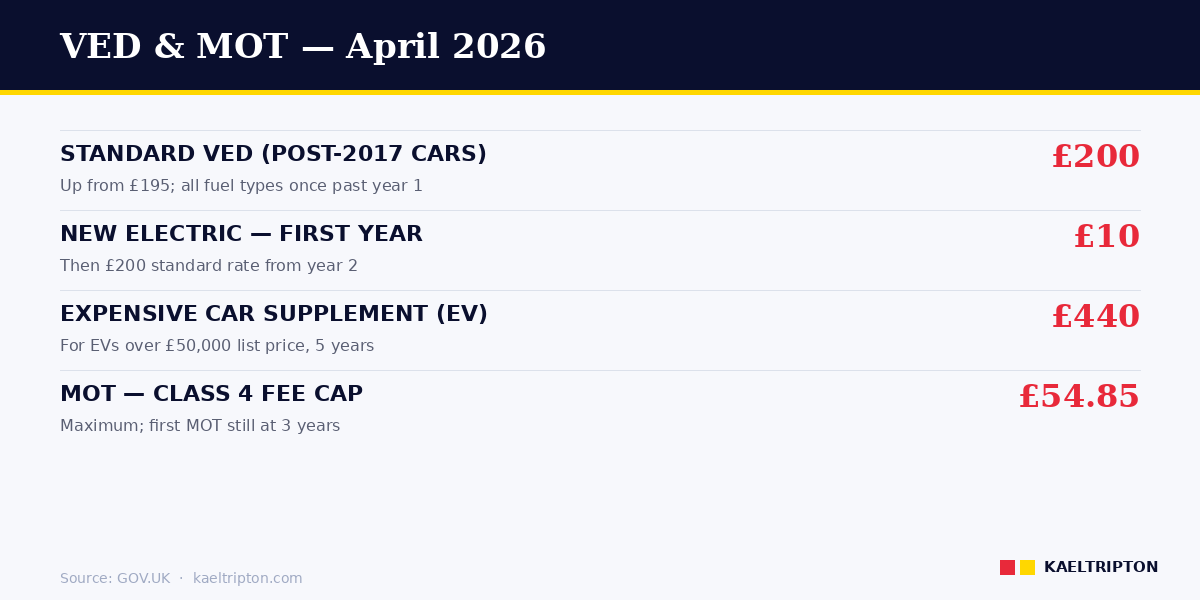
From 1 April 2026: standard VED is £200, the EV expensive-car threshold rises to £50,000, and new electric cars pay £10 in year one then £200. Pay-per-mile eVED (3p/mile for EVs, 1.5p for PHEVs) is confirmed for April 2028. The first MOT still falls at 3 years - the consultation on moving to 4 was scrapped for 2026. MOT fee cap unchanged at £54.85. |
The headline numbers - VED from 1 April 2026
The standard annual rate of Vehicle Excise Duty (VED) rose from £195 to £200 on 1 April 2026, reflecting Retail Price Index inflation. This is the flat rate most drivers pay - applied to petrol, diesel, hybrid and electric cars first registered on or after 1 April 2017, once they move past their first year of registration.
The DVLA’s V149 rates of vehicle tax table for the 2026/27 tax year confirms the rates below. These are not forecasts - they are the published rates applied to every vehicle renewal from 1 April 2026 to 31 March 2027.
| Vehicle & registration date | First-year rate | Standard annual rate |
|---|---|---|
| Petrol/diesel, registered on/after 1 April 2017 | By CO2 band (see below) | £200 |
| Petrol/diesel, registered 1 March 2001-31 March 2017 | n/a - CO2 bands A-M | £20 - £790 |
| New electric, registered on/after 1 April 2025 | £10 | £200 |
| Electric, registered 1 April 2017-31 March 2025 | n/a (already past Year 1) | £200 |
| Electric, registered before 1 April 2017 | n/a | £20 |
The expensive car supplement - luxury car tax
On top of the standard annual rate, any car with a list price over a threshold attracts an additional £440 per year for five years, starting from the second year of registration. Total annual bill in the supplement years: £640.
The threshold changed on 1 April 2026:
- Petrol, diesel and hybrid cars: threshold stays at £40,000 list price.
- Zero-emission cars (electric): threshold rises from £40,000 to £50,000, applying to cars first registered on or after 1 April 2025.
The House of Commons Library briefing CBP-9690 confirms this: “From April 2026, the government increased this threshold to £50,000 if the car is fully zero-emissions. For 2026/27, the expensive car supplement is £440.”
Critical detail that catches out used-car buyers: the supplement is based on the original manufacturer’s list price at first registration, not the price you paid second-hand. A £60,000 electric car you bought used for £30,000 still pays the supplement if it was over £50,000 when new. DVLA records the original list price at first registration and it does not change.
First-year CO2 rates - the “showroom tax”
New petrol and diesel cars pay a first-year rate based on CO2 emissions. From 1 April 2026 these jumped steeply - a deliberate policy to deter high-emission vehicles:
| CO2 emissions (g/km) | First-year rate (petrol) |
|---|---|
| 0 (electric) | £10 |
| 1-50 | £110 |
| 51-75 | £135 |
| 76-90 | £270 |
| 91-100 | £350 |
| 101-110 | £390 |
| 111-130 | £440 |
| 131-150 | £540 |
| 151-170 | £1,360 |
| 171-190 | £2,190 |
| 191-225 | £3,300 |
| 226-255 | £4,680 |
| Over 255 | £5,690 |
Diesel cars that do not meet the RDE2 real-driving emissions standard pay the rate for the next band up - a penalty that can add hundreds of pounds to a new diesel purchase. After Year 1, everything drops to the £200 standard rate (plus any applicable expensive car supplement).
Pre-2017 cars - the CO2 band system
Cars registered between 1 March 2001 and 31 March 2017 use a 13-band (A to M) system based on CO2 emissions. Low-emission cars pay very little; high-emission cars pay considerably more than the standard £200 flat rate. From April 2026:
- Band A (up to 100 g/km): previously £0, now £20
- Band D (121-130 g/km): around £165
- Band M (over 255 g/km): around £790
The 2026 change that matters most here: the zero-rate band (historically Band A) is gone. Even the cleanest pre-2017 cars now pay £20 per year. Honest John confirmed this in their April 2026 rates explanation, citing the Skoda Citigo GreenTech at 98 g/km as an example - previously zero-rated, now £20.
Electric vehicles - now fully inside the tax system
From 1 April 2025, zero-emission vehicles started paying VED for the first time. 2026/27 is the first full tax year in which electric vehicles are embedded in the system. The Commons Library briefing CBP-9690 summarises the regime:
- New electric cars registered on/after 1 April 2025: £10 first year, £200 thereafter.
- Electric cars registered 1 April 2017-31 March 2025: £200 standard rate from April 2026 onwards.
- Electric cars registered before 1 April 2017: £20 annual rate.
- Electric vans pay the standard annual rate for light goods vehicles.
- Electric motorcycles pay the lowest applicable motorcycle rate.
The £10 discount for hybrid and alternative-fuel vehicles (AFVs) has been removed. Hybrids now pay the same £200 as petrol and diesel. This aligns the tax treatment and removes a legacy incentive that the government judged no longer necessary.
Coming in April 2028 - eVED pay-per-mile
The Autumn Budget 2024 announced Electric Vehicle Excise Duty (eVED), a per-mile charge on electric and plug-in hybrid vehicles. This takes effect from April 2028 - two full tax years away - and sits alongside, not instead of, standard VED.
Announced rates:
- Electric vehicles: 3p per mile
- Plug-in hybrids: 1.5p per mile
Government figures estimate an 8,000-mile-per-year EV driver will pay an additional £240 per year under eVED on top of the £200 standard VED. HMRC and the Treasury have stated mileage will not be tracked by GPS or any device installed in the car. Instead, mileage will likely be checked at registration anniversaries, with MOT centres expected to play a role in verification.
Implementation detail is still being worked through. The Commons Library briefing notes that the policy was announced in the Autumn Budget 2024 but legislative and operational detail sits with HMRC and the DVLA. Expect further consultation in 2026 and 2027 before the April 2028 go-live.
How to pay - direct debit, lump sum, six months
VED can be paid:
- Annually in one payment - no surcharge. £200 for the standard rate.
- Every six months - 5% surcharge. £110 per six months (£220 total per year).
- Monthly by direct debit - 5% surcharge spread. £17.50 per month (£210 per year).
You can tax your vehicle online at gov.uk/vehicle-tax, by phone, or at a Post Office. You need your V5C logbook reference or a V11 reminder. Tax starts from the first day of the month in which you apply - there is no mid-month saving, so taxing on the last day of a month is effectively a free first month on the next cycle if you catch the timing.
If you are not using a vehicle, make a Statutory Off Road Notification (SORN) online at gov.uk/sorn. A SORN vehicle cannot be used or parked on a public road, but it owes no VED while declared.
MOT - the 3-1-1 rule still holds in 2026
Despite years of consultation, the MOT frequency has not changed for 2026. The Honest John MoT Test Changes 2026 explainer confirms this bluntly: “Despite a high-profile consultation about delaying the first MoT until a car is four years old, the government has officially scrapped the idea for 2026.”
The rule remains:
- First MOT: three years from first registration.
- Every year thereafter - annually, regardless of age, mileage or condition.
Exemption: vehicles over 40 years old, provided they have not undergone substantial modifications in the last 30 years. This is a rolling exemption - each year, another cohort of 40-year-old vehicles becomes MOT-exempt. Exempt vehicles must still be maintained in a roadworthy condition and the owner remains liable for any defect.
MOT costs - the £54.85 cap
The Government-set maximum MOT fee for a standard car (Class 4) is £54.85. Motorcycle MOTs (Class 1 or 2) are capped at £29.65. These are maximum prices - garages can and often do charge less to win business, with typical offers in the £35 to £45 range. The cap has not changed for several years.
If your vehicle fails, you can have a partial re-test for free within 10 working days if the vehicle remains at the test station for repair, or a charged re-test within 10 working days if it leaves the premises. The re-test charge is capped in proportion to the original fee.
What changed in MOT regulation on 9 January 2026
The DVSA MOT Special Notice 05-25, published on gov.uk, introduced tighter rules on MOT tester discipline from 9 January 2026. The key change: MOT testers and Authorised Examiner Principals (AEPs) who receive a two-year or five-year disciplinary “cessation” are now completely banned from holding any MOT-related role during the suspension period - closing a loophole that had allowed suspended individuals to operate behind the scenes through other businesses.
The practical impact for drivers is minimal: you may notice stricter documentation at your MOT centre, and DVSA audit activity may be visible, but no new test items have been introduced. Core checks - brakes, tyres, lights, suspension, steering, exhaust emissions - are unchanged.
New equipment rules from 1 April 2026
From 1 April 2026, new or changing MOT facilities must use jacking equipment meeting updated specifications: a minimum 2-tonne safe working load and 1,700mm minimum lifting pad spacing. This applies to newly-opening MOT centres, sites changing ownership, sites adding a test lane, or sites restarting testing after a pause. Existing facilities with compliant equipment face no change.
The reasoning, per DVSA: modern EVs and SUVs are significantly heavier than older cars, and older jacking equipment risks damaging vehicles or failing under load. The change is about workshop safety and vehicle protection, not about the test itself.
EV-specific MOT checks - what’s different
Electric vehicles face the same Class 4 MOT as any other car, minus the emissions portion. The DVSA has updated the inspection manual to require specific visual checks on:
- High-voltage cables (identifiable by their orange casing) for damage or chafing.
- Charging port condition and mounting security.
- Traction battery mountings for damage, leakage or corrosion.
EVs do not pass or fail on emissions because they have none. But they are not exempt from the MOT - once an EV reaches three years from first registration, it must be MOT-tested annually like any petrol or diesel car.
Ghost MOTs - the DVSA anti-fraud push
The DVSA has been tightening fraud controls against so-called “ghost MOTs” - certificates issued for vehicles that never actually entered the test bay. By 2026, most MOT centres are required to upload a “proof of life” photograph showing the vehicle and its number plate in the test bay. The image is stored in the official digital MOT record. Motorists do not see this on their certificate but it is searchable by DVSA audit teams.
If you buy a used car, you can check its MOT history including expired certificates at gov.uk/check-mot-history. A suspicious pattern - a ten-year-old car with advisories showing up only in the past two years, for example - can indicate earlier tests that should be questioned.
Penalties for driving untaxed or without MOT
Driving an untaxed vehicle on a public road attracts an automatic penalty from DVLA: a fine of £80 (reduced to £40 if paid within 28 days), or up to £1,000 plus court costs if prosecuted. Police Automatic Number Plate Recognition (ANPR) cameras identify untaxed vehicles in real time against the DVLA database, so the days of risking a few days without tax are long gone.
Driving without a valid MOT carries a maximum fine of £1,000. Additionally, insurance is usually invalidated by driving without an MOT (policies generally require the vehicle to be roadworthy and legal to drive), so an accident while uninsured could leave you liable for third-party damages personally. The only permitted journey without a valid MOT is to or from a booked MOT test or to have repairs done following a failed test.
Company cars - Benefit-in-Kind changes from 6 April 2026
Company car drivers face a separate tax layer: Benefit-in-Kind (BiK). BiK is a tax on the “benefit” you receive from using a company vehicle privately, calculated as a percentage of the car’s P11D value (list price plus options, less any capital contribution).
From 6 April 2026, the BiK rate for fully electric company cars rose from 3% to 4%. This is a modest increase in isolation but part of a trajectory announced in the Autumn Budget 2024: the EV BiK rate is scheduled to climb by one percentage point each year, reaching 9% by 2029/30. Petrol, diesel and hybrid BiK rates remain considerably higher - typically 15% to 37% depending on CO2 emissions - so electric company cars remain meaningfully tax-advantaged, just less so than in previous years.
For a basic-rate taxpayer driving a £40,000 electric company car, the 1-percentage-point BiK rise adds roughly £80 to the annual tax bill. For a higher-rate taxpayer, roughly £160. Payroll teams update BiK automatically from the April payroll - you do not need to do anything, but your take-home may shift slightly from the April pay packet onwards.
Salary sacrifice and EV schemes
Salary sacrifice schemes for electric cars remain one of the most tax-efficient ways for employees to access an EV. You give up a portion of gross salary in exchange for the use of a car; the employer leases the vehicle and you pay BiK on the cash-equivalent benefit. Because the salary sacrifice comes from gross (pre-tax) pay, the effective cost to a higher-rate taxpayer is substantially below the retail lease price.
The 2026 BiK rise slightly reduces the advantage but does not eliminate it. HMRC’s “Optional Remuneration Arrangements” (OpRA) rules, in force since 2017, exempt ultra-low-emission vehicles (ULEVs - under 75 g/km CO2) from the rule that taxes the higher of the salary sacrificed and the BiK value. This exemption is what makes EV salary sacrifice so attractive and has not been withdrawn for 2026. Always confirm with your payroll or an accountant before committing to a multi-year scheme.
London-specific charges - ULEZ and congestion charge
Vehicle tax is a national levy. On top, London applies its own charges. The Ultra Low Emission Zone (ULEZ) covers all London boroughs and requires Euro 4 petrol, Euro 6 diesel or fully electric to avoid a £12.50 daily charge. The Congestion Charge in central London - a separate scheme - is £18 per day as of 2026, and electric vehicles previously exempt now receive a 25% Auto Pay discount rather than a full exemption. These charges are payable in addition to VED and are not a substitute for it.
Other English cities operate Clean Air Zones with varying rules. Birmingham, Bristol, Sheffield, Bradford, Portsmouth, Tyneside and Greater Manchester all operate or are introducing CAZ-style schemes. Check gov.uk/clean-air-zones for the current list. CAZ charges are not affected by VED payment status - a taxed, MOT’d vehicle can still incur a daily CAZ charge if it does not meet the local emission standard.
Buying and selling - what happens to the tax
Vehicle tax does not transfer with a vehicle sale. When you sell a car, the remaining tax is automatically refunded to the registered keeper for each full month left on the licence. The buyer must tax the car in their own name before using it on a public road - even a drive home from the seller’s driveway requires valid tax.
This catches out private buyers regularly. If you buy a car on a Saturday and drive it home, the tax the seller had paid is refunded to the seller at the moment DVLA processes the V5C transfer - usually within a day or two. You need to tax the car yourself before the drive, using the new-keeper reference number from the V5C green slip. This can be done online or at a Post Office in minutes.
Related guides
- UK Tax Guide 2026/27
- UK Mortgage Calculator
- UK Income Tax Calculator
- UK Salary & Cost of Living Calculator
Disclaimer
Rates and rules in this guide reflect the DVLA V149 tables for April 2026 to March 2027 and DVSA MOT guidance published on GOV.UK as of April 2026. VED rates, MOT rules and future charges including eVED are subject to change by legislation and Budget announcements. Always confirm the current position on gov.uk/vehicle-tax-rate-tables and gov.uk/check-vehicle-tax before making financial decisions. This article is not financial or legal advice.
Frequently asked questions
How much is car tax for a standard petrol car in 2026/27?
£200 per year if your car was first registered on or after 1 April 2017 and is past its first year. New petrol cars pay a higher first-year rate based on CO2 emissions, then drop to £200 from year two.
Do electric cars pay road tax now?
Yes. From 1 April 2025, zero-emission vehicles started paying VED. New EVs registered from April 2025 pay £10 in year one, then £200 standard rate. Existing EVs registered 2017-2025 pay £200 from April 2026. Pre-2017 EVs pay £20.
What’s the luxury car tax threshold for electric cars?
£50,000 from 1 April 2026, applying to EVs first registered on or after 1 April 2025. If the original list price was over £50,000, you pay an extra £440 per year for five years from year two. For petrol, diesel and hybrids the threshold stays at £40,000.
When does the pay-per-mile eVED start?
April 2028, at 3p per mile for electric cars and 1.5p per mile for plug-in hybrids. This comes in addition to standard VED. The government has confirmed no tracking devices will be required - mileage checks will likely happen at MOT time.
Is the first MOT moving from three to four years?
No. Despite consultation, the government confirmed in 2025 that the first MOT stays at three years for 2026. The current 3-1-1 rule (three years to first MOT, then annually) is unchanged.
How much is an MOT in 2026?
The maximum legal fee for a Class 4 car is £54.85, unchanged for 2026. Motorcycles (Class 1/2) are capped at £29.65. Garages can and often do charge less - typical offers are £35 to £45.
Are classic cars exempt from MOT and VED?
Vehicles over 40 years old are exempt from MOT, provided they have not been substantially modified in the last 30 years. “Historic vehicle” VED classification (zero rate) also applies once a vehicle reaches 40 years old, but you must apply for this - it is not automatic. Owners remain responsible for keeping exempt vehicles roadworthy.
Sources
- DVLA V149 - Rates of vehicle tax for cars, motorcycles, light goods and private light goods vehicles (April 2026 edition)
- GOV.UK - Vehicle tax for electric, zero and low emission vehicles
- House of Commons Library - CBP-9690: Vehicle excise duty and zero emission vehicles
- GOV.UK - MOT Special Notice 05-25: MOT role restrictions following a cessation
- HM Treasury - Autumn Budget 2024 (eVED announcement)
- GOV.UK - Vehicle tax rate tables


