

UK vehicle tax exemptions for disabled drivers come in two tiers: 100% exemption for those with enhanced-rate mobility benefits, and 50% reduction for those with standard-rate PIP mobility. Neither applies automatically. This guide walks through eligibility, documents, and the specific differences between applying for full exemption and the 50% reduction.
Two tiers of UK disabled vehicle tax relief: 100% exemption for PIP enhanced mobility / DLA higher rate / ADP enhanced / WPMS / AFIP recipients, and 50% reduction for PIP standard mobility recipients. 100% route: first-time application at a Post Office with Certificate of Entitlement. 50% route: by post to DVLA, Swansea, SA99 1BF with DWP award letter. One vehicle at a time; nominated-driver arrangements allowed. |
The two tiers - 100% exemption and 50% reduction
UK disabled drivers can claim one of two forms of vehicle tax relief. Full (100%) exemption means £0 VED on a qualifying vehicle. 50% reduction halves the standard VED rate. Both are applied at the Post Office for first-time applications and require specific benefit-entitlement documentation. You can only hold one vehicle tax exemption or reduction at any time, and the vehicle must be registered in the disabled person’s name or their nominated driver’s name.
The exemption applies to the vehicle, not the person. A disabled driver can use the relief on only one vehicle at any time. If the family owns two cars and the disabled person uses them interchangeably, only one gets the exemption - the other pays full standard VED.
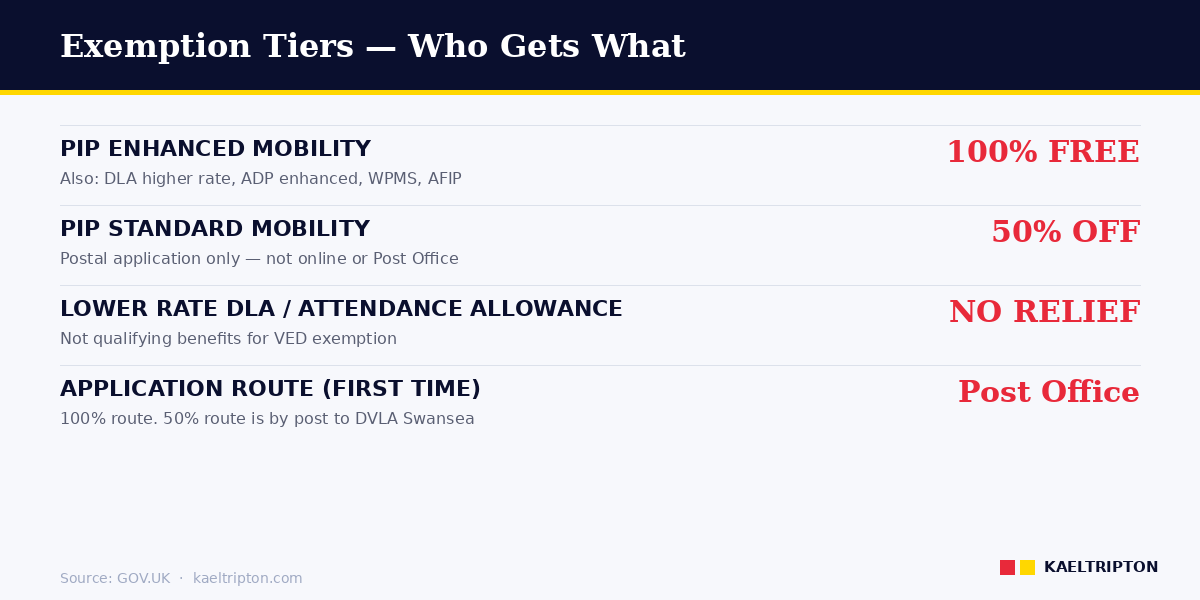
Who qualifies for 100% exemption
Full vehicle tax exemption applies if the disabled person receives any of the following at the qualifying rate:
| Benefit | Qualifying rate |
|---|---|
| Personal Independence Payment (PIP) | Enhanced rate mobility component |
| Disability Living Allowance (DLA) | Higher rate mobility component |
| Adult Disability Payment (ADP) - Scotland | Enhanced rate mobility component |
| Child Disability Payment (CDP) - Scotland | Higher rate mobility component |
| Scottish Adult Disability Living Allowance (SADLA) | Higher rate mobility component |
| Armed Forces Independence Payment (AFIP) | Full entitlement |
| War Pensioners Mobility Supplement (WPMS) | Full entitlement |
Lower-rate mobility components of DLA and PIP do not qualify for full exemption. Attendance Allowance, Carer’s Allowance, and Employment and Support Allowance also do not qualify regardless of rate.
Who qualifies for 50% reduction
50% VED reduction applies only if you receive the standard rate mobility component of PIP. DLA, WPMS, AFIP and ADP recipients at their respective rates do not qualify for the 50% reduction - they qualify for 100% exemption at the higher rate or not at all.
The 50% reduction can only be applied for by post to DVLA, Swansea, SA99 1BF - not online, not at a Post Office. This is a procedural quirk: the 100% exemption has a Post Office route; the 50% reduction does not.
How to apply for 100% exemption - first time
First-time applications for 100% exemption are made at a Post Office that handles vehicle tax. You can’t do this online on the first application. What you need:
- V5C registration certificate in the disabled person’s name. If you’ve just bought the vehicle, bring the V5C/2 green slip plus a completed V62 application form.
- Certificate of Entitlement to DLA, PIP, CDP, ADP, SADLA, AFIP or WPMS. DWP or Social Security Scotland issues this automatically when your benefit is awarded. If lost, you can request a replacement. Write the registration number of the vehicle in the top right-hand corner of the certificate before taking it to the Post Office.
- Valid MOT evidence (electronic screenshots from gov.uk/check-mot-history are accepted), or a Goods Vehicle Test (GVT) certificate where applicable.
- Insurance certificate or cover note (Northern Ireland only).
The Post Office counter staff change the vehicle’s tax class to “Disabled” and process the application. You pay £0 at the counter. A new V5C showing the updated tax class arrives by post within a few weeks.
How to apply for 50% reduction - by post only
The 50% reduction cannot be obtained at a Post Office or online. You apply by post directly to DVLA. Required documents:
- A letter or statement from the Department for Work and Pensions showing your PIP rate and the dates you’re receiving it (for PIP claimants), or an ADP decision letter from Social Security Scotland showing mobility component rate and dates (for ADP claimants).
- Your V5C registration certificate (logbook) in your name.
- Evidence of a current MOT or GVT certificate.
- A cheque or payable order made out to “DVLA, Swansea” for 50% of the full rate of car tax for the vehicle.
- An insurance certificate or cover note (Northern Ireland only).
Send to DVLA, Swansea, SA99 1BF. Do not send medical assessments, GP letters, or PIP assessment reports - only the DWP letter confirming award. DVLA processes and returns your documents within a few weeks. Thereafter you can renew the 50% reduction online or by phone in subsequent years.
Once the tax class is set - renewal is simpler
After the first successful application, the vehicle sits in the “Disabled” tax class on DVLA records. Annual renewal can then be done online at gov.uk/vehicle-tax, by phone on 0300 123 4321, or at a Post Office, using the V11 reminder or V5C reference.
There’s one exception: if you receive AFIP (Armed Forces Independence Payment), you cannot renew online or by phone - you must renew at a Post Office each time. This is a DVLA system limitation acknowledged in the guidance.
You do not need a fresh Certificate of Entitlement each year. Keep the serial number from your original certificate - DVLA will reference it during online or phone renewal.
Nominated drivers - how it works
The disabled person does not have to drive the vehicle themselves. They can nominate another person as the driver. The vehicle is registered in the disabled person’s name or the nominated driver’s name, and the vehicle must only be used for the disabled person’s needs.
“For the disabled person’s needs” means journeys where the disabled person benefits - taking them to hospital, shopping, social visits. The nominated driver cannot use the vehicle for their own personal errands (nipping to work alone, picking up their own children from school) without the disabled person. DVLA does not actively police this, but the rule exists and failure to follow it can invalidate the exemption if investigated.
The Motability Scheme - a different route
The Motability Scheme is separate from the DVLA tax exemption. Motability lets disabled people exchange their mobility allowance (PIP enhanced mobility, DLA higher rate mobility, or ADP enhanced mobility) for a leased vehicle. The lease includes insurance, maintenance, tyres and breakdown cover. Motability does not give you the vehicle - it’s a three-year lease.
Eligibility:
- Higher rate mobility part of DLA, or
- Enhanced rate mobility part of PIP, or
- Enhanced rate mobility part of ADP (Scotland), or
- War Pensioners’ Mobility Supplement, or
- Armed Forces Independence Payment.
Most leases require an advance payment, typically between £100 and £2,000 depending on the vehicle. The Motability Foundation maintains detailed eligibility and pricing on motability.co.uk.
From July 2026, VAT and Insurance Premium Tax rules on Motability leases change. The core zero-rating on the portion of a lease covered by the mobility benefit remains, but “top-up” payments for more expensive vehicles will now attract standard 20% VAT unless the vehicle is specifically adapted for wheelchair or stretcher use. This was announced in the Autumn Statement 2024 and takes effect from July 2026.
Scenario - a first-time applicant
Consider a realistic case. A woman in Coventry has just been awarded PIP at the enhanced rate for both daily living and mobility components, following a multiple sclerosis diagnosis. She owns a 2018 Ford Fiesta registered in her name. Her current VED is £165 on the pre-emissions-banded standard rate.
Her DWP award letter arrives in mid-March 2026. A few weeks later, DWP issues her Certificate of Entitlement to PIP - a one-page document confirming the award, the rate and the dates. She writes her car’s registration number in the top right corner of the certificate.
On 1 April she visits her local Post Office that handles vehicle tax with her V5C, the Certificate of Entitlement, and a screenshot of her MOT history from gov.uk. The counter staff change her tax class from Private Light Goods to Disabled. No payment. Her existing VED (due to expire 31 March) is not refunded because it expired anyway, but from 1 April she pays £0 for the duration of her PIP award.
Teaching point: time the application to coincide with tax expiry or shortly after. If you apply mid-way through a tax period, you get a refund for unused full months but the administrative friction is greater. A clean start at month boundary simplifies the paperwork.
When the exemption stops - common triggers
Several events end your exemption:
- Benefit award changes. If your PIP mobility rate drops from enhanced to standard at reassessment, you lose the 100% exemption but may qualify for the 50% reduction. Notify DVLA with the new DWP letter.
- Benefit award ends. If your benefit is withdrawn entirely, the exemption ends. You must re-tax the vehicle at the standard rate on the next renewal or the £80 LLP applies.
- Vehicle change. Every time you buy a different vehicle, you must reapply. The exemption does not transfer between cars.
- Death of the disabled person. The exemption dies with them. A surviving spouse who was the nominated driver cannot continue the exemption - they must re-tax under standard rules or apply under their own eligibility if applicable.
Blue Badge is separate
The Blue Badge parking scheme is a different entitlement from the DVLA vehicle tax exemption. A Blue Badge lets you park in disabled bays and on yellow lines for limited periods; the tax exemption waives VED on your own vehicle. Most disabled drivers hold both, but qualification is assessed separately.
Blue Badge applications go through your local council (England, Scotland, Wales) or the Department for Infrastructure in Northern Ireland. Eligibility criteria are similar but not identical - for example, blindness can qualify for a Blue Badge but does not automatically qualify for the 100% VED exemption unless accompanied by PIP enhanced mobility, DLA higher rate mobility, or equivalent.
Claiming a refund for VED you’ve already paid
If you were eligible for the disability exemption but paid full VED in earlier months of your current tax period, DVLA refunds the unused full months automatically when your tax class changes to Disabled. If you paid in advance annually on 1 April and your exemption is processed on 1 July, you get nine months of VED refunded to your original payment method within six weeks.
Refunds do not extend backwards beyond the current licence period. If you paid full VED for two previous years on a vehicle that should have been exempt, those years are not refundable. DVLA’s position: eligibility must be actively claimed, not retrospectively identified. This is why applying as soon as your qualifying benefit is awarded matters - each month of delay is money you cannot get back.
What to do if DVLA rejects your application
Rejections are rare on properly completed applications but they happen. Common reasons:
- Certificate of Entitlement is out of date (reissued after a reassessment).
- Vehicle not registered in the disabled person’s or nominated driver’s name.
- MOT expired or missing on the day the tax starts.
- Application made for a second vehicle while an exemption is already in force on another.
If rejected, DVLA returns your documents with a reason. Fix the specific issue and reapply. There is no formal appeal route for a disability exemption rejection - it’s a procedural check, not a substantive judgement. For benefit decisions themselves (PIP mobility rate, DLA reassessment), appeals go to the DWP or Social Security Scotland through their mandatory reconsideration process, not to DVLA.
Related guides
- UK Car Tax 2026: Vehicle, MOT and Tax
- How to Tax Your Car Online UK 2026
- How to Renew Vehicle Tax UK 2026
- UK Clean Air Zones 2026
Disclaimer
This guide reflects DVLA and DWP rules published on GOV.UK and in the DVLA leaflet INS216 as of April 2026. Eligibility criteria and benefit rates can change with each annual uprating, and PIP/DLA reassessment outcomes vary. Always check the current position at gov.uk/financial-help-disabled/vehicles-and-transport before applying. For complex cases, consult a Citizens Advice adviser or a disability rights specialist. This article is not legal advice.
Frequently asked questions
Who qualifies for 100% free vehicle tax in the UK?
Recipients of: enhanced rate mobility PIP, higher rate mobility DLA, enhanced rate mobility ADP (Scotland), higher rate mobility CDP (Scotland), Scottish Adult DLA, Armed Forces Independence Payment (AFIP), or War Pensioners Mobility Supplement (WPMS). The vehicle must be registered in the disabled person’s name or a nominated driver’s name and used only for the disabled person’s needs.
Who qualifies for 50% vehicle tax reduction?
Only recipients of the standard rate mobility component of PIP. DLA, WPMS, AFIP and ADP recipients either qualify for 100% exemption at their higher rates or not at all. The 50% reduction must be applied for by post to DVLA, Swansea, SA99 1BF - it cannot be applied for at a Post Office or online on first application.
Can someone else drive my vehicle if I have the disability exemption?
Yes, through the nominated driver system. The nominated driver can drive the vehicle but only for the disabled person’s needs - taking them to appointments, shopping, social visits. The nominated driver cannot use the vehicle for their own personal errands without the disabled person. The vehicle must be registered in either the disabled person’s or nominated driver’s name.
How do I apply for the disabled vehicle tax exemption for the first time?
For 100% exemption: at a Post Office that handles vehicle tax with your V5C, Certificate of Entitlement to your qualifying benefit, and MOT evidence. For 50% reduction: by post to DVLA, Swansea, SA99 1BF with your DWP/Social Security Scotland letter, V5C, MOT evidence, and a cheque for 50% of the standard VED rate. First-time online applications are not available for either route.
Do I need to reapply every year?
No. Once your vehicle is in the Disabled tax class (or the reduced-rate equivalent), annual renewal can be done online, by phone, or at a Post Office using the V11 reminder or V5C reference. Exception: AFIP recipients must renew at a Post Office each year. You do not need a fresh Certificate of Entitlement annually - the original certificate’s serial number is retained on DVLA records.
What if my PIP rate changes at reassessment?
If your PIP mobility drops from enhanced to standard, you lose the 100% exemption but can apply for the 50% reduction instead. If your PIP is withdrawn entirely, the exemption ends and the vehicle returns to the standard rate at the next renewal. Notify DVLA with the new DWP decision letter in either case - don’t wait for DVLA to discover the change through its systems.
Is the Motability Scheme the same as the DVLA tax exemption?
No. Motability is a lease scheme that exchanges your mobility allowance for a three-year leased vehicle including insurance and maintenance. The DVLA tax exemption is a separate relief on a vehicle you own. Motability leased vehicles are already taxed by the scheme; you don’t need to claim a separate DVLA exemption on a Motability lease. Most Motability users don’t need the DVLA route.
Sources
- GOV.UK - Financial help if you’re disabled: Vehicles and transport
- GOV.UK - Get free vehicle tax if you’re a driver with a disability
- DVLA - INS216: How to apply for free disabled tax
- Motability Scheme - motability.co.uk
- HM Treasury Autumn Statement 2024 - Motability VAT and IPT changes from July 2026
- DWP - PIP benefit rates and mobility component entitlement


