

A SORN is the DVLA’s off switch for a vehicle. Done right, it saves you the full annual VED bill. Done wrong, or skipped entirely, it triggers an automatic £80 late licensing penalty and in some cases a clamped car on your drive. This is the rulebook, sourced directly from GOV.UK.
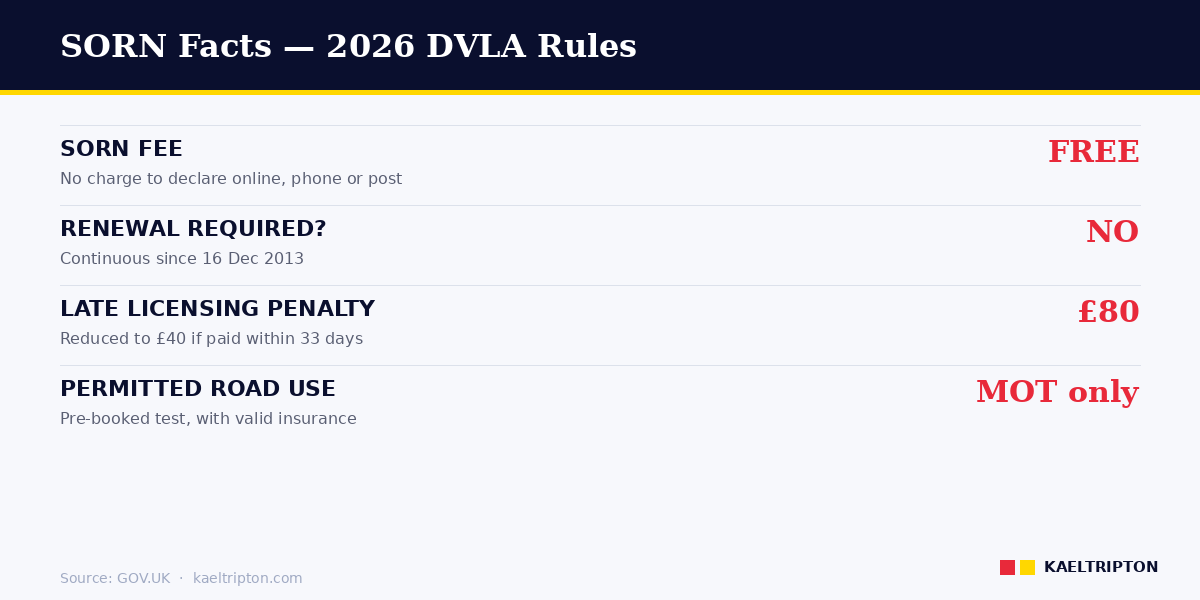
A SORN is free, takes 60 seconds online, and protects you from the automatic £80 late licensing penalty. Declare the moment a vehicle leaves road use - whether for winter storage, a restoration project, or a policy renewal gap. One permitted journey exists: to and from a pre-booked MOT, with valid insurance in force. |
What a SORN actually is
A SORN - a Statutory Off Road Notification - is a free DVLA declaration that a UK-registered vehicle is being kept off public roads and will not be taxed or insured. Once declared, the SORN stays in force indefinitely until the vehicle is taxed, sold, scrapped or permanently exported. Failing to declare a SORN on an untaxed vehicle triggers an automatic £80 late licensing penalty (LLP) from the DVLA.
The legal mechanic is simple. UK law assumes every registered vehicle is on the road and therefore taxable unless you tell DVLA otherwise. The SORN is that telling. Since 16 December 2013 the declaration is continuous - no annual renewal. You declare once, and it lasts.
When you must declare a SORN
The GOV.UK guidance at gov.uk/sorn-statutory-off-road-notification sets out four trigger situations:
- The vehicle tax is running out and you don’t intend to re-tax.
- You have no insurance, even briefly (such as during a policy renewal gap).
- You want to break the vehicle down for parts before scrapping.
- You’ve bought or received a vehicle and want to keep it off the road - you cannot inherit the previous keeper’s SORN.
The last point is the most-missed. SORNs do not transfer. If you buy a SORN’d vehicle, the SORN lapses on sale and the clock starts on your obligation to either tax or re-SORN.
How to declare - three routes
The quickest route is online at sorn.service.gov.uk. You need either the V5C logbook reference number (11 digits) or the V11 tax reminder reference (16 digits), or for a newly-purchased vehicle the V5C/2 new keeper slip (12 digits). Declaration is immediate and DVLA sends confirmation by email.
By phone: call DVLA on 0300 123 4321. 24-hour service, automated.
By post: complete the back of your V11 tax reminder and send to DVLA, Swansea, SA99 1AR. Allow up to four weeks.
When your SORN starts - and why timing matters
If you declare a SORN in the month your tax expires, it starts on the first day of the next month. If you declare before your current tax expires and outside that final month, the SORN starts immediately. You cannot backdate a SORN under any circumstances. That rule catches out seasonal drivers.
Consider a realistic case. A retired teacher in Harrogate owns a 1987 Ford Sierra Sapphire Cosworth kept in a heated garage from October to March. She drives it April through September only. Taxing all year would cost the full standard rate because the car hits 40 years old in 2027 - a year away from historic-vehicle exemption. She declares the SORN on 1 October, not late September, so it aligns cleanly with the tax expiry. DVLA automatically refunds the six unused months. On 1 April she re-taxes. Net saving: roughly half a year of VED, every year, perfectly legal.
What happens to tax and insurance when you SORN
DVLA automatically refunds any full remaining months of VED. If you pay by monthly direct debit, the instruction is automatically cancelled. There is no form to fill; the refund appears by cheque or to the original payment method within six weeks.
Insurance you must cancel yourself - DVLA does not communicate with insurers. Most insurers will refund the unused premium minus a small admin fee, and some allow you to suspend cover (so that you restart the same policy when you re-tax). Check with your provider; terms vary.
The one permitted journey
A SORN’d vehicle must be kept on private property - garage, driveway, private land with the owner’s consent. The single legal exception is a drive to or from a pre-booked MOT or other statutory test. For that journey you must have valid insurance in force, even though the vehicle is SORN’d. A short-term policy (one day, seven days) from a specialist insurer is common; annual insurers sometimes cover this by extension.
Driving a SORN’d vehicle on a public road for any other reason is a criminal offence under the Vehicle Excise and Registration Act 1994. Enforcement is automatic: ANPR cameras flag the registration against DVLA records within seconds.
Penalties for skipping a SORN
If you let tax run out without declaring a SORN, DVLA issues an automatic £80 late licensing penalty. The notice arrives by post, addressed to the registered keeper. The figure drops to £40 if paid within 33 days.
If unpaid, DVLA escalates. The DVLA Vehicle Enforcement Policy sets out the ladder: prosecution in a magistrates’ court, fines up to £1,000 plus back-tax, and wheel-clamping or impounding by DVLA’s contractor. Impounded vehicles attract a release fee plus daily storage, and if unclaimed can be sold or crushed.
| Stage | What happens | Source |
|---|---|---|
| Day 0: tax lapses, no SORN | ANPR and monthly register scans flag the vehicle | DVLA enforcement policy |
| Within 33 days | £80 LLP issued; reduced to £40 for early payment | DVLA enforcement policy |
| Day 34+ | Full £80 due; persistent non-payment escalates | DVLA enforcement policy |
| Court route | Fine up to £1,000 plus costs and back-tax | VERA 1994 / enforcement policy |
| Clamping / impound | Release fee plus storage; risk of disposal | DVLA enforcement policy |
Buying a vehicle that’s already SORN’d
A SORN is tied to the registered keeper, not the vehicle. The moment ownership transfers, the SORN lapses. The new keeper must either re-declare a SORN in their own name or tax the vehicle - immediately, before any road use.
This catches buyers of project cars and classic cars. You collect a SORN’d Morris Minor from a seller’s garage, load it onto a trailer, and drive home. Legal: the vehicle was on a trailer, not being driven on the road under its own power. Drive it off the trailer and down your street to your garage? Illegal without tax in your name - the previous keeper’s SORN died at point of sale. Tax it online before the wheels touch the road, using the V5C/2 green slip the seller hands over.
Checking SORN status
You can verify any UK vehicle’s tax and SORN status free at gov.uk/check-vehicle-tax. Enter the registration number and you see tax status, MOT status, and whether a SORN is in force. This is the same database DVLA enforcement uses. Useful before buying a used car, before an insurance renewal, or simply to confirm your own SORN was processed.
Related guides
- How to Tax Your Car Online UK 2026
- How to Check If a Car Is Taxed UK 2026
- How to Renew Vehicle Tax UK 2026
- UK Car Tax 2026: Vehicle, MOT and Tax
Disclaimer
This guide reflects DVLA rules published on GOV.UK as of April 2026. Rules and penalty amounts can change. Always verify the current position on gov.uk/sorn-statutory-off-road-notification before making a declaration. This article is not legal advice.
Frequently asked questions
How much does a SORN cost?
Nothing. SORN declarations are free. DVLA charges no fee to submit one online, by phone or by post. You may be charged a small admin fee by your insurer if you cancel a policy mid-term, but that’s a separate matter from the SORN itself.
Do I need to renew my SORN every year?
No. Since 16 December 2013 SORN declarations have been continuous. Once declared, the SORN stays in force until the vehicle is taxed, sold, scrapped or permanently exported. Older guidance mentioning annual renewal is out of date.
Can I drive my SORN’d car at all?
One exception only: to or from a pre-booked MOT or other statutory test. Valid insurance must be in force for that journey. Any other road use of a SORN’d vehicle is a criminal offence under the Vehicle Excise and Registration Act 1994, detectable by ANPR.
What happens to my direct debit when I SORN?
DVLA cancels it automatically. You don’t need to contact your bank. Any unused full months of VED are refunded to the original payment method within six weeks. If you later re-tax the vehicle, you set up a fresh direct debit from scratch.
Can I park a SORN’d car on the street outside my house?
No. A SORN’d vehicle must be kept on private property - garage, driveway, or private land with the owner’s permission. Parking a SORN’d car on any public road risks clamping, impounding and prosecution regardless of whether it’s been moved recently.
I’ve bought a car that’s already SORN’d - what do I do?
The SORN lapses the moment ownership transfers. Before any road use you must either tax the vehicle in your own name (using the V5C/2 green slip the seller gives you) or declare a fresh SORN in your own name. Do one or the other before the wheels touch a public road.
Can I make a SORN at the last minute if my tax is about to expire?
Yes. A SORN declared in the month your tax is due to expire starts on the first day of the next month - it doesn’t need lead time. What you cannot do is backdate it. If tax expired last week and you haven’t SORN’d or re-taxed, the £80 LLP may already be on its way.
Sources
- GOV.UK - When you need to make a SORN
- GOV.UK - Tell us you’re taking your vehicle off the road (SORN service)
- GOV.UK - DVLA Vehicle Enforcement Policy
- GOV.UK - Pay a DVLA fine
- GOV.UK - Check if a vehicle is taxed and has an MOT
- Legislation.gov.uk - Vehicle Excise and Registration Act 1994


