

UK car tax enforcement runs on autopilot. A lapsed tax triggers an £80 penalty automatically - no warning letter, no grace period. This guide walks through the full escalation ladder, how ANPR actually detects untaxed vehicles, and your specific appeal options when a penalty lands wrongly.
UK car tax enforcement runs on autopilot. ANPR detects lapses in seconds; £80 LLPs issue automatically; escalation goes up to £1,000 court fines plus clamping and impound. No warning letter after the V11 reminder. Pay £40 within 33 days to settle; contest in writing within 28 days if the LLP was issued in error. |
The automatic £80 penalty - what it is
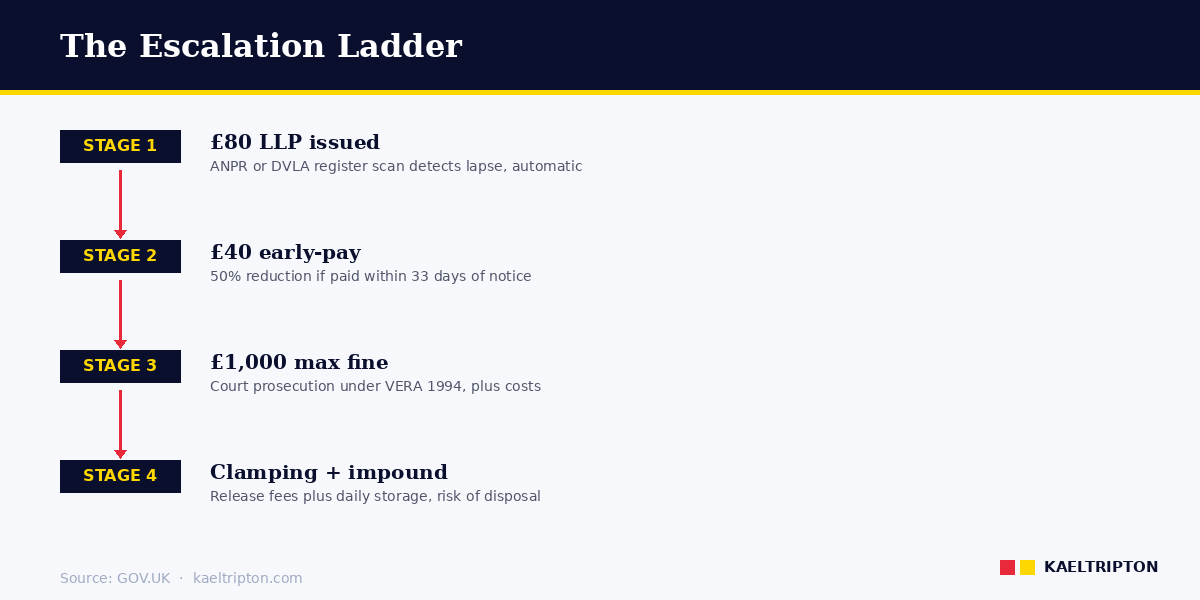
Driving or keeping an untaxed vehicle on a UK public road triggers an automatic £80 Late Licensing Penalty (LLP) from DVLA. The figure drops to £40 if paid within 33 days of the notice. If unpaid, DVLA can escalate to court prosecution with fines up to £1,000, back-tax recovery, vehicle clamping, impounding, and ultimately disposal. ANPR cameras detect non-compliance nationwide around the clock.
The legal basis sits in the Vehicle Excise and Registration Act 1994 (VERA). Every UK-registered vehicle must be either taxed or SORN’d. There is no third state. The moment your tax expires without a SORN in force, you are committing an offence.
How DVLA actually detects untaxed vehicles
Two mechanisms run in parallel.
First, ANPR cameras. Automatic Number Plate Recognition cameras sit on motorways, A-roads, at petrol stations, in car parks, on police vehicles and on DVLA contractor patrol units. Each camera reads number plates and cross-references them in real time against the DVLA database. An untaxed vehicle shows up as a red flag within seconds. The DVLA Vehicle Enforcement Policy confirms this is the primary detection method for vehicles in use on the road.
Second, monthly register scans. DVLA runs regular scans of its own vehicle register to identify keepers whose tax has lapsed and who have not declared a SORN. These scans catch vehicles that haven’t necessarily been driven - they catch registered keepers who simply forgot. This is how a vehicle parked on a driveway but untaxed still gets an £80 LLP in the post.
There is no warning letter beyond the V11 tax reminder that arrives around three weeks before expiry. GOV.UK’s own enforcement page is explicit: “non-receipt of the reminder is not considered a justifiable reason for failing to tax a vehicle.”
The full escalation ladder
| Stage | What happens | Typical timeframe |
|---|---|---|
| Day 0 | Tax expires; ANPR or register scan flags the vehicle | Instant |
| Within days | DVLA issues £80 LLP by post to registered keeper | 2-14 days |
| Within 33 days | Pay £40 to settle (50% reduction for early payment) | 33 days from notice |
| Day 34+ | Full £80 becomes due; unpaid penalties accrue | - |
| Court route | Prosecution under VERA 1994; fine up to £1,000 plus costs plus back-tax | Weeks to months |
| Clamped | DVLA contractor clamps vehicle; release fee plus storage | On detection |
| Impounded | Vehicle removed to DVLA pound; release fee plus daily storage | 24 hours |
| Disposal | Unclaimed vehicles auctioned or scrapped | After statutory holding period |
DVLA does not publish fixed clamp-release and impound-release figures because they vary by location and contractor, but the enforcement policy confirms both release fee and per-day storage apply, and that impounded vehicles can be disposed of if unclaimed within the statutory period.
Why the direct debit isn’t the safety net you think it is
Paying VED by monthly direct debit looks foolproof. In practice, it has a specific failure mode that catches out thousands of keepers each year.
Consider a realistic case. A consultant in Manchester sets up monthly direct debit in 2023 and stops paying close attention afterwards, assuming it auto-renews forever. In April 2026 her bank card expires. DVLA attempts the April payment - it bounces. A second attempt fails. Per DVLA’s enforcement policy, after two failed collections DVLA cancels the direct debit and considers the vehicle untaxed. On day 15 the vehicle shows as untaxed in the database. Four days later, ANPR on the M602 flags the car. An £80 LLP arrives. She pays £40 within 33 days and re-taxes online. Total cost: around £240 once back-month VED is added.
Teaching point: the registered keeper remains legally responsible for confirming tax is in force. DVLA does not email or text when a direct debit fails - the communication is an LLP in the post, after detection. Check status monthly at gov.uk/check-vehicle-tax if you rely on direct debit.
Back-tax liability - what gets added to the penalty
An LLP is only part of the bill. DVLA also recovers unpaid VED from the date the tax lapsed to the date you settle. If your tax expired on 1 April and the vehicle is taxed on 1 June, you owe two months of VED on top of the penalty. For a standard £200-per-year car, that’s roughly £33 of back-tax - small but real. For a higher-banded car or one inside the expensive-car-supplement years, back-tax can be several hundred pounds.
Back-tax is charged pro-rata by calendar month. There is no partial-month calculation. If the tax lapsed on the 28th of one month, that full month counts.
Clamping and impound - what it costs
If a DVLA contractor clamps your vehicle, you have 24 hours to either tax it and pay the release fee or apply for a SORN surety. Unresolved clamps escalate to impound - the vehicle is removed to a DVLA compound and daily storage charges begin accruing.
To recover an impounded vehicle the registered keeper must produce:
- The V5C registration certificate, or a V62 application if the V5C is missing.
- Photographic proof of identity and proof of address (utility bill, bank statement).
- Payment of back-tax, release fee and accumulated daily storage.
- Evidence of insurance in force before the vehicle can leave the compound.
If unclaimed within the statutory holding period, DVLA can dispose of the vehicle by auction or crushing, and the registered keeper remains liable for any fees exceeding the disposal proceeds.
The appeal route - when and how
An LLP is not a court fine and does not carry criminal record implications at the LLP stage. But it is a DVLA demand for payment, and you do have routes to challenge it.
If you believe the LLP was issued in error - for example, you had SORN’d the vehicle but DVLA hadn’t processed the declaration, or the vehicle was sold before the tax lapse - you can respond within the 28-day reply window stated on the LLP notice. The process:
- Write to DVLA at the address on the notice within 28 days. Include the LLP reference number, your V5C reference, and evidence supporting your position (SORN confirmation email, V5C/2 slip showing date of sale, etc.).
- DVLA reviews and either cancels the penalty or confirms it stands.
- If the LLP is confirmed and you still dispute, non-payment leads to court. You can plead the case in a magistrates’ court. Defences that work: proof of SORN before the lapse date, proof you had notified DVLA of sale, proof the vehicle was off-road and DVLA failed to process your paperwork.
Defences that do not work: “I didn’t receive the V11 reminder” (GOV.UK explicitly excludes this), “I was abroad”, “I forgot”, “the direct debit failed”. DVLA’s position is that the registered keeper is responsible for confirming tax status regardless of postal delivery, travel or payment failures.
Selling a vehicle before the tax lapses
A common trap: you sell a vehicle, you assume DVLA knows, and an LLP arrives weeks later because the sale wasn’t recorded. Unless you tell DVLA of the sale (via the V5C section 9 or the online sold-vehicle service at gov.uk/sold-bought-vehicle), you remain the registered keeper and continue to be liable for tax.
Sellers should always notify DVLA on the day of sale. DVLA confirms receipt within a few days. If you later receive an LLP for a vehicle you’ve sold, the sale notification is your defence - keep the email confirmation.
Paying an LLP - the specific process
Pay online at gov.uk/pay-dvla-fine. You need the reference number on the notice and a credit or debit card. Paying promptly (within 33 days) halves the penalty to £40. Pay the full amount after that window.
If you cannot pay in full, contact DVLA using the number on the notice to discuss a payment plan. DVLA does occasionally agree instalments for hardship cases but this is discretionary, not a right.
The one scenario where you can drive legally without tax
A SORN’d vehicle may be driven to and from a pre-booked MOT or other statutory test, provided valid insurance is in force. This is the only permitted use of a SORN’d or untaxed vehicle on public roads. Any other journey - to the shops, to a friend’s garage, to a scrapyard - is prosecutable.
For the MOT journey itself, keep the booking confirmation accessible in case of a police stop. ANPR will flag the untaxed status; the booking evidence is what turns a potential prosecution into a cleared encounter.
Related guides
- SORN Statutory Off Road Notification UK 2026
- How to Tax Your Car Online UK 2026
- How to Check If a Car Is Taxed UK 2026
- How to Renew Vehicle Tax UK 2026
Disclaimer
Rates and penalties in this guide reflect the DVLA Vehicle Enforcement Policy and VERA 1994 as published on GOV.UK and legislation.gov.uk in April 2026. Penalties and enforcement practice can change by Finance Act or Statutory Instrument. Always confirm the current position on gov.uk/pay-dvla-fine before making decisions. This article is not legal advice; if you face prosecution, consult a motoring law solicitor.
Frequently asked questions
How much is the fine for no car tax in the UK?
£80 automatically, reduced to £40 if paid within 33 days of the notice. If unpaid and the case goes to court, the maximum fine is £1,000 plus back-tax, plus court costs. Vehicle clamping, impounding and disposal are all possible at the enforcement end of the ladder.
Do I get a warning before the £80 fine?
No. DVLA sends a V11 tax reminder around three weeks before your tax expires, but once the expiry date passes without a SORN or renewal, the £80 late licensing penalty is automatic. GOV.UK explicitly states that not receiving the V11 is not a valid defence.
Will my insurance be invalidated if my car is untaxed?
Not automatically by the insurer, but driving an untaxed vehicle typically also means driving without a valid MOT (since a valid MOT is required to tax a car). Most policies exclude cover for vehicles that are not roadworthy or legally able to be driven, which can leave you personally liable for any third-party damages.
Does car tax transfer when I buy a used car?
No. Since October 2014, car tax does not transfer between owners. The seller receives an automatic refund for whole remaining months, and the buyer must tax the vehicle in their own name before any road use, including the journey home. Driving away on the seller’s old tax is illegal.
Can DVLA take money from my bank account?
Not directly. DVLA can obtain a county court judgment (CCJ) for unpaid penalties, which can then lead to earnings attachment or bailiff action. DVLA also uses FCA-regulated debt collection agencies. Neither DVLA nor its agencies can access your bank account without a court order.
What happens if I sold the car but the new owner didn’t tax it?
If you notified DVLA of the sale on the day (via V5C section 9 or online), you’re clear - DVLA’s records show the buyer as the new registered keeper. If you didn’t notify, you remain liable. Always keep the DVLA sale-confirmation email; that’s your defence if an LLP arrives.
Can I appeal an £80 LLP?
Yes, within 28 days of the notice. Write to DVLA at the address shown, including evidence supporting your position (SORN confirmation, proof of sale, etc.). DVLA reviews and either cancels the penalty or confirms it. If you still dispute after review, non-payment leads to a magistrates’ court hearing where you can present your defence in person.
Sources
- GOV.UK - DVLA Vehicle Enforcement Policy
- GOV.UK - Specific offences and enforcement action
- GOV.UK - Pay a DVLA fine
- GOV.UK - Tax your vehicle
- GOV.UK - Check if a vehicle is taxed
- GOV.UK - Tell DVLA you’ve sold, transferred or bought a vehicle
- Legislation.gov.uk - Vehicle Excise and Registration Act 1994


