

Paying car tax online in the UK in 2026 takes about five minutes if the right reference number is at hand and the car has current MOT and insurance on DVLA's records. The standard annual rate rose to £200 on 1 April 2026 (up from £195), and drivers of electric vehicles are now in scope for VED for the first time. For drivers already on Direct Debit, renewal is automatic and the V11 paper reminder no longer arrives.
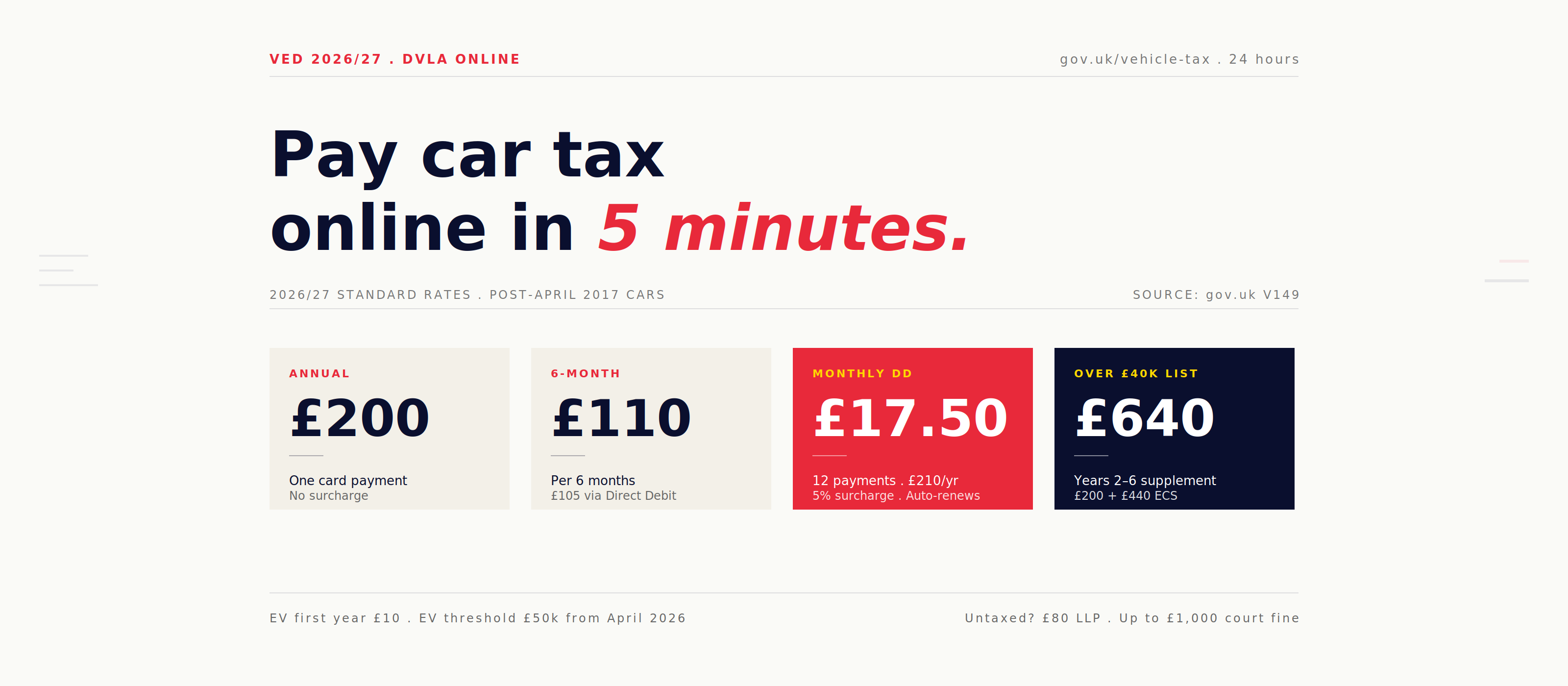
This guide covers how to pay UK car tax online in 2026: what information is needed, which payment methods work, how Direct Debit spreads the cost (with a 5% surcharge for anything other than annual payment), what happens if the payment fails, and how to correct the most common mistakes at the checkout stage. All figures and rules reflect the gov.uk V149 rates table and the DVLA online service in force on 23 April 2026.
|
KEY FACTS (VERIFIED 23 APRIL 2026) Standard annual VED: £200 for most cars registered after 1 April 2017. Paid annually online, by phone, or at the Post Office. Monthly Direct Debit: £210 total over 12 months (5% surcharge). Auto-renews unless cancelled. Six-month option: £110 (or £105 per six-month block via Direct Debit). Online payment methods: Debit card, credit card, or Direct Debit. No cash or cheque online. What you need: V11 reminder (16-digit reference), V5C logbook or V5C/2 new keeper slip (11-digit reference). Plus a valid MOT and insurance on the DVLA database. |
How to pay car tax online in 2026: the standard flow
The DVLA online service at gov.uk/vehicle-tax handles car tax payments 24 hours a day. The process takes around five minutes for most drivers. There are no account logins; each payment is identified by a one-off reference number from the tax reminder or logbook.
Step 1: Go to gov.uk/vehicle-tax and click Start now. Beware of copy-cat sites that charge a fee for what is a free government service. The genuine URL always starts with gov.uk, never co.uk, .org, or .net variants.
Step 2: Enter the reference number. The reference comes from one of three sources, all issued automatically by DVLA. The V11 reminder letter carries a 16-digit number. The V5C logbook held by the registered keeper carries an 11-digit number. The V5C/2 new keeper slip given by the previous owner when a car is sold also carries an 11-digit number.
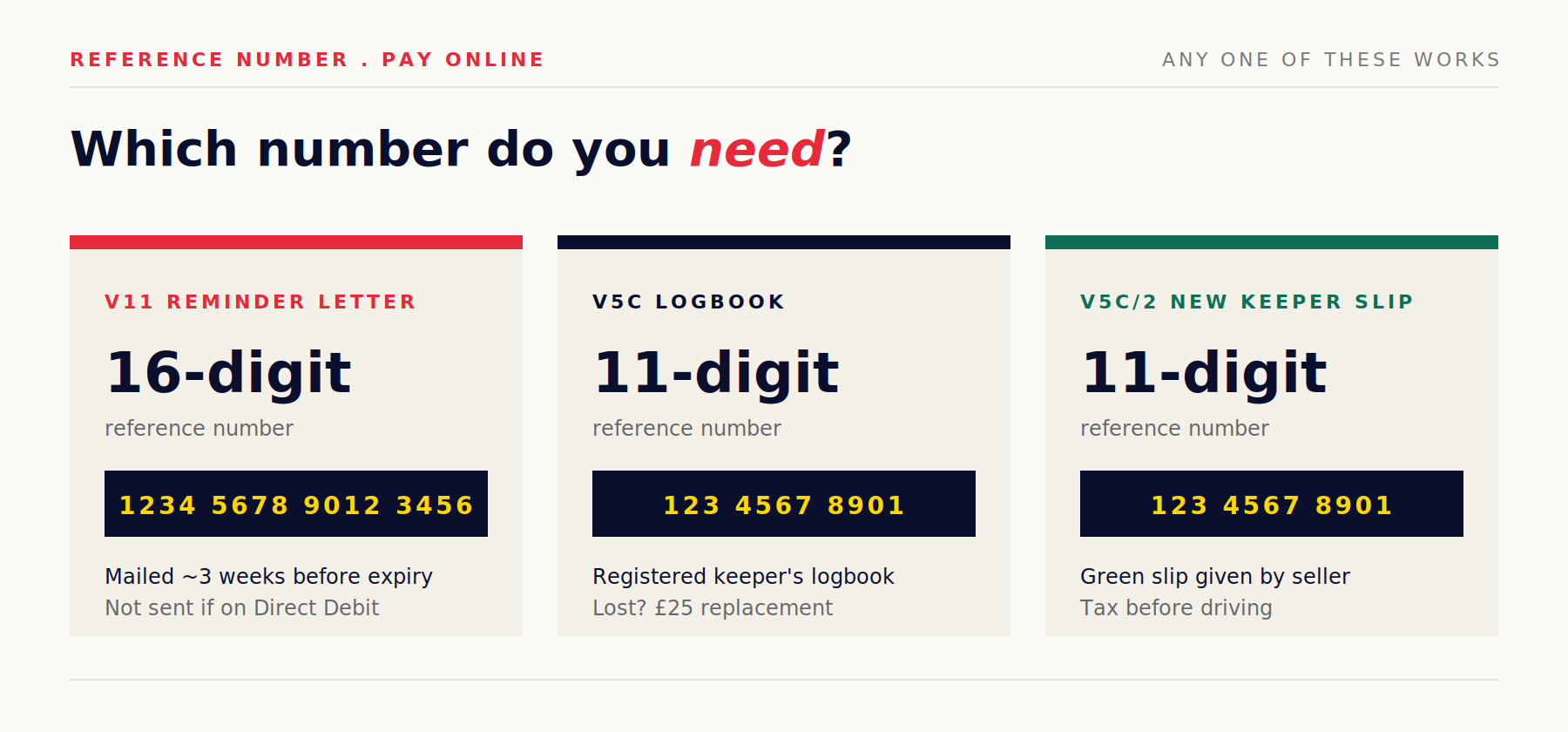
Step 3: Confirm the vehicle details. The DVLA system pulls the car's make, model, CO2 emissions, and current tax band from its database. Verify that the details match. If they do not, stop and contact DVLA on 0300 790 6802 before paying.
Step 4: Choose the payment term and method. The available options are 12 months annual by card, 6 months annual by card, 12 months monthly Direct Debit, 6 months by Direct Debit, or annual Direct Debit. The monthly and 6-month options carry a 5% surcharge over the pure annual rate.
Step 5: Enter payment details. For a card payment, enter the 16-digit card number, expiry, security code, and billing address. For Direct Debit, provide bank name, account number, sort code, and account holder name. The account holder must authorise the DD either as part of the online flow or by a subsequent bank confirmation.
Step 6: Receive confirmation. An email confirmation arrives immediately and the tax is registered on the DVLA database within 24 hours (often within minutes). There is no physical tax disc; police cameras and Automatic Number Plate Recognition (ANPR) systems check tax status directly against the DVLA record.
What it costs: the 2026/27 rate card
The amount paid depends on three factors: when the car was first registered, its CO2 emissions at registration (for cars registered after March 2001 and before April 2017), and the list price when new (for cars registered after April 2017 and the Expensive Car Supplement).
| Vehicle type (registered after 1 April 2017) | Annual rate | 6-month rate | 12-month DD total |
|---|---|---|---|
| Standard petrol, diesel, hybrid (year 2 onwards) | £200 | £110 | £210 |
| Electric vehicle (year 2 onwards) | £200 | £110 | £210 |
| EV first-year rate (registered on or after 1 April 2026) | £10 | N/A | N/A |
| Expensive Car Supplement (list price over £40k ICE/hybrid, £50k EV) | +£440/yr (years 2-6) | +£242 | +£462 |
| Car over £40,000 (or £50,000 EV): total with supplement | £640 | £352 | £672 |
| First-year rate, highest CO2 band (over 255 g/km) | £5,690 | N/A | N/A |
Cars registered between 1 March 2001 and 31 March 2017 use the old CO2 band system (Bands A to M). Band A (up to 100 g/km) is now £20 per year for 2026/27 (from zero previously). The jump from Band C (up to 120 g/km) at £35 to Band D (up to 130 g/km) at £170 is the steepest in the old system, so knowing a car's exact CO2 figure matters. The gov.uk vehicle tax rate checker at gov.uk/check-vehicle-tax shows the exact band for any UK-registered vehicle.
Cars registered before 1 March 2001 are taxed by engine size, not CO2: £220 per year for engines up to 1549cc or £360 for engines over 1549cc in 2026/27. Classic cars over 40 years old are usually exempt from VED under the historic vehicle rolling exemption.
Payment methods: what works, what does not, and the 5% surcharge
The DVLA online portal accepts three payment mechanisms: UK-issued debit card, UK-issued credit card, and Direct Debit from a UK bank account. It does not accept PayPal, Apple Pay, Google Pay, cash, cheque, or foreign bank cards at the online checkout. Phone payment (0300 123 4321) and Post Office counter payment remain as alternatives for drivers without online access or UK bank cards.
Direct Debit is the default choice for most drivers renewing existing tax because it avoids lapse. The three DD options are:
- Annual Direct Debit. One payment each year on the renewal anniversary. Total cost equals the pure annual rate (£200 for a standard car). Auto-renews.
- Six-monthly Direct Debit. Two equal payments per year, each of £105 for a standard car. Total £210 (a 5% surcharge over the annual). Auto-renews.
- Monthly Direct Debit. 12 equal payments of £17.50 for a standard car. Total £210 (5% surcharge). Auto-renews.
The 5% surcharge applies to any payment spread beyond annual. A driver paying monthly on a £640 Expensive Car Supplement vehicle therefore pays £672 over 12 months in 12 instalments of £56. Over a typical five-year ownership, spreading the payment costs an additional £160 compared with paying annually.
Card payments are one-off. The driver must remember to renew manually before the tax expires. The DVLA sends a V11 reminder by post about three weeks before expiry, and email reminders are now available by opting in at gov.uk/sign-in-to-vehicle-tax-reminder. Drivers already on Direct Debit do not receive a V11 reminder because auto-renewal happens automatically (provided MOT is valid).
Direct Debit cancellation is straightforward: the driver instructs their bank or uses the DVLA online cancellation form at gov.uk/cancel-vehicle-tax-direct-debit. The DD automatically cancels when the vehicle is sold, scrapped, exported, or declared off-road via SORN (Statutory Off Road Notification).
Scenario: what happens when Direct Debit fails twice in four working days
Joanna pays her car tax by monthly Direct Debit. The DVLA system takes £17.50 on the first working day of each month from her Lloyds current account, which she also uses for three other Direct Debits and a monthly standing order to a joint savings account.
On Wednesday 1 April 2026, her DVLA Direct Debit tries to take £17.50 but her balance shows £12.40 because a larger-than-expected energy bill arrived the previous Friday. The bank rejects the debit for insufficient funds. DVLA's published process at gov.uk/vehicle-tax-direct-debit/payment-fails explains what happens next. The account holder receives an email from DVLA the same day. DVLA then attempts the debit again "within 4 working days." Joanna sees the first failure email but does not transfer funds immediately; she plans to move money at the weekend.
On Tuesday 7 April 2026, four working days later, DVLA retries. Joanna has since moved £200 into the account, but her standing order to the joint savings account ran on the morning of 7 April before the DVLA retry cleared. Her balance at the moment of retry is £15.60, still short. The bank rejects the debit a second time. DVLA's system treats this as a terminal event. She receives a second email from DVLA stating that "the Direct Debit has failed twice and has been permanently cancelled" and that her vehicle is no longer taxed. The original tax becomes void; ANPR enforcement begins the same day.
The implications go beyond the missed payment. The gov.uk guidance is explicit: "It's illegal to drive your vehicle until you've taxed it. You'll be fined £80 if you do not tax your vehicle or tell DVLA that it's off the road." The £80 Late Licensing Penalty is issued automatically by the DVLA enforcement system within a few days of the untaxed status appearing on the register. Paying within 33 days reduces it to £40. Continuing to drive risks ANPR-triggered clamping (£100 release fee plus back-tax) or impounding (£200 plus £21 per day storage).
Joanna must now re-tax manually. She cannot simply fix the Direct Debit because the permanently-cancelled DD cannot be re-authorised on the same mandate; she has to set up a new Direct Debit from scratch, and DVLA may require a different bank account if the first one continues to have insufficient funds patterns. She uses the 11-digit reference from her V5C logbook (not the V11, which is not issued for DD customers) at gov.uk/vehicle-tax, pays annually by card (£200, no surcharge) to clear the immediate gap, and then sets up a fresh monthly DD from a different account for the next tax year.
The broader lesson is that DVLA Direct Debit has zero tolerance for two consecutive failures. Councils and TV licensing typically allow three or four failed attempts before terminal cancellation. DVLA stops at two. Anyone running a tight current account should either pay tax annually (no surcharge, no retry risk) or ensure the DD account carries a £100+ buffer above scheduled outflows on the first and seventh working day of each month, which are the two likeliest payment-attempt dates.
What if the online payment fails or the system rejects the car?
The DVLA online service rejects a small percentage of attempts each year. The reasons are predictable and fixable:
No valid MOT. A car over three years old (or four years old in Northern Ireland for new cars) must have a current MOT certificate for its tax to renew. The DVLA system checks the MOT database in real time. If the MOT has expired, the tax payment is rejected with a message to "get an MOT first." A car without MOT cannot be taxed and cannot legally be driven on public roads (except to a pre-booked MOT test).
No insurance. Continuous Insurance Enforcement means every registered vehicle must have insurance unless formally declared off-road via SORN. The DVLA checks the Motor Insurance Database (MID). If no current policy is shown, the tax payment fails. The fix is to buy insurance, wait up to 24 hours for the MID to update, then retry.
The reference number is rejected. The 16-digit number on a V11 reminder is valid until the stated expiry date. If the number has expired, the driver uses the 11-digit reference from the V5C logbook instead. If the V5C is missing or lost, order a replacement at gov.uk/order-vehicle-registration-certificate (£25 fee, takes up to 10 working days).
The card is declined. Usually a fraud-prevention block by the card issuer or an expired card. Try a different card or phone the card issuer to approve the transaction. DVLA does not retry a declined payment automatically.
Just bought the car. A new keeper uses the green V5C/2 slip from the seller, not a V11. The V5C/2 shows an 11-digit reference valid for taxing the car. The seller is responsible for returning the main V5C to DVLA, after which the new keeper receives a fresh V5C in their name within two to four weeks.
The fines for getting it wrong
Driving an untaxed vehicle on a public road is an offence. The DVLA's Automatic Number Plate Recognition (ANPR) cameras identify untaxed vehicles by cross-referencing number plates against the tax database. The typical enforcement path is automated.
Late Licensing Penalty (LLP). If a vehicle's tax has expired and no SORN is in place, DVLA issues an automatic £80 penalty. Paying within 33 days reduces this to £40. The LLP is civil, not criminal; it does not show on a driving record. However, the tax must still be paid separately to legalise the vehicle.
Court fine. If the LLP is ignored, the case can progress to a magistrates' court. The maximum fine is £1,000 or five times the annual VED, whichever is greater. A court conviction also appears on the driver's record.
Vehicle clamping or impounding. DVLA wheel-clamp contractors patrol streets identifying untaxed vehicles. A clamped vehicle costs £100 release fee plus back-tax; an impounded vehicle costs £200 plus daily storage fees (currently £21 per day). Unclaimed impounded vehicles are sold or scrapped after seven days.
Continuous Insurance Enforcement (CIE) fine. Separate to the tax offence: driving (or even keeping on a public road) a vehicle without insurance risks a £100 Fixed Penalty Notice, rising to up to £1,000 and potential seizure of the vehicle.
Changing vehicle, address, or keeper: what breaks the tax
Vehicle tax does not transfer between keepers. When a car is sold, the seller is refunded any full months of unused tax automatically (triggered by notifying DVLA of the sale online at gov.uk/sold-bought-vehicle). The new keeper must tax the car in their own name before driving it. There is no grace period.
Changing address does not break the tax, but the V5C must be updated within 14 days at gov.uk/change-address-v5c. Failing to update a V5C can result in a £1,000 fine. The V11 reminder will otherwise go to the old address and the driver misses the renewal prompt.
Changing vehicle type (for example, from petrol to electric via a major modification) requires DVLA approval and may change the tax band. Insurance changes do not affect tax directly, but CIE rules mean a genuinely uninsured vehicle cannot hold tax unless SORN-declared.
Declaring a vehicle off-road via SORN is done free online at gov.uk/make-a-sorn. A SORN cancels any Direct Debit and refunds unused full months of tax. The vehicle cannot then be kept on a public road: it must be on private property. SORN lasts indefinitely until cancelled by re-taxing the vehicle.
Refunds and reclaiming unused tax
Refunds of unused tax are issued automatically by DVLA when a vehicle is sold, scrapped, exported, or declared SORN. The refund covers any full calendar months remaining on the tax. Part-months are not refunded. If tax was paid annually in January and the car is sold in June, four full months (August to November) are refunded at £16.67 per month for a standard £200 car.
Refunds for Direct Debit customers stop future instalments and refund overpayment relative to months actually held. Refunds for card payments are issued by cheque to the registered keeper at the address on the V5C. Processing takes up to six weeks.
If a refund does not arrive, the DVLA helpline is 0300 790 6802. The most common cause of missing refunds is an out-of-date address on the V5C; DVLA sends the cheque to the last known address, and Royal Mail returns undelivered cheques to DVLA who hold them for 42 days before voiding.
What changes in April 2026 that matters for renewal
Three 2026/27 tax year changes affect how drivers renew car tax. First, electric vehicles registered before 1 April 2026 now pay £200 per year, the same as petrol and diesel, instead of the prior zero rate. Many EV owners are receiving a V11 reminder for the first time in 2026 and should treat it seriously: the switch was announced at Autumn Statement 2022 and confirmed at Autumn Budget 2024, so there is no further grace period. Second, the Expensive Car Supplement threshold for new electric vehicles rose from £40,000 to £50,000 from April 2026, matching the higher price point of most new EV models. This gives EV buyers a £10,000 buffer over petrol and diesel buyers before the £440 annual supplement kicks in for years 2 to 6. Third, the standard annual rate rose from £195 to £200 for most post-April 2017 cars. Drivers on Direct Debit saw their monthly instalment rise by approximately 42 pence (from £17.06 to £17.50) at their next renewal after April 2026.
Further ahead, the government announced at Budget 2025 the introduction of electric vehicle excise duty (eVED), a new pay-per-mile road pricing system for EVs and plug-in hybrids, from April 2028. Under proposed rates, EV drivers would pay 3p per mile and plug-in hybrid drivers 1.5p per mile, on top of the existing annual VED. This is not live yet and has no effect on 2026/27 renewals, but drivers planning multi-year vehicle decisions should factor it in.
WHAT TO DO NEXT Tax expires soon: go to gov.uk/vehicle-tax with the V11 reminder (16-digit reference) or V5C logbook (11-digit reference). Pay annually by card to avoid the 5% surcharge, or choose Direct Debit for peace of mind against a lapse. Just bought a car: use the V5C/2 green slip reference from the seller. Tax the car before driving it. No grace period applies. Missed a payment: pay the tax immediately at gov.uk/vehicle-tax. Any Late Licensing Penalty letter arrives separately and can be settled at half price within 33 days. |
This article is for informational purposes only and does not constitute financial advice. Always verify rates with official sources before making any financial decision.
Frequently asked questions
How do I pay my car tax online in the UK?
Go to gov.uk/vehicle-tax, enter the reference number from your V11 reminder (16 digits) or your V5C logbook / V5C/2 new keeper slip (11 digits), confirm the vehicle details, then pay by debit card, credit card, or Direct Debit. The process takes around five minutes and updates the DVLA database within 24 hours.
How much is car tax in 2026?
For most cars registered after 1 April 2017, the standard rate is £200 per year from April 2026 (up from £195). Cars over £40,000 list price (or £50,000 for new electric vehicles) pay an additional £440 per year in years 2 to 6. First-year rates for new high-CO2 cars can reach £5,690.
Can I pay my car tax monthly?
Yes, via Direct Debit. You pay in 12 equal monthly instalments that total 5% more than the annual rate. A £200 standard tax costs £210 split into 12 payments of £17.50. Direct Debit auto-renews each year unless cancelled.
Do electric vehicles pay road tax in 2026?
Yes. From April 2025, electric vehicles lost their full VED exemption. From April 2026, new EVs pay £10 in the first year, then the standard £200 annual rate from year 2 onwards. Existing EVs registered between April 2017 and March 2025 pay £200. The Expensive Car Supplement threshold for EVs is £50,000 (compared with £40,000 for petrol, diesel, and hybrid).
What happens if I drive without paying car tax?
DVLA's ANPR cameras detect untaxed vehicles. The automatic penalty is an £80 Late Licensing Penalty (£40 if paid within 33 days). Court prosecution can lead to fines up to £1,000 or five times the VED, whichever is greater. Vehicles can be clamped (£100) or impounded (£200 plus £21 per day storage).
Can I tax a car without a V11 reminder?
Yes. Use the 11-digit reference from your V5C logbook instead, or the V5C/2 green slip if you have just bought the car. If both the V11 and V5C are missing, apply for a replacement V5C at gov.uk/order-vehicle-registration-certificate (£25, up to 10 working days).
Why was my car tax payment rejected online?
The three most common reasons are: no current MOT on record (MOT must be valid and registered at gov.uk), no insurance on the Motor Insurance Database, or an expired reference number. Fix the underlying issue and retry. Call DVLA on 0300 790 6802 if the online service still rejects the payment.
How do I get a refund if I sell my car?
DVLA refunds any full months of unused tax automatically when you tell them the vehicle has been sold. Submit the sale notification online at gov.uk/sold-bought-vehicle using the reference number from your V5C. Refunds by cheque take up to six weeks and are sent to the address on the V5C.
Sources and verification
All rates, processes, and fines reflect the DVLA online service and gov.uk V149 rate tables as of 23 April 2026.


