

Germany's Autobahn famously has long stretches with no speed limit, but that is the easiest rule to handle - it just means paying attention to other traffic. The harder 2026 rules for UK drivers are the green Umweltplakette environmental sticker required in over 60 German city centres, the 0.5 g/l drink-drive limit, the strictly enforced Rettungsgasse emergency corridor rule, and the discipline of lane use on multi-lane roads. This guide covers every requirement the German Federal Ministry for Digital and Transport (BMDV) publishes for 2026.
| ★ EDITOR'S VERDICT Green sticker in every city. Form the corridor in every jam. |
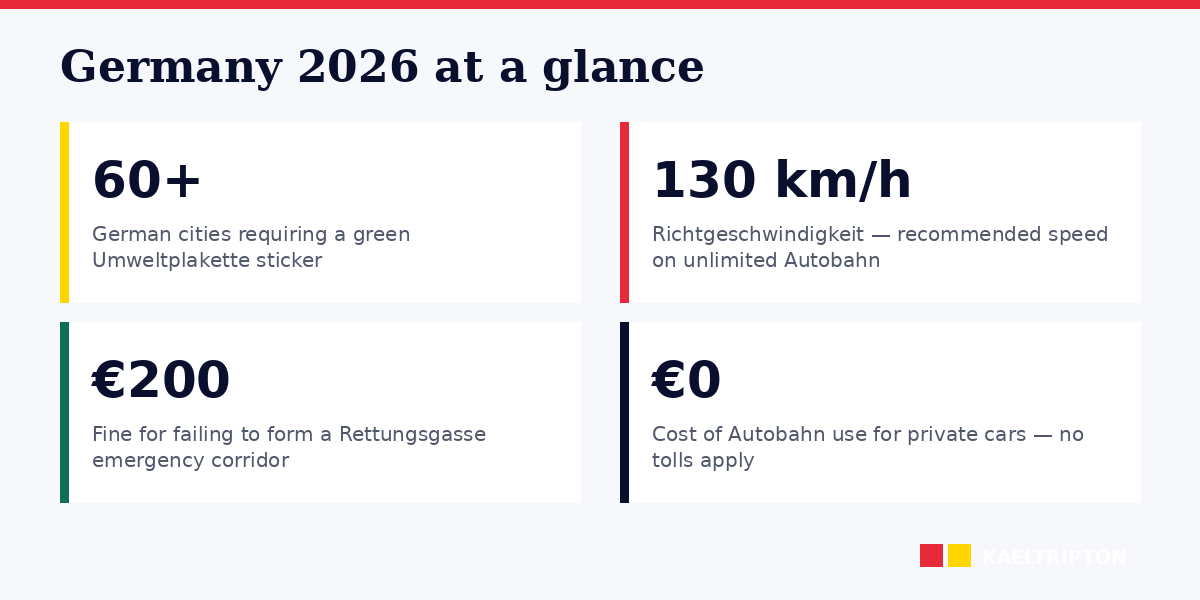
Every German city centre needs a green Umweltplakette - order before you travel and pay €15 to €20 including UK postage. The Autobahn is free but not reckless: the 130 km/h Richtgeschwindigkeit affects your insurance position. The single rule that catches UK drivers hardest is Rettungsgasse - form the emergency corridor the instant traffic slows, not when you see blue lights. Fine for failing is €200 and two points. |
What you need to carry
Germany's approach to equipment is practical: few items are strictly mandatory, but everything that is required is strictly enforced.
Documents:
- Full UK photocard driving licence. No International Driving Permit is needed for tourist trips. If you stay longer than six months, you must exchange your UK licence for a German one.
- V5C registration certificate or VE103 for leased vehicles
- Motor insurance certificate - no Green Card required since 2 August 2021. Confirm with your insurer that your policy covers Germany and check whether comprehensive cover applies abroad.
- Passport with at least three months' validity on your return date
- Valid MOT (the UK equivalent of Germany's Hauptuntersuchung), if your vehicle is over three years old
Equipment (legally required for every vehicle on German roads):
- Warning triangle
- First aid kit - unlike France or Spain, Germany requires a basic first aid kit in every car. A UK kit is acceptable provided it contains the typical DIN 13164 contents (plasters, sterile dressings, triangular bandages, gloves, scissors, blanket)
- High-visibility reflective jacket - one per vehicle minimum (a jacket per occupant is the safer standard)
- UK sticker on the rear of the vehicle, unless your number plate already shows the UK identifier with the Union flag
- Spare glasses if you wear them to drive - recommended, not legally mandatory, but insurers often cite this in negligence claims
Items not required: fire extinguisher, spare bulbs, breathalyser. Snow chains are only required on specifically signposted alpine routes in winter.
Umweltplakette: the green sticker you almost certainly need
An Umweltplakette (also called Feinstaubplakette) is a windscreen-displayed emissions certificate required to drive in any of Germany's 60+ designated environmental zones (Umweltzonen). These zones cover the centres of virtually every major German city: Berlin, Munich, Frankfurt, Hamburg, Cologne, Dortmund, Stuttgart, Leipzig, Dresden, Hanover, Nürnberg and dozens more.
Since 2025, only the green Category 4 sticker is valid in any German environmental zone. The older red and yellow stickers are no longer issued or accepted. A vehicle qualifies for a green sticker if it meets:
- Petrol: Euro 1 onwards with a catalytic converter (essentially any petrol car from 1993 onwards)
- Diesel: Euro 4 onwards, or Euro 3 with an accredited diesel particulate filter retrofit
- Electric and hydrogen: always eligible
A diesel car registered before 2006 without a retrofit cannot get a green sticker and cannot legally drive in any German Umweltzone. The practical consequence: older UK diesels that pass through English CAZs with an exemption or that were never charged are blocked from driving into the centre of Berlin or Munich.
The sticker costs €5 to €20 depending on where you buy it. The cheapest source is any TUÜV or DEKRA inspection station in Germany for €5 - fine if you enter the country at a border point without an Umweltzone between you and the nearest inspection station. To avoid the risk, order online before travel from a reputable provider such as umwelt-plakette.de or the DEKRA direct portal for around €15 to €20 including postage. Allow two to three weeks for UK delivery.
Fine for driving in an Umweltzone without a valid green sticker: €80 to €100. Note that the fine applies even if the car would qualify for a green sticker but does not have one displayed - eligibility is not enough, the physical sticker must be on the windscreen.
One key point the sources agree on: motorways running through an Umweltzone do not require the sticker. If your route passes an Umweltzone on the Autobahn but does not exit into the zone, no sticker is needed. Enter the zone's marked roads and the requirement is active.
Autobahn rules and speed limits
German motorway speed rules are the most misunderstood element for UK drivers. The reality:
- Roughly 30% of the Autobahn network has no general speed limit. These sections are marked with a circular sign of four thin diagonal stripes (the Ende aller Streckenverbote sign). The recommended safe speed (Richtgeschwindigkeit) is 130 km/h (81 mph) - not legally enforced, but important for insurance.
- The other 70% has posted limits - usually 100, 120 or 130 km/h. These are legally enforced via speed cameras as strictly as any UK motorway limit.
- Minimum vehicle capability: vehicles unable to maintain at least 60 km/h are banned from the Autobahn. Cyclists, mopeds under 50cc and pedestrians are also prohibited.
The Richtgeschwindigkeit matters even on unlimited sections because if you are in an accident at over 130 km/h, your insurer can reduce payouts on the basis that you contributed to the accident by exceeding the recommended speed. UK drivers who assume "no limit means no liability" are wrong.
Other speed limits:
| Road type | Speed limit |
|---|---|
| Built-up areas (towns, cities) | 50 km/h (31 mph) |
| Main roads outside built-up areas | 100 km/h (62 mph) |
| Dual carriageways (not Autobahn) | 100 km/h recommended |
| Autobahn (limited sections) | 100, 120 or 130 km/h as posted |
| Autobahn (unlimited sections) | 130 km/h recommended |
Two rules that catch UK drivers out
Rettungsgasse (emergency corridor)
When traffic comes to a standstill on an Autobahn or dual carriageway, German law requires drivers to create a corridor for emergency vehicles between the leftmost lane and the lane next to it. On two-lane roads, traffic in the left lane moves left, traffic in the right lane moves right. On three-lane roads, left-lane traffic moves left, middle-lane traffic moves right, right-lane traffic stays right.
The corridor must be formed as soon as traffic slows below walking pace, not after emergency services arrive. Failure to create a Rettungsgasse is a €200 fine, two penalty points on the German driving record, and a one-month licence ban if it obstructs an emergency vehicle. Police enforce this rigorously at every motorway incident.
Passing on the right
Overtaking on the right on the Autobahn is illegal and draws a €100 fine plus one penalty point. In practice, the left lane is strictly for overtaking; you must return to the right lane as soon as the overtake is complete. UK drivers accustomed to English "middle-lane cruising" find German lane discipline abrupt - a flash of headlights from behind in the left lane is a signal to move right immediately, not an invitation to brake-check.
Drink-driving: 0.5 general, 0.0 for under-21 and new drivers
Germany's general blood alcohol limit is 0.5 g/l, lower than England's 0.8. For drivers under 21 or within the first two years of their licence, the limit is zero - any detectable alcohol is an offence. UK drivers with full licences of more than two years' standing are treated at the general 0.5 limit.
Fines escalate quickly: €500 for 0.5 to 1.09 g/l (with one month driving ban on top), criminal prosecution with fines up to €3,000 and mandatory driving ban above 1.1 g/l. Drug testing is routine at roadside checks.
Tolls and vignettes
Germany has no toll system for private cars on the Autobahn - the network is free to use for passenger vehicles. There is no equivalent of the Austrian or Swiss vignette for cars. Trucks over 7.5 tonnes pay a distance-based Maut via an electronic tolling system, but this does not apply to cars, motorcycles, or vans under 7.5 tonnes.
A proposed "Pkw-Maut" car toll was struck down by the European Court of Justice in 2019 as discriminatory against foreign drivers. There is currently no parliamentary plan to reintroduce it before 2027.
A real 2026 scenario: Munich to Berlin via Frankfurt
A couple from Manchester flies to Munich, hires a German-plated car, and drives Munich-Frankfurt-Berlin over a week in August 2026.
At the Munich hire desk: they confirm the green Umweltplakette is on the windscreen (standard for every German rental fleet vehicle). They verify the first aid kit and warning triangle are present. Insurance is handled by the hire contract.
Documents: both hold UK photocard licences. They carry passports with the required three months' remaining validity.
Munich to Frankfurt via the A9 and A3: roughly 400 km, entirely free to drive, mixture of limited sections around Nuremberg and unlimited sections in between. They stick to 130 km/h as a matter of insurance prudence. Total fuel cost: around €50.
Frankfurt: the car has a green Umweltplakette, so driving into the centre is legal. They stay three nights and pay for parking via the city's app-based system.
Frankfurt to Berlin via the A7 and A2: roughly 540 km. One planned stop in Hanover. At Hanover, an accident on the A2 stops traffic for 20 minutes. They form the Rettungsgasse immediately by moving to the right because they are in the right lane; an emergency helicopter lands and a fire truck passes through the corridor within two minutes. Had they failed to move, €200 fine minimum.
Total week cost: approximately €100 in fuel, €140 in parking across all three cities, zero in tolls, zero in fines.
Frequently asked questions
Do UK drivers need an IDP to drive in Germany?
No. A full UK photocard licence is sufficient for tourist trips. Paper-only licences are not accepted - upgrade to photocard before travel. If you stay in Germany longer than six months, you must exchange your UK licence for a German one.
Can I drive in Germany with a UK Blue Badge?
Yes. German local authorities recognise UK Blue Badges for parking concessions on the same terms as German Schwerbehindertenausweis holders. Display the badge on the dashboard and check specific city parking rules. A small number of older German towns have stopped recognising foreign badges - the city website for your destination is the authoritative source.
Is the green Umweltplakette valid forever?
Yes, for the same vehicle. The sticker ties to the number plate. If the plate changes (for example, the vehicle is re-registered) a new sticker is needed. Stickers that become unreadable due to sun damage must also be replaced. No renewal is required otherwise.
What if the green sticker is damaged or obscured during my trip?
German inspection stations (TUÜV, DEKRA) will issue a replacement immediately for €5 against presentation of the V5C. Keep the V5C accessible in case you need a replacement mid-trip. If the sticker is completely missing, you risk the €80 to €100 fine per Umweltzone entry until you replace it.
Can I use my mobile phone with a hands-free kit while driving?
Yes, but the standard is strict. Any visible handling of the phone - even to start a call on a cradle-mounted device - can draw a €100 fine and one penalty point. True hands-free via Bluetooth and voice commands is legal. Texting while driving, even at a red light, is an offence.
What happens if I have a minor accident in Germany?
Call 110 for police or 112 for emergency services. For any accident involving personal injury, police attendance is legally required. For property-only accidents, exchange insurance details and complete a European Accident Statement (Unfallbericht) - the same form used across the EU. Do not drive away from a parking-dent incident without leaving contact details; German law treats this as Unfallflucht (leaving the scene) and it is a criminal offence.
Are Autobahn speed cameras the same as UK ones?
Yes in principle, with one key difference: many German speed cameras are mobile and move between sites daily. The fixed cameras on limited-speed sections of Autobahn are well-signposted and as reliable as any UK equivalent. Mobile cameras on the B-roads are heavily enforced. Post-Brexit, Germany can no longer directly send speed-camera fines to UK-registered vehicles, but unpaid fines remain enforceable on subsequent EU trips.
Sources
- GOV.UK, Driving in the EU and Foreign travel advice - Germany
- Bundesministerium für Digitales und Verkehr (BMDV), Verkehrsrecht und Fahrerlaubnis
- 35. BImSchV (35th Federal Immission Control Ordinance), establishing the environmental zone and sticker framework
- Straßenverkehrs-Ordnung (StVO), German Road Traffic Regulations - in particular §11 on Rettungsgasse
- Bundesamt für Justiz, Bußgeldkatalog (Fines Catalogue)
- DEKRA and TUÜV, Umweltplakette - Anforderungen und Ausgabe
- European Commission, Going abroad by car - Germany
- ADAC, Verkehrsinformationen für ausländische Reisende (Traffic Information for Foreign Travellers)


