

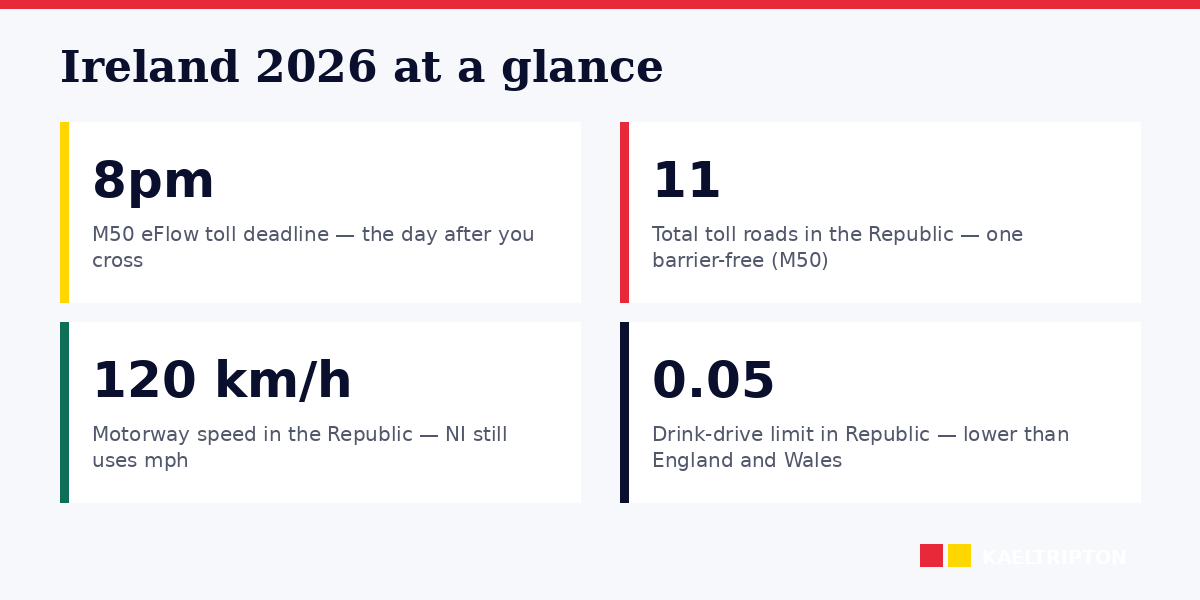
Ireland is the easiest EU destination for UK drivers. Same side of the road, UK licence valid, no Green Card needed, and Common Travel Area rules mean no border formalities crossing from Northern Ireland. What catches UK drivers is the M50 barrier-free toll around Dublin (pay by 8pm the next day or face penalties), the km/h speed limits (not mph), and the lower 0.05 drink-drive limit. This guide covers every requirement from GOV.UK, the Road Safety Authority and Transport Infrastructure Ireland for 2026.
| ★ EDITOR'S VERDICT Same side of the road. Pay the M50 by 8pm tomorrow. |
Ireland is the most forgiving EU destination for UK drivers - same side of the road, UK licence valid under the Common Travel Area, no UK sticker needed. The single rule that catches everyone is the M50 barrier-free toll around Dublin. Pay by 8pm the day after you cross or face escalating fines. The rest is just a km/h conversion and the tighter 0.05 drink-drive limit. Rental cars handle M50 tolls automatically; own-car drivers should register at eflow.ie on the morning of travel. |
What you need: Common Travel Area basics
Ireland and the UK share the Common Travel Area (CTA), a bilateral arrangement predating EU membership that gives British and Irish citizens mutual rights of travel, residence, study and work. The CTA means:
- No passport check at the UK-Ireland border for British or Irish citizens (a passport is still required for foreign nationals, and airlines require photo ID)
- UK driving licences are fully recognised in Ireland for the duration of any visit
- UK vehicles may be brought into Ireland for up to 12 months without formality
- Cross-border trips between Northern Ireland and the Republic are essentially seamless
What you still need to carry:
- Full UK photocard driving licence. No IDP required. Paper-only UK licences are accepted in Ireland under the CTA, though upgrading to photocard is still recommended.
- V5C registration certificate for your own vehicle, or VE103 for hired or leased
- Motor insurance certificate. All UK policies provide third-party cover in Ireland as standard. Comprehensive cover may need to be confirmed with your insurer.
- Passport - not required for UK/Irish citizens under CTA, but you need photo ID. A passport is simplest, especially for onward travel to the EU.
Equipment: Ireland does not mandate reflective jackets, warning triangles or any other safety equipment, though the Road Safety Authority strongly recommends carrying both. A UK sticker is not required for Ireland - it is the only EU country where UK drivers are explicitly exempt from the UK sticker rule.
The M50 eFlow toll: the single biggest catch
The M50, Dublin's orbital motorway, is the only barrier-free toll in Ireland and the single rule that trips UK drivers up most often. There are no toll booths. Cameras on overhead gantries at one specific point between Junctions 6 (Blanchardstown) and 7 (Lucan) photograph every passing vehicle's registration plate.
If you drive on that section of the M50, you must pay the toll by 8pm the following day. Payment options:
- Online at eflow.ie
- By phone on 01-4618866
- In person at any Payzone retail outlet (newsagents, petrol stations, post offices - there are over 900 nationwide)
- Via the eFlow mobile app (iOS and Android)
2026 toll rates for a Category 1 passenger car: €3.70 peak hours, €3.50 off-peak, or €2.40 per crossing with a registered eFlow tag. Peak hours are 07:00-10:00 and 16:00-19:00 weekdays.
Missing the 8pm deadline triggers escalating penalties: an initial €3 late payment fee, rising to €41.50 if unpaid after 14 days, and €103.50 plus the toll after 56 days. Persistent non-payment can lead to court prosecution with fines up to €5,000 and a six-month prison sentence. Hire cars handle M50 tolls automatically - check your rental contract for the per-crossing surcharge the company adds (typically €3-5).
The other 10 toll roads
Ireland has 11 toll roads in total. Ten of them use standard toll plazas where you stop and pay by cash or card as you pass through. These are:
- M1 Gormanston-Monasterboice (Drogheda bypass)
- M3 Clonee-Kells
- M4 Kilcock-Kinnegad
- M6 Galway-Ballinasloe
- M7/M8 Portlaoise-Castletown and Portlaoise-Cullahill
- M25 Waterford bypass (N25)
- N6 Limerick-Galway (Limerick Tunnel)
- East Link (Dublin Port toll bridge)
- Dublin Port Tunnel
- Fermoy (N8 Fermoy bypass)
Standard car tolls on these range from €1.90 to €3.90 per crossing. Cash and card both work at the booths. Carrying some euro coins is useful for smaller tolls where queues at card terminals can be longer than cash lanes.
Speed limits in 2026
Ireland's speed limits are in kilometres per hour. Signs on both sides of the border look nearly identical except for the unit - Northern Ireland uses mph, Republic uses km/h.
| Road type | Speed limit | Approximate mph |
|---|---|---|
| Motorways (M roads) | 120 km/h | 75 mph |
| Dual carriageways (some N roads) | 100 km/h | 62 mph |
| National roads (most N roads) | 100 km/h | 62 mph |
| Regional roads (R roads) | 80 km/h | 50 mph |
| Local roads (L roads) | 80 km/h | 50 mph |
| Built-up areas (default) | 50 km/h | 31 mph |
| School zones and high pedestrian areas | 30 km/h | 19 mph |
Speeding fines are a flat €160 for most violations if paid within 28 days, rising to €240 between days 29 and 56. Unpaid after 56 days, the matter goes to court with fines up to €1,500 and three penalty points on the Irish driving record (which does not affect a UK licence directly but creates complications for residents).
Drink-driving: 0.05 general, 0.02 for learners and professional drivers
The Irish blood alcohol limit is 0.05 g/l (50mg per 100ml) - lower than England and Wales at 0.08 but identical to Scotland. For learner drivers, drivers within their first two years after passing, and professional drivers (bus, taxi, HGV), the limit drops to 0.02 g/l (20mg).
UK visitors with full licences of more than two years' standing are treated at the 0.05 limit. The Garda run routine mandatory breath-testing operations, including on main routes and near tourist destinations. Penalties escalate: €200 fixed fine plus three months off the road for 0.05-0.10 g/l, rising to criminal prosecution and a disqualification period above 0.10 g/l.
The practical implication: most UK drivers who have had a single pint in an Irish pub are close to or over the 0.05 limit. The sensible rule is zero alcohol before driving.
Roundabouts, priority and which side
Ireland drives on the left in right-hand drive vehicles - exactly the same as the UK, Cyprus, Australia, Japan. Roundabouts are clockwise. Vehicles already on the roundabout have priority. At unmarked junctions, traffic on the major road has priority over traffic on the minor road (signs clearly indicate which is which).
This is the single biggest comfort for UK drivers: Ireland feels immediately familiar. The road markings, the signage style (though in kilometres and with some Irish-language signs in Gaeltacht areas), and the driver positioning all match UK expectations. The main adjustments are the unit change (km/h not mph) and remembering that Irish-language-only signs exist in parts of Donegal, Connemara, the Aran Islands and parts of Kerry and Cork.
Crossing the border: Northern Ireland to the Republic
The border between Northern Ireland and the Republic is entirely open under the Common Travel Area. There are no checkpoints, no customs, and no identity check. The only signals you have crossed are the change from mph to km/h on speed signs, the change from "M1" to "N1"-style road prefixes, and (sometimes) a small sign welcoming you to "Éire".
Things that change the moment you cross:
- Speed limits convert from mph to km/h (70 mph motorway becomes 120 km/h motorway)
- Phone roaming - though since UK roaming charges were reinstated post-Brexit, many UK providers still charge for Ireland. Check your plan.
- Currency - Northern Ireland uses pounds, Republic uses euros
- Drink-drive limit drops from 0.08 (NI) to 0.05 (Republic)
- Tolls start appearing on main roads in the Republic (there are no tolls in Northern Ireland)
Your UK insurance typically covers both sides of the border automatically. Hire car companies may or may not allow cross-border use - confirm with the specific contract and expect a £50-80 surcharge plus VAT for short cross-border trips.
A real 2026 scenario: Belfast to Galway via Dublin
A couple from Newcastle flies into Belfast, hires a car, and drives Belfast-Dublin-Galway-Killarney-Cork-Dublin-Belfast over 10 days in August 2026.
At the Belfast rental desk: standard UK-registered hire car. No UK sticker needed for Ireland - the company confirms cross-border cover for no extra charge on this particular contract.
Belfast to Dublin: 160 km via the A1 and M1. They pay the M1 Drogheda toll (€1.90) in cash at the booth. No M50 passage on this direct route, so no eFlow concern.
Dublin sightseeing: they park at the Red Cow Park&Ride (€5/day) and take the Luas tram into the centre. No ZTL issues - Dublin does not operate a restricted traffic zone, though parts of central Dublin around College Green are pedestrianised.
Dublin to Galway via the M4 and M6: the M4 Kilcock toll is €2.90, the M6 Galway toll is €1.90. They cross the M50 briefly on the way out of Dublin - paid online at eflow.ie that evening (€3.50, within deadline).
Galway to Killarney: entirely free of tolls. N18 to Limerick, N21 to Tralee, onward to Killarney on the N72.
Killarney to Cork to Dublin to Belfast: picks up the M8 (Fermoy toll €2.10, Portlaoise toll €2.40), then joins the M7 and M50 back through Dublin. Another M50 eFlow crossing paid online.
Total tolls for the 10-day trip: around €28. Fuel approximately €110. Parking €50. Zero fines because the eFlow deadline was met after each M50 crossing.
Frequently asked questions
Can I drive in Ireland with a UK provisional licence?
No. Ireland requires a full, valid driving licence. UK provisional licences are not accepted anywhere in the EU. The minimum age to drive a car in Ireland is 17 (same as UK), but hire car companies typically set their minimum at 25 with a young-driver surcharge for 21-24 year olds.
Do I need a UK sticker for Ireland?
No. Ireland is the only EU country where UK drivers do not need a UK sticker or UK-identifier number plate. This is a specific exemption under GOV.UK guidance. You still need the physical sticker for onward travel anywhere else in the EU, so most UK drivers still fit one for convenience.
What happens if I forget to pay the M50 toll?
You have until 20:00 the day after you passed under the cameras. Miss that and a €3 late fee is added automatically, rising to €41.50 after 14 days and €103.50 after 56 days. Persistent non-payment escalates to court proceedings. The best insurance against this is to pay the toll on the morning of the day you pass through, before the deadline matters.
Is Ireland in the Green Card scheme?
Ireland is in the EU so Green Cards are not required for UK drivers since August 2021. Your UK insurance certificate is sufficient. The Green Card scheme itself still exists for UK drivers visiting countries outside the EU/EEA (Albania, Belarus, Moldova, Morocco, Turkey, Ukraine and others).
Can I bring my UK-registered car into Ireland long-term?
For visits under 12 months, yes, without formality. If you become an Irish resident, you must register the vehicle with Revenue and obtain Irish plates within 30 days of taking up residence. Vehicle Registration Tax (VRT) applies unless the vehicle is exempted under transfer-of-residence rules.
Are there any Irish low-emission zones?
Not at city-centre level. Ireland does not operate Clean Air Zones or equivalent charging schemes in 2026. Dublin City Council has trialled restrictions on heavy goods traffic in specific central streets, but no general LEZ exists. This is a point of difference from most of the EU, where LEZs are now standard in every major city.
Do I need snow tyres or chains in Ireland?
No. Ireland does not require winter tyres or snow chains at any time. Winters are mild enough that standard all-season tyres work year-round. Black ice is the main winter hazard, particularly on rural roads in the north-west and in the Midlands - adjust speed accordingly.
Sources
- GOV.UK, Driving in the EU and Foreign travel advice - Ireland
- Road Safety Authority Ireland (RSA), Rules of the Road 2026
- Transport Infrastructure Ireland (TII), Tolls and motorway operations
- eFlow, M50 toll payment - eflow.ie
- An Garda Síochána, Drink driving limits and fixed charge notices
- Department of Transport Ireland, Common Travel Area and UK driving licences
- Irish Statute Book, Road Traffic Act 2010 (as amended)
- Tourism Ireland, Driving in Ireland - ireland.com


