

The short answer: if you hold a UK photocard driving licence, you can drive in the EU, Switzerland, Norway, Iceland and Liechtenstein without an International Driving Permit (IDP). The longer answer covers paper licences, longer-term stays, rental company practices, and the specific countries that still require an IDP alongside the photocard. Built entirely from GOV.UK guidance and UK legislation.
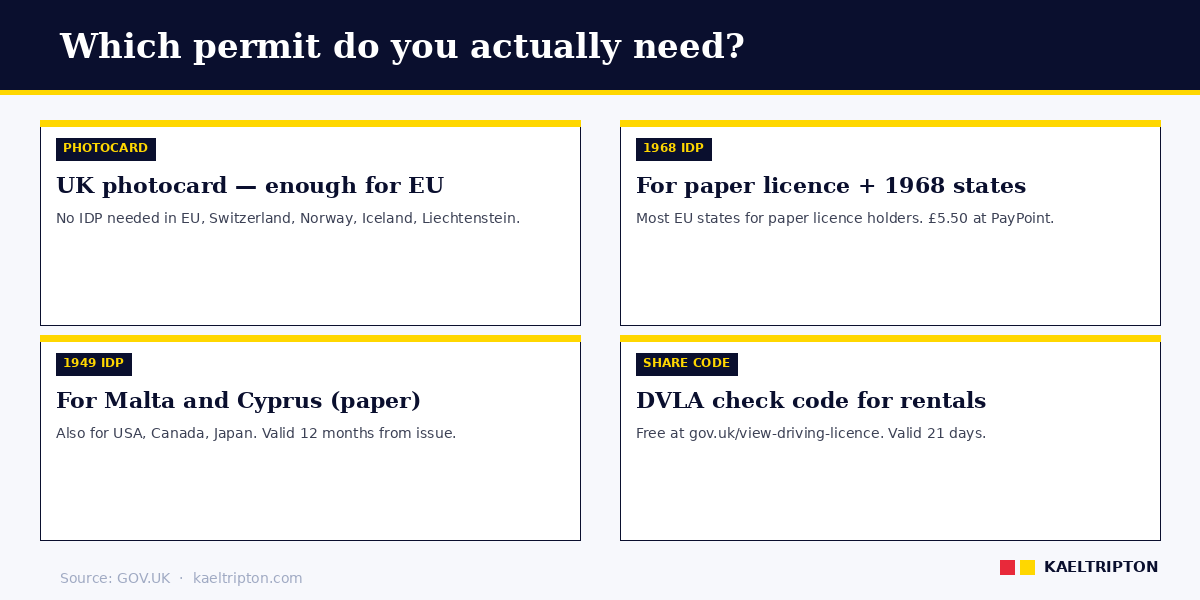
If you hold a UK photocard driving licence, you do not need an IDP to drive in the EU, Switzerland, Norway, Iceland or Liechtenstein. IDPs (£5.50 from PayPoint shops, since Post Offices stopped issuing them on 1 April 2024) are only needed with paper licences, Crown Dependency licences, or for non-EU destinations. Most rental companies now require a DVLA share code - free at gov.uk/view-driving-licence, valid 21 days. |
The one rule most UK drivers need to know
Since the post-Brexit transition, the UK and the EU agreed on mutual recognition of driving licences for visitors. If you hold a UK photocard driving licence issued by the DVLA (for Great Britain) or the DVA (for Northern Ireland), you can drive in all 27 EU member states, plus Switzerland, Norway, Iceland and Liechtenstein, without needing an IDP. Your UK photocard is enough.
This is confirmed on the GOV.UK page “Driving abroad: check if you need an international driving permit (IDP)”. The page maintains a country-by-country table of when an IDP is required alongside your UK licence and which Convention (1926, 1949 or 1968) the destination country requires.
The rule applies to holiday trips and short business visits. It does not apply to UK residents who relocate to an EU country - those drivers must eventually exchange their UK licence for a local licence under the host country’s rules (typically after six to twelve months of residence).
When you do still need an IDP
Three situations where a UK driver needs an IDP for a European trip:
- You hold a UK paper driving licence. These are still held by some older drivers who have never updated to the photocard. A paper-only licence is not universally recognised for mutual driving in the EU; some countries (including Italy and Spain under some circumstances) require the paper licence to be accompanied by an IDP.
- Your licence was issued in Gibraltar, Guernsey, Jersey or the Isle of Man. Crown Dependency and Gibraltar licences are not UK DVLA/DVA licences for the purposes of EU recognition. Holders typically need an IDP in most EU countries, with specific rules per destination.
- You are driving outside the EU/EEA. Destinations like Turkey, Morocco, Egypt, Israel, Albania, Bosnia, Moldova and Ukraine are signatories to the 1968 Vienna Convention on Road Traffic, not covered by UK-EU mutual recognition. An IDP is required alongside your photocard licence in those countries.
The three types of IDP - which one for which country
An IDP is a multilingual translation of your UK driving licence, issued under one of three international conventions. The type you need depends on the country you’re driving in:
| IDP type | Convention | Validity | Main use in Europe |
|---|---|---|---|
| 1968 IDP | Vienna Convention on Road Traffic 1968 | 3 years or until UK licence expires (whichever is sooner) | Most EU/EEA countries for paper-licence holders; Turkey, Albania, Bosnia, Moldova |
| 1949 IDP | Geneva Convention on Road Traffic 1949 | 12 months | Malta and Cyprus for paper-licence holders; USA, Canada, Australia, Japan, many African states |
| 1926 IDP | International Convention relative to Motor Traffic 1926 | 12 months | Mexico and Somalia only - no EU use |
A single trip may require two types of IDP if you’re crossing conventions. A UK paper-licence holder driving from France (1968) to Malta (1949) would need both. The photocard holder needs neither - the UK-EU agreement covers both.
Where to buy an IDP in the UK
Since 1 April 2024, IDPs are no longer issued at Post Offices. They are now available from shops participating in the PayPoint scheme - typically local convenience stores, corner shops and newsagents. The fee is £5.50 per IDP, set by the Department for Transport.
To buy an IDP:
- Find a participating PayPoint IDP location via the PayPoint store locator.
- Bring your UK photocard driving licence (both front and back) or your paper licence if that’s what you hold.
- Bring a passport-size photograph (if you hold a paper licence). Photocard holders do not need a separate photo.
- Bring a valid UK passport for identity if requested (some stores require this for paper-licence customers).
- Pay the £5.50 in cash or card.
The IDP is issued on the spot. You cannot apply online or by post - the Department for Transport requires in-person issue to verify the underlying licence. You cannot obtain an IDP from outside the UK; if your IDP is lost or stolen abroad, you cannot replace it and must rely on your domestic licence.
Eligibility for a UK IDP
To buy an IDP in the UK you must:
- Be at least 18 years old.
- Hold a full (not provisional) UK driving licence.
- Be a resident of Great Britain or Northern Ireland.
If your UK licence has been suspended, revoked or has expired, you cannot obtain an IDP - the IDP supplements but does not replace a valid domestic licence. Diplomatic licence holders and licence holders from the Channel Islands, Isle of Man or outside the UK are ineligible under UK rules and must apply through their own authorities.
The Vienna Convention framework
The current EU-wide IDP picture for paper-licence holders is a legacy of the 1968 Vienna Convention on Road Traffic. The UK acceded to the Vienna Convention on 28 March 2019. Before that date, the UK was only a party to the 1949 Geneva Convention, which is why some older guidance still references only the 1949 IDP.
The Explanatory Memorandum to the International Driving Permits (Fees) (EU Exit) Regulations 2019, laid before Parliament in February 2018 and published on legislation.gov.uk, sets out the fee-setting framework that supports the £5.50 IDP charge today. The House of Lords EU Committee’s 2018-19 Brexit report on road transport documented industry concerns about mutual recognition that were later resolved through the UK-EU Trade and Cooperation Agreement - hence today’s simpler photocard-only position.
Car hire abroad - what rental companies require
Car rental practice often diverges from the legal minimum. Even where your UK photocard is legally sufficient, individual rental companies impose their own requirements. Common rental-desk asks include:
- DVLA share code. Request one at gov.uk/view-driving-licence. The code is valid for 21 days and lets the rental company see any endorsements or disqualifications. This has become near-universal in Europe.
- Credit card in the main driver’s name. Debit cards are often refused at pick-up, especially for higher-value rentals. A credit card with sufficient limit for the security deposit is usually mandatory.
- Passport. Brought to pick-up for ID verification.
- Second form of photo ID. Occasionally requested, especially for younger drivers or higher-value vehicles.
Some rental companies will ask for an IDP even when legally not required - particularly budget rental companies at smaller airports. If pressed, you can refuse and point to the legal position, but in practice paying £5.50 for an IDP before travelling often saves a holiday argument.
If you’re hiring a car, get a DVLA check code
The DVLA share-code system replaces the old paper counterpart of the photocard licence. It is free, takes two minutes online, and is now required by almost every European rental company. The code expires after 21 days of issue, so generate it close to your rental pick-up date.
Northern Ireland drivers who still hold the old paper counterpart alongside their DVA photocard should carry both - some rental desks in continental Europe are still catching up on DVA vs DVLA differences and want to see the paper document.
Edge case - driving in Cyprus
Cyprus is a 1949 Convention country rather than 1968. For photocard UK licence holders on short visits, no IDP is needed in practice - the UK-EU mutual recognition arrangement covers Cyprus in the same way as other EU states. But older guidance still references a 1949 IDP requirement for paper-licence holders and for visits over 30 days. If you plan an extended Cyprus stay and hold a paper licence, a 1949 IDP is prudent even where not strictly demanded.
Edge case - driving in Malta
Malta, like Cyprus, is a 1949 Convention country. The practical rules mirror Cyprus: photocard holders are fine; paper-licence holders should carry a 1949 IDP. Maltese car hire desks occasionally ask for an IDP regardless - policy varies by firm.
Edge case - driving in Switzerland, Norway, Iceland, Liechtenstein
These four non-EU European states are party to agreements that mirror the EU recognition of the UK photocard licence. No IDP is needed for short visits with a UK photocard. Paper-licence holders may need a 1968 IDP for Norway and Switzerland; check GOV.UK’s country-specific guidance on the day of travel.
Edge case - driving commercial or heavier vehicles
The mutual recognition arrangement covers category B (car) and equivalent. If you intend to drive a heavier vehicle in Europe - a larger motorhome requiring C1 category, a minibus requiring D1, or towing a sizeable trailer requiring B+E - confirm that your UK licence categories are recognised for that vehicle class in the destination country. Requirements vary, and insurance practice often follows local law rather than the mutual recognition principle.
Green Card insurance - confirmed no longer needed
The European Commission confirmed in 2021 that UK vehicles no longer need to carry a physical Green Card when driving in the EU, EEA, Switzerland, Andorra or Serbia. Your UK motor insurance certificate provides the minimum compulsory third-party cover required under national law. This remains the position in 2026.
You should still inform your insurer that you are taking your car abroad - many policies automatically extend to minimum cover but require notification for comprehensive cover to continue. Cross-check with your insurer before a long trip.
What to carry in the car in Europe
Different European countries require different equipment in the car. The broad picture for UK drivers in the EU:
- Warning triangle - required in most EU countries. Always carry one.
- Hi-vis vest - required for driver and, in some countries (France), all occupants. Must be accessible without leaving the car.
- Headlamp beam deflectors or adjustment - required for right-hand-drive UK cars in left-hand-drive countries. Modern LED headlamps can often be adjusted via the car’s menu; older halogen lamps need physical deflector stickers.
- UK sticker - since September 2021 the UK identifier on vehicles is “UK” rather than “GB”. If your number plate shows the UK identifier already, you do not need a separate sticker. If not, you need a UK sticker on the rear of the vehicle.
- Spare bulbs and first aid kit - required in some countries (France, Germany, Spain).
- Breathalyser - was legally required in France until 2020; no longer an active offence.
The AA and RAC sell European driving kits that bundle these items. If you drive to Europe occasionally, a ready-made kit in the boot is simpler than checking each country’s current list per trip.
Tolls and low-emission zones across Europe
Motorway tolls operate in France, Spain, Italy, Portugal, Austria (vignette), Switzerland (vignette), Slovenia (vignette) and several others. UK cards work at most toll booths; cash is still widely accepted in France. Electronic toll transponders (Telepass in Italy, Liber-t in France) are available for regular visitors and speed up tolls significantly.
Low-emission zones exist across Europe. France operates the Crit’Air system requiring a windshield sticker (€4.61 online from the official site) for driving in many French cities. Germany operates Umweltzone stickers for cities including Berlin, Hamburg and Munich. Italy operates ZTL zones in historic city centres - entering these without a permit generates an automatic fine that arrives at your UK address months later via the hire company.
What to do after an accident abroad
If you are involved in an accident in the EU:
- Stop at the scene, turn on hazard lights, place warning triangle.
- Exchange details with the other driver: name, address, insurance details, registration numbers.
- Complete a European Accident Statement (Constat amiable) if the other driver has one - this is a standardised form recognised across the EU.
- Photograph the scene, vehicle damage and positions.
- Call the local police if anyone is injured or if the other driver refuses to exchange details.
- Contact your UK insurer as soon as possible. Under the Motor Insurance Directive, you can usually claim against the other driver’s insurer through a UK representative appointed by that insurer.
Speeding fines from abroad - will they reach you?
Since the UK left the EU’s Cross-Border Enforcement Directive on 31 January 2020, enforcement of minor driving offences committed in the EU against UK-registered vehicles has weakened considerably. A speeding fine issued in France or Italy against a UK-registered vehicle is harder to enforce than it was pre-Brexit, because automatic data-sharing between UK and EU vehicle registers was one of the frameworks the UK left. But this does not mean you can ignore such fines:
- If you drove a rental car, the hire company will bill your card for the fine plus an administration fee - typically €50 on top.
- If you return to the same country, the unpaid fine can be attached to the vehicle and enforced at the border.
- Some countries (the Netherlands, Germany, Austria) have bilateral collection arrangements with UK debt collectors.
- Non-payment of a serious fine can result in a ban from driving in the issuing country on future visits.
Practical advice: pay minor fines promptly. Serious penalties (for example, reckless-driving allegations) warrant legal advice before responding.
Electric vehicles in Europe - charging practicalities
Charging an electric vehicle across Europe is workable but requires some planning. Apps like A Better Routeplanner (ABRP) and Google Maps now incorporate charging stops. Major networks with UK-compatible access include Ionity (across the EU), Fastned (NL, DE, BE, FR, UK), Allego (most of Western Europe) and Tesla Superchargers (now open to most EV brands across Europe).
Carry a CCS cable at minimum; Type 2 AC for destination chargers; and consider a Chademo adapter for older Asian EVs. A single charging membership rarely covers the whole continent - Plugsurfing, Chargemap and Shell Recharge each aggregate multiple networks. Paying by credit card at the charger is almost universally supported in 2026 but reserve membership apps as a backup.
Brexit’s lasting impact on UK drivers in Europe
Aside from the IDP and Green Card changes described above, Brexit left a few less-prominent changes that still affect UK drivers:
- UK sticker not GB. The international vehicle identifier changed from “GB” to “UK” on 28 September 2021. Cars displaying the old GB Euroflag plate or a GB sticker should add a UK sticker, or replace the plate.
- Parking permits in cities. Some EU cities that previously recognised UK resident parking permits for short stays (Paris, Amsterdam) no longer do. Tourist parking rules apply.
- Driving for work. If your UK employer sends you to the EU to drive a company vehicle for work, HGV and minibus categories are subject to the EU operator-licensing regime that UK operators left in 2020. Most short assignments are fine; extended postings or commercial haulage require separate authorisation under the Trade and Cooperation Agreement’s road transport provisions.
Related guides
- Driving in the EU 2026 - Full Country Guide
- British Passport Holders in the EU 2026
- UK Car Tax 2026 - Vehicle, MOT and Tax
- Is My Passport Valid for UK Travel 2026?
Disclaimer
This guide reflects UK and international driving rules as published on GOV.UK and at legislation.gov.uk as of April 2026. National rules in destination countries can change, and rental-company policies often exceed legal minimums. Always check the destination country’s embassy in London and your rental company’s requirements before travel. This article is not legal advice.
Frequently asked questions
Do I need an International Driving Permit for Europe in 2026?
Not if you hold a UK photocard driving licence. The UK photocard is recognised across all EU member states, Switzerland, Norway, Iceland and Liechtenstein for visiting drivers. An IDP is only needed if you hold a paper licence, a Gibraltar/Channel Islands licence, or if you’re driving outside the EU/EEA in specific 1968 or 1949 Convention countries.
How much does a UK IDP cost?
£5.50 from PayPoint-participating shops. Post Offices stopped issuing IDPs on 1 April 2024. The fee is set by the Department for Transport and has not changed.
How long is a UK IDP valid?
A 1968 Convention IDP is valid for three years or until your UK driving licence expires, whichever is sooner. A 1949 Convention IDP is valid for 12 months. A 1926 IDP is valid for 12 months. IDPs cannot be renewed - once expired, you must apply for a new one.
Can I apply for an IDP online?
No. IDPs must be bought in person from a PayPoint-participating shop in the UK. You cannot apply by post, online, or from overseas. The in-person requirement is set by the Department for Transport to allow verification of the underlying UK licence.
Do car hire companies in Europe accept my UK photocard?
Yes, legally and in practice. Most European rental companies also ask for a DVLA check code (free, two minutes online at gov.uk/view-driving-licence) so they can view endorsements. Occasionally a rental desk will ask for an IDP even when not legally required - buying one for £5.50 before travelling can save arguments.
Do I need a Green Card for my car in Europe?
No. The European Commission confirmed in 2021 that UK vehicles no longer need a physical Green Card for driving in the EU, EEA, Switzerland, Andorra or Serbia. Your UK motor insurance certificate provides the minimum third-party cover. Inform your insurer before long trips to confirm cover.
What if I’m moving to an EU country, not just visiting?
Visitor recognition does not cover residents. After you establish residence in an EU country, local rules require you to exchange your UK licence for a local licence, typically within six to twelve months. Processes and test requirements vary by country - some offer direct exchange without a test, others require a theory test, and a few require a full practical test.
Sources
- GOV.UK - Check if you need an international driving permit
- GOV.UK - Get an international driving permit
- UK Legislation - Explanatory Memorandum, International Driving Permits (Fees) (EU Exit) Regulations 2019
- UK Legislation - The Motor Vehicles (International Circulation) (Amendment) Order 2019
- House of Lords EU Committee - Brexit: road, rail and maritime transport (2018-19)
- European Commission - Green Card no longer required for UK vehicles, August 2021


