

British passport holders travelling to the European Union in 2026 face a genuinely different landscape from the one that existed before 31 December 2020. The Entry/Exit System (EES) went live at Schengen borders on 12 October 2025 and became fully operational on 10 April 2026. The European Travel Information and Authorisation System (ETIAS) is expected to follow in Q4 2026, though as of 23 April 2026 no start date has been confirmed and no valid ETIAS can be issued. Meanwhile the post-Brexit 90-in-180-day limit continues to govern how long UK travellers can actually stay in the Schengen area.
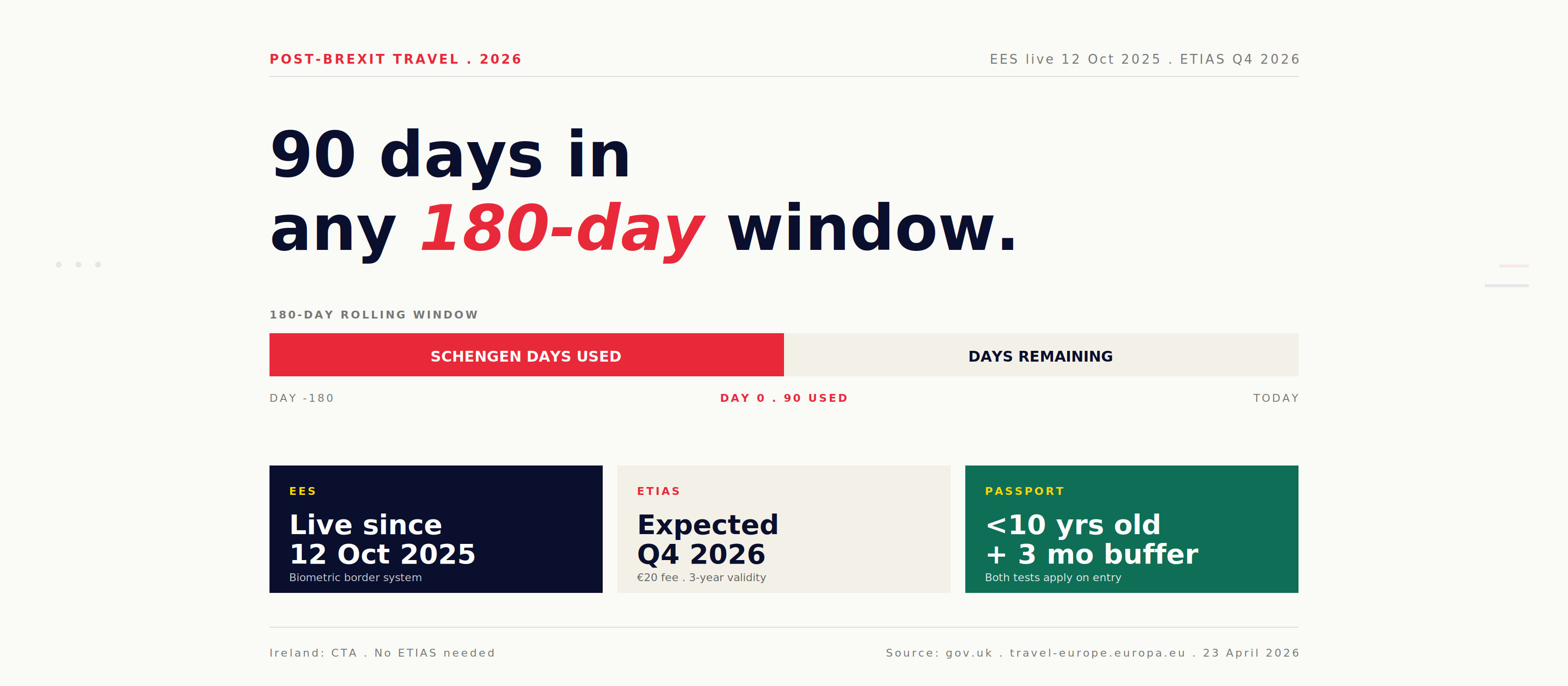
This guide walks through the rules that apply to a UK passport holder visiting, transiting, or making short stays in the Schengen area and other EU countries in April 2026. It covers the 90-in-180 rule in practical detail, the new EES biometric registration, the pending ETIAS, passport-validity requirements, country-specific exceptions, and the boundary between a short visit and something that needs a national visa or residence permit.
|
KEY FACTS (VERIFIED 23 APRIL 2026; ETIAS TIMELINE REVIEWED 15 JULY 2026) 90-in-180-day rule: UK passport holders can stay in the Schengen area for up to 90 days in any rolling 180-day period without a visa. EES live: The EU's Entry/Exit System started on 12 October 2025 and became fully operational on 10 April 2026. Fingerprints and a photograph are taken on first entry. No fee. ETIAS pending: Originally expected Q4 2026 (Autumn 2026); media reports in July 2026 suggest a possible slip into 2027, though the EU's official ETIAS portal had not confirmed a revised date as of 15 July 2026. Fee €20 (exempt for under-18s and over-70s). Valid three years or until passport expiry. Cannot be applied for yet. Passport validity: Issued within the last 10 years on the date of Schengen entry, and valid for at least 3 months after the planned date of leaving the Schengen area. Ireland: Not part of Schengen. Common Travel Area rules apply: no entry restrictions for British and Irish citizens. |
The 90-in-180 rule, explained with examples
Since 1 January 2021, British passport holders have been treated as "third-country nationals" under EU immigration law. The core rule that follows: a UK passport holder can spend up to 90 days in the Schengen area in any rolling 180-day window, without a national visa, for tourism, business visits, family visits, cultural or sporting events, or visa-free work meetings.
The window is rolling, not calendar-based. On any given day at the Schengen border, a border guard looks back 180 days and counts how many days the traveller has been inside the Schengen area. If the total is 90 or fewer (including today), entry is allowed. If it is more than 90, entry is refused and overstays are recorded. Overstaying can lead to bans from the Schengen area ranging from one year for minor overstays to five years for significant ones.
A frequent misunderstanding: the 90 days is not a total across the year's calendar. Nor does it reset annually. Days spent in any Schengen country count towards the same 90-day budget. A week in Spain, a fortnight in France, and a month in Italy all draw from the same pool. Days on entry and exit both count.
The European Commission publishes a Schengen short-stay calculator at ec.europa.eu/home-affairs/content/short-stay-visa-calculator_en. Travellers planning multiple trips in a year should use it before booking, because the rolling nature of the window means a seemingly innocent trip pattern can tip someone into overstay territory.
| Travel pattern | Days in Schengen over 180 | Compliant? |
|---|---|---|
| A single 3-month holiday to Spain | 88 days | Yes (under 90) |
| Two weeks in France + four weeks in Italy + three weeks in Greece (all within 6 months) | 63 days | Yes |
| 85-day winter stay in Portugal + separate week in Germany 90 days later | 92 days in the rolling 180-day window | No (overstay by 2 days) |
| Six weekends in Paris + one two-week summer trip to Croatia | 28 days | Yes, with plenty of room |
| 60 days in Spain in spring, 45 days in Italy in autumn | 105 days in rolling 180 | No (15-day overstay) |
The Entry/Exit System (EES), live since October 2025
The Entry/Exit System is the EU's replacement for manual passport stamping. It went live at Schengen external borders on 12 October 2025 and became fully operational across all participating countries on 10 April 2026, though the UK government notes that implementation at individual borders may still vary.
For British passport holders, the change is mechanical, not legal. The 90-in-180 rule has not changed; EES just records compliance digitally instead of in ink. On first entry after 12 October 2025, a UK traveller registers four fingerprints and a facial photograph at a self-service kiosk or at the border desk. The biographical details from the passport are recorded alongside date and place of entry.
On each subsequent entry or exit, the biometric is verified against the EES record and a timestamp is added. The system calculates the 90-in-180 counter automatically. Initial first-time enrolment is valid for three years from the first entry; after that, the fingerprints are refreshed.
There is no fee for EES registration. No advance application is needed. The UK government guidance at gov.uk/guidance/eu-entryexit-system explicitly states no action is required from travellers before their trip. Wait times at the border were elevated in the weeks immediately following 12 October 2025, particularly at Dover, the Eurostar terminal at St Pancras, and the Port of Folkestone. Waiting times have largely normalised by April 2026 but remain slower than pre-EES at peak holiday periods.
ETIAS: what it is, when it starts, what it costs
The European Travel Information and Authorisation System is a pre-travel authorisation similar in concept to the US ESTA or the UK's own ETA. It will be mandatory for visa-exempt travellers (including UK passport holders) planning short stays in 30 European countries. As of 23 April 2026, ETIAS is not yet live. The UK government and the EU had both indicated a Q4 2026 (Autumn 2026) start, with a precise launch date to be announced several months before. Update, 15 July 2026: media reports, including the Financial Times, indicate EU officials are now considering pushing the launch into 2027, citing continued strain from the Entry/Exit System rollout. The European Commission's official ETIAS portal had not confirmed a revised launch window as of 15 July 2026, so travellers should check travel-europe.europa.eu/etias close to their travel date rather than relying on the original Q4 2026 estimate.
When ETIAS launches, British travellers will need to apply online through the official EU portal at travel-europe.europa.eu/etias before travelling. The fee is €20 (approximately £17 at current rates), payable by card. Applicants under 18 and over 70 are exempt from the fee but still need an approved ETIAS. Decisions are typically issued within minutes, though up to 96 hours is possible for applications that need additional review.
An ETIAS authorisation is valid for three years or until the passport expires, whichever comes first. During that period, the holder can make unlimited short trips to participating countries, subject always to the 90-in-180-day limit. A new ETIAS is needed if the passport expires, is replaced, or changes nationality. The authorisation does not guarantee entry; border guards still verify all other entry conditions.
The ETIAS-participating countries are the 29 Schengen states plus Cyprus, which is an EU member in the process of joining Schengen. Ireland is not included, consistent with its Common Travel Area arrangement. Bulgaria and Romania joined the Schengen area for air and sea borders in March 2024 and full land-border integration in 2025, and are within ETIAS scope from launch.
The EU has been clear on one point worth repeating: no genuine ETIAS can be issued before launch. Any website taking ETIAS applications or payments as of April 2026 is operating fraudulently. The UK government gov.uk guidance repeats this warning. Apply only on the official EU site when the system opens.
Country-by-country: where British passports work differently
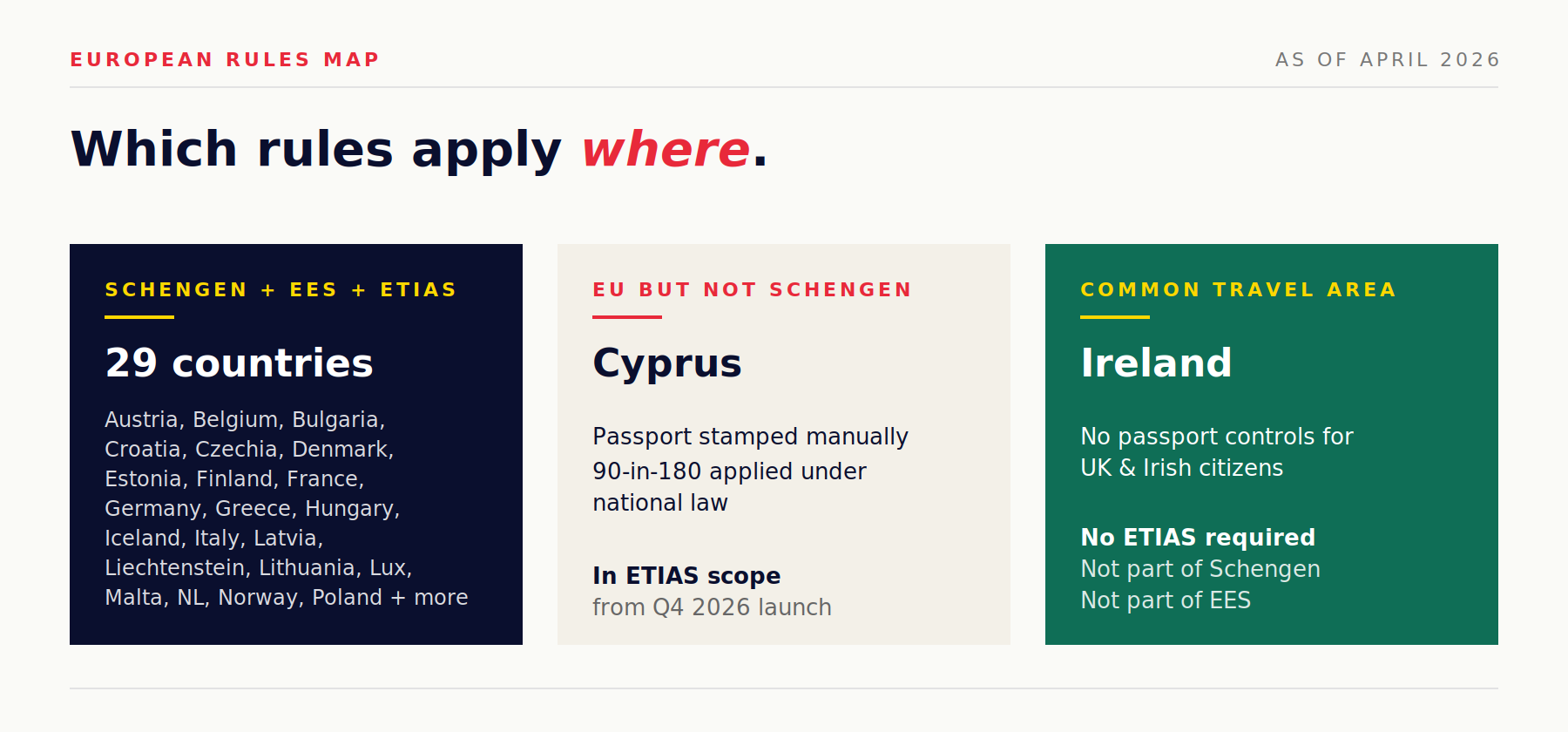
Most Schengen countries apply the uniform 90-in-180 rule and accept UK passports identically. A handful have specific nuances worth knowing.
Ireland. Not in Schengen, but part of the Common Travel Area with the UK. British and Irish citizens can travel, live, work, and study in each other's countries without immigration controls. Passports are not routinely stamped and no ETIAS is needed. Non-British, non-Irish travellers face standard Irish immigration rules.
Cyprus. EU member but not yet full Schengen. UK passports are stamped manually on entry. The 90-in-180 rule applies under Cypriot national law, assessed separately from Schengen time. Cyprus is in scope for ETIAS from launch.
Bulgaria and Romania. Joined Schengen for air and sea borders in March 2024 and for land borders in 2025. They now apply Schengen rules. Time in Bulgaria or Romania now counts towards the Schengen 90-in-180 total.
Croatia. Joined Schengen on 1 January 2023. Time in Croatia counts towards Schengen 90-in-180.
European non-EU Schengen members. Iceland, Norway, Switzerland, Liechtenstein. All four are in EES and will be in ETIAS. Time spent counts towards the same 90-in-180 Schengen budget.
Passport validity: the rule that gets most people caught
Post-Brexit, UK passports must meet two separate validity tests to enter the Schengen area. Both apply on the day of entry.
Test 1: Issued within the last 10 years. The passport must have been issued less than 10 years before the date of entry to the Schengen area. This catches travellers whose adult passport was issued in the pre-Brexit era when the Passport Office sometimes extended new passports by up to nine months if they were issued early (the old "9-month carry-over" rule). That carry-over time does not count towards validity for Schengen purposes. The 10-year clock runs from the issue date printed inside the passport.
Test 2: Valid for at least 3 months after intended departure. The expiry date printed on the passport must be at least 3 months after the day the traveller plans to leave the Schengen area. If the visit ends on 1 August, the passport must not expire before 1 November.
Both tests are checked by airline check-in staff before boarding and by border guards on arrival. A passport that fails either test leads to denied boarding, which is a matter for the airline, not the Home Office. The traveller is responsible for their own passport validity; airlines routinely reject travellers whose passports fail these tests. The UK government's "Check a passport for travel to Europe" tool at gov.uk provides a simple yes/no answer based on passport issue date, expiry date, and planned entry/exit dates.
Scenario: the 25 February 2026 carrier rules and a British-German dual citizen stranded in Düsseldorf
Hans holds dual British and German citizenship. He was born in Germany to a British father, naturalised as British through Section 4C of the British Nationality Act, and has held both passports for 14 years. On 12 March 2026 he tries to board a Lufthansa flight from Düsseldorf to Manchester for a three-day family visit. His British passport expired in October 2025; he had intended to renew it before his next trip but kept deferring. He presents only his German passport at the check-in desk.
The Lufthansa agent runs the standard pre-departure Home Office check that became mandatory for carriers on 25 February 2026 under the final ETA rollout phase. The check is described in detail at gov.uk/guidance/electronic-travel-authorisation-eta-guide-for-dual-citizens (updated 25 February 2026). The system returns: no permission to travel on this document. Hans is British, so he is ineligible for an ETA (British and Irish citizens cannot apply). But without a valid British passport or a Certificate of Entitlement (CoE) endorsement in his German passport, the carrier's system cannot verify his right of abode. He is denied boarding.
The House of Commons Library briefing CBP-10344, published on 1 April 2026, documents that this situation affected a meaningful number of British dual nationals who relied on non-British passports before the 25 February 2026 enforcement date. The Home Office's publicity campaign from October 2024 onwards had warned that "British citizens seeking to travel on a non-British passport (without a CoE) will encounter difficulties at the point of boarding." The guidance is unambiguous: dual British citizens travelling to the UK need either a valid British passport or a non-UK passport containing a Certificate of Entitlement, physical or digital.
Hans has three options. The fastest is the emergency travel document (ETD) route for British citizens abroad, applied for at the British Consulate General in Düsseldorf. ETDs are issued in urgent cases at around £100 and typically delivered within two working days. The second option is to return home to Germany, apply for a fresh British passport (three-week processing abroad as standard), and travel after it arrives. The third option, available only to people who do not currently hold any valid British passport, is to apply for a Certificate of Entitlement for endorsement in his German passport; this takes six weeks on the standard service.
One carve-out exists but does not apply to Hans. From 10 March 2026, the Home Office policy update at gov.uk/dual-citizenship confirmed that dual British citizens who first obtained status under the EU Settlement Scheme and later naturalised as British can continue to travel using their EU or EEA passport linked to their UKVI account. Hans naturalised under Section 4C, not via EUSS, so this exception does not cover him. He applies for an ETD, returns to Manchester three days later, and books a priority British passport renewal the following week.
The lesson is documentary, not legal: British citizenship is not the issue. The carrier system's ability to verify that citizenship in a recognised format before boarding is. Macfarlanes' analysis (25 February 2026) and Baker McKenzie's corporate mobility briefing (18 February 2026) both reach the same conclusion: dual British citizens who previously travelled on a non-UK passport without problems now need to carry a valid British passport or a CoE. Expired British passports no longer work under the digital check unless the carrier chooses to accept them under temporary discretionary guidance, and carriers increasingly do not.
Can British citizens still live and work in the EU?
Living and working in an EU country no longer happens automatically for British nationals. Each member state operates its own work and residence permit system for third-country nationals, with its own eligibility criteria, salary thresholds, and documentation.
Common routes for UK nationals relocating to EU countries include:
EU Blue Card. For highly qualified workers with a degree and a job offer paying at least 1.5 times the average national salary in the host country. Valid across most EU states, with some intra-EU mobility rights after 12 to 18 months. Rules harmonised under the 2024 revised Blue Card Directive.
National skilled worker routes. Germany's Opportunity Card (Chancenkarte), the Netherlands' Highly Skilled Migrant route, Spain's Highly Qualified Professional visa, and similar national programmes in most larger EU economies.
Digital nomad visas. Portugal, Spain, Greece, Italy, Estonia, Croatia, and several others now offer remote-worker visas with minimum income requirements typically between €2,500 and €4,500 per month.
Passive income and retirement routes. Portugal D7, Spain NLV, Italy Elective Residence, France VLS-TS Visiteur, Greece Financially Independent Person.
Family reunification. Spouses, civil partners, and dependent children of EU citizens or settled third-country nationals can apply under each country's family reunification rules.
Practical checklist: before you travel in 2026
- Check passport validity against both the 10-year issue-date rule and the 3-months-beyond-departure rule at gov.uk.
- Calculate your 90-in-180 position using the Schengen calculator if you have travelled to Europe in the last six months.
- Factor extra time at the border for EES biometric registration on first entry, particularly at Dover, Folkestone, and St Pancras.
- Check ETIAS status close to travel date. If it has launched, apply at least 72 hours in advance on travel-europe.europa.eu.
- Arrange travel insurance including medical cover. The EU-wide EHIC/GHIC still provides basic reciprocal healthcare for UK citizens but does not replace comprehensive travel cover.
- Driving? Keep a photocard UK driving licence, V5C log book or a VE103 vehicle-on-hire certificate, and consider an International Driving Permit (IDP) for countries that require one (most Schengen countries accept UK licences without an IDP for short visits).
- If staying more than 90 days, research and apply for a national long-stay visa well in advance: most take six to twelve weeks to process.
WHAT TO DO NEXT If travelling before ETIAS launches: no advance authorisation needed. Just arrive at the border with a valid passport. Expect EES biometric registration on first entry. If travelling after ETIAS launches: apply online at travel-europe.europa.eu at least 72 hours before departure. Fee €20. Use only the official EU site. If planning to stay more than 90 days: apply for a national long-stay visa from the relevant country's consulate. Spain NLV, France VLS-TS, Portugal D7, Italy Elective Residence are all suitable for non-working stays. |
This article is for informational purposes only and does not constitute financial advice. Always verify rates with official sources before making any financial decision.
Frequently asked questions
Can British citizens still travel to the EU without a visa in 2026?
Yes, for short stays of up to 90 days in any rolling 180-day period in the Schengen area. No visa is required for tourism, family visits, business meetings, or short-term activities. Once ETIAS launches, UK travellers will need a €20 travel authorisation before departure. The launch was originally expected in Q4 2026, though media reports in July 2026 suggest it may slip into 2027; no official change has been confirmed by the European Commission.
How long can I stay in the Schengen area as a UK passport holder?
Up to 90 days in any 180-day rolling window. The window is calculated day by day: on any date, border guards look back 180 days and count Schengen days. If the total exceeds 90, entry is refused. The 90 days covers the entire Schengen area combined, not per country.
Do I need an ETIAS to visit France, Spain, or Italy in 2026?
Not yet. ETIAS was originally expected to launch in Q4 2026, though media reports in July 2026 suggest the launch may be pushed into 2027; the European Commission had not confirmed a revised date at the time of this update. As of 23 April 2026, no valid ETIAS can be issued, and none can be issued before an official launch. When the system goes live, UK passport holders will need an ETIAS for travel to 30 European countries including France, Spain, and Italy. Check travel-europe.europa.eu closer to your travel date for the confirmed launch window.
What is EES and what do I need to do?
The Entry/Exit System is the EU's biometric border system. It started on 12 October 2025 and became fully operational on 10 April 2026. On first entry after 12 October 2025, you register fingerprints and a photograph at the border. No advance application, no fee. Allow extra time at the border for first registration.
How long must my UK passport be valid for EU travel?
Two tests apply. Your passport must have been issued within the last 10 years from the date you enter the Schengen area, and it must be valid for at least 3 months after you plan to leave. Old passport extensions (the pre-2018 9-month carry-over) do not count. Check at gov.uk with the passport validity tool.
Do I need ETIAS to travel to Ireland?
No. Ireland is not in Schengen and not part of ETIAS. British citizens travelling to Ireland are covered by the Common Travel Area, which means no passport or immigration controls for UK and Irish citizens. Non-British, non-Irish travellers face standard Irish immigration rules.
What happens if I overstay the 90 days in the Schengen area?
Overstays are recorded in EES from October 2025 onwards. Minor overstays typically result in a fine and a warning; longer overstays can lead to entry bans of 1 to 5 years across the whole Schengen area. Future visa or ETIAS applications become harder. Never knowingly overstay: apply for a long-stay national visa if more time is needed.
Can I use my EHIC or GHIC card in the EU?
Yes. The UK Global Health Insurance Card (GHIC) and remaining EHICs issued to UK nationals continue to provide state-provided healthcare on the same basis as local residents in EU countries and Switzerland, Norway, Iceland, and Liechtenstein. Apply free at nhs.uk/using-the-nhs/healthcare-abroad. It does not replace comprehensive travel insurance.
Sources and verification
All rules, dates, and fees reflect the status as of 23 April 2026, with the ETIAS timeline reviewed again on 15 July 2026.


