

Moving to Bulgaria from the UK in 2026 is substantially easier than before. Bulgaria joined the Schengen Area in January 2025 (air and sea borders; full land border integration completed later in 2025), adopted the euro in January 2026 replacing the lev at a fixed rate, and formally launched a Digital Nomad Visa on 20 December 2025. The flat 10% personal income tax - one of the lowest in the EU - remains Bulgaria's biggest attraction for UK movers. Combined with 2026 UK tax reforms that abolished non-dom status for residents, Bulgaria has become a genuinely competitive alternative for UK retirees and remote workers. This guide covers the Type D visa, the new Digital Nomad Visa, post-arrival registrations, tax residency, NHIF healthcare, and the path to permanent residence.
| ★ EDITOR'S VERDICT Bulgaria is the stealth winner for UK movers in 2026. |
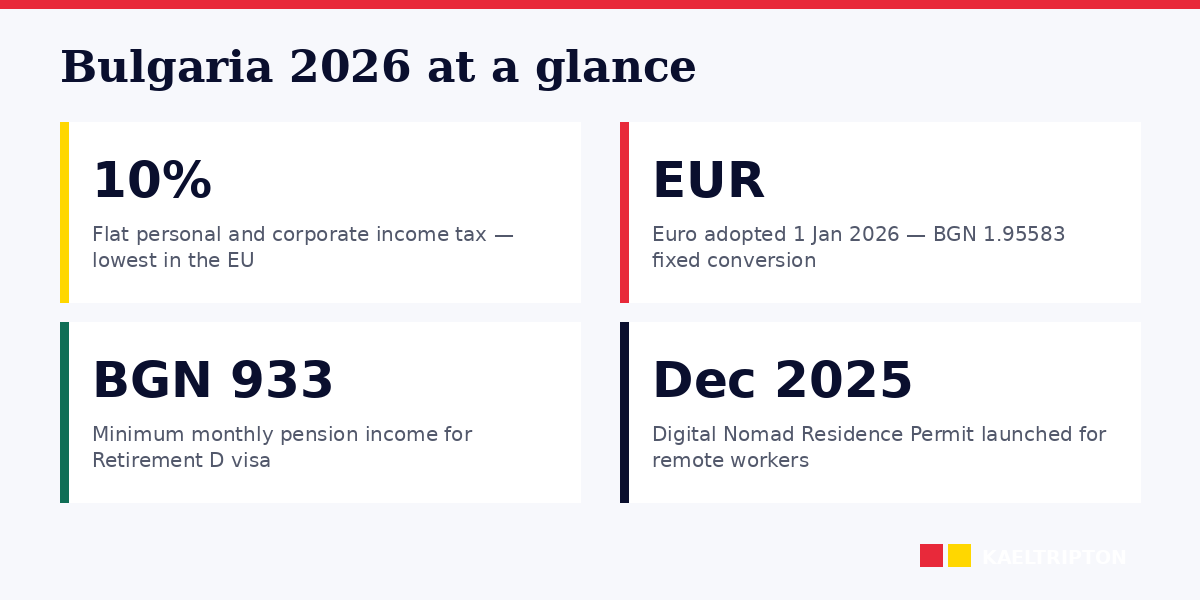
Three 2026 shifts changed Bulgaria's positioning: Schengen integration (air/sea 2024, ground 2025), euro adoption 1 January 2026, and the launch of a Digital Nomad Visa in December 2025. Combined with the 10% flat personal and corporate income tax - among the lowest in the EU - Bulgaria is the cleanest tax alternative for UK residents exiting non-dom or the UK tax system generally. Retirement D visa requires only BGN 933/month pension income (approximately £410). Path to permanent residence in 5 years, no inheritance tax, and exceptional cost of living compared to UK or Western Europe. |
What changed in 2026
- Euro adoption - 1 January 2026. Bulgaria replaced the lev (BGN) with the euro at the fixed conversion rate BGN 1.95583 = EUR 1. Prices are displayed in both currencies during 2026 transition; all banking, salaries, and government fees are now in euro.
- Schengen Area membership - January 2025 (air/sea); ground border phased 2025-2026. UK citizens entering Bulgaria no longer face passport checks from other Schengen countries on arrival. Bulgarian residence cards now provide Schengen travel rights.
- Digital Nomad Visa - launched 20 December 2025. Bulgaria's first formal digital nomad residence permit for remote workers earning from foreign employers or clients. Valid 12 months, renewable once. Non-EU/EEA nationals only.
- UK non-dom abolition (6 April 2025) - UK abolished the remittance basis tax regime, replacing it with a narrower 4-year foreign income and gains (FIG) exemption for new UK residents. UK residents with foreign income now face full UK tax after the initial window. Bulgaria's flat 10% tax is a cleaner alternative for UK residents planning to exit the UK tax system.
These changes collectively make Bulgaria the most UK-friendly EU destination it has been since Brexit. Schengen membership removes border friction; euro adoption removes currency mismatch; Digital Nomad Visa creates a clean remote worker route; and the tax environment remains dramatically lower than the UK.
Visa routes for UK citizens
UK citizens are third-country nationals for Bulgarian immigration purposes. Short visits up to 90 days in any 180-day Schengen period need no visa. Longer stays require a Type D (long-stay) visa followed by a residence permit. Main routes:
- Type D + Retirement residence permit - for UK pensioners with state or private pension income of at least BGN 933/month (approximately EUR 477, roughly £410). Healthcare access via NHIF. Valid 1 year initially, renewable annually. Path to permanent residence after 5 years.
- Type D + Digital Nomad residence permit - new from December 2025. For remote workers employed by non-Bulgarian employers or freelancers with non-Bulgarian clients only. Minimum income thresholds set by Ministry of Interior regulation; confirm current figures before applying. Valid 12 months, one renewal for total 24 months.
- Type D + Business permit - for UK nationals establishing a trade representative office, founding a Bulgarian company (with job creation requirement of 10 jobs for Bulgarian citizens under investor category), or investing in Bulgarian real estate.
- Type D + Self-employed permit - for UK freelancers with Bulgarian economic activity.
- Type D + Family reunification - for spouses and dependants of Bulgarian residents.
- Type D + Employment permit - for UK nationals with a Bulgarian employer sponsorship and Single Permit issued via the Employment Agency.
- Bulgarian Golden Visa (permanent residence by investment) - EUR 512,000 investment in a Bulgarian Alternative Investment Fund (AIF) or Exchange-Traded Fund (ETF). Direct permanent residence without physical presence requirement during the application phase.
- Withdrawal Agreement residents - UK nationals lawfully resident in Bulgaria before 31 December 2020 have rights under the Withdrawal Agreement. Residence document must be current; no new visa needed for this group.
The application sequence
Before travel
- Choose your route (Retirement / Digital Nomad / Business / Employment) and prepare the documentation pack
- Apply for Type D visa at the Bulgarian Consulate in London. Documents typically required: passport valid at least 18 months, completed visa form, two photographs, proof of accommodation in Bulgaria (rental contract or property deed), UK ACRO criminal record check with apostille, proof of income meeting the route's threshold, health insurance covering Bulgaria for EUR 30,000 minimum
- Visa fee typically around EUR 100
- Processing 2-4 weeks
On arrival
- Apply at the Migration Directorate within 14 days of arrival for your 12-month temporary residence permit (the Type D visa is the entry document; the residence permit is the permission to stay).
- Bulgarian bank account - required for the application. Open via Paysera (works through EuroBank Bulgaria AD, serving Bulgarian IBANs) remotely, or in-branch at UniCredit Bulbank, DSK, or Fibank on arrival.
- EGN (personal identification number) issued upon residence permit approval. Required for employment, tax filing, healthcare registration.
- Register with NHIF for public healthcare once you have EGN and residence permit. Monthly contribution approximately BGN 45-55 (about EUR 25-30) for voluntary registration, or automatically deducted from payroll for employees.
- Bulstat registration if becoming self-employed; VAT registration if turnover exceeds the registration threshold.
Bulgarian tax residency and the 10% flat tax
Bulgarian tax residency begins when you stay in Bulgaria more than 183 days in any 12-month period, or when your centre of vital interests moves to Bulgaria. Once resident, worldwide income is taxable in Bulgaria - but at Bulgaria's distinctively low flat 10% personal income tax rate.
This is the core attraction for UK movers:
- Personal income tax: flat 10% on worldwide income (employment, self-employment, dividends, interest)
- Corporate income tax: flat 10% - among the lowest in the EU
- Social contributions: 24.8-32.7% total split between employer and employee (employees typically pay 13.78%; self-employed pay the full amount)
- VAT: 20% standard rate
- No net wealth tax
- Inheritance tax: close family exempt; other heirs 0.4-0.8% municipal rate
The UK-Bulgaria double taxation treaty (2015, in force 15 December 2015, modified by the Multilateral Instrument) allocates taxing rights. Business profits are taxed only in the country of residence. Pensions: private pensions and the UK State Pension are taxable in Bulgaria for Bulgarian residents. UK government service pensions remain UK-taxable. Interest and royalties: 5% cap. Bulgaria credits any UK tax paid under the treaty.
A UK retiree with £45,000/year in private pension + UK State Pension + £15,000 in dividends, tax-resident in Bulgaria, pays approximately 10% Bulgarian income tax = £6,000. The equivalent UK tax bill would be roughly £13,500-£14,000. Annual saving after 12 months of residence: approximately £7,500-£8,000. Over 5 years, £37,500-£40,000 - before considering lower living costs.
Annual tax returns are due by 30 April (electronic) for residents. The National Revenue Agency (NRA) online portal handles filing.
NHIF healthcare
Bulgaria's universal healthcare is managed by the National Health Insurance Fund (NZOK / NHIF). Once registered, residents access:
- GP appointments (general practitioner)
- Specialist consultations via referral
- Hospital treatment
- Prescription medications with partial reimbursement
- Dental care with partial coverage (mostly basic services)
Public healthcare has known limitations - outdated facilities in some hospitals, limited funding, staff shortages particularly outside Sofia, Varna, and Plovdiv. Many UK residents use private health insurance alongside NHIF for access to international-standard clinics with English-speaking staff. Typical private insurance premiums EUR 300-800/year per person depending on age and coverage level.
UK state pensioners qualify for S1 form healthcare - UK funds their Bulgarian NHIF coverage. Apply through NHS Overseas Healthcare Services before leaving. The S1 transfer has been operational between UK and Bulgaria since Brexit.
Cost of living: Bulgaria delivers exceptional value
Bulgaria remains one of the cheapest EU countries to live in, particularly outside Sofia. 2026 monthly estimates for a single person:
- Sofia one-bedroom rental central: EUR 600-900 (£525-790)
- Plovdiv / Varna one-bedroom: EUR 350-550 (£305-480)
- Smaller towns (Veliko Tarnovo, Burgas): EUR 250-450 (£220-395)
- Groceries single person: EUR 300-450 (£260-395)
- Utilities (electricity, water, heating, internet): EUR 100-180 (£90-160) per month - higher in winter
- Public transport Sofia monthly pass: EUR 28 (£25)
- Eating out mid-range: EUR 12-20 per person (£10-18)
A UK retiree with £35,000/year pension income has approximately £2,915/month (EUR 3,350/month). Bulgarian living costs for a modest but comfortable lifestyle are EUR 1,400-2,000/month in Sofia or EUR 1,100-1,600/month in a smaller town. The gap translates to EUR 1,350-2,250/month of disposable income above essential costs - triple or quadruple the equivalent UK disposable income.
Permanent residence and citizenship
Bulgarian permanent residence is available after 5 years of continuous legal residence on qualifying temporary permits. Requirements:
- 5 years of temporary residence without significant interruptions
- Stable income sufficient to support yourself and dependants
- Adequate accommodation
- Health insurance
- No serious criminal record
- Bulgarian language examination at basic level
Bulgarian citizenship typically requires 5 years of permanent residence (total 10+ years from initial move) and more demanding Bulgarian language and Bulgarian history / constitutional knowledge. Bulgarian citizenship is generally allowed with UK dual citizenship, though specific cases may require renunciation. Confirm with a Bulgarian immigration lawyer for your specific circumstances.
A real 2026 scenario: retired UK couple move to Varna
A retired UK couple (both 64), combined pension income £62,000/year (£45k teacher's pension + £17k state pensions), move to Varna on the Bulgarian Black Sea coast in June 2026.
March 2026. Visit Varna for a week, find a 2-bed apartment at EUR 450/month long-term rental. Sign 12-month lease through Bulgarian letting agent. Open Paysera account remotely with Bulgarian IBAN.
April 2026. Apply for Retirement D visa at Bulgarian Consulate in London. Documents: passports, pension letters showing £62k/year combined income (well above the retirement threshold), ACRO criminal record, private health insurance covering Bulgaria for EUR 30,000, Paysera bank statements, rental agreement.
May 2026. Both visas approved. Book flights to Varna for June.
June 2026. Fly to Varna. Within 12 days of arrival attend the Varna Migration Directorate to apply for 12-month residence permits. Pay EUR 250 combined fee. Issued EGN (personal ID numbers). Register with NHIF via their EGNs - voluntary contribution arranged. Register address with the local municipality.
July 2026. S1 forms arrive from NHS Overseas Healthcare Services; submit to NHIF to convert voluntary contributions to UK-funded status.
Tax year 2026. As Bulgarian tax residents, they declare worldwide income in Bulgaria. UK pensions taxable in Bulgaria at 10% flat = approximately EUR 6,250 per year on combined income. Comparable UK tax bill would have been approximately £14,500 (EUR 16,640). Annual tax saving: approximately EUR 10,390 (£9,100).
Total first-year admin costs: Type D visas EUR 200, residence permits EUR 250, apostilles and translations £300, initial private health insurance £900, rental deposit EUR 900, flights £560. Total approximately £3,250 in one-off spend. Annual tax savings alone cover this within 4 months.
Frequently asked questions
Did Bulgaria really adopt the euro in 2026?
Yes. Bulgaria formally adopted the euro on 1 January 2026. The Bulgarian lev was replaced at the fixed conversion rate of BGN 1.95583 to EUR 1. Prices are displayed in both currencies during 2026 transition but all banking, salaries, and government fees are now euro. Bulgarian residents received euro currency at their existing lev account values automatically.
Is Bulgaria in Schengen yet?
Yes. Bulgaria joined the Schengen Area for air and sea borders on 31 March 2024, with full integration including land borders completed on 1 January 2025. UK residents with Bulgarian residence cards gain visa-free Schengen travel for up to 90 days in any 180-day period.
Can UK citizens use the Digital Nomad Visa?
Yes. UK citizens qualify as non-EU/EEA nationals for the Bulgarian Digital Nomad Residence Permit (launched 20 December 2025). Key requirements: working for a non-Bulgarian employer or freelancing with non-Bulgarian clients only, income meeting the ministerial threshold, valid private health insurance for 12 months, and Bulgarian accommodation. Work for Bulgarian clients is not permitted under this permit.
How much is the 10% flat tax?
Exactly 10% on worldwide income for Bulgarian tax residents. There is no progression, no higher rate, no wealth tax, and minimal exemptions on top of the flat rate. Social security contributions are separate (24.8-32.7% split between employer and employee). UK pensions, dividends, and interest all taxed at 10% in Bulgaria under the 2015 UK-BG double tax treaty.
What about the impact of UK non-dom abolition?
Significant. The UK abolished the remittance basis of taxation from 6 April 2025, replacing it with a narrow 4-year foreign income and gains (FIG) exemption for new arrivals. UK residents with significant foreign income now face full UK tax after the 4-year window. For UK movers seeking to exit the UK tax system, becoming a Bulgarian tax resident at Bulgaria's 10% flat rate is one of the cleanest cross-border strategies available in 2026.
Is Sofia or the coast better for retirement?
Depends on lifestyle. Sofia offers more amenities, larger expat community, better international schools and medical facilities, but higher costs. The Black Sea coast (Varna, Burgas) offers substantially lower costs, milder climate, and established UK retiree communities, particularly in coastal villages around Burgas. Most UK retirees find the coast gives them more lifestyle for the same budget; Sofia suits those wanting urban convenience or with younger family needs.
Can I bring my UK car to Bulgaria?
Yes. Under transfer-of-residence rules, vehicles you've owned for 12+ months can be imported without VAT and customs duty if you're moving permanently to Bulgaria. Re-register with Bulgarian plates within 30 days of residence permit issue. Import excise and annual vehicle tax apply; costs depend on vehicle age, engine size, and emissions. Many UK movers find selling the UK car and buying locally simpler than importing.
Sources
- Bulgarian Ministry of Interior, Type D visa categories and residence permit procedures 2026
- Bulgarian National Revenue Agency (NRA), Personal and corporate income tax 2026
- GOV.UK, Foreign travel advice - Bulgaria and Living in Bulgaria
- Bulgarian Law on Foreigners in the Republic of Bulgaria - amended 2025 to include Digital Nomad category
- NHIF (National Health Insurance Fund), Registration and contribution rates 2026
- NHS Business Services Authority, S1 certificates for UK pensioners moving to the EU
- UK-Bulgaria Double Taxation Convention (2015, in force 15 December 2015)
- European Commission, Bulgaria euro adoption - January 2026 conversion rate


