

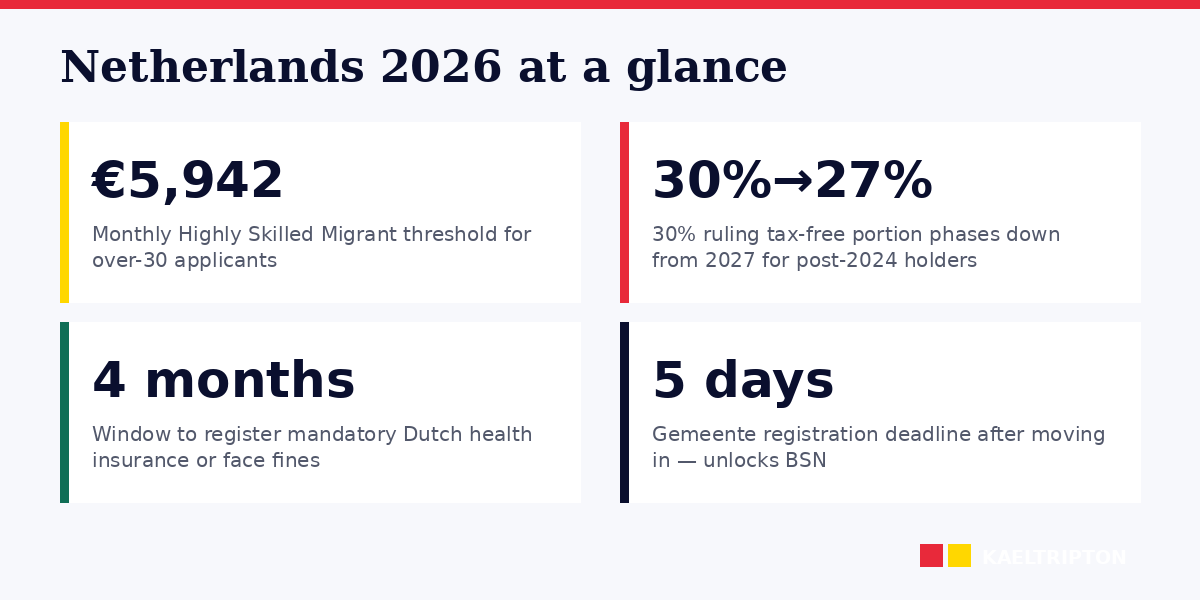
Moving to the Netherlands from the UK in 2026 means a residence permit for any stay over 90 days. The Highly Skilled Migrant (kennismigrant) route is the main path for UK professionals - 2026 monthly salary thresholds are €5,942 for over-30s and €4,357 for under-30s, with lower thresholds for recent graduates. The 30% ruling (now phasing to 27% from 2027) can cut tax on qualifying salaries significantly. The honest catch is housing: Amsterdam, Utrecht and The Hague all have severe shortages and rental prices to match. This guide covers visas, BSN registration, the 30% ruling, mandatory health insurance, and the tax rules that apply once resident.
| ★ EDITOR'S VERDICT Kennismigrant + 30% ruling is the UK professional's route. |
The Netherlands is the most financially attractive destination for salaried UK professionals earning €69,000+ because of the 30% ruling - even with the 27% phase-down from 2027 for post-2024 holders, the tax saving is substantial versus comparable UK or German packages. UK citizens cannot use the DAFT visa (US-only) so ignore any relocation guide suggesting €4,500 deposits. The real obstacle is housing: Amsterdam and Utrecht rental markets are tight in 2026 and budget at least €2,000/month for a one-bed in central districts. Sort accommodation before the job start date. |
Who needs what visa
UK nationals are non-EU citizens in Dutch immigration terms. Short visits up to 90 days in a rolling 180-day Schengen period need no visa. For longer stays, the route depends on your purpose:
- Highly Skilled Migrant permit (kennismigrant) - the dominant route for UK white-collar workers. Employer must be an IND-recognised sponsor. 2026 thresholds: €5,942/month gross (excluding 8% holiday pay) for applicants 30 and over; €4,357/month for those under 30; €2,989/month for recent master's or PhD graduates within 3 years of completing in the Netherlands. Processing typically 2-4 weeks once the sponsor files.
- EU Blue Card - parallel route for highly qualified workers. 2026 threshold €5,688/month. Similar benefits to kennismigrant but portable to other EU countries after 18 months.
- Self-employed residence permit - for freelancers and entrepreneurs without a DAFT-equivalent treaty. Points-based assessment on business plan, added value to the Dutch economy, education, experience. More demanding than the US DAFT route.
- Orientation Year (zoekjaar) - graduates of Dutch universities or top-200 global institutions can stay for 12 months after graduation to search for qualifying employment. Cannot be used by applicants who haven't recently studied.
- Family reunification - spouse, registered partner or dependent children of a Dutch resident. Income requirement on the sponsor (roughly €1,985/month for couples in 2026).
UK citizens are exempt from the MVV (provisional residence permit) requirement that applies to most non-EU nationalities. This means you can travel to the Netherlands and apply for your residence permit locally, rather than having to apply at the Dutch Consulate in London first.
The DAFT myth for UK citizens
The Dutch-American Friendship Treaty (DAFT) visa - €4,500 capital deposit route for self-employed entry - is a common reference in Netherlands relocation content. UK citizens cannot use DAFT. It is a bilateral US-Netherlands treaty signed in 1956. UK freelancers must use the standard self-employed residence permit, which is a substantially more involved application (business plan, points assessment, evidence of Dutch-economy benefit) than the near-automatic DAFT route Americans use.
This catches many UK relocation guides out. If you are reading advice suggesting a €4,500 capital deposit for UK freelancers, it is wrong.
The 30% ruling in 2026
The 30% ruling (30%-regeling) is a Dutch tax benefit that allows qualifying employees recruited from abroad to receive up to 30% of their gross salary tax-free for up to 5 years. It is the main financial incentive that attracts high-salary UK professionals to Dutch roles.
Eligibility in 2026:
- You must have been recruited from abroad or transferred within a multinational
- You must have lived more than 150km from the Dutch border for at least 16 of the 24 months before your new start date
- Minimum gross salary of €69,000 per year (or €52,531 for applicants with a master's degree under 30)
- Specific expertise scarce or absent in the Dutch labour market (automatically met if salary threshold is met)
- Application filed with the Belastingdienst within 4 months of starting work to get backdated coverage to day 1
The phase-down: from 2024 onwards the ruling was legislated to reduce over time. From 2027, holders who started the ruling from 1 January 2024 onwards will see the tax-free portion reduce from 30% to 27%. Existing holders from pre-2024 periods retain the full 30% for their remaining 5-year window.
For a UK professional earning €85,000 in 2026 with the 30% ruling, the effective Dutch tax reduction versus standard rates is typically €12,000-€17,000 per year depending on the specific tax position. This is the single biggest factor making Netherlands relocation financially attractive versus France or Germany at comparable gross salaries.
The post-arrival sequence
After arrival, four critical steps in order:
1. Register at the municipality (gemeente) and get a BSN
Book an appointment at your local gemeente within 5 days of moving into a Dutch address. Required documents: passport, IND letter (if your kennismigrant permit was pre-approved), signed lease agreement, birth certificate with apostille. At the appointment you are registered in the Basisregistratie Personen (BRP) and allocated a BSN (Burgerservicenummer) - the Dutch equivalent of a National Insurance number. BSN arrives by post 2-5 working days later in smaller municipalities; immediately in some major cities.
The BSN is the foundation for everything: bank account, employment contract, tax, health insurance, rental contracts, mobile phone contracts.
2. Set up DigiD
DigiD is the Netherlands' central digital identity system used to log in to virtually every government service. Apply at digid.nl with your BSN; activation code arrives by post within 3-5 working days. Essential for filing your tax return, accessing Mijn Belastingdienst, healthcare portals, municipal services.
3. Register for Dutch health insurance
Dutch health insurance is legally mandatory for every resident. You have 4 months from the date your residence permit is issued to register, or you trigger fines starting at €500 plus backdated premiums. Basic cover costs €130-€170 per month in 2026. Every provider offers the same statutory minimum (Basispakket); competition is on premium-level top-ups, waiting times, and customer service. Comparison sites (Independer, Zorgwijzer) show all providers side by side.
UK state pensioners moving under an S1 form have their Dutch healthcare funded by the UK, with registration handled at CAK after BSN issue.
4. Open a Dutch bank account
Required for salary payment, rent direct debit, utilities. Major banks ING, ABN AMRO and Rabobank all handle expat accounts. Digital-first options include Bunq and Revolut (which now issue Dutch IBANs). All need your BSN, passport, proof of address and, for traditional banks, an in-branch appointment. Online-only providers open accounts within 1-2 days; traditional banks 1-3 weeks.
Tax: residency, progressive rates and Box 3
You become Dutch tax-resident from the date you register in the BRP. From that date all worldwide income is reportable, subject to the UK-Netherlands double taxation agreement.
Dutch income tax is organised into three "boxes":
- Box 1 - employment income, self-employment, pensions. Progressive rates in 2026: 36.97% on income up to €75,624, 49.50% above that.
- Box 2 - income from substantial shareholdings (5%+ in a company). Flat 33% in 2026.
- Box 3 - savings and investments. Tax on deemed yield from wealth, currently being redesigned following a 2021 Supreme Court ruling. Interim rules in 2026 tax a notional return based on actual asset mix at 36%.
UK ISAs and pension investments are not recognised as tax-advantaged in the Netherlands. UK rental income on property retained there remains primarily UK-taxable. UK state pensions are taxable in the Netherlands for Dutch residents. UK government service pensions remain taxable in the UK.
The Dutch tax year is the calendar year. First partial-year return due by 1 May of the following year (with extensions through a tax adviser).
Housing: the single biggest obstacle
The Netherlands is running a severe housing shortage in 2026. Amsterdam, Utrecht, The Hague, Rotterdam and Eindhoven all have rental markets where one-bedroom apartments under €1,800/month are rare and apply-on-viewing competition is standard. Typical deposits are 1-2 months' rent.
Three practical tips that matter more than any other advice:
- Start your housing search before your arrival date. Realtors will show places remotely via video tours.
- Budget €1,200-€2,500/month for a one-bedroom in the major cities; €800-€1,400 in smaller cities like Groningen or Maastricht.
- Avoid short-term furnished rentals advertised on international expat sites - they're often 2-3x the market rate and you cannot use them for Anmeldung-equivalent BSN registration if the landlord won't co-sign.
Real estate website Funda is the industry standard for both rentals and purchases. For rentals specifically, Pararius and Kamer.nl also aggregate listings.
A real 2026 scenario: product manager from London to Amsterdam
A product manager from London joins a fintech scale-up in Amsterdam on €92,000 base salary plus bonus. Company is an IND recognised sponsor.
March 2026. Signs contract. Employer's HR files the kennismigrant application with IND. Approval in 8 working days.
April 2026. Flies to Amsterdam with UK passport. Picks up residence permit sticker at Schiphol IND desk (same-day service for pre-approved kennismigrant). Checks into a 14-day serviced apartment while house-hunting. Books gemeente appointment for 2 weeks out.
Late April 2026. Secures a 1-bedroom rental in De Pijp at €2,100/month. Signs the lease and completes gemeente registration the following week. BSN arrives by post 3 working days later.
May 2026. Starts work. Employer files 30% ruling application on day 1. Approved 4 weeks later, backdated to first day. Registers with a health insurer (CZ) via his BSN - Basispakket plus supplementary cover at €160/month total. Opens an ING bank account.
January 2027. First full Dutch tax return due 1 May 2027. His Belastingdienst account shows kennismigrant income with 30% exempt, plus remaining employment income taxed in Box 1. He engages a Dutch-English tax adviser (€700) for the first return to handle UK-Netherlands double taxation treatment on the interim Jan-Apr 2026 income.
Annual tax saving via 30% ruling: approximately €14,000 compared to standard rates - a decisive financial factor versus the equivalent London role.
Frequently asked questions
Can UK citizens use the DAFT visa?
No. DAFT is a US-Netherlands treaty only. UK freelancers and entrepreneurs must use the standard self-employed residence permit, which has a points-based assessment rather than the €4,500 capital deposit route Americans use.
How does the 30% ruling phase-down work?
From 1 January 2027, holders who started the 30% ruling from 1 January 2024 onwards see the tax-free portion reduce from 30% to 27%. Existing 30% ruling holders before 2024 retain their original 30% through their remaining 5-year window. New applicants in 2026 go onto the 27% path from 2027.
Do I need an MVV entry visa before travelling?
No, UK citizens are MVV-exempt. You can travel to the Netherlands on your UK passport and complete the residence permit process after arrival, provided the kennismigrant application has been pre-approved by the IND.
What counts as qualifying sponsor status?
Employers must be IND-recognised sponsors to hire kennismigrant workers. Most multinationals and established Dutch scale-ups hold this status. Smaller companies can apply (€2,539 for fewer than 50 employees, €5,080 for larger) but adds 6-8 weeks to the hiring timeline. Always confirm sponsor status before signing a contract.
Is housing as tight as reported?
Yes. Amsterdam and Utrecht specifically have year-long waiting lists for middle-income rental properties. Budget €2,000-€2,500/month for a one-bedroom in central districts. Smaller cities are easier and often 30-40% cheaper - Rotterdam, The Hague, Eindhoven and Groningen are reasonable alternatives depending on your work location.
Can I convert my UK licence to a Dutch one?
Yes. UK photocard holders who are kennismigrant or 30% ruling beneficiaries can exchange their UK licence for a Dutch licence (rijbewijs) without a driving test within 185 days of BSN registration. Standard non-qualifying UK licence holders can drive for 185 days then must pass the Dutch theory and practical tests.
What are the tax implications of owning a UK property while Dutch-resident?
UK rental income remains primarily UK-taxable under the double-taxation treaty, but must be declared on your Dutch return with a foreign tax credit applied. UK property is not included in Box 3 wealth tax if it is let commercially. UK pensions received from private schemes are taxable in the Netherlands; UK state pensions are taxable in the Netherlands; UK government service pensions remain taxable in the UK.
Sources
- Immigration and Naturalisation Service (IND), Highly Skilled Migrant salary thresholds 2026 - ind.nl
- Belastingdienst, 30% facility (30%-regeling) 2026 rules
- Rijksoverheid.nl, Moving to the Netherlands - visa and residence permit guidance
- GOV.UK, Foreign travel advice - Netherlands and Living in the Netherlands
- Vreemdelingenwet 2000 (Aliens Act) and Vreemdelingenbesluit (implementing regulations)
- CAK (Dutch health insurance regulator), S1 forms for UK pensioners
- HMRC, Double Taxation Convention with the Netherlands
- Zorgverzekeringswet (Health Insurance Act) - obligation and registration window


