

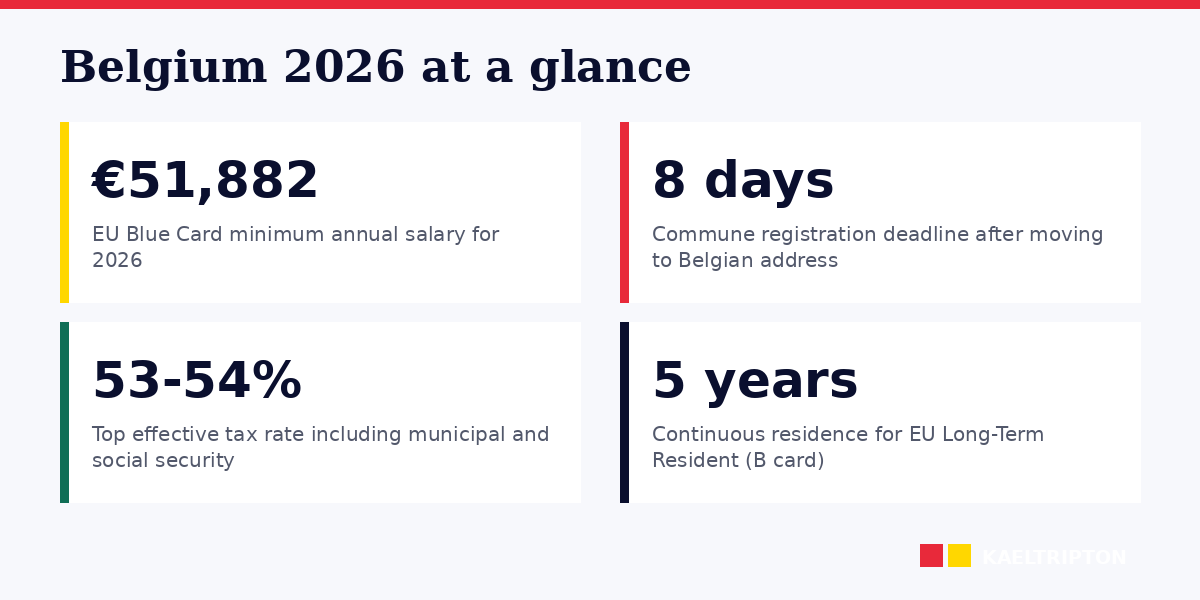
Moving to Belgium from the UK in 2026 needs a long-stay D visa for any stay over 90 days. The EU Blue Card at €51,882 annual salary is the main route for qualified professionals; self-employment permits (the professional card) need a business plan and economic-benefit assessment. After arrival you must register at your local commune within 8 days and join a mutualité (public health insurance fund) within a similar short window. Belgium has high taxes, but Brussels hosts NATO, the European Commission, the Council of the EU, and hundreds of associated organisations - UK professionals in EU policy, international trade, and diplomatic support work find it the natural destination. This guide covers visas, commune registration, health insurance, tax residency, and the path to long-term residence.
| ★ EDITOR'S VERDICT Brussels for the EU policy career, with high tax as the price. |
Belgium is where you move for EU-focused work - NATO, European Commission, Council of the EU, hundreds of associated organisations. EU Blue Card at €51,882 is the main route and the path to 5-year permanent residence is clear. The 8-day commune registration rule is strict and triggers the residence check that can delay everything. Tax is high - effective 53-54% at the top - but the career opportunity in international policy is the offset. Most UK movers to Belgium are there for the work, not the tax. |
The visa routes UK citizens actually use
Since 1 January 2021 UK nationals are third-country nationals under Belgian immigration law. Short visits up to 90 days in a 180-day Schengen period need no visa. Longer stays require a D visa, which Belgium calls the long-stay visa. Five routes cover almost all UK movers:
- EU Blue Card - for non-EU professionals with a job offer, a higher education qualification, and a contract of at least one year meeting the salary threshold. 2026 minimum: €51,882 gross annual salary. Processing typically 60-90 days. Pathway to permanent residence after 5 years; portable to other EU countries after 18 months.
- Single Permit (standard work permit) - combined work and residence permit for employed workers who don't qualify for Blue Card. The employer applies through the regional authorities (Brussels-Capital, Flanders, or Wallonia - the process differs slightly by region). Processing 3-6 months.
- Professional Card (Carte Professionnelle) - for self-employed workers and entrepreneurs. Region-specific. Requires a business plan and economic-benefit assessment. Typically 4-6 months processing. The Belgian equivalent of the German Freiberufler permit.
- Long-stay visitor visa - for retirees and financially independent movers. Proof of stable passive income, accommodation, and health insurance. Does not permit employment.
- Family reunification - for spouses and dependents of Belgian residents.
Belgium also runs a Limosa system - a pre-registration requirement for short-term posted workers from EU/EEA countries. UK nationals on long-stay permits do not need Limosa declarations, but short-term UK contractors working in Belgium for less than 12 months may.
The application sequence
Before you travel
- Apply for the long-stay D visa at the Belgian Embassy in London or the VFS Global Belgium Visa Application Centre. Book 4-8 weeks in advance. Submission is usually in person for biometrics.
- Documents: passport valid for at least 5 years, employment contract or business plan, proof of accommodation in Belgium (rental contract or property deed), UK ACRO criminal record check, health insurance valid in Belgium, apostilled birth certificate, proof of financial resources.
- Visa fee: approximately €180 for Blue Card, €180-€250 for other D visas.
- Processing: typically 60-90 days. The Belgian consulate forwards applications to the Immigration Office in Brussels for decision.
On arrival: the 8-day commune registration
Within 8 days of arriving at your Belgian address, you must register at your local commune (or gemeente in Dutch-speaking Flanders). This is the single most important administrative step and is strictly enforced. Delays over 14 days can trigger fines or affect residence permit renewal.
Documents needed: passport with valid D visa, rental contract signed by landlord, any family documents (marriage certificate, birth certificates with apostille). The commune officer registers you in the national register (Rijksregister/Registre National) and issues a temporary residence slip called Bijlage 19ter (or Annex 19ter in French).
A community police officer then visits your declared address within 2-4 weeks to confirm you actually live there. This is called the enquête de résidence. Make sure your name is on the letterbox and postbox, and be physically present if possible when the officer calls (they usually leave a note if you're out and return twice more). Fail the residence check and the whole permit is at risk.
Once the residence check is complete, the commune issues your full residence card (A card for temporary, B card for those on the path to permanent, C or D for established long-term residents). Expect 4-8 weeks from registration to card issue.
Mutualité: mandatory health insurance within the same window
Belgian health insurance is mandatory for every resident and typically must be arranged within your first few weeks. The system operates through non-profit mutuelles (in French) or ziekenfondsen (in Dutch) - the main funds are Mutualité Chrétienne, Socialistische Mutualiteit, Liberale Mutualiteit, Neutrale Mutualiteit, and Onafhankelijke Ziekenfondsen. All offer the same statutory coverage regulated by INAMI/RIZIV; they differ on supplementary policies, service quality, and political/religious affiliation.
Contributions for 2026:
- Employees: 4.7% of gross salary withheld automatically by employer
- Self-employed: minimum quarterly contribution of around €872 (2025 figure; 2026 figure indexed)
- Annual membership fee: €64/year in 2026 (reduced to €32 for low-income members)
- Dependents covered at no extra premium
Public insurance reimburses approximately 75% of medical costs. Most Belgians (roughly 80% of the population) take out voluntary private top-up cover called hospitalisatieverzekering or assurance hospitalisation for the remaining 25% plus private room coverage. Typical top-up cost €15-€40 per month.
UK state pensioners under S1 have their Belgian mutualité contributions funded by the UK. Apply for the S1 through NHS Overseas Healthcare Services before leaving.
Waiting period warning: some Belgian mutualités apply a waiting period of up to 6 months before certain reimbursements are available, while you establish contribution history. During that window, private international health insurance is worth keeping in place.
Tax: among Europe's highest, but navigable
You become Belgian tax resident from the date you register with the commune. Worldwide income is then subject to Belgian income tax, with credit for any tax paid abroad under the UK-Belgium double taxation agreement.
2026 federal income tax brackets:
- Up to €16,320: 25%
- €16,320 - €28,800: 40%
- €28,800 - €49,840: 45%
- Above €49,840: 50%
Plus municipal surcharge (typically 6-8% of federal tax) and social security contributions. The effective top marginal rate including all contributions is approximately 53-54%, which puts Belgium among Europe's highest-taxed jurisdictions.
UK state pensions are taxable in Belgium for Belgian residents. UK government service pensions remain taxable in the UK. UK rental income on property retained there is primarily UK-taxable but must be declared in Belgium with a foreign tax credit.
Belgium has severe penalties for non-disclosure of foreign assets. All residents must declare:
- Foreign bank accounts (separately from the annual tax return, via the National Bank of Belgium disclosure)
- Foreign life insurance policies
- Foreign legal structures (including UK-resident trusts)
First Belgian tax return typically due 30 June (paper) or 15 July (online) following the relevant calendar year. Complex returns (self-employment, foreign income) often get extensions to October.
Languages and regions: Flemish, French, or German
Belgium is a federal country divided into three regions (Flanders, Wallonia, Brussels-Capital) and three language communities (Dutch, French, German). Your region determines the administrative language of your residence permit process, business registration, and tax filings:
- Flanders - Dutch only. Antwerp, Ghent, Bruges, Mechelen, Leuven. Communications with officials in Dutch. Most residents also speak English, especially in business contexts.
- Wallonia - French only. Liège, Namur, Mons, Charleroi. Communications with officials in French.
- Brussels-Capital - bilingual French and Dutch, with English widely used in practice thanks to the EU institutions. Residence and employment permits available in both languages.
- Eastern Cantons (small German-speaking area near the Belgian-German border) - small pockets where German is the official administrative language.
UK professionals overwhelmingly choose Brussels, which has the largest English-speaking expat community outside the UK and Ireland. Public services accommodate English widely; the trick is knowing which regional authority (Dutch-speaking or French-speaking) to route applications through.
Long-term residence and citizenship
After 5 years of uninterrupted legal residence in Belgium, you can apply for long-term residence (EU long-term resident permit, or Belgian F+ card). Requirements:
- 5 years of continuous legal stay (with absences up to 6 months allowed)
- Stable income sufficient to support yourself and dependents without public assistance
- Adequate accommodation
- Health insurance
- No serious criminal record
A 2025 Federal Government agreement flagged likely introduction of a language test and integration exam as additional requirements for new long-term residence applicants from 2026-2027 onwards. The language requirement would be at A2 level in one of Belgium's official languages.
Belgian citizenship is available after 5-10 years depending on integration pathway. Belgium allows dual citizenship, so UK citizenship need not be given up. Language requirements and residency conditions vary; most naturalisation applicants go through the 5-year expedited route with demonstrated integration evidence.
A real 2026 scenario: EU policy consultant from London to Brussels
A policy consultant from London takes up a role at a Brussels-based think tank focusing on EU financial regulation. Gross salary €72,000.
March 2026. Signs employment contract confirming the role qualifies for EU Blue Card (above the €51,882 threshold). Employer's HR submits the Blue Card work permit application to the Brussels-Capital regional authority.
April 2026. Applies for the D visa at VFS Global London with the Blue Card approval letter, passport, ACRO check, health insurance, rental contract. Visa fee €180. Processing takes 5 weeks.
June 2026. Flies to Brussels. Registers at her Ixelles commune within 3 days with passport, D visa, and signed lease. Receives Annex 19ter (temporary registration slip). Residence officer visits the following week to confirm she lives at the address.
July 2026. Enrols with Mutualité Chrétienne (the largest mutuelle) via her BCE number. Opens a KBC bank account. Registers with SKAT-equivalent Belgian tax authority for withholding.
August 2026. Full residence card arrives - A card valid for 12 months, renewable, converting to a B card after 5 years for long-term residence eligibility.
Total first-year costs: visa €180, ACRO check £45, legalised translations £250, private health insurance gap cover £420, apostille fees £150. Around £1,200 in admin costs for the full move. Annual Belgian tax liability on €72,000 salary: roughly €25,400 net of deductions - equivalent to a UK net take-home on around £55,000. The EU career benefit is the reason most UK policy professionals accept this.
Frequently asked questions
Do I need to speak French or Dutch to move to Belgium?
No for the initial D visa or for most Brussels-based roles, where English is widely used. From 2026-2027, long-term residence applications may require A2 proficiency in French, Dutch, or German. Employers in Flanders often expect Dutch for customer-facing roles; the Wallonia equivalent applies for French. Brussels remains the most English-friendly city for UK professionals.
Can I register with the commune before I have a rental contract?
No. A signed rental contract (or property deed) is mandatory for commune registration. Short-term Airbnb or serviced apartments usually do not qualify because the landlord cannot sign the required residence declaration. Book a long-term rental before travel, or be prepared for the clock on your 8-day window to start only once you have one.
Is EU Blue Card worth it over a standard Single Permit?
Yes if you qualify. Blue Card gives faster permanent residence eligibility (effectively 5 years vs. 5-year minimum for other routes plus integration conditions), labour market mobility across the EU after 18 months, and a simpler family reunification process. The €51,882 salary threshold is the main constraint.
How much Belgian tax will I actually pay at €70,000 salary?
Approximately €31,000-€33,000 in total deductions (federal income tax, social security, municipal surcharge) leaving net take-home of €37,000-€39,000. The effective rate on €70,000 is around 44-47% depending on municipality and family composition. Belgian tax advisers (fiduciaire or boekhouder) routinely optimise declared deductions including professional expenses, childcare, and pension savings.
Does the UK state pension pay out normally if I move to Belgium?
Yes. UK state pension payments continue to residents of Belgium (and every EU country) with no reduction. Payments are taxable in Belgium for Belgian residents, not in the UK, under the UK-Belgium double tax treaty. Annual uprating (cost of living adjustments) applies because Belgium is within the EU reciprocal social security coordination.
Can I exchange my UK driving licence in Belgium?
Yes, within 2 years of commune registration. Apply at your commune with your UK photocard licence, passport, proof of residence, and a recent medical examination form. No driving test needed under the UK-Belgium mutual recognition agreement. Processing 2-6 weeks.
What happens to my UK ISAs and pensions after becoming Belgian tax resident?
UK ISA tax advantages are not recognised in Belgium; the income within the ISA becomes taxable in Belgium. UK pensions can be transferred to a Qualifying Recognised Overseas Pension Scheme (QROPS) with careful tax planning, but this typically only makes sense for larger balances given the 25% Overseas Transfer Charge that may apply. Most UK movers leave UK pensions in place and draw them as ordinary foreign income subject to the UK-Belgium double tax treaty.
Sources
- Belgian Immigration Office (Office des Étrangers / Dienst Vreemdelingenzaken), Long-stay D visa and residence permit categories
- GOV.UK, Living in Belgium and Foreign travel advice - Belgium
- INAMI/RIZIV (Institut National d'Assurance Maladie-Invalidité), Mutualité registration and contribution rates 2026
- SPF Finances / FOD Financiën, Belgian federal income tax rates 2026 and foreign asset disclosure requirements
- NHS Business Services Authority, S1 certificates for UK pensioners moving to the EU
- HMRC, Double Taxation Convention with Belgium
- Vreemdelingenwet (Aliens Act) and implementing royal decrees
- Federal Agreement of 31 January 2025 (flagging language and integration requirements for long-term residence)


