

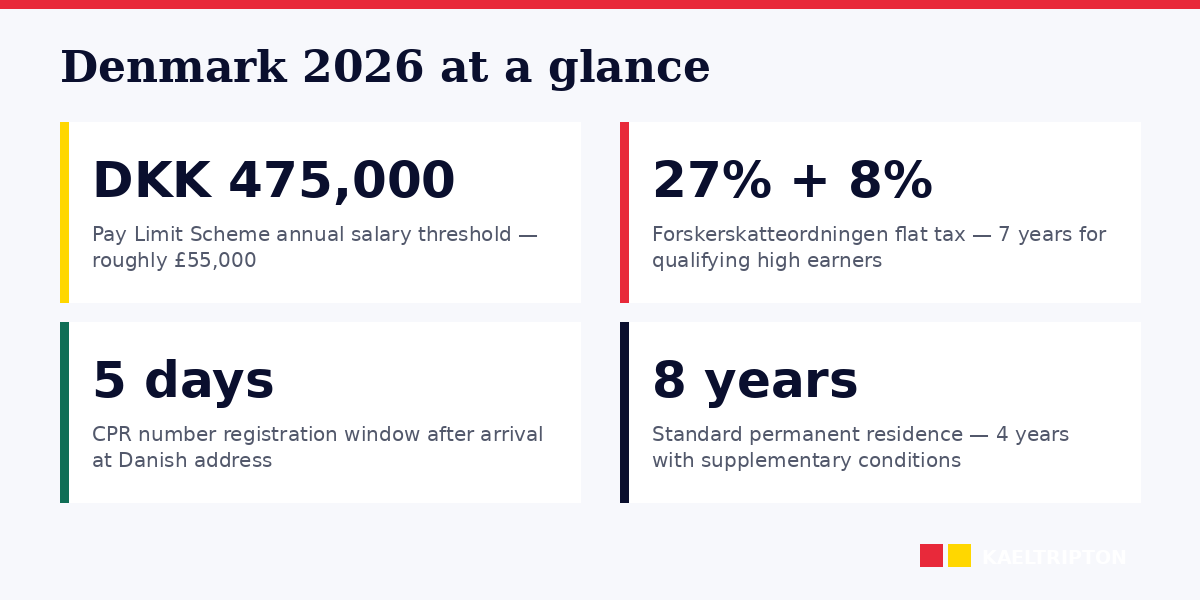
Moving to Denmark from the UK in 2026 needs a work permit or residence visa for any stay over 90 days. The Pay Limit Scheme (DKK 475,000/year salary, roughly £55,000) is the fastest route for salaried professionals; the Positive List covers shortage occupations with lower thresholds; the Fast-Track Scheme lets certified employers hire more quickly. The single most valuable feature of the Danish system for high earners is the Forskerskatteordningen - the researcher and key employee tax scheme - which offers a 27% flat tax rate plus 8% labour market contribution for up to 7 years, substantially lower than the standard 42-55% Danish effective rate. Register for your CPR number within 5 days of arrival and everything else unlocks. This guide covers the visa routes, CPR registration, MitID digital identity, the yellow health card, and the expat tax scheme that turns Denmark from one of the highest-taxed countries into one of the most competitive for qualifying professionals.
| ★ EDITOR'S VERDICT Denmark is high-tax - unless you qualify for Forskerordningen, then it's highly competitive. |
Standard Danish tax rates reach 52%. But the Forskerskatteordningen (27% flat plus 8% labour market contribution) changes the arithmetic entirely for qualifying professionals earning over DKK 65,400/month. For a UK biotech scientist or senior tech specialist, Denmark on Forskerordningen beats Germany, France, and Spain on net take-home. The 6-month application window is unforgiving - miss it and the full 7-year benefit is lost. CPR registration within 5 days is the foundation; Fast-Track Scheme with a certified employer lets you start work immediately. |
Visa routes: Pay Limit, Positive List, Fast-Track
UK citizens became third-country nationals for Danish immigration from 1 January 2021. Short visits up to 90 days in a 180-day Schengen period need no visa. Longer stays require a residence and work permit, administered by SIRI (Styrelsen for International Rekruttering og Integration - the Agency for International Recruitment and Integration).
The six main UK-relevant routes:
- Pay Limit Scheme - for any job meeting the salary threshold of DKK 475,000 per year (approximately £55,000) in 2026. No shortage-list restriction. Most common route for UK professionals in tech, finance, engineering, and pharmaceuticals.
- Positive List (Higher Education) - 183 qualifying occupations requiring higher-education qualifications. Covers healthcare, IT specialists, engineering disciplines, and scientific research. Lower salary thresholds apply. List updated twice yearly.
- Positive List (Skilled Work) - 57 qualifying skilled trades. Covers construction, green energy, and specific industrial roles.
- Fast-Track Scheme - for certified Danish employers only. The employer must have sponsor accreditation from SIRI. Allows immediate provisional work authorisation while the formal permit is processed, which means the employee can start working within days of arrival rather than weeks.
- Establishment Card - for international graduates of Danish universities wanting to stay to find work. Valid 2 years post-graduation.
- Family reunification - for spouses and dependents of Danish residents or workers.
The Pay Limit and Positive List schemes typically process in 30-60 days. Fast-Track offers the Quick Job Start option with provisional work authorisation on arrival, processing the formal permit in 2-4 weeks afterwards. Certified employers complete much of the paperwork electronically through the SIRI portal; applicant personal documents (passport, qualifications, criminal record) are uploaded via the same system.
The application sequence
Before you travel
- Secure a qualifying job offer. Employer files the work permit application through SIRI's online portal with your details, contract, and supporting documents.
- Submit biometrics at the Danish Embassy in London (or VFS Global in some cases). UK applicants have the option to submit biometrics at the Danish Embassy in London within 14 days of application.
- Pay the application fee (DKK 4,355 for Pay Limit Scheme in 2026; DKK 2,590 for Positive List).
- Processing: typically 30-60 days for standard applications; 10-14 days for Fast-Track.
On arrival: the critical 5-day sequence
The first five days in Denmark are unusually concentrated:
- Within 5 days: register at your local municipal Citizen Service (Borgerservice) or International Citizen Service (Copenhagen, Aarhus, or Odense) to obtain your CPR number. Bring passport, residence permit approval letter, signed rental contract, and employment contract. The 10-digit CPR number is Denmark's national identity number - essential for healthcare, banking, tax, mobile phones, and everything else.
- Same appointment or immediately after: apply for your MitID digital identity. MitID is the login for every Danish government service and most banks. You wait 24 hours after CPR issue before activating the MitID app on your smartphone.
- Within 2 weeks: your yellow health insurance card (sundhedskort) arrives by post. Includes your CPR number and your assigned GP. The yellow card is also available in app form.
- Week 2-3: open a Danish bank account at Danske Bank, Nordea, Jyske Bank, or online-first alternatives. You need your CPR number and MitID. Register this account as your NemKonto (mandatory salary/public payment account) via borger.dk.
- Week 2-3: apply for your tax card (skattekort) on skat.dk via MitID. This tells your employer how much tax to withhold from your salary. Without a tax card, your employer legally must deduct 55% - which is more than even Denmark's top marginal rate. Getting this sorted in the first fortnight is the single most important money step.
Within 3 months: SIRI biometric appointment
Shortly after arrival you attend a SIRI biometric appointment. Fingerprints and photograph taken. Your physical residence card arrives by post 2-4 weeks later. Without the physical card your legal status is valid but some banks and landlords ask to see it.
Danish healthcare: tax-funded and well-organised
Denmark operates a universal, tax-funded healthcare system. Once you have a CPR number and yellow health card, you are assigned a GP (almen lægepraksis) who acts as gatekeeper to the system. GP visits, hospital treatment, and most specialist referrals are free at point of use. Prescription medication has a sliding-scale copay capped at DKK 4,345 per person per year in 2026.
Dental care for adults is not covered by the public system and typically costs DKK 800-DKK 2,000 per visit. Many employers offer supplementary private health insurance (sundhedsforsikring) as a benefit, giving access to private clinics with shorter waits for elective procedures. Typical premium DKK 300-DKK 600 per month for a single employee.
UK state pensioners qualify for S1-funded Danish healthcare. Apply through NHS Overseas Healthcare Services before leaving.
Danish tax: among the highest, but the Forskerskatteordningen changes everything for qualifying workers
Denmark has the highest effective marginal tax rates in the EU. The standard combined rate reaches approximately 52% (municipal + state + labour market contribution) on high incomes. Personal allowance (personfradrag) is DKK 54,100 in 2026.
2026 tax brackets (approximate, varies by municipality):
- Labour market contribution (AM-bidrag): 8% of gross salary (pre-tax, applies to all earnings)
- Municipal tax (~25%, varies 22-28% by kommune) + bottom-bracket state tax (12.09%) on income up to DKK 611,800 after allowances
- Top-bracket state tax: additional 15% on income above DKK 611,800
Forskerskatteordningen (Researcher/Key Employee Tax Scheme)
This is the single most valuable feature of Danish tax for qualifying foreign professionals. Under the "Forskerordning" you pay a flat 27% income tax plus 8% labour market contribution (roughly 32.84% total effective rate) for up to 7 years, compared to standard Danish rates that effectively reach 52-55%.
Eligibility in 2026:
- You must not have been Danish tax-resident in the past 10 years
- Monthly salary must exceed DKK 65,400 in 2026 (roughly £7,600/month gross; €8,750/month)
- Or you must hold specific researcher/scientist credentials qualifying under the research category (no salary threshold but requires PhD-level qualifications or equivalent)
- Application via skat.dk within 6 months of starting work in Denmark
- Once elected, the scheme runs for a continuous 7-year window - you cannot switch in and out
For a UK engineer earning DKK 800,000/year (£93,000), the difference between standard Danish tax and Forskerskatteordningen is approximately DKK 130,000 (£15,000) per year. Over 7 years this is £105,000 in tax saving - the reason Denmark remains genuinely competitive with Switzerland and the Netherlands 30% ruling for high-salary UK professionals.
Standard Danish tax beyond the researcher scheme
You become Danish tax-resident when you establish a home (bopæl) in Denmark or stay more than 183 days. Once resident, worldwide income is taxable in Denmark.
The UK-Denmark double taxation agreement prevents double taxation. UK state pensions are taxable in Denmark for Danish residents. UK government service pensions remain taxable in the UK. UK ISAs are not tax-advantaged in Denmark.
First Danish tax return (årsopgørelse) arrives automatically via your MitID in March each year, showing SKAT's calculation of your tax for the previous year. Most employees simply review and correct the pre-filled return. Self-employed, rental income earners, and those with foreign income need to supplement the return with additional forms. Filing deadline 1 May, extended to 1 July for those using a tax adviser.
Permanent residence and citizenship
Standard Danish permanent residence requires 8 years of continuous legal residence. Accelerated routes reduce this to 4 years for applicants meeting supplementary conditions: full-time employment for 3.5 of the past 4 years, Danish B1 proficiency (Prøve i Dansk 2), active citizenship participation, and no significant criminal record.
Danish citizenship requires 9 years of residence (reducible with special conditions), B2-level Danish (Prøve i Dansk 3), a citizenship test, self-sufficiency for 4.5 of the past 5 years, and no significant public debt. Denmark has historically been strict on dual citizenship but has allowed it since 2015.
A real 2026 scenario: biotech scientist from Oxford to Copenhagen
A molecular biologist from Oxford, 29, accepts a role at Novo Nordisk's Copenhagen research centre on DKK 780,000/year.
March 2026. Novo Nordisk is a Fast-Track Scheme certified employer. HR files her application through SIRI portal with contract, qualifications, and proof of accommodation. Application processed in 12 days.
April 2026. Biometrics at Danish Embassy in London. Flies to Copenhagen 3 weeks later with pre-approved permit.
Day 1-5 in Copenhagen. Registers at International Citizen Service Copenhagen within 3 days. Gets CPR number on the spot (ICC is a one-stop-shop covering SIRI biometrics, CPR registration, and tax card in a single appointment). Registers MitID next day. Yellow health card arrives by post 10 days later.
Week 2. Opens Nordea bank account. Registers Nordea as her NemKonto via borger.dk. Applies for tax card on skat.dk - without this her employer would deduct 55% of her first paycheque.
Week 4. Applies for Forskerskatteordningen via skat.dk within the 6-month window. Her DKK 780,000 salary exceeds the DKK 65,400/month threshold. Approved backdated to her first Danish paycheque. Tax rate drops to approximately 32.84% total versus the standard 45-50% for her income band.
Annual net salary under Forskerordningen: DKK 524,400 (£61,000) versus DKK 432,000 (£50,200) under standard Danish tax - £10,800/year advantage from electing the scheme. Over 7 years: £75,600 saved. This is the single biggest financial factor making Denmark competitive for UK researchers and high-earners versus alternatives.
Frequently asked questions
How quickly can I start working in Denmark?
Under Fast-Track Scheme with a certified employer, you can start within days of arrival - provisional work authorisation is granted at the SIRI appointment. Under Pay Limit Scheme, you must wait for full permit approval (typically 30-60 days). UK citizens can enter on their passport while the application is processing, but cannot work until the permit is granted.
Is the Forskerskatteordningen really as good as it sounds?
Yes, if you qualify. The catch is the 6-month application deadline from starting work in Denmark, and the 7-year maximum duration (once expired, you revert to standard Danish tax rates for the rest of your stay). Planning with a Danish tax adviser in your first month is essential - a missed deadline means the full 7-year benefit is permanently lost.
Can I apply for Danish permanent residence after 4 years under the fast track?
Yes if you meet the supplementary conditions: 3.5 of the past 4 years in full-time employment, Danish B1 language (Prøve i Dansk 2 exam), active citizenship demonstration, and no significant criminal record. These are genuinely demanding but achievable for motivated applicants.
Does Denmark recognise dual citizenship with the UK?
Yes since 2015. Previously Danish citizens who naturalised elsewhere lost Danish citizenship automatically; the 2015 law change removed this. UK citizens who naturalise as Danish after the required residency period can keep both nationalities.
How tight is Copenhagen housing?
Very. Copenhagen rental prices typically range DKK 10,000-DKK 15,000 (£1,200-£1,750) per month for a one-bedroom apartment. Competition is fierce; start the search weeks before arrival. BoligPortal is the main rental platform. Many employers offer temporary serviced accommodation for the first 1-3 months while you hunt for a long-term rental.
What if I cannot get a Danish bank account quickly?
Major Danish banks take 2-4 weeks to approve an account for a new CPR holder. This is a real squeeze because your first salary must be paid into a Danish account. Online-first alternatives like Revolut (which issues Danish IBANs in some setups) and LunarWay are faster but don't always qualify for NemKonto registration. Most employers have standing arrangements with specific Danish banks to fast-track expat account opening.
Can I bring my UK driving licence?
Yes. UK photocard licences can be exchanged for a Danish licence (kørekort) free without a driving test within 90 days of CPR registration. Older paper-only UK licences may need the photocard upgrade first.
Sources
- SIRI (Danish Agency for International Recruitment and Integration), Work permit schemes - newtodenmark.dk
- GOV.UK, Foreign travel advice - Denmark and Living in Denmark
- Life in Denmark portal, CPR registration, MitID and yellow health card process - lifeindenmark.borger.dk
- Skattestyrelsen (SKAT), Forskerskatteordningen (Researcher/Key Employee Tax Scheme) 2026 rules
- NHS Business Services Authority, S1 certificates for UK pensioners moving to the EU
- HMRC, Double Taxation Convention with Denmark
- Sundhed.dk (official Danish health portal), GP registration and public healthcare access
- Nordic cooperation for social security coordination (the Nordic Convention on Social Security)


