

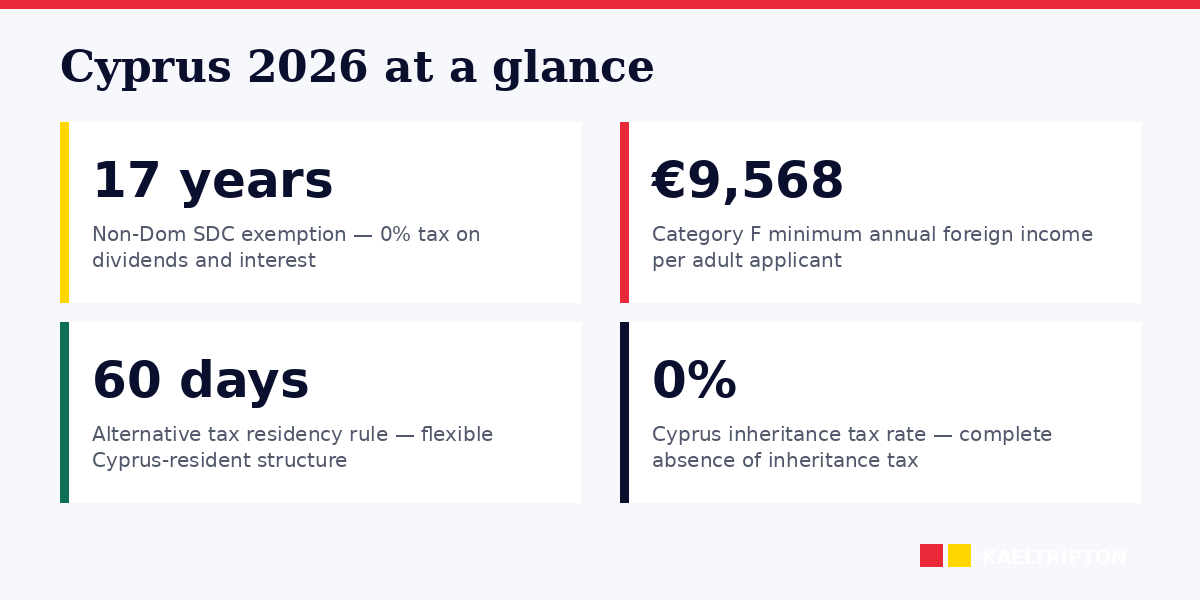
Moving to Cyprus from the UK in 2026 offers the UK retiree and entrepreneur one of the most favourable tax environments in the EU - 17 years of 0% Special Defence Contribution on foreign dividends and interest under the Non-Dom tax status, plus a 60-day tax residence rule that lets you become Cyprus-resident while minimising physical presence. Category F permanent residency requires only €9,568 annual income from abroad per adult applicant. Cyprus has an English-based legal system, no inheritance tax, and GESY universal healthcare for registered residents. The island is the quiet winner for UK pensioners and high-net-worth movers who want EU residency with genuinely low tax friction. This guide covers the Category F visa, Non-Dom tax planning, GESY registration, and the practical sequence from UK to Cyprus residency.
| ★ EDITOR'S VERDICT Cyprus is the quiet winner for UK retirees with investment income. |
17 years of 0% tax on foreign dividends and interest under the Non-Dom regime is the EU's most aggressive investment-income exemption. Category F permanent residency needs only €9,568/year income from abroad. No inheritance tax. English common law legal system. GESY universal healthcare with small contribution. 60-day rule lets you establish tax residency without giving up global travel. The single catch: Category F processing backlog means 2026 applications may be decided in 2030+ - most UK movers live on the pink slip (renewable temporary permit) in the meantime. |
Why Cyprus is different from most EU destinations
Cyprus is an English-speaking former British colony with a legal system derived from English common law. Property contracts, company incorporations, and most government forms are available in English alongside Greek. An estimated 58,000 British expats currently live in Cyprus, concentrated in Paphos, Limassol, and Larnaca. The appeal for UK movers is not just sunshine - it's the combination of English-language administration, low bureaucratic friction, and a deliberately expat-friendly tax regime that makes Cyprus genuinely competitive with Portugal, Italy and Malta.
Visa routes: which category fits you
UK citizens are third-country nationals for Cyprus immigration since 1 January 2021. Short visits under 90 days in any 180-day Schengen period need no visa. Longer stays need permanent residency or a temporary residence permit. Cyprus uses a category system:
- Category F (Permanent Residency - passive income route) - the most common UK choice. Permanent residence for people with secured annual income of at least €9,568 (plus €4,613 per dependent) from foreign sources. No investment required. You cannot work in Cyprus on Category F, but can be a shareholder in a Cypriot company. Application backlog is significant - 2026 applications being processed are from 2020 submissions. Most applicants live in Cyprus under temporary permits while waiting.
- Category 6(2) (Permanent Residency - Fast-Track Investment) - for investors willing to commit €300,000 in real property (new build, plus VAT) or eligible alternative investments. Processing in 6 months. No minimum stay requirement but must visit once every 2 years to maintain status.
- Temporary Residence Permit (Pink Slip) - for those with Category F pending, or for retirees and financially independent movers. Annual renewal. Does not grant work rights.
- Work Permit / Employment Residence Permit - employer-sponsored. Employer applies through the Civil Registry and Migration Department after a labour market test.
- Digital Nomad Visa - introduced 2021, extended in 2025 after the 500-permit cap. For remote workers with €3,500/month minimum income from non-Cypriot sources.
- Self-employed permit (Categories C and D) - for those starting a Cyprus business. Category C (trade): €260,000 capital. Category D (profession or science): sufficient funds proof.
- Family reunification - for spouses and dependents.
For most UK retirees, the practical sequence is apply for Category F while living on a temporary "pink slip" residence permit. The Category F application itself takes years to decide but the pink slip covers you in the meantime with annual renewals.
The Non-Dom tax regime: Cyprus's big attraction
Cyprus operates a Non-Domiciled Tax Resident regime that gives new residents 17 years of preferential treatment on investment income. For UK movers with substantial investment portfolios or business dividends, the savings can be enormous.
Eligibility is straightforward:
- You become Cyprus tax resident (either through the 183-day rule, or the 60-day rule explained below)
- You have not been Cyprus tax resident in the previous 17 years
- You obtain Non-Domiciled Certificate from the Cyprus Tax Department
Non-Dom benefits:
- 0% Special Defence Contribution (SDC) on dividends from any worldwide source, for 17 years. Domiciled Cyprus residents pay 5% SDC on dividends under 2026 reforms (reduced from 17% previously). Non-Doms pay nothing.
- 0% SDC on interest income from savings and bonds worldwide. Domiciled residents pay 17% SDC.
- 0% capital gains tax on the sale of securities (shares, bonds, crypto held as investments). Applies to all Cyprus residents, not just Non-Doms, but combined with Non-Dom SDC exemptions creates an almost tax-free investment income environment.
- No inheritance tax in Cyprus - complete absence, regardless of domicile status.
- No wealth tax
Cyprus still charges income tax on earned income (salaries, self-employment, pensions) at standard progressive rates:
- Up to €19,500: 0%
- €19,501 - €28,000: 20%
- €28,001 - €36,300: 25%
- €36,301 - €60,000: 30%
- Above €60,000: 35%
So: a UK retiree with a €40,000 pension plus €60,000 in dividends and €20,000 in interest pays standard Cyprus income tax on the pension (approximately €4,100) and zero Cyprus tax on the dividends and interest. Total Cyprus tax liability on €120,000 total income: approximately €4,100 (3.4% effective rate). The UK-Cyprus double taxation treaty ensures this income is not double-taxed.
The 60-day rule: become tax resident with minimal physical presence
Cyprus has a uniquely flexible alternative to the standard 183-day tax residence rule. You can become a Cyprus tax resident by spending only 60 days in Cyprus in a calendar year, provided all five conditions are met:
- You spent at least 60 days in Cyprus during the tax year (1 January to 31 December)
- You did not reside in any other single country for more than 183 days
- You are not a tax resident of any other country
- You maintain a permanent residence in Cyprus (owned or rented)
- You are employed, self-employed, or hold a directorship in a Cyprus company
This is particularly attractive for remote workers, consultants, digital nomads, and retirees who want EU tax residency while retaining flexibility to travel. Structuring a Cyprus tax position through the 60-day rule is a specialist exercise - professional advice from a Cyprus-licensed tax adviser is essential.
Category F application: the pink slip and the long wait
The standard Category F permanent residency application involves several steps:
- Secure a Cyprus rental contract (minimum 12 months) or property purchase.
- Open a Cyprus bank account to receive and evidence foreign income. Typical Cyprus bank account opening requires in-person visit and passport, proof of address in UK, proof of income source. Processing 1-4 weeks.
- Apply for a Temporary Residence Permit (pink slip) at the local Civil Registry and Migration Department (CRMD). Fees €70 per person. Processing 6-12 weeks.
- Submit the Category F application (Form MIP2) at the CRMD with ACRO criminal record, proof of €9,568+ annual income, Cyprus bank account statements, rental or property proof, health insurance, curriculum vitae. Fee €500.
- Wait. The 2020 backlog means 2026 applications are being processed from 2020 submissions - so new applications in 2026 may be decided in 2030 or later. Live in Cyprus on the pink slip in the meantime.
The pink slip must be renewed annually until the Category F decision arrives. You must be physically in Cyprus when applying for the pink slip - visits from the UK to renew are possible if structured around each annual cycle.
GESY: the General Healthcare System
Cyprus implemented its universal healthcare system GESY (Γενικό Σύστημα Υγείας) from 2019, replacing the previous patchwork of public and private systems. All legal residents have access to GESY once registered. Contributions are income-based at modest rates:
- Employees: 2.65% of gross salary (employer pays 2.90%)
- Self-employed: 4.00% of income
- Pensioners: 2.65% of pension
- Income from dividends and interest: 2.65% (subject to cap)
The annual contribution cap is based on €180,000 of gross income per person - maximum individual contribution of around €4,770/year. Dependents are covered without additional contribution.
GESY covers GP visits, specialist consultations, hospital treatment, prescription medicines (€1 per item), dental checks, and maternity. Wait times for elective procedures are generally shorter than the NHS. Many Cyprus residents maintain private health insurance (€400-€1,500/year) for private hospitals and English-speaking specialists - BUPA, Cigna, Eurolife, and a handful of local insurers dominate the market.
UK state pensioners qualify for S1 healthcare - UK-funded GESY registration. Apply through NHS Overseas Healthcare Services before leaving. Working-age movers who haven't yet registered for GESY need private health insurance.
Property: buying is straightforward for UK citizens
UK citizens have unrestricted rights to buy Cyprus property. The purchase process is based on English common law and is straightforward compared to most EU jurisdictions:
- A Council of Ministers approval is technically required for non-EU buyers, but this is routine and virtually always granted for residential property below €5 million
- Transfer tax: approximately 3-8% of purchase price depending on property value (sliding scale)
- Stamp duty: 0.15-0.2% of contract value
- VAT: 19% on new-build properties; 5% reduced rate available on first main residence up to 130 square metres
- Capital gains tax on future sale: 20% flat rate, but with €17,086 personal allowance per person, rising to €85,430 if the property has been your main residence for 5+ years
Median property price for a 2-bed apartment in Paphos or Larnaca is around €180,000-€280,000 in 2026. Limassol is considerably more expensive (€300,000-€600,000 for equivalent) due to ongoing demand from international business and high-net-worth buyers. Typical UK retiree budget for a freehold property is £200,000-£400,000 with good options in Paphos and less-touristy villages.
A real 2026 scenario: retired UK accountant from Manchester to Paphos
A retired accountant from Manchester, 62, with £45,000/year pension income, £32,000/year in investment dividends, and £180,000 in savings, decides to move to Paphos in 2026.
Pre-move (March-May 2026). Visits Paphos in March, secures a 12-month rental at €1,100/month in a 2-bed near Coral Bay. Returns to UK, engages a Cyprus tax adviser (€1,500 retainer), applies for ACRO criminal record check.
June 2026. Flies to Cyprus, opens a Bank of Cyprus account. Visits Paphos CRMD to apply for Temporary Residence Permit (pink slip). Fee €70. Processing takes 8 weeks.
August 2026. Pink slip issued. Submits Category F application (€500 fee). Application enters the 2026 queue - expected decision sometime 2030-2032 based on current processing.
September 2026. Applies for Non-Domiciled Certificate at the Cyprus Tax Department. Meets the 60-day rule (she plans to live in Cyprus full-time, so easily). Non-Dom status approved within 6 weeks.
October 2026. S1 form from NHS Overseas Healthcare Services arrives. Registers with GESY at her local health centre in Paphos. GP assigned.
Tax outcome: UK pension income taxable in Cyprus at standard rates - approximately €4,100/year. UK dividends (£32,000) taxable in Cyprus at 0% SDC under Non-Dom status - UK withholding tax may apply but can be reclaimed. Interest on savings: 0% SDC in Cyprus. Total Cyprus tax liability: approximately €4,100. UK tax liability: zero once non-resident status is established. Effective global tax rate on €88,000 equivalent income: approximately 4.7%. Massive saving versus UK tax position of approximately £21,000 (about €24,500) per year. Over 17 years, Non-Dom status saves roughly £340,000 compared to remaining UK tax-resident.
Frequently asked questions
Can I work in Cyprus on Category F?
No. Category F prohibits employment or self-employment in Cyprus. You can be a shareholder and receive dividends from a Cyprus company, but cannot be an employee or actively trade. If you plan to work, apply for a Work Permit or self-employed residence permit (Category C or D) instead.
How long will the Category F backlog last?
As of early 2026, the CRMD is processing applications submitted in 2020. The backlog is approximately 6 years and has been growing. For most new applicants, the pink slip (temporary residence permit) is the practical status for the foreseeable future. Pink slip renewals are annual but straightforward.
Is Non-Dom status automatic when I move?
No. You must apply for the Non-Domiciled Certificate at the Cyprus Tax Department after establishing tax residency. The process takes 4-8 weeks and requires proof you haven't been Cyprus tax resident in the previous 17 years. Most Cyprus tax advisers handle this as part of an initial relocation package.
Does the 60-day rule really work?
Yes, but the conditions are all binding. You must not be tax resident elsewhere. You must not spend more than 183 days in any other single country. You must have a Cyprus home and a Cyprus directorship or employment. Many international contractors and consultants genuinely qualify, but informal "I'll just spend 60 days in Cyprus and claim it" setups rarely survive scrutiny. Professional structuring is essential.
What happens to UK state pension when I move to Cyprus?
It continues to be paid as normal, with annual uprating because Cyprus is within the EU social security coordination framework. Under the UK-Cyprus double tax treaty, state pensions are taxable only in the country of residence - so Cyprus, not the UK. UK government service pensions (civil service, armed forces) remain UK-taxable.
Can I rent my UK property and retain it after moving?
Yes. UK rental income remains primarily UK-taxable under the double taxation treaty. You must continue to file UK tax returns as a non-resident landlord (form NRL1 to HMRC to receive rent without withholding). The net UK rental income must also be declared on your Cyprus tax return, though a foreign tax credit applies. Keeping UK property as a rental investment is a common UK-to-Cyprus strategy.
Is there inheritance tax in Cyprus?
No. Cyprus has no inheritance tax whatsoever. This is a major part of the retirement planning case for the island. However, UK Inheritance Tax still applies to UK-domiciled individuals on worldwide assets - and domicile is a separate concept from tax residency. Breaking UK domicile requires severing UK ties over a period of years, which most Cyprus retirees never fully complete. Good planning with a UK-Cyprus adviser is essential for estate purposes.
Sources
- Cyprus Civil Registry and Migration Department (CRMD), Residence permit categories and application processes
- Cyprus Ministry of Finance / Tax Department, Non-Domiciled tax resident regime and 60-day rule - 2026 Tax Reform Act
- GESY (General Healthcare System), Registration and contribution rates - gesy.org.cy
- GOV.UK, Foreign travel advice - Cyprus and Living in Cyprus
- NHS Business Services Authority, S1 certificates for UK pensioners moving to the EU
- HMRC, Double Taxation Convention with Cyprus
- Cyprus Land Registry, Property transfer and ownership procedures
- Special Defence Contribution Law 117/2002 (as amended through 2026 reforms)


