

Moving to Portugal from the UK in 2026 needs a long-stay visa applied for before travel. The main routes are the D7 passive income visa (for pensioners and those with stable passive income), the D8 digital nomad visa (for remote workers earning 4× Portuguese minimum wage), and the Golden Visa (investment route, though the property option closed in 2023). The much-discussed old Non-Habitual Resident (NHR) tax regime closed to new applications in 2024; the replacement IFICI regime is significantly narrower. This guide walks through the routes that actually work in 2026, NIF registration, the tax reality, and SNS healthcare.
| ★ EDITOR'S VERDICT D7 or D8, but don't plan around the old NHR - it's gone. |
Portugal is still an excellent retirement destination, but the 2026 reality is different from the NHR-era marketing. Foreign pension income is now taxed at standard progressive rates (up to 48%) under IFICI. The 7% favourable rate on pensions only exists in Italy now. D7 remains straightforward for pensioners with stable income; D8 suits remote workers earning €28k+/year. AIMA backlogs are real - build 4-9 month buffers into residence permit timing. The lower cost of living still makes Portugal competitive against the UK even without NHR tax relief. |
The visa routes that work in 2026
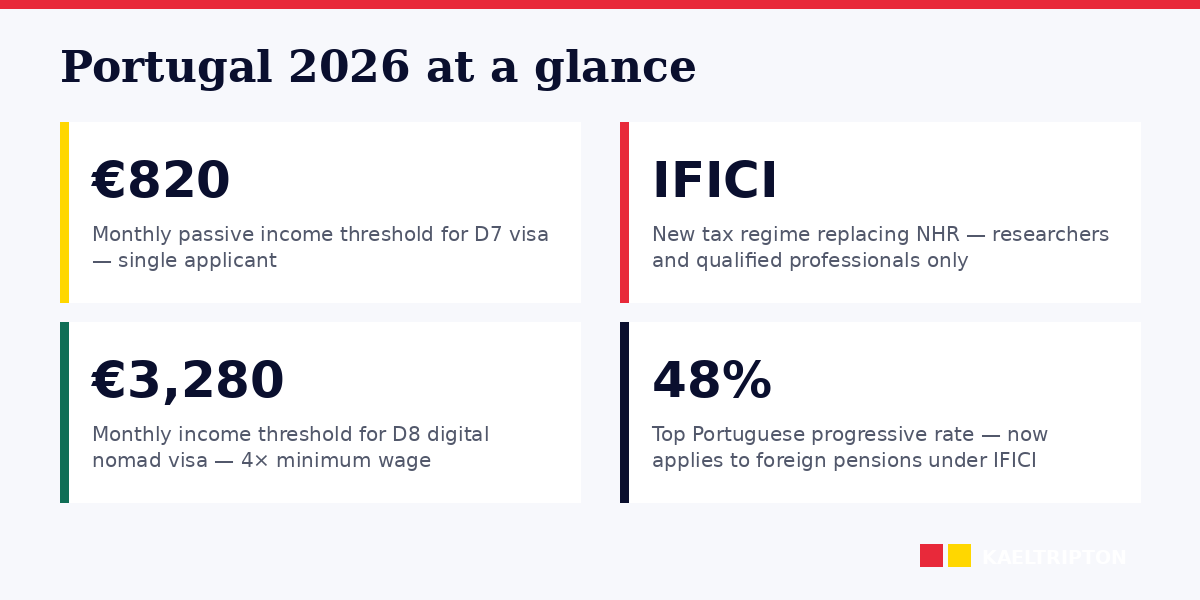
- D7 Visa (Passive Income) - the retirement workhorse. Monthly passive income roughly equivalent to Portuguese minimum wage (2026: around €820/month for a single applicant, +50% for a spouse, +30% for each dependent child). UK state pension, private pensions, rental income, dividends, interest all qualify. Valid 1 year initially, converts to a 2-year residence permit, then 3-year renewals. Path to permanent residence after 5 years.
- D8 Visa (Digital Nomad / Remote Work) - introduced October 2022. For non-EU remote workers earning at least 4× Portuguese minimum wage (roughly €3,280/month in 2026). Two variants: temporary 1-year visa for stays up to 12 months, or residence visa leading to a full residence permit after arrival.
- D2 Visa (Entrepreneur) - for UK nationals starting a business in Portugal or transferring an existing company. Requires a viable business plan, proof of funds, and sometimes evidence of market research or existing contracts.
- Golden Visa - investment-based residency. October 2023 reforms removed the real estate route that was the most popular option. Current qualifying investments: €500,000 in investment funds supporting Portuguese business, €500,000 in R&D, €250,000 in art or cultural heritage, creation of 10 jobs.
- Family reunification - for spouses and dependents of Portuguese residents.
AIMA (Agência para a Integração, Migrações e Asilo), which replaced SEF in October 2023, handles residence permit applications inside Portugal. Wait times have been significant post-transition; AIMA published a residency extension programme in early 2026 to deal with the backlog.
The NHR 2.0 (IFICI) reality
The original Non-Habitual Resident (NHR) regime that made Portugal famous among UK expats closed to new applicants on 31 December 2023, with a transitional window closing 31 March 2025 for those who could demonstrate they had begun the relocation process during 2023.
The replacement regime is IFICI - Incentivo Fiscal à Investigação Científica e Inovação (Tax Incentive for Scientific Research and Innovation), often marketed as "NHR 2.0". Despite the marketing, the two regimes are fundamentally different:
| Feature | Old NHR (closed to new applicants) | IFICI (NHR 2.0) |
|---|---|---|
| Target | Retirees, remote workers, HNWIs | Researchers, scientists, qualified specialists in innovation sectors |
| Foreign pension income | 10% flat rate | Taxed at standard progressive rates (up to 48%) |
| Foreign income exemption | Broad - most foreign-source income exempt if taxable at source | Retained for qualifying IFICI holders only |
| Portuguese-source qualifying income | 20% flat rate | 20% flat rate - but only for narrow defined activities |
| Duration | 10 years | 10 years |
| Who qualifies (2026) | Closed to new applicants | Researchers, university teachers, qualified roles in certified startups, highly qualified roles in export-focused companies (>50% export revenue) |
The single biggest change for UK retirees: foreign pension income is no longer taxed at a favourable rate under IFICI. It is subject to standard Portuguese progressive income tax rates, which reach 48% at the top bracket. This removes the single most attractive feature of the old NHR for UK pensioners.
For UK professionals working in technology, engineering, life sciences, or research roles, IFICI can still deliver meaningful tax savings through the 20% flat rate on qualifying Portuguese employment income and foreign-income exemptions. For retirees, the financial case for Portugal versus Spain or France has narrowed considerably.
The application sequence
Six to four months before travel
- Apply for a Portuguese NIF (Número de Identificação Fiscal) - the tax identification number. Non-EU residents need a fiscal representative in Portugal to apply. Cost €75-€150 through a representative, or free if you can attend a Finanças office in person. Required before almost every other step.
- Open a Portuguese bank account using the NIF. Some banks (Millennium BCP, Novo Banco, ActivoBank) now offer remote account opening for non-residents.
- Secure accommodation - rental contract or property deed - required for the visa application.
Three months before travel
- Book an appointment at VFS Global (the visa application centre) in London, Manchester, or Edinburgh. VFS handles the biometric intake on behalf of the Portuguese consulate.
- Submit the D7, D8 or D2 application with passport, NIF, bank statements, proof of accommodation, health insurance, clean criminal record check.
- Processing typically 60-90 days. The consulate retains your passport during assessment.
On arrival
- Attend your pre-booked AIMA appointment (usually 120 days after the visa is issued) to exchange the visa for a residence permit (Título de Residência).
- Register with your local junta de freguesia (parish council) for the Atestado de Residência.
- Register with SNS (Serviço Nacional de Saúde) at your local health centre (Centro de Saúde) with passport, NIF, residence certificate, and proof of address.
- Update your NIF fiscal address to the Portuguese address via Finanças portal.
Tax residency and the 183-day rule
You become Portuguese tax-resident if you spend more than 183 days in Portugal during any 12-month period, or if you maintain a permanent home there with the intention of staying long-term. Once resident, worldwide income is taxable in Portugal under the IRS (Imposto sobre o Rendimento das Pessoas Singulares).
Portuguese income tax rates for 2026 are progressive:
- Up to €7,703: 14.5%
- €7,703 - €11,623: 21%
- €11,623 - €16,472: 26.5%
- €16,472 - €21,321: 28.5%
- €21,321 - €27,146: 35%
- €27,146 - €39,791: 37%
- €39,791 - €51,997: 43.5%
- €51,997 - €81,199: 45%
- Above €81,199: 48%
Plus a solidarity surcharge of 2.5% on income €80,000-€250,000 and 5% above €250,000.
The UK-Portugal double taxation agreement prevents double taxation. UK state pensions are taxable in Portugal for Portuguese residents. UK government service pensions remain taxable in the UK. UK rental income is primarily UK-taxable.
Healthcare: SNS and private cover
Portugal's National Health Service (SNS) provides universal healthcare. Legal residents register at their local Centro de Saúde with proof of NIF, residence certificate and address. Registration is free. Small utente (user) fees apply for most consultations and services (€5-€25 range) but are waived for pensioners, low-income residents, and chronic condition management.
UK state pensioners qualify for S1 healthcare - UK-funded SNS coverage on the same basis as Portuguese citizens. Apply for the S1 through NHS Overseas Healthcare Services before leaving the UK.
Working-age D7 and D8 visa holders typically combine SNS with private health insurance (ADSE-affiliated policies or private insurers like Multicare, Médis, Tranquilidade). Private cover €40-€120 per month for a single adult, giving access to private hospitals with English-speaking doctors and shorter waits.
Private health insurance is required for the visa application itself (valid for 90 days minimum, with €30,000+ coverage). Most UK movers retain a private policy alongside SNS registration for the first 1-2 years.
A real 2026 scenario: retired teacher from Bristol to Cascais
A retired secondary school teacher from Bristol, 64, with a £2,200/month UK teacher's pension and £80,000 in savings, relocates to Cascais (a coastal town near Lisbon) in September 2026.
March 2026. Applies for NIF through a Lisbon-based fiscal representative (€125). Opens a non-resident account with Millennium BCP remotely (€30 opening fee). Signs a 12-month rental contract on a 2-bed flat in Cascais at €1,600/month. Books D7 visa appointment at VFS Manchester for June.
June 2026. Submits D7 application with passport, bank statements showing €26,400/year pension income (well above the D7 threshold), NIF, rental contract, private health insurance (€80/month Multicare policy). Visa fee €90.
August 2026. D7 visa approved. Passport returned by VFS. Books flight to Lisbon.
September 2026. Arrives in Portugal. Pre-scheduled AIMA appointment in January 2027 for residence permit conversion. Meanwhile, completes junta de freguesia registration, updates NIF fiscal address to Cascais, registers with SNS at the local Centro de Saúde. Applies for UK state pension (when eligible) via the International Pension Centre.
November 2026. S1 form arrives from NHS Overseas Healthcare Services, linking her to UK-funded SNS coverage. Files first Portuguese IRS return by May 2027 for 2026 partial-year income.
Tax reality: her UK teacher's pension of £26,400/year (€31,000 at 2026 rates) is subject to standard Portuguese IRS progressive rates since IFICI does not help retirees. Approximate IRS liability in her first full year: €4,800. This is around €2,500/year higher than it would have been under the old NHR regime - but Cascais living costs are approximately 35-40% lower than Bristol, so the move is still strongly net-positive on cost of living despite the higher tax.
Frequently asked questions
Can I still apply for the old NHR tax regime?
No. The original NHR regime closed to new applicants on 31 December 2023, with the final transitional window for 2023 relocators closing 31 March 2025. Existing NHR holders retain their regime for the full 10-year period. New applicants in 2026 are considered for IFICI only.
Does the D7 visa mean I can work in Portugal?
The D7 is primarily for passive income but allows remote work for foreign employers and limited local employment. It is less flexible than the D8 digital nomad visa for active earners. Many UK retirees with small consulting practices use D7 without issue, but anyone planning substantial earned income should consider D8 or D2 instead.
What happened to the Golden Visa real estate route?
Closed in October 2023. Property investments no longer qualify for Golden Visa eligibility. The remaining qualifying investments are fund investments (€500k), R&D (€500k), art/cultural heritage (€250k), or job creation (10 jobs). UK citizens seeking residency through investment face a substantially harder route in 2026 than pre-2023.
Do UK pensioners pay tax on their pension in Portugal?
Yes. Under IFICI (NHR 2.0), foreign pension income is taxed at standard Portuguese progressive rates up to 48%. This removes the preferential 10% treatment that existed under the old NHR. UK government service pensions remain UK-taxable under the double taxation treaty; private UK pensions and state pensions are Portugal-taxable for Portuguese residents.
How long does AIMA residence permit processing take?
AIMA inherited significant backlogs when it took over from SEF in October 2023. 2026 wait times from AIMA appointment to card issuance range from 4 to 9 months depending on location. Lisbon and Porto have longer waits than regional offices. The government's January 2026 extension programme automatically extended expired residence documents to 15 June 2026 to reduce immediate pressure on renewals.
Can I bring my UK car to Portugal?
Yes, under transfer-of-residence rules (Alteração de Residência). The car must have been owned for at least 12 months before the move, you must become a Portuguese resident, and the car must be registered with Portuguese plates within 6 months of your residence permit issue. Import under transfer-of-residence is tax-free; standard ISV import tax is steep on vehicles imported without this relief.
Is healthcare free in Portugal?
SNS is largely free at point of use for legal residents, with small utente fees on most consultations (waived for pensioners, chronic conditions, low-income residents). Private insurance is widely used to supplement SNS for faster specialist access and English-speaking consultations. UK state pensioners use S1 for UK-funded SNS coverage.
Sources
- AIMA (Agência para a Integração, Migrações e Asilo), Residence permit applications and extensions 2026 - aima.gov.pt
- Portuguese Ministry of Foreign Affairs, D7, D8, D2 and Golden Visa requirements 2026
- Portuguese Tax Authority (Autoridade Tributária), IFICI regime - Portaria 352/2024 and IRS 2026 tax brackets
- GOV.UK, Foreign travel advice - Portugal and Living in Portugal
- NHS Business Services Authority, S1 certificates for UK pensioners moving to the EU
- HMRC, Double Taxation Convention with Portugal
- SNS (Serviço Nacional de Saúde), Registration for foreign residents
- Law 109/2009 (NHR regime, closed to new applicants) and Law 82/2023 (IFICI creation)


