

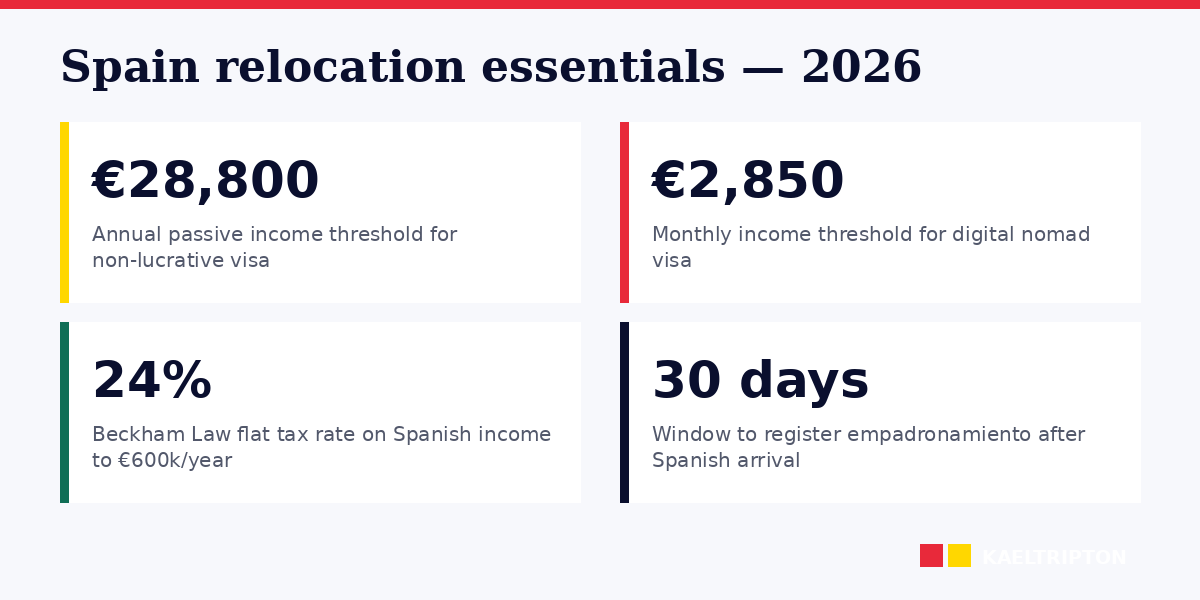
Moving to Spain from the UK in 2026 needs a long-stay visa applied for in the UK before travel. The two main routes are the non-lucrative visa (for retirees and those with passive income of €28,800+ per year) and the digital nomad visa (for remote workers earning at least €2,850 per month). Both lead to residence permits, both allow family members to join, and both open the door to Spain's Beckham Law flat-rate tax regime for high earners. Once resident, you need an NIE number, a Spanish bank account, the padrón (town hall registration), and SIP card for healthcare. Here is how each step works in 2026.
| ★ EDITOR'S VERDICT Two clear routes. Pick by whether you work. |
Retirees and passive-income movers use the Non-Lucrative Visa at €28,800/year. Remote workers and freelancers use the Digital Nomad Visa at €2,850/month. The Beckham Law 24% flat tax is the headline saving for DNV employees but the 6-month application deadline from Social Security registration is unforgiving. After arrival, register empadronamiento in 30 days, get NIE, open a Spanish bank account, apply for the TIE card, register for the SIP card. Standard progressive tax from day 184 of residence; file through a gestoría for the first two years at minimum. |
The visa question: non-lucrative or digital nomad
For UK nationals moving permanently to Spain post-Brexit, the visa choice is almost always between these two routes:
| Feature | Non-Lucrative Visa (NLV) | Digital Nomad Visa (DNV) |
|---|---|---|
| Income requirement | €28,800/year passive income (400% of IPREM) | €2,850/month (200% of SMI) |
| Can you work? | No, not at all | Yes, remotely for foreign employers or as freelancer (up to 20% Spanish clients) |
| Initial visa duration | 1 year | 1 year (then 3-year residence permit) |
| Permanent residency | After 5 years of continuous residence | After 5 years of continuous residence |
| Beckham Law eligible? | No | Yes (remote employees) |
| Best for | Retirees, pensioners, financially independent individuals | Remote workers, freelancers with non-Spanish clients |
| UK application fee 2026 | Approximately £516 (plus ~£9 processing) | Approximately £80 plus notary and translation (total ~€1,200) |
The income figures are crucial. Non-lucrative requires demonstrated passive income or savings of approximately €28,800 per year for a single applicant, plus 25% more (€7,200) for each family member. Digital nomad requires €2,850 per month for the main applicant, plus €1,070 for the first dependant and €356 for each additional dependant.
Both figures are linked to Spanish indices updated annually. IPREM (the public income indicator) is revised in January each year and drives the non-lucrative threshold. SMI (the Spanish minimum wage) sets the digital nomad threshold. 2026 figures were updated on 1 January 2026 and are expected to rise roughly 2-3% in January 2027.
The non-lucrative visa route in detail
The non-lucrative visa (NLV) is the traditional retirement route, though it works for any non-working resident with sufficient passive income. The headline rule: you cannot work at all, for anyone, while holding an NLV. Any professional activity is prohibited, including remote work for a UK employer.
Income evidence accepted:
- UK state pension letters plus private pension statements
- Investment income documentation (dividends, rental income from UK property)
- Bank statements showing substantial savings (the €28,800 threshold can be met through savings drawdown)
- Fixed-term deposits or government bonds
Documents are submitted at your nearest Spanish consulate in the UK (London, Manchester, Edinburgh) via BLS Spain Visa Application Centres. The 2026 UK consular fee is £516 plus the BLS processing fee. Processing typically takes 1-3 months.
On arrival in Spain you have 30 days to register at your local town hall (empadronamiento) and apply for your TIE card (Tarjeta de Identidad de Extranjero) at the Foreigner's Office. Miss the 30-day window and you risk losing your residency status.
The digital nomad visa route in detail
Introduced in 2023 under Spain's Startup Act, the digital nomad visa (Visa de Teletrabajo de Carácter Internacional) is the only clear route for remote workers and freelancers wanting Spanish residency. The key rules:
- You must work for a non-Spanish company as an employee, or as a freelancer with non-Spanish clients
- Self-employed applicants can have Spanish clients, but not more than 20% of total income
- The foreign company must have existed at least 1 year
- You must have a university degree or at least 3 years of professional experience in your field
- Clean criminal record from every country lived in for the past 2 years
- Private health insurance meeting Spanish standards
The visa is initially valid for 1 year. On arrival you apply for the residence card (also called the TIE), which is valid for 3 years renewable for another 2 years. After 5 continuous years of residence, you can apply for permanent residency; after 10 years, Spanish citizenship.
Applications can be made from the UK at the Spanish consulate or, in some cases, from within Spain if you are already there on another valid permission. In-Spain applications are handled by the Unidad de Grandes Empresas y Colectivos Estratégicos (UGE) and are typically faster than consular processing.
Beckham Law: the 24% flat tax regime
Spain's Special Expat Tax Regime (known as the Beckham Law after David Beckham, who famously benefited when the regime was broader) offers qualifying newcomers a flat 24% income tax rate on Spanish-source income up to €600,000 per year, instead of the standard progressive rates that reach 47%.
Eligibility in 2026:
- You have not been Spanish tax-resident in the previous 5 years
- Your relocation is for employment purposes (digital nomad employees qualify; pure freelancers typically do not)
- You move to Spain because of employment - the Home Office relocation letter or equivalent employment documentation is evidence
- You register for Spanish Social Security
The critical deadline: you must apply for Beckham Law status within 6 months of registering with Spanish Social Security. Miss this window and you cannot use the regime for the entire duration of your stay. The application is via Agencia Tributaria Form 149.
Duration: 6 years (the year of arrival plus 5 additional tax years). Foreign-source income is exempt from Spanish tax during this period if taxed in its source country.
Beckham Law is not automatically the best option. If your total Spanish-source income is under €30,000, standard progressive rates with personal allowances may produce a lower tax bill than the 24% flat rate. For earners above €55,000-€60,000, Beckham Law typically saves thousands per year. A Spanish tax adviser (asesor fiscal) should model both scenarios before you apply.
The administrative essentials after arrival
NIE (Número de Identidad de Extranjero)
Your foreigner identity number, used for virtually every formal transaction in Spain. Needed for a bank account, signing a lease, buying property, paying taxes, getting a SIM card. If applying from outside Spain, you can obtain your NIE through the Spanish Consulate in London. In-Spain applications are at your local National Police Foreigners' Office. Processing fee is around €10-20. Typical processing time 3 months.
Empadronamiento (town hall registration)
Register your Spanish address at your local Ayuntamiento within 30 days of arrival. Bring passport, visa, rental contract or property deed. Free. The Certificado de Empadronamiento you receive is required for healthcare, schools, local services, and the TIE card application.
TIE card (physical residence card)
After visa approval and empadronamiento, book an appointment at your provincial Oficina de Extranjería to take biometrics and apply for the physical TIE. Fee is around €15-20. Card issued typically 4-6 weeks after biometrics. Valid for 1, 3, or 5 years depending on your visa type.
Spanish bank account
Open within the first month. Required for paying rent (most landlords demand Spanish IBAN), utilities, autónomo contributions if freelancing. Major banks include Santander, BBVA, CaixaBank and Sabadell. Digital-only banks like N26 and Revolut work for some purposes but lack local IBAN functionality for certain use cases. Expect €0-€10 monthly account fees.
Healthcare: SIP card and the state system
Spain's universal healthcare system provides access to residents who register with Social Security. Once you have your TIE and NIE, register at your local health centre (Centro de Salud) with passport, empadronamiento and residence documents. You are issued a SIP card (Tarjeta Sanitaria Individual) - the Spanish equivalent of a French Carte Vitale.
UK state pensioners moving to Spain under the non-lucrative visa qualify for S1 healthcare - the UK funds their Spanish healthcare on the same basis as UK citizens. Apply for the S1 before leaving the UK via the NHS Overseas Healthcare Services.
During the gap between arrival and SIP card issuance (typically 2-3 months), private health insurance is essential and is required for the visa application anyway. Typical cost: €50-€80 per month for a single applicant, €120-€180 for a couple.
Tax residency in Spain
You become Spanish tax-resident in any calendar year in which you spend 183 days or more in Spain. Unlike the UK, Spain has no split-year treatment - you are either resident for the whole year or non-resident. Physical presence is the primary test, though Spain can also deem you resident if your main economic interests are here.
Once resident, you declare worldwide income via IRPF (Impuesto sobre la Renta de las Personas Físicas). The UK-Spain double taxation agreement prevents double taxation but the interaction is complex:
- UK state pensions are taxable in Spain for Spanish residents
- UK government service pensions remain taxable in the UK
- UK rental income on property retained there remains primarily UK-taxable but must also be declared in Spain
- UK ISA and pension contribution tax advantages do not carry over - Spain taxes the investment income normally
Spanish tax returns are filed annually between April and June. Penalties for late or incorrect filing are material (typically 50-150% of unpaid tax plus interest) so most UK expats use a Spanish accountant (gestoría) for at least the first two or three years.
A real 2026 scenario: freelance designer from Edinburgh to Valencia
A self-employed UX designer from Edinburgh relocates to Valencia in September 2026. She works remotely for two UK-based tech agencies and earns around £52,000 per year (equivalent to €62,000 at 2026 exchange rates, comfortably above the €2,850/month threshold).
April 2026. She confirms the digital nomad visa is her route. Gathers criminal record check, 3-year employment history, university degree certificate, contract copies from both agencies, bank statements showing €5,200/month income, private health insurance quotation.
May 2026. Submits her application to the Spanish Consulate in London via BLS. Total cost €1,240 including notary and apostilled translations. Processing takes 6 weeks; visa approved in late June.
August 2026. Flies to Valencia, moves into a 12-month rental in Ruzafa. Registers empadronamiento within 2 weeks. Applies for NIE and TIE at the Oficina de Extranjería. Opens a Santander account. Private health insurance bridging the gap.
October 2026. Registers with Spanish Social Security as autónoma (self-employed) via her gestoría. She wants the Beckham Law but her freelance status makes it harder to qualify - her gestoría advises against applying because autónomos rarely succeed under Beckham. She stays on standard progressive rates.
January 2027. SIP card arrives. Files her first partial-year Spanish tax return (2026 covered because she became resident in August, spending ≥183 days that year marginal - her gestoría models both scenarios and confirms non-resident status for 2026 is cleaner). First full tax year 2027.
Total 2026 cost: visa and consular fees €1,240, apostilles and translations €400, first-year private health insurance €720, NIE/TIE administration €80, gestoría for autónomo registration and first Spanish tax return €600. Total around €3,000 in one-off relocation costs plus ongoing €280/month autónomo social security contributions.
Frequently asked questions
Can I apply for a Spanish visa after arriving in Spain on a tourist stay?
Generally no, with narrow exceptions. The digital nomad visa can be applied for from inside Spain if you entered legally on tourist status and remain within the 90-day Schengen limit, but the process is more complex and most applicants are advised to apply from the UK before travel. The non-lucrative visa cannot be switched into from tourist status.
What happens if I lose my remote work job during the digital nomad visa?
You have a grace period to secure new qualifying employment (typically 3 months). If you cannot, your residence permit may be cancelled at renewal. The visa does not automatically allow you to switch to Spanish employment - that requires a different permit type.
How does the 183-day tax residency rule interact with my first year in Spain?
If you arrive in Spain before 1 July in a given year, you will exceed 183 days that year and become Spanish tax-resident for the whole year. If you arrive after 1 July, you remain non-resident for that year and become resident from 1 January the following year. This timing has significant tax consequences and is one of the main reasons people plan their move for autumn rather than spring.
Can my spouse and children join me on either visa?
Yes, both visas allow family reunification. You must demonstrate the additional income required (€7,200/year per dependant for NLV; €1,070/month for first dependant, €356 for each additional dependant for DNV). Family members receive their own TIE cards with the same duration as yours.
Is private health insurance mandatory during the visa application?
Yes, for both NLV and DNV. The policy must cover you in Spain with no co-payments, no exclusions for pre-existing conditions, and cover equivalent to Spanish state healthcare. Standard UK travel insurance does not qualify. Dedicated expat health insurance policies from Bupa Global, Cigna, or Spanish providers like Sanitas are typical choices.
Can I bring my UK-registered car to Spain?
Yes, but you must re-register it with Spanish plates within 30 days of becoming a resident (60 days if imported as part of a transfer-of-residence move). This triggers Spanish vehicle tax (IVTM) and may involve import duty depending on the vehicle age and origin. Many UK movers sell their UK car before moving and buy a Spanish-plated vehicle after arrival to avoid the registration complexity.
What about the 90-day Schengen rule before my visa is issued?
You must not exceed 90 days in the Schengen area in any rolling 180-day period before your long-stay visa starts. If you have visited France, Spain or any other Schengen country in the 6 months before your intended Spanish move, count carefully - the 90-day clock includes all Schengen countries combined, not just Spain.
Sources
- Spanish Ministry of Foreign Affairs, Consulate of Spain in London visa guidance - exteriores.gob.es/Consulados/londres
- Ministry of Inclusion, Social Security and Migration, Visa de Teletrabajo de Carácter Internacional (Digital Nomad Visa)
- Ministerio del Interior, Non-Lucrative Visa requirements and IPREM 2026 thresholds
- Agencia Tributaria, Beckham Law (Régimen especial aplicable a los trabajadores desplazados) Form 149
- GOV.UK, Foreign travel advice - Spain and Living in Spain
- NHS Business Services Authority, S1 certificates for UK state pensioners moving to the EU
- HMRC, Double Taxation Convention with Spain
- Startup Act of Spain (Law 28/2022, 21 December 2022) establishing Digital Nomad Visa


