

Moving to Italy from the UK in 2026 needs a long-stay visa. The Elective Residence Visa (ERV) suits retirees with passive income. The Digital Nomad Visa launched in April 2024 covers remote workers. The Investor Visa (€250,000 minimum into Italian startups) is the HNWI route. Italy's 7% flat tax for foreign pensioners who move to small southern towns is Europe's most generous retirement tax regime - 10 years of 7% on all foreign income. This guide covers the visa routes, codice fiscale registration, SSN healthcare, and the three distinct tax regimes Italy now offers to new residents.
| ★ EDITOR'S VERDICT Italy now beats Portugal for retirees with the 7% flat tax regime. |
Italy's 7% flat tax for foreign pensioners in small southern towns is Europe's best retirement tax regime in 2026 - 10 years at 7% on all foreign-source income, including UK pensions, dividends, and rental income. The catch is geographic: you must live in a municipality under 20,000 people in Sicily, Calabria, Sardinia, Basilicata, Campania, Abruzzo, Molise, or Puglia. For workers the impatriate regime (50% exemption on Italian salary for 5 years) is separately valuable. HNWIs use the €200,000 flat tax on worldwide foreign income. Italy has genuinely become one of Europe's most tax-competitive destinations, and the bureaucracy, while slow, is navigable with a good commercialista. |
The visa routes in 2026
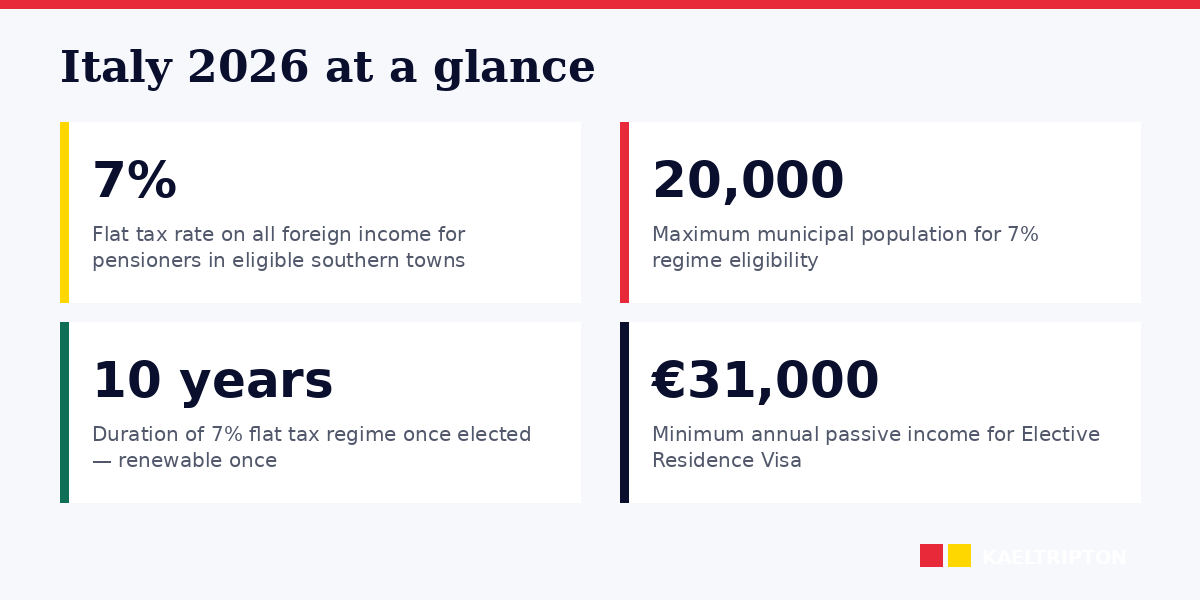
- Elective Residence Visa (ERV / Visto per Residenza Elettiva) - the traditional Italian retirement route. No work permitted. Minimum income around €31,000/year for a single applicant; substantially higher for families. Passive income only (pensions, rental income, investment returns). Property ownership or long-term rental required. Valid 1 year initially, converts to a permesso di soggiorno renewable for 2-year periods.
- Digital Nomad Visa - introduced April 2024 under Italy's 2022 Budget Law. Remote workers earning at least €28,000/year (2026 threshold) from non-Italian employers or clients. Initial 1-year visa, renewable subject to continued eligibility. Allows remote work for foreign employers only; limited Italian client work up to 20% of income.
- Self-Employment Visa (Lavoro Autonomo) - for UK nationals starting a business in Italy. Quota-restricted under Italy's Decreto Flussi (annual quota decree). Requires business plan, proof of qualifications, evidence of economic benefit.
- Work Visa (Lavoro Subordinato) - employer-sponsored, also quota-restricted under Decreto Flussi. Most applicants need a nulla osta (work permit) issued by the Sportello Unico per l'Immigrazione before the visa application.
- Investor Visa (Visto per Investitori) - for HNWI investors. Minimum investments: €250,000 in innovative Italian startups, €500,000 in Italian companies, €2m in Italian government bonds, or €1m in philanthropic initiatives. 2-year residence permit renewable for 3-year periods.
- Family reunification - for spouses and dependents of Italian residents.
The 7% flat tax: Europe's best retirement regime
Italy's most famous 2026 feature for UK retirees is the 7% flat tax regime under Article 24-ter of the Italian Income Tax Code (TUIR). It lets qualifying foreign pensioners pay a flat 7% tax on all foreign-source income - pensions, dividends, rental income, capital gains - for up to 10 years.
Eligibility:
- You receive a foreign pension (UK state pension, UK private pension, any non-Italian pension)
- You have not been an Italian tax resident in the previous 5 years
- You become resident in a municipality with under 20,000 inhabitants located in one of these southern regions: Sicily, Calabria, Sardinia, Basilicata, Campania, Abruzzo, Molise, Puglia, or in specific earthquake-repopulation zones in central Italy
Once elected, the 7% flat tax applies to all foreign-source income, not just the pension. A retired couple with a £35,000 UK teacher's pension, £8,000 in dividends, and £4,000 in UK rental income would pay roughly €3,290 total Italian tax on €47,000 of income - versus tens of thousands under standard Italian progressive rates.
The regime is elected in your first Italian tax return after becoming resident. Application is via your Italian tax adviser (commercialista) using Modello Redditi. Duration: 10 years.
Other Italian tax regimes worth knowing
Italy has evolved over the past decade into one of Europe's most tax-competitive destinations, with three distinct regimes for new residents:
- 7% flat tax for pensioners (described above)
- €200,000 flat tax for HNWIs (increased from €100,000 under the 2026 Budget Law) - any new Italian tax resident who hasn't been resident for 9 of the last 10 years can elect this. They pay €200,000/year as a flat tax on all foreign-source income, regardless of amount. Family members pay €25,000/year additional for the same regime. Duration: up to 15 years.
- Impatriate regime (Regime degli Impatriati) - for UK workers moving to Italy for employment. 50% of Italian employment income is exempt from Italian tax for 5 years. Can be extended to 10 years in specific circumstances (relocation to southern regions, presence of dependent children). Must be recruited from abroad and commit to Italian tax residency for at least 2 years.
These regimes can be combined: an impatriate worker with substantial foreign investment income could use the 50% exemption on Italian salary AND the €200,000 flat tax on foreign income simultaneously.
Standard Italian income tax (IRPEF) rates for 2026 (after the 2026 Budget Law reform):
- Up to €28,000: 23%
- €28,001 - €50,000: 33% (reduced from 35%)
- Above €50,000: 43%
Plus regional surcharges (1.23-3.33%) and municipal surcharges (0-0.9%), bringing the effective top rate to approximately 47%.
The application sequence
Three months before travel
- Obtain a codice fiscale (Italian tax code) - the foundation ID for every Italian administrative step. Free through the Italian Consulate in London, Manchester, or Edinburgh, or via a consulate appointment in person. Some lawyers charge €100-200 for remote assistance.
- Secure accommodation - rental contract or property deed - needed for every visa type.
- Arrange private health insurance with €30,000+ cover, no exclusions, valid in Italy. Required for every visa application. Typical cost €60-€150/month.
- Book the visa appointment at VFS Global or the Italian Consulate. Most consulates accept applications 90 days before the intended travel date.
The visa application
- ERV: passport, income proof (pension statements, bank records showing €31,000+ annual), rental contract or property ownership, health insurance, clean UK criminal record check (ACRO certificate), €116 application fee
- Digital Nomad Visa: passport, employment contract or freelance client contracts showing €28,000+ annual income, accommodation, health insurance, professional qualifications (degree or 3 years' experience), €116 fee
- Processing typically 60-90 days
Within 8 days of arrival
Apply for the permesso di soggiorno (residence permit) at your local Questura (police headquarters) or through the Poste Italiane kit system. The permesso replaces the visa as your legal document of stay. Fee around €100 plus €16 revenue stamp. Biometric appointment at the Questura follows within 2-3 months. The physical permesso card arrives 2-6 months later; a receipt (ricevuta) from Poste Italiane serves as evidence of status in the meantime.
Within 20 days of arrival
Register at your local Anagrafe (Registry Office) for the residenza (official residence). Required documents: permesso di soggiorno receipt, codice fiscale, rental contract, completed form. A home visit from a local officer confirms you actually live at the address; the official residenza is then registered. This triggers your taxe d'habitation-equivalent (IMU on second homes; TARI waste tax on all residences).
After residenza is confirmed
- Update your codice fiscale fiscal address at the local Agenzia delle Entrate office
- Register with SSN (Servizio Sanitario Nazionale) at your local ASL (Azienda Sanitaria Locale) - €2,000/year voluntary contribution for ERV holders, free for employed residents, free for S1 pensioners
- Exchange your UK driving licence for an Italian licence within 12 months of residenza
- Open an Italian bank account (Fineco, Intesa Sanpaolo, UniCredit all handle expats)
SSN healthcare
Italy's Servizio Sanitario Nazionale (SSN) ranks #2 globally by the WHO for healthcare quality. Registration routes vary by visa type:
- Employed residents: free, automatic via employer contributions
- ERV holders: voluntary SSN registration at approximately €2,000/year (F24 form, tax code 8846), covering the individual. Dependents must be added separately or via family registration if they meet income criteria
- UK state pensioners: free via S1 form, arranged with NHS Overseas Healthcare Services before leaving the UK
- Digital nomads and self-employed: voluntary SSN or private insurance; varies by region
Registration at the local ASL with passport, permesso, codice fiscale, and certificato di residenza issues the tessera sanitaria (Italian health card), the equivalent of the French Carte Vitale. Assigns you a GP (medico di base).
SSN fees are minimal where they apply - typical consultation is free, specialist visit €15-€35 ticket, prescription medications €0-€15. Private insurance widely used to supplement SSN for English-speaking consultations, faster specialist access, and private room hospital stays.
A real 2026 scenario: retired consultant from Leeds to Puglia
A retired management consultant from Leeds, 67, with a £45,000/year pension income, decides to relocate to Ostuni (a town of 30,500 in Puglia - too large for 7% flat tax eligibility) and consults with his adviser. The adviser identifies Martina Franca (19,800 residents) or Ceglie Messapica (18,500) as qualifying towns within 30 minutes of Ostuni. He chooses Martina Franca.
February 2026. Applies for codice fiscale via the Italian Consulate in Manchester. Arranges private health insurance with Generali Global (€95/month). Sets up a rental of a trullo-style stone farmhouse at €1,200/month on a 12-month contract.
April 2026. Submits ERV application at VFS with passport, UK pension statements showing £45,000 annual, rental contract, health insurance, ACRO certificate, €116 visa fee. Processing takes 8 weeks.
June 2026. ERV approved. Flies to Brindisi, collects passport at Bari consulate. Within 8 days applies for permesso di soggiorno at the Poste Italiane post office in Martina Franca. Within 20 days completes residenza registration at the Martina Franca Anagrafe.
August 2026. Residenza confirmed after home visit. Updates codice fiscale fiscal address. Applies for S1 healthcare through NHS Overseas Healthcare Services. Opens a Fineco Bank account.
September 2027. Files his first Italian tax return (Modello Redditi for 2026 partial-year income). Elects the 7% flat tax regime with proof of Martina Franca residence, his UK pension statements, and a self-certification confirming he wasn't Italian tax-resident in 2021-2025. €45,000/year foreign pension + €8,000 UK investment income = €53,000 total foreign income × 7% = €3,710 Italian tax. Under standard IRPEF this would have been roughly €14,000. Saves approximately £8,800 per year for 10 years.
Living costs in Martina Franca: rent €1,200, utilities €150, groceries €350, dining out/leisure €400, healthcare via S1 essentially free, fuel and transport €180. Total around €2,280/month for one person, versus equivalent UK lifestyle at £3,500+/month in Leeds.
Frequently asked questions
What counts as a "qualifying municipality" for the 7% flat tax?
Municipalities with under 20,000 inhabitants in Sicily, Calabria, Sardinia, Basilicata, Campania, Abruzzo, Molise, or Puglia. Also certain earthquake-repopulation zones in central Italy (Lazio, Umbria, Marche, Abruzzo). ISTAT publishes current population data by municipality; a town that crosses 20,000 during your 10-year window does not disqualify you retrospectively.
How does the 7% regime interact with UK tax?
UK government service pensions remain UK-taxable under the double taxation treaty (not covered by Italian residency). UK state pensions and private pensions become Italian-taxable once you are resident and elect the 7% regime. UK rental income on property retained there is primarily UK-taxable but must be reported in Italy. Under the UK-Italy treaty, if the foreign-source income is fully taxed in Italy (even at 7%), it is generally exempt in the UK beyond the initial UK deduction period.
Can I apply for Italian citizenship eventually?
Yes, after 10 years of legal residence (or 4 years for EU nationals, but post-Brexit UK citizens fall under the 10-year rule). Italy allows dual citizenship, so UK citizenship need not be relinquished. Italian language B1 proficiency is required from 2018 onwards.
Does the 7% flat tax apply to Italian-source income?
No. It only applies to foreign-source income. Any Italian-source income (Italian employment, Italian rental, Italian business profits) is taxed under standard IRPEF progressive rates. This is why the 7% regime suits retirees with passive foreign income rather than workers or entrepreneurs.
What's the catch with the Elective Residence Visa?
Working is not permitted - not in Italian employment, not remotely for UK employers, not as a freelancer. Some ERV holders have had permits revoked when Italian authorities discovered remote work. If you plan to continue any professional activity, the Digital Nomad Visa or Self-Employment Visa are the correct routes, not ERV.
How much does permesso di soggiorno cost?
Around €130-150 total: €70.46 for the residence permit card, €16 revenue stamp (marca da bollo), €30.46 administrative fee, plus €30 for renewal applications. Payable at the Poste Italiane post office when submitting the kit.
Can I rent rather than buy to qualify for ERV or the 7% regime?
Yes. A 12-month rental contract registered with the Italian tax authorities (Agenzia delle Entrate) is acceptable proof of accommodation for the visa and for establishing residenza. Purchase is not required. Many UK retirees rent for the first 1-2 years before deciding whether to buy.
Sources
- Italian Ministry of Foreign Affairs, Visa types - Visto per Residenza Elettiva, Lavoro Autonomo Digital Nomad, Investitori
- Agenzia delle Entrate, Article 24-ter TUIR (7% flat tax for foreign pensioners) and €200,000 flat tax regime (Budget Law 2026 update)
- Agenzia delle Entrate, Regime degli Impatriati (impatriate regime) - Decree 209/2023
- Italian Ministry of the Interior, Permesso di soggiorno and residenza registration
- GOV.UK, Foreign travel advice - Italy and Living in Italy
- NHS Business Services Authority, S1 certificates for UK pensioners moving to the EU
- HMRC, Double Taxation Convention with Italy
- Ministero della Salute, SSN registration for non-Italian residents


