

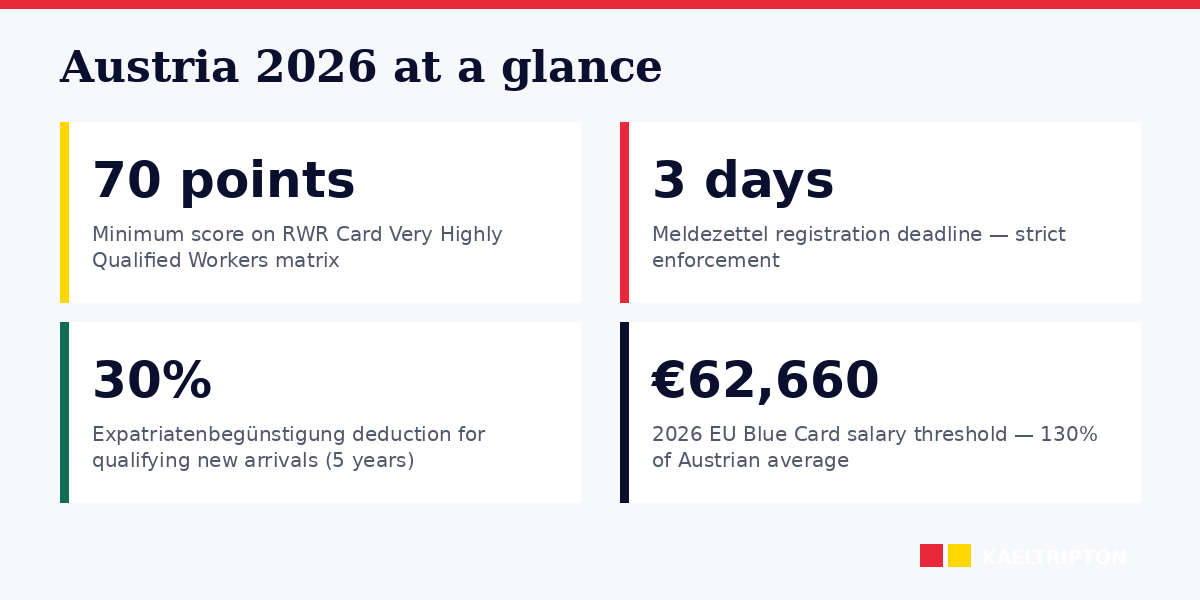
Moving to Austria from the UK in 2026 needs a residence permit for any stay over 6 months. The Red-White-Red Card (Rot-Weiss-Rot Karte) is Austria's main work-based route and uses a points-based system that is considerably more accommodating than German or Swiss equivalents for mid-career professionals. The Meldezettel address registration within 3 days of moving in is the binding rule - later than that and you risk fines and delays. Austria's federal structure and high quality of life have made it a quiet favourite among UK professionals in tech, pharmaceuticals, and the UN agencies based in Vienna. This guide walks through the visa routes, registrations, ÖGK health insurance, tax residency, and the expat-tax incentive that can save qualifying UK workers up to 30% on their Austrian income tax.
| ★ EDITOR'S VERDICT Points-based but fair, with one of Europe's best underrated tax breaks. |
Austria's Red-White-Red Card is genuinely welcoming for mid-career UK professionals - 70 points on education, experience, language, age are achievable for most under-45s with degrees. The Expatriatenbegünstigung 30% income deduction for 5 years is one of Europe's best-kept expat tax secrets: apply within 6 months or lose it forever. Vienna has the UN agency base, strong tech sector, and among the highest quality of life ratings in Europe. The catch: Austria doesn't permit dual citizenship for naturalised citizens, so most UK movers stay on the EU Long-Term Resident permit rather than naturalising. |
Visa routes: which applies to you
UK citizens are third-country nationals for Austrian immigration purposes. Short visits up to 90 days in a 180-day Schengen period need no visa. Longer stays require a residence permit. Unusually, Austria allows UK citizens (along with US, Canadian, Australian, Japanese, New Zealand, Serbian, and a few other nationalities) to enter visa-free and apply for the residence permit directly in Austria during the 90-day visa-free window - a significant advantage over the UK's experience in most of Europe.
- Red-White-Red Card (Rot-Weiss-Rot Karte) - the flagship route for qualified workers. Points-based system requiring 70 points minimum across education, experience, language skills, age, and salary. Valid 24 months initially, renewable. Five sub-categories: Very Highly Qualified Workers, Skilled Workers in Shortage Occupations, Other Key Workers, Self-Employed Key Workers, and Graduates of Austrian Universities.
- EU Blue Card - alternative to the RWR Card for university graduates earning at least 130% of the average Austrian wage (€62,660 in 2026). Portable across the EU after 18 months.
- Red-White-Red Card Plus - the follow-on permit after 21-24 months on the RWR Card or EU Blue Card. Gives unrestricted labour market access (no employer tie).
- Settlement Permit for Self-Employed (Niederlassungsbewilligung - selbständig) - for entrepreneurs with substantial investment, business plan, and evidence of economic benefit to Austria.
- Settlement Permit Excepted from Gainful Employment (Niederlassungsbewilligung - ausgenommen Erwerbstätigkeit) - for retirees and financially independent individuals with passive income of at least €2,160 per month (equalisation supplement reference rate).
- Family Reunification - for spouses and dependents of Austrian residents, requires basic A1 German before the visa is granted.
The Red-White-Red Card points system
The RWR Card for Very Highly Qualified Workers awards points across five categories. You need 70 out of 100 minimum:
- Qualifications: up to 40 points (PhD 40, Master's 30, Bachelor's 20, secondary-school-exit equivalent 15). Studies in STEM shortage areas get bonus points.
- Work experience: up to 20 points (2 points per year of experience in field)
- Language skills: up to 10 points (German A1 4 points, German A2 5 points, German B1 8 points, German B2 10 points; similar scale for English)
- Age: up to 20 points (under 35: 20 points; 35-39: 15 points; 40-44: 10 points; 45+: 0 points)
- Research/innovation awards: up to 20 points for patents, publications, major academic awards
Practical consequence: a 32-year-old with a UK Master's, 8 years of professional experience, and B2 German reaches 70 points comfortably (30 + 16 + 10 + 20 = 76). A 46-year-old with the same qualifications and B1 German reaches 66 points and would not qualify under this category - they would need the Skilled Workers in Shortage Occupations route or the EU Blue Card if salary matches.
The application sequence
From the UK (recommended for most categories)
- Secure a job offer or have business plan ready.
- Book an appointment at the Austrian Embassy in London (the only UK consulate accepting residence permit applications). Fingerprints are taken at the embassy.
- Submit application with passport, contract/business plan, education certificates (apostilled and translated into German by a court-certified translator), ACRO criminal record check, health insurance, accommodation evidence.
- Embassy forwards the file to the Austrian Magistrat or Bezirkshauptmannschaft for decision.
- Processing typically 4-8 weeks; longer in peak months.
- Fees: €120-€160 plus €20 personalisation fee.
In Austria (visa-free route for UK citizens)
UK citizens (and other "visa-free" nationalities) can enter Austria on their passport for up to 90 days and apply for the residence permit locally. Advantages: faster in practice; simpler for those with time on the ground; lets you view accommodation and secure a lease before committing to the application.
Disadvantages: if the application isn't decided before the 90-day visa-free period expires, you must leave the Schengen area until approval. For complex categories this can be a real risk.
Meldezettel: 3 days is the binding rule
Within 3 days of moving into any Austrian address, you must register at the local Meldeamt (usually the town hall or Magistrat citizen service desk) by completing a Meldezettel signed by you and your landlord. You receive the Meldebestätigung (confirmation of registration) and a unique national registration number.
This is the foundation document for nearly every subsequent step - opening a bank account, receiving your tax ID, enrolling with ÖGK health insurance, obtaining a mobile phone contract. Failure to register can attract fines of €50-€1,000, and more importantly, creates a paper-trail gap that complicates residence permit applications.
Two points worth flagging:
- The Meldezettel is different from the Anmeldebescheinigung (EU registration certificate, relevant only for EU/EEA/Swiss citizens, costs €15 - UK citizens no longer qualify for this).
- UK citizens on RWR Card or similar permits need an Aufenthaltstitel (residence permit card) in addition to the Meldezettel.
ÖGK health insurance
Austrian health insurance is legally mandatory for every resident and typically automatic:
- Employees: enrolled automatically in ÖGK (Österreichische Gesundheitskasse) via employer payroll. Contributions approximately 18.12% of gross salary, with employer paying roughly half.
- Self-employed: register with SVS (Sozialversicherung der Selbständigen). Contributions typically 24.7% of net profit with mandatory minimum contributions.
- Retirees and financially independent: voluntary ÖGK enrolment at around €500-€650 per month for a single applicant. S1-form holders (UK state pensioners) have their costs funded by the UK.
- Students: ÖGK student self-insurance at €70.72/month (2026 rate) for those under 35.
Once registered, you receive an e-card (digital health insurance card) used at every medical appointment. GP visits and specialist consultations are free at contracted practices (Kassenarzt); small co-payments apply for prescription medicines (€7.50 per item in 2026) and hospital stays (€12 per day capped at 28 days). Austria's healthcare ranks among Europe's top tier for quality and access.
Austrian tax: high but with a meaningful expat incentive
You become Austrian tax resident from the date you establish a home (Wohnsitz) in Austria, OR by spending more than 183 days in a calendar year. Once resident, worldwide income is taxable. 2026 progressive income tax rates:
- Up to €13,308: 0%
- €13,308 - €21,617: 20%
- €21,617 - €35,836: 30%
- €35,836 - €69,166: 40%
- €69,166 - €103,072: 48%
- €103,072 - €1,000,000: 50%
- Above €1,000,000: 55%
Social security contributions of approximately 18.12% (employees) or 24.7% (self-employed) apply on top of income tax, though with a contribution ceiling of €87,600 per year in 2026.
The expat tax incentive: Expatriatenbegünstigung
Austria operates one of Europe's lesser-known but meaningful expat tax incentives. Qualifying newly-arrived workers who have not been Austrian tax-resident in the previous 10 years can claim a 30% flat-rate income-related expenses deduction on their Austrian employment income for up to 5 years. Must be claimed within 6 months of establishing Austrian residency. For a €80,000 salary this saves around €9,600 per year in tax liability.
The UK-Austria double taxation agreement prevents double taxation. UK state pensions are taxable in Austria for Austrian residents. UK government service pensions remain taxable in the UK. UK ISAs are not recognised as tax-advantaged in Austria.
Long-term residence and citizenship
After 5 years of uninterrupted legal residence on an RWR Card, RWR Card Plus, or EU Blue Card, you can apply for the EU Long-Term Resident Permit (Daueraufenthalt EU). Requirements:
- 5 years continuous legal residence
- Integration Agreement Module 2 completion - effectively B1 German proficiency
- Stable income meeting the equalisation supplement rate (€2,160/month in 2026 for singles)
- Adequate accommodation
- Health insurance
- No serious criminal convictions
Austrian citizenship is strict - generally 10 years of residence with B1 German proficiency, integration test, no significant criminal record, and proof of self-sufficiency for the last 3 years. Austria does not generally allow dual citizenship, meaning most UK applicants must renounce UK citizenship to become Austrian. This is a major practical barrier; most long-term UK residents in Austria maintain EU Long-Term Resident Permit status instead.
A real 2026 scenario: pharmaceuticals engineer from Cambridge to Vienna
A pharmaceuticals engineer from Cambridge, 34, with a UK Master's and 9 years' experience at AstraZeneca, accepts a role at a Vienna-based biotech firm at €78,000/year.
March 2026. Checks the RWR Card points calculator: Master's 30 + 18 years × 2 = ends at 36 points for experience (capped at 20), B1 German 8 points, age 34 = 20 points, specialised pharmaceuticals patents = 8 points. Total 86 points. Comfortably qualifies under Very Highly Qualified Workers category.
April 2026. Austrian employer confirms job offer and provides signed contract. She books an appointment at the Austrian Embassy in London for late May.
May 2026. Submits application at the embassy with passport, contract, apostilled and certified-translated Master's certificate, ACRO check, private health insurance quote, rental contract for a Vienna apartment at €1,400/month. Fee €140.
July 2026. RWR Card approved. Flies to Vienna. Registers Meldezettel at her Mariahilf district Meldeamt within 2 days of arrival. Opens ÖGK health insurance via her new employer's HR, who also registers her for the mandatory ASVG social insurance.
August 2026. Applies for the Expatriatenbegünstigung via her first payroll run. Payroll withholding is calculated on 70% of her salary instead of 100%, saving approximately €9,400 per year in tax.
Annual tax take-home: €78,000 gross, roughly €49,500 net after income tax (reduced by Expatriatenbegünstigung) and social security contributions. Comparable to a £60,000 UK gross salary after deductions, but with substantially better healthcare, lower cost of living in Vienna than London, and closer proximity to the Alps.
Frequently asked questions
Do I need to speak German to get a Red-White-Red Card?
Not strictly for the initial application, though language points help reach the 70-point threshold. A1 German gives 4 points; B2 gives 10 points. Some RWR sub-categories require evidence of basic German (A1 or A2) before the permit is granted. Integration Agreement Module 1 (A2 German) is required within 2 years of initial residence permit issue.
Can I live in Austria while waiting for my RWR Card decision?
If you entered visa-free, yes - for up to 90 days. If the decision takes longer, you must leave the Schengen area and wait outside for the decision. This is one reason many UK applicants prefer to apply from the UK and wait for approval before travelling.
What's the difference between RWR Card and RWR Card Plus?
RWR Card is the initial 24-month employment-tied permit. RWR Card Plus is the follow-up after 21-27 months that removes the employer tie and grants unrestricted labour market access. RWR Card Plus is effectively a stepping stone to EU Long-Term Residence after 5 years.
Is Austria's healthcare better than the NHS?
Most foreign residents find Austria's healthcare provides faster specialist access than the NHS. Consultation with a Kassenarzt (contracted GP or specialist) is typically available within days rather than weeks. Hospital quality is high. Dental care is partially covered (major procedures require top-up insurance). Medication co-payments are low.
Does Austria recognise UK qualifications automatically?
For most regulated professions, no. Medical doctors, lawyers, and architects need formal qualification recognition through the relevant Austrian regulator before practising. Tech, pharmaceuticals, engineering, and most business roles don't require this - the employer's assessment is sufficient. Applications for qualification recognition go through the relevant Austrian chamber of professions.
Can I bring my UK-registered car to Austria?
Yes, but it must be re-registered with Austrian plates within 1 month of Meldezettel registration. Import under transfer-of-residence rules is tax-free if you've owned the vehicle 6+ months before the move. TÜV-equivalent NoVA (registration tax) and motor vehicle tax apply. Cost typically €300-€1,200 depending on vehicle type.
Does the Austrian tax year run on the calendar?
Yes. Austrian tax returns are due annually by 30 April of the following year for paper filing, 30 June online. Self-employed and complex-income cases can extend to September through a tax adviser (Steuerberater). First partial-year return covers the period from your Austrian tax residency start to 31 December.
Sources
- Austrian Federal Ministry of the Interior (BMI), Residence and Settlement Act (Niederlassungs- und Aufenthaltsgesetz) - residence permit categories
- Make it in Austria (Federal Government platform), Red-White-Red Card points system - migration.gv.at
- BMEIA (Federal Ministry for European and International Affairs), Austrian Embassy London - residence permit applications
- Austrian Federal Ministry of Finance (BMF), Income Tax Act 2026 (EStG) brackets and Expatriatenbegünstigung provisions
- ÖGK (Österreichische Gesundheitskasse), Public health insurance contributions and coverage 2026
- GOV.UK, Foreign travel advice - Austria and Living in Austria
- HMRC, Double Taxation Convention with Austria
- Federal Government Agreement of 31 January 2025 (language and integration test proposals for permanent residence)


