

Moving to Germany from the UK in 2026 needs a residence permit for any stay beyond 90 days. Job-seeker visa, standard work permit, EU Blue Card (€50,700 salary threshold for 2026), freelance permit (Freiberufler) or family reunification cover most UK movers. Germany's combination of well-paid employment, world-class healthcare and structured public administration makes it a common choice for UK professionals, though the bureaucracy rewards careful sequencing. This guide walks through visa routes, the Anmeldung registration, German health insurance (mandatory), tax residency, and the path to permanent residence (Niederlassungserlaubnis).
| ★ EDITOR'S VERDICT Blue Card if you qualify. Anmeldung within 14 days. GKV before everything. |
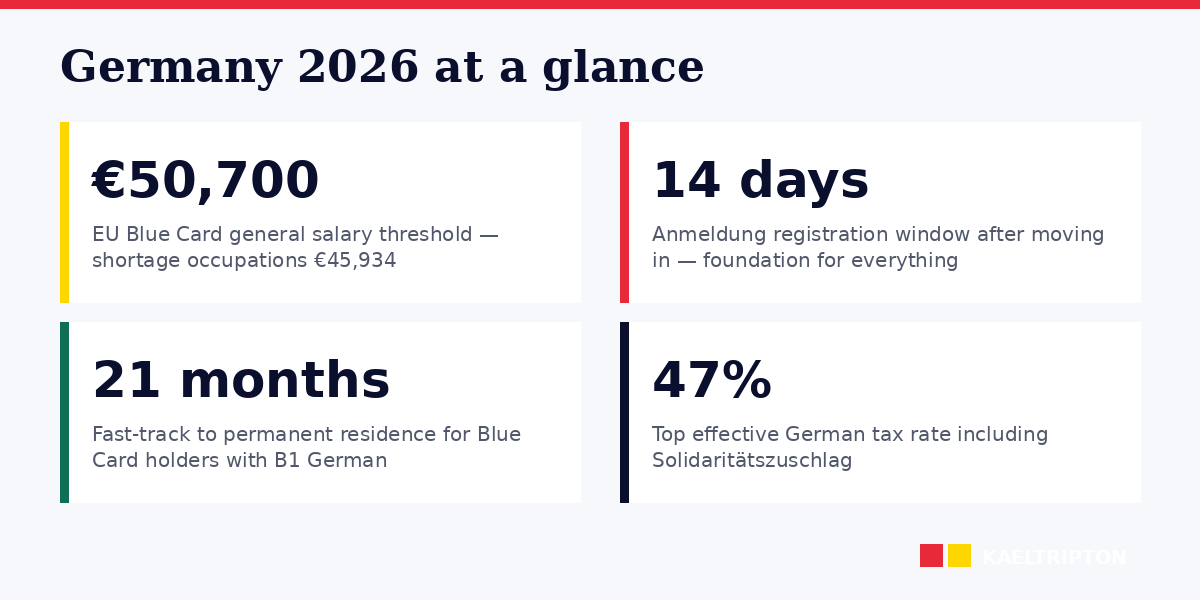
Germany is procedurally heaviest of the four relocation destinations in this batch but rewards careful sequencing. EU Blue Card at €50,700 (€45,934 for shortage roles) is the fast-track for qualified UK professionals - 21 months to permanent residence with B1 German is genuinely achievable. The Anmeldung is the key step that unlocks everything else, so prioritise a long-term rental with a cooperative landlord. Statutory health insurance is mandatory, widespread, and works well. |
The 90-day rule and the visa routes that follow
Since January 2021 UK nationals are third-country citizens under EU immigration law. Short stays up to 90 days in any 180-day Schengen period need no visa. Longer stays require a residence permit applied for before arrival, or - as a concession - within 90 days of arriving if you entered visa-free.
The five routes most UK movers use:
- EU Blue Card - for university graduates with a job offer. 2026 minimum gross salary is €50,700/year, reduced to €45,934.20 for shortage occupations (engineering, IT, healthcare) and new graduates within 3 years of completing their degree. IT specialists without a degree can qualify by showing 3 years of relevant professional experience. Fast-track to permanent residence (21 months with B1 German, 27 months with A1 German).
- Standard work visa / residence permit for employment - any qualified job offer from a German employer. Minimum salary is generally the market rate for the role; Blue Card thresholds do not apply here.
- Job seeker visa - 6 months to find work in Germany. University degree and financial self-support required. Converts to a work permit once you have a job offer.
- Freelancer/self-employment permit (Freiberufler / Selbständige Tätigkeit) - for recognised liberal professions (IT consultants, journalists, translators, architects, tax advisers, artists, healthcare professionals). Needs a business plan, evidence of German clients or customers, financial projections, and adequate health insurance.
- Family reunification - spouse or registered partner of a German or resident with permission to work. Basic A1 German usually required before the visa is granted (with narrow exemptions).
The application sequence
Two sequences are possible - applying in advance at the German Embassy in London, or entering visa-free and applying in Germany. The second route is faster for UK citizens (who are specifically exempted from the general MVV entry-visa requirement) but has trade-offs.
Applying from the UK
- Book an appointment at the German Embassy in London or the Consulate General in Edinburgh or Manchester via the Auswärtiges Amt booking portal. Appointments often booked 4-8 weeks ahead.
- Submit the application with passport, job offer or business plan, proof of qualifications (apostilled if needed), health insurance, proof of accommodation.
- Processing typically 4-12 weeks.
- On approval, receive a D-visa (National Visa) in your passport valid for 3-6 months.
- Travel to Germany and complete Anmeldung and residence permit conversion within that window.
Applying after visa-free arrival
- Enter Germany with your UK passport (no visa needed for 90 days).
- Within 14 days of establishing a residence, complete Anmeldung at the local Einwohnermeldeamt or Bürgeramt with passport, Wohnungsgeberbestätigung (landlord confirmation) and rental contract. You receive the Anmeldebestätigung - the foundation document for everything that follows.
- Arrange mandatory health insurance (statutory GKV if employed, private PKV if self-employed or high-income).
- Book an appointment at the Ausländerbehörde (Foreigners' Authority). Some Berlin and Hamburg appointments are booked 3-6 months ahead in 2026; smaller cities are faster.
- Attend with full application pack. If your 90-day window is running out before the appointment, some Ausländerbehörde offices issue a Fiktionsbescheinigung (temporary residence certificate) letting you stay and, depending on visa type, work while the application is processed.
Anmeldung: the foundation document
Anmeldung (address registration) is the single most important administrative step in Germany. You cannot open a German bank account, sign a long-term mobile phone contract, get a tax ID, or complete a residence permit application without your Anmeldebestätigung. The 14-day rule from the date you move in is treated strictly in some cities (€50-€1,000 fines for late registration, though these are rarely enforced) and more loosely in others.
To register you need a Wohnungsgeberbestätigung - a one-page form your landlord signs confirming you live at the address. Many landlords are familiar with the form; if not, the city websites publish a template. Short-term rentals (Airbnb) usually cannot issue valid Wohnungsgeberbestätigung.
Your Steueridentifikationsnummer (tax ID) arrives by post within 2-3 weeks of Anmeldung. This is the second foundation number; you need it for a first paycheque, among many other things.
Health insurance: legally mandatory
Germany makes health insurance mandatory for every resident. You cannot receive a residence permit without proof of adequate coverage. The two systems:
- Gesetzliche Krankenversicherung (GKV) - public statutory insurance. Standard route for employees below €73,800 gross annual salary (2026 threshold). Contributions around 14.6% of gross salary plus Zusatzbeitrag (averaging 1.7% in 2026), split roughly 50/50 between employer and employee. Family members covered at no extra premium.
- Private Krankenversicherung (PKV) - private insurance. Option for employees above €73,800, self-employed, freelancers, civil servants. Premiums €200-€600+/month depending on age, health history, cover level. Family members pay individual premiums.
UK state pensioners moving to Germany can use the S1 form to have the UK fund their German GKV coverage, same as in France or Spain. Apply for the S1 through the NHS Overseas Healthcare Services before leaving the UK.
Working-age movers typically need private international health insurance for the visa application stage, switching to GKV or PKV once employment starts or the residence permit is issued.
Tax: worldwide income once resident
You become German tax-resident if you have a permanent home in Germany (Wohnsitz) or habitually reside there for more than 183 days in a calendar year. Once resident, you are subject to German income tax (Einkommensteuer) on worldwide income. Rates for 2026:
- €0 - €12,096: 0%
- €12,097 - €17,443: 14-24% progressive
- €17,444 - €68,480: 24-42% progressive
- €68,481 - €277,825: 42%
- Above €277,826: 45% (Reichensteuer)
On top of income tax, a 5.5% Solidaritätszuschlag applies only to high earners (above roughly €96,000 for singles), plus church tax (8-9%) if registered with a church. The UK-Germany double taxation agreement prevents being taxed twice on the same income. UK state pensions are taxable in Germany for German residents; UK government service pensions remain taxable in the UK.
Before leaving the UK complete HMRC form P85. You usually remain UK-resident until the end of the UK tax year in which you leave. German tax filing runs on calendar years; your first German return covers the period from your tax residency start to 31 December, due by 31 July of the following year (with extensions available through a Steuerberater).
Permanent residence: Niederlassungserlaubnis
Temporary residence permits are renewable and typically issued for 1-3 years at a time. After 5 years of continuous legal residence (minus any absences over 6 months), you can apply for permanent residence (Niederlassungserlaubnis) with:
- 60 months of pension insurance contributions (reduced for some visa types)
- B1 level German language proficiency
- Passed Einbürgerungstest (naturalisation test) or "Leben in Deutschland" integration test
- Adequate income and accommodation
- No recent criminal convictions
Faster routes exist. EU Blue Card holders qualify for Niederlassungserlaubnis after 21 months with B1 German or 27 months with A1 German. Successful self-employed entrepreneurs can qualify after 3 years if the business is sustainable. Skilled workers on specific qualified-worker residence permits qualify after 3 years with B1 German.
German citizenship follows after a further 3 years of Niederlassungserlaubnis under the 2024 citizenship reforms (previously 8 years total; now typically 5 years for well-integrated applicants, or 3 years for exceptional integration).
A real 2026 scenario: software engineer from Bristol to Munich
A software engineer from Bristol accepts a job with a Munich-based autonomous driving startup at €82,000/year. She relocates in August 2026.
May 2026. Signs the Munich job contract. Confirms her role qualifies for an EU Blue Card (IT specialist, above the €50,700 general threshold).
June 2026. Books an appointment at the German Consulate in Manchester for mid-July. Employer provides the Blue Card application template. She gathers her university degree (notarised and apostilled), employment contract, rental contract for a temporary furnished Munich flat, German private health insurance for the visa application.
August 2026. Blue Card approved. Flies to Munich with the D-visa. Completes Anmeldung at the KVR (Kreisverwaltungsreferat) within 7 days of moving in. Tax ID arrives by post 12 days later.
September 2026. Starts work. Switches from private health insurance to statutory GKV via Techniker Krankenkasse (her employer's default partner). Opens a bank account with N26 using her Anmeldebestätigung. Visits the KVR to convert the D-visa to a full Blue Card residence permit (€147 fee) - approved on the spot, card arrives in 4 weeks.
Total first-year admin costs: visa fee €75, Blue Card card fee €147, health insurance (first three months private) €480, Anmeldung free, translation and apostille £180. Approximately £650 in one-off administrative costs for the move. After 21 months (May 2028) she qualifies for Niederlassungserlaubnis if her German reaches B1.
UK driving licence in Germany
UK licence holders can drive in Germany on a UK licence for the first 6 months of residency. After that, the licence must be exchanged for a German Führerschein. The exchange is free if you qualify under the UK-Germany reciprocity agreement (most UK categories are directly exchangeable without a test) at your local Führerscheinstelle. Allow 3-6 months for the exchange; apply before the 6-month deadline to avoid driving without a valid licence.
Frequently asked questions
Do I need to speak German to get a residence permit?
Generally no for the initial residence permit. EU Blue Card, standard work permits and freelancer permits do not require German language skills at application. Family reunification usually requires A1 German (with exemptions for highly qualified workers' dependents). B1 German is required for permanent residence (Niederlassungserlaubnis) for most permit types, reduced to A1 for EU Blue Card holders after 27 months.
Can I work on a job seeker visa while looking for a job?
No, not in paid employment. You can attend interviews, trial shifts and training but cannot take up paid work. Once you have a job offer, you apply to convert the job seeker visa into a work residence permit, which takes 2-4 weeks at your local Ausländerbehörde.
Is the €4,500 bank deposit for the DAFT visa relevant for UK citizens?
No. The DAFT visa is US-only under the 1956 Dutch-American Friendship Treaty (used for the Netherlands, not Germany). UK freelancers moving to Germany use the Freiberufler or Selbständige Tätigkeit route instead, which has no fixed capital requirement but requires a viable business plan and evidence of demand.
How quickly can I open a German bank account?
Online-first banks (N26, DKB, Commerzbank's Girokonto) typically open accounts within 2-5 days of Anmeldung. Traditional branch-based banks like Sparkasse or Deutsche Bank take 2-4 weeks and require in-branch appointments. All need Anmeldebestätigung, passport, and a German address.
Can I bring my UK-registered car to Germany?
Yes, but it must be re-registered with German plates within 6 months. Import under transfer-of-residence rules is tax-free if you've owned the vehicle for at least 6 months before the move. TÜV inspection required. Cost roughly €200-500 for registration, plus any necessary modifications (headlight adjustment, daytime running lights if not fitted).
What if my employer hasn't got a vacant sponsor slot?
Not an issue in Germany - there is no employer sponsorship licence system as in the UK Skilled Worker route. German work residence permits are granted on the basis of the individual job offer and qualification match, without employers needing pre-approved sponsor status.
Do I need to pass the Leben in Deutschland test?
Only for permanent residence (Niederlassungserlaubnis) and citizenship. The test has 33 questions on German society, history, law and politics, with a pass mark of 17. Available in German only. Preparation courses widely available at Volkshochschulen and online.
Sources
- Make it in Germany (Federal Government portal), Skilled Immigration Act and EU Blue Card thresholds 2026
- Bundesamt für Migration und Flüchtlinge (BAMF), Niederlassungserlaubnis and integration requirements
- Federal Foreign Office (Auswärtiges Amt), Visa categories and D-visa applications
- GOV.UK, Foreign travel advice - Germany and Living in Germany
- NHS Business Services Authority, S1 certificates for EU healthcare
- HMRC, Double Taxation Convention with Germany
- Bundesministerium der Finanzen, Einkommensteuer 2026 brackets
- Aufenthaltsgesetz (Residence Act) - consolidated text at gesetze-im-internet.de


