

Moving to France from the UK in 2026 is a long-stay visa (VLS-TS) applied at the French consulate at least three months before travel, proof of income at or above the French minimum wage (SMIC), and private health insurance. UK nationals are now third-country nationals under French immigration law. The good news: France remains one of the most accessible EU destinations for UK relocators, with a well-defined visitor visa route for retirees and financially independent movers. This guide covers the realistic sequence from decision to settling in, the 2026 fee changes, French tax residency rules, and the healthcare registration process.
| ★ EDITOR'S VERDICT Visa before travel. PUMA after arrival. Carte de séjour before year one ends. |
France remains the most accessible EU destination for UK relocators. VLS-TS Visiteur is the route for most retirees and financially independent movers. Apply three months before travel, prove €1,430+ monthly income, show private health insurance, validate within three months of arrival. The 2026 carte de séjour fee rose from €200 to €300 from 1 May. UK state pensioners use the S1 route into PUMA for UK-funded French healthcare - apply before leaving the NHS. |
The 90-day rule and why a long-stay visa matters
Under post-Brexit Schengen rules, UK nationals can visit France without a visa for up to 90 days in any rolling 180-day period. For stays of 91 days or more, a long-stay visa is mandatory and must be applied for from the UK before travel. Attempting to convert tourist status to residency after arrival is not possible - France does not operate an in-country switch route for UK visitors.
The most common long-stay visa for UK movers is the Visa de Long Séjour valant Titre de Séjour (VLS-TS), which doubles as a temporary residence permit for 4 to 12 months. The "Visiteur" category is the route for retirees and financially independent individuals who do not intend to work for a French employer. Other categories exist for students, workers, family reunification and the Passeport Talent programme for skilled professionals.
The income requirement in 2026
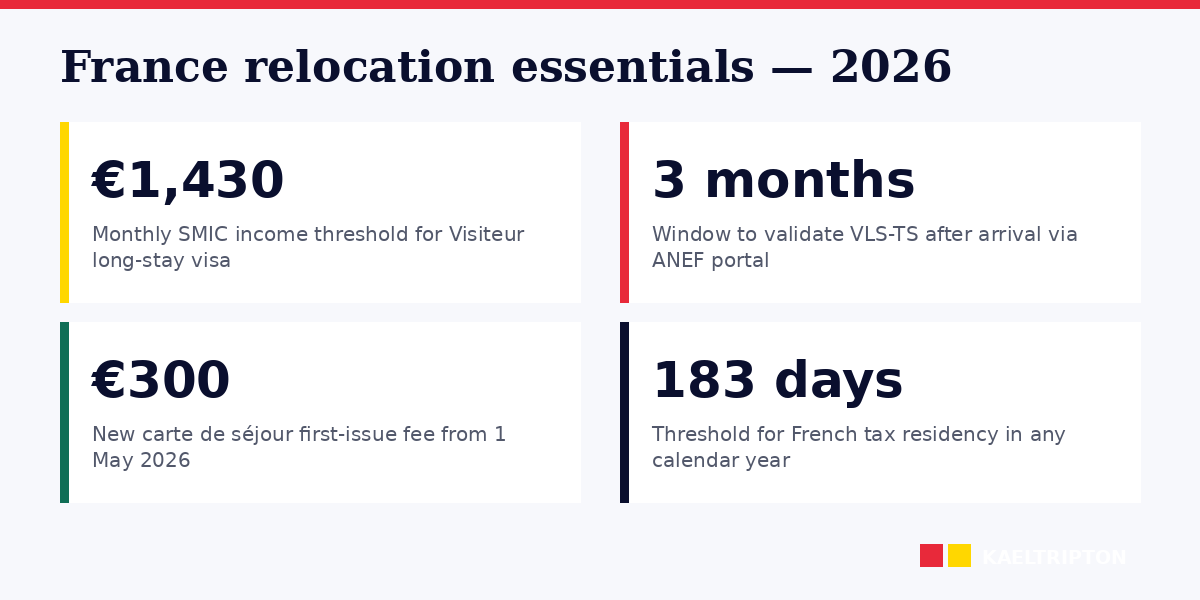
French consulates require applicants to demonstrate financial resources at least equal to the French minimum wage (Salaire Minimum Interprofessionnel de Croissance, SMIC). As of early 2026, this threshold is approximately €1,430 net per month for a single applicant. The figure is revised annually each January when the SMIC is updated.
Evidence accepted:
- UK state pension letters or other pension scheme statements
- Bank statements covering the past 6-12 months showing stable income or sufficient savings
- Investment income evidence (dividends, rental income)
- For couples, combined income of roughly €1,700-€1,900 is typical expectation, though consulates assess individually
The SMIC is a floor, not a target. Consulates prefer evidence of income comfortably above the minimum, particularly for Visiteur visas where you are committing not to work. A settling-in fund of around £10,000 in addition to regular income is a sensible buffer for the first year.
The application sequence
Six months before travel
- Confirm which visa category matches your circumstances (Visiteur, Passeport Talent, family, student)
- Start gathering documents: passport valid for the stay duration, six months of bank statements, pension letters, clean criminal record check (ACRO certificate from UK police)
- Arrange private health insurance covering France (typical cost £600-£1,500 for a year of comprehensive cover for a single applicant)
- Begin property search - long-term rental contracts are acceptable evidence of accommodation, but purchases often take 3-4 months
Three months before travel
This is the earliest most French consulates accept visa applications. Submit online via france-visas.gouv.fr, then book an in-person appointment at TLScontact or VFS Global (the third-party centres handling UK visa appointments). Attend with originals and copies of all documents. Fees in 2026 are €99 for the visa itself, plus TLScontact processing charges of around £40.
Processing time: typically 2-6 weeks. The consulate retains your passport during assessment.
On arrival in France
Your VLS-TS is valid for the visa period but you must validate it within 3 months of arrival via the Administration Numérique des Etrangers en France (ANEF) portal at administration-etrangers-en-france.interieur.gouv.fr. Miss the validation window and your stay becomes irregular.
Within the same 3-month window you may also be required to attend an OFII medical examination (typically chest X-ray plus general health screening) and in some cases sign the Contrat d'Intégration Républicaine (CIR), which commits you to civic education and French language assessment.
Before the VLS-TS expires
Two months before the visa expiry date, apply for a full carte de séjour (residence permit) via the ANEF portal. The card is typically valid for 1-4 years depending on category and is renewable. As of May 2026 the standard first-issue fee for most carte de séjour types rises from €200 to €300; reduced-rate categories (students, family reunification) rise from €50 to €100. Applications completed before 30 April 2026 secure the lower fees.
From 1 January 2026, all first-time applicants for a carte de séjour pluriannuelle (multi-year card) or a 10-year resident card must pass two state-run tests covering French language proficiency and knowledge of French civic values.
French tax residency: the 183-day rule
You become a French tax resident in any calendar year in which you spend 183 days or more in France, or if France becomes your centre of economic interests. Once tax-resident, you must declare your worldwide income to the French tax authorities (Direction Générale des Finances Publiques), regardless of where the income is sourced.
The UK-France double taxation agreement prevents you paying tax twice on the same income. UK state pensions are taxed in France (not the UK) for French tax residents. UK government service pensions remain taxable in the UK. UK rental income on property you still own remains primarily UK-taxable, though it must be declared in France too.
Before leaving the UK, complete HMRC form P85 to update your UK tax status. You typically remain UK-resident until the end of the UK tax year in which you leave, then become French-resident from the day you establish residence.
French income tax is progressive, with rates from 0% (up to €11,497 in 2026) through 11%, 30%, 41% and up to 45% for income over €180,294. French residents also pay social charges (prélèvements sociaux) on most income at around 17.2%, though EU and EEA pensioners with S1 cover are exempt from these on UK pension income.
Healthcare: from NHS to PUMA
Once tax-resident in France, NHS coverage ends. France's universal healthcare system, Protection Universelle Maladie (PUMA), provides access to the French state healthcare system for anyone lawfully resident for more than three months. PUMA covers approximately 70% of most medical costs; most residents top this up with voluntary complementary insurance called a mutuelle (typically €40-€120 per month depending on age and cover level).
UK state pensioners qualify for an S1 form from the NHS Overseas Healthcare Services, entitling them to join PUMA on the same terms as French citizens, with the UK funding their care rather than the French social security budget. Apply for the S1 before you leave the UK; processing takes 4-8 weeks.
During the gap between arrival and PUMA registration (which itself can take 3-6 months), private cover is essential. Most French consulates require proof of private health insurance as part of the visa application, so this is sorted before travel anyway.
After PUMA registration completes, you receive a social security number (numéro de sécurité sociale) and a Carte Vitale, the green chip card used at every French medical visit.
Property and housing
UK nationals can buy property freely in France. There are no restrictions on foreign ownership. The process is different from the UK:
- Purchase is handled by a notaire, a state-licensed legal officer who represents both parties neutrally
- You sign a compromis de vente (preliminary agreement) roughly 2-3 months before completion
- A 10-day cooling-off period runs from the date you receive the compromis
- Deposit at compromis stage is typically 5-10% of the purchase price
- Completion at the notaire's office with an acte de vente (final deed)
Transaction costs in France are meaningful. Buyers pay notaire fees of approximately 7-8% on older properties and 2-3% on new builds, plus ongoing taxe foncière (owner's council tax) and taxe d'habitation (occupier's council tax, now largely abolished on main residences but retained on second homes).
A real 2026 scenario: retiring from Manchester to the Dordogne
A couple from Manchester, both 62, sell their house and relocate to a village near Sarlat in the Dordogne in May 2026. Here is their actual sequence.
November 2025 (six months out). They list their Manchester house with a local estate agent. They start gathering papers: passports, combined pension documentation showing €2,100/month joint income, UK criminal record checks via ACRO.
January 2026. They visit the Dordogne for a week, view 8 properties, put an offer on a rural farmhouse at €285,000. The compromis is signed with a target completion in April.
February 2026. They book a TLScontact appointment in Manchester. Two weeks later they attend with their full document pack and hand over their passports. Processing takes 4 weeks.
March 2026. Both passports returned with VLS-TS Visiteur visas valid for 12 months from their intended arrival date. They apply for S1 forms via the NHS Overseas Healthcare Services.
April 2026. House completion in France. They move their belongings using a European removal company (approximately £6,500 including the Transfer of Residence customs paperwork).
May 2026. They arrive in France and validate the VLS-TS online within 3 weeks. OFII medical exam booked for July. Apply for PUMA registration immediately; Carte Vitale arrives in September.
April 2027. Two months before visa expiry, they apply online via ANEF for a carte de séjour "Visiteur" valid for 1 year, renewable. Fee paid is €300 per person under the post-May 2026 schedule.
Total first-year cost excluding property and removal: visa fees £80 each, S1 processing free, private health insurance £2,400 for the transition period, OFII fees €250 each, carte de séjour renewal €300 each, legal and translation costs around £600. Around £5,000 in administrative costs for the full process.
UK driving licence in France
UK licence holders can drive in France for the first year of residency on their UK licence. After 12 months, UK licences must be exchanged for a French permis de conduire. The exchange is free, no driving test needed (under the UK-France exchange agreement), and handled through the ANTS portal (ants.gouv.fr). Allow 2-4 months for processing.
For everything else about driving in France (compulsory kit, Crit'Air stickers, speed limits, tolls), see our guide to driving in France from the UK.
Frequently asked questions
Do I need a long-stay visa if I only want to spend 6 months in France?
Yes. Any stay over 90 days in a rolling 180-day Schengen period requires a visa. A 6-month stay triggers the long-stay requirement regardless of whether you intend to become a permanent resident.
Can I apply for a French long-stay visa if my UK property has not yet sold?
Yes, if you can show adequate liquid funds in bank statements to support yourself in France during the transition. The consulate also requires evidence of French accommodation - a long-term rental contract works if your purchase is not yet complete.
What is the difference between VLS-TS and VLS-T?
VLS-TS (valant titre de séjour) doubles as a residence permit and allows you to stay and access public services including healthcare. VLS-T (temporaire) is a fixed-term long-stay visa that does not confer residency rights and cannot be extended without leaving France and reapplying. For genuine relocators, VLS-TS is the correct route.
How long does a carte de séjour take to arrive?
Processing times through ANEF have improved through 2025 but remain uneven by prefecture. Typical 2026 waits are 3-6 months from application to card collection. Applicants close to visa expiry are advised to apply 2 months before expiry rather than right up against the deadline.
Do I need to speak French to get a carte de séjour?
For the initial 12-month Visiteur visa, no French language test is required. For the multi-year carte de séjour pluriannuelle from 1 January 2026, applicants must pass French language and civic values tests. The language requirement is typically A2 level (elementary conversational French). Passeport Talent visas have their own language criteria.
Can I work in France on a Visiteur visa?
No. The Visiteur visa explicitly prohibits working for a French employer. You may continue to work remotely for a UK or non-French employer from France, though French tax residency rules will apply to the income once you cross 183 days. For local employment, Passeport Talent, a standard Travailleur visa, or the salarié / salarié détaché routes are the correct options.
What happens to my NHS entitlement when I move to France?
You lose automatic NHS entitlement when you become tax-resident in France. UK state pensioners retain healthcare cover through the S1 form arrangement, with the UK funding their French healthcare. Working-age movers without S1 rely on PUMA and complementary insurance. Non-residents visiting the UK briefly retain emergency-only access via the Global Health Insurance Card (GHIC).
Sources
- France-Visas, Long-stay visa - france-visas.gouv.fr
- Service-Public.fr, Titre de séjour et carte de séjour
- Ministère de l'Intérieur, Administration Numérique des Etrangers en France (ANEF)
- GOV.UK, Foreign travel advice - France and Living in France
- NHS Business Services Authority, S1 certificates for UK state pensioners moving to the EU
- HMRC, P85 form for leaving the UK and Double Taxation Convention with France
- Direction Générale des Finances Publiques, French tax residency and Impôt sur le Revenu 2026 thresholds
- Assurance Maladie, PUMA and Carte Vitale registration


