

Moving to Poland from the UK in 2026 needs a long-stay Type D visa or a temporary residence permit (Temporary Residence Card, TRC) for any stay over 90 days. The MOS (Moduł Obsługi Spraw) digital portal became mandatory on 1 January 2026 - all residence permit applications now go exclusively through the online system, paper submissions at voivodeship offices are rejected. Fees quadrupled from 1 January 2026: standard residence permit is now PLN 400 (up from PLN 100). PESEL (national identification number) and meldunek (address registration) are the foundation of your legal stay. Poland combines a fast-growing economy, extremely low cost of living relative to Western Europe, and reasonable tax rates for employees. This guide covers the 2026 MOS process, PESEL registration, NFZ healthcare, tax brackets, and the path to permanent residence.
| ★ EDITOR'S VERDICT Poland 2026 is MOS-only, fees quadrupled, but still excellent value. |
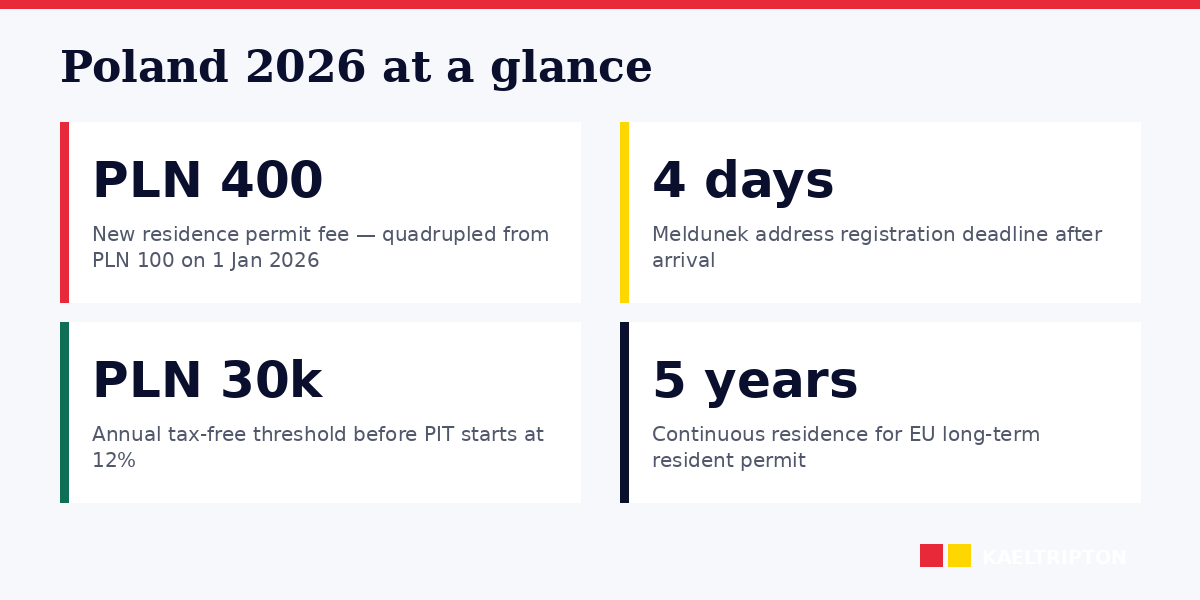
From 1 January 2026, every residence permit application goes through the MOS digital portal. Paper submissions are rejected. Fees jumped from PLN 100 to PLN 400 (roughly £78) and biometrics are now in-person-only. The 4-day meldunek registration window is critical - miss it and the PESEL number is delayed, which blocks banking, healthcare, and the TRC application itself. Even with fee increases, Poland remains one of the best value-for-career destinations in the EU - Kraków, Warsaw and Wrocław tech salaries have risen sharply while costs remain 40-50% below London. |
The 2026 MOS system: what changed
Poland's Ministry of the Interior rolled out a fundamental overhaul of the residence permit process at the start of 2026. The changes in force from 1 January 2026:
- MOS (Moduł Obsługi Spraw) is mandatory. All temporary residence permit applications must be filed through the online portal. Voivodeship offices no longer accept paper walk-in submissions.
- Fees quadrupled. Standard residence permit rose from PLN 100 (approximately £20) to PLN 400 (approximately £78). Posted-worker permits are PLN 800.
- Biometric data now in person only. Proxy applications for biometrics are no longer accepted - applicants must attend in person.
- Central Foreigner Register cross-checks. The MOS system links to the tax authority (ZUS), labour office, and educational institutions. Claims made in applications are cross-verified automatically.
- Official 60-day decision time - but first-quarter 2026 backlogs are likely as offices work through the transition.
Practical consequence: applications need to be pre-assembled more carefully than before. The system auto-rejects incomplete uploads. HR teams and individual applicants should pre-collect notarised passport copies, health insurance proof, and accommodation leases before filing.
Visa and residence permit routes for UK citizens
UK citizens became third-country nationals for Polish immigration from 1 January 2021. The main routes for legal long-stay:
- Type D long-stay visa - issued by the Polish Consulate in London, Edinburgh, or Belfast for stays longer than 90 days and up to 1 year. UK citizens have visa-free tourist access up to 90 days; the Type D is typically preceded or replaced by in-country TRC application for employment-based moves.
- Temporary Residence Card (TRC) - the main long-stay permit for UK nationals. Applied for in-country via MOS. Valid up to 3 years initially, renewable. Sub-categories cover employment, EU Blue Card, business activity, student, family reunification, and "other purposes".
- EU Blue Card Poland - for UK nationals with higher education and a qualifying job offer. 2026 minimum monthly salary approximately PLN 10,840 (roughly £2,125). Faster permanent residence path than standard TRC.
- Business activity permit - for UK nationals founding or registering a business (sole proprietorship JDG) in Poland. Demonstrates genuine economic contribution; not a "hang out" visa.
- Family reunification - for spouses and dependants of Polish residents or EU nationals living in Poland.
- Withdrawal Agreement residents - UK nationals lawfully resident in Poland before 31 December 2020 have rights under the Withdrawal Agreement. Residence document issued separately. No new permit needed for this group.
The application sequence in 2026
Before travel
- Secure a job offer (Blue Card or standard employment) or business registration plan
- Gather required documents: passport, employment contract or business documents, educational certificates (notarised and translated into Polish by a sworn translator - "tłumacz przysięgły"), UK ACRO criminal record check with apostille, health insurance
- Arrange accommodation - long-term rental contract preferred; short-term serviced apartments rarely qualify for meldunek registration
- Obtain a Trusted Profile (Profil Zaufany) once you have a PESEL - required for accessing MOS and virtually every Polish e-government service
On arrival (within the first 4 days)
- Register your address at the local commune office (urząd gminy) - "meldunek" procedure, within 4 days of arrival. Bring passport, rental contract, signed declaration from landlord.
- Apply for PESEL at the commune office or municipal ID office. PESEL is the 11-digit national identification number used for banking, healthcare, tax, employment. Processing typically 7-14 days.
- Set up Profil Zaufany online at profilzaufany.gov.pl using your PESEL. This unlocks MOS and Poland's wider e-government system including ePUAP.
- File the TRC application through MOS before your initial 90-day visa-free period expires. Pay PLN 400 residence permit fee. Attend in-person biometrics appointment at your voivodeship office.
Within first month
- Open a Polish bank account (mBank, PKO BP, Santander are expat-friendly; Revolut offers Polish IBANs as a digital alternative)
- Register with NFZ (Narodowy Fundusz Zdrowia) for public healthcare via your PESEL and residence documentation
- Register with ZUS (social insurance) if self-employed or employed directly (employer handles this for salaried staff)
- Register for PIT (income tax) via the US (Urząd Skarbowy) tax office
Polish tax residency
You become Polish tax resident if you stay in Poland more than 183 days in a calendar year, or if your centre of vital interests shifts to Poland. Once resident, worldwide income is taxable under Polish rules.
Personal income tax (PIT) brackets for 2026:
- Up to PLN 30,000: 0% (tax-free threshold)
- PLN 30,001 - PLN 120,000: 12% on excess over the threshold
- Above PLN 120,000: 32%
Plus 9% National Health Fund contribution (NFZ), 13.71% Social Insurance (ZUS) on employees up to the annual cap, and 4.9% health insurance contribution for some self-employed categories.
For self-employed UK nationals registering as sole proprietors (JDG), three tax options:
- Standard progressive - 12%/32% as above
- Flat 19% - available for business income regardless of level
- Lump-sum (ryczałt) - 2-17% depending on activity type, on turnover (not net income), available up to EUR 2 million annual turnover
Ryczałt is often most attractive for IT professionals and consultants where allowed - some IT activities qualify at 8.5% or 12% lump-sum on turnover. Professional advice from a Polish accountant (księgowy) is essential to pick the right tax model in your first year.
The UK-Poland double taxation agreement prevents double taxation. UK state pensions are taxable in Poland for Polish residents. UK government service pensions remain UK-taxable.
NFZ healthcare
Poland operates universal healthcare through NFZ (Narodowy Fundusz Zdrowia). Contributions are paid via ZUS for employees (employer handles payroll deduction) or directly for self-employed residents. Once registered, the system provides:
- GP appointments (typically free at point of use)
- Specialist consultations via referral
- Hospital treatment
- Subsidised prescription medications
- Emergency care (always free for accident and emergency)
Polish public healthcare has historical underfunding and staff shortages, particularly outside major cities. Wait times for non-urgent specialist care can be significant. Many expats supplement with private insurance or direct pay to private clinics - LuxMed and Medicover are the two major providers, and many employers offer private health insurance as a standard employment benefit. Typical private premium PLN 150-400 per month (£30-80) depending on cover.
UK state pensioners qualify for S1 form healthcare - UK funds their NFZ coverage. Apply through NHS Overseas Healthcare Services before leaving.
Cost of living: why Poland wins for value
Poland offers roughly 40-50% lower cost of living than the UK while salaries for skilled professionals have risen substantially. 2026 estimates for a single professional in Warsaw:
- Warsaw one-bedroom rental central: PLN 3,500-5,500 (£690-1,080)
- Kraków / Wrocław / Poznań one-bedroom: PLN 2,500-4,200 (£490-830)
- Groceries single person: PLN 1,200-1,800 (£235-355) per month
- Warsaw public transport monthly pass: PLN 110 (£22)
- Utilities (heating, electricity, water, internet): PLN 500-800 (£100-155)
- Eating out mid-range restaurant: PLN 50-80 per person (£10-16)
A tech specialist on PLN 18,000/month (£3,540) gross has comparable purchasing power to a UK equivalent on £70,000+ after differences in tax, rent, and daily costs. Polish tech salaries have risen sharply since 2020 as international firms (IBM, HP, Goldman Sachs, CD Projekt, and others) established major service centres in Warsaw, Kraków and Wrocław.
Permanent residence and citizenship
Permanent residence (EU long-term resident permit, "zezwolenie na pobyt rezydenta długoterminowego UE") is available after 5 continuous years of legal residence on qualifying permits. Requirements:
- 5 years continuous legal residence
- Polish language certificate at B1 level (from an authorised testing centre)
- Stable income
- Health insurance
- No significant criminal record
EU Blue Card holders qualify after a shorter track under specific provisions. Polish citizenship follows typically 3 years after permanent residence is granted. Poland allows dual citizenship, so UK citizenship need not be given up.
A real 2026 scenario: UK data analyst moves to Kraków
A 28-year-old data analyst from Manchester accepts a role at a Kraków-based shared service centre on PLN 14,500 gross per month (approximately £2,850).
February 2026. Signs contract. Gathers passport, ACRO check, Master's certificate (translated by sworn translator in UK), employment contract. Books flight to Kraków for late March.
March 2026. Enters Poland visa-free on UK passport. Signs 12-month rental contract at PLN 3,200/month in Kazimierz. Registers meldunek at the Kraków commune office within 3 days of move-in. Applies for PESEL at same appointment; issued 11 days later.
April 2026. Sets up Profil Zaufany. Files TRC application via MOS for employment purpose. Fee PLN 400. Attends biometrics appointment at the Małopolska Voivodeship Office in Kraków. Opens mBank account using PESEL. Registers with NFZ.
July 2026. TRC approved after ~70 days. Valid for 3 years, tied to employer. Plans to begin Polish language classes at level A1 through a Kraków school with a view to B1 by 2029 for permanent residence eligibility.
Annual take-home: PLN 14,500 × 12 = PLN 174,000 gross. After PIT, ZUS and NFZ contributions, net approximately PLN 117,000 (£23,000 net) per year. Against Kraków living costs of roughly PLN 4,800/month total (rent + food + utilities + transport = £950), she saves meaningfully - PLN 4,950/month after expenses, or PLN 59,400/year (£11,700). For a comparable UK career step this level of disposable income would require £50,000+ gross.
Frequently asked questions
Do UK citizens need a visa to enter Poland?
No, not for stays under 90 days in any 180-day period. UK passports grant visa-free tourist access. For longer stays, a Type D visa or in-country TRC application is required. For employment-based moves, the TRC route is typical - applied for after arrival via MOS.
Can I apply for a Polish TRC from the UK?
No. TRC applications must be filed from inside Poland via the MOS portal. The correct sequence is: enter Poland visa-free on UK passport, complete meldunek and PESEL within 4 days, set up Profil Zaufany, apply for TRC before your 90-day visa-free period expires.
Is the PLN 400 MOS fee refundable if my application is rejected?
No. The fee is the cost of processing the application, not a deposit against approval. Applications that are auto-rejected for incomplete documents may allow you to resubmit corrected documents within a window, but the fee is typically lost.
How quickly does PESEL arrive?
Typically 7-14 working days after meldunek registration at the commune office. Without PESEL, you cannot open a bank account, register with NFZ, create a Profil Zaufany, or file TRC. Prioritising this registration in your first week is critical.
Can I freelance for foreign clients from Poland?
Yes. Polish law treats work as work regardless of where the client is based, but foreign-sourced remote freelance income is legitimate. You need a residence permit authorising economic activity (JDG self-employment registration or an employment-based TRC). Income becomes taxable in Poland at 183 days of residence.
Do I need to speak Polish for a professional role?
Not for most international shared service centres, banks, tech companies, and multinationals - English is the working language. For local Polish employers, public sector roles, and most customer-facing positions, Polish is usually required. B1 Polish becomes compulsory for permanent residence and citizenship applications.
Can I bring my UK car to Poland?
Yes under transfer-of-residence rules (mienie przesiedleńcze), which can waive import duty and VAT if you've owned the vehicle over 12 months and are moving permanently. File relevant customs forms (ToR1 from UK side; Polish customs documentation on arrival). Registration with Polish plates within 30 days of customs clearance. Polish excise tax on imports over 3 years old can still apply.
Sources
- Polish Ministry of the Interior and Administration, MOS portal and residence permit procedure 2026
- GOV.UK, Foreign travel advice - Poland and Living in Poland
- Office for Foreigners (Urząd do Spraw Cudzoziemców), Temporary Residence Card (TRC) application procedure
- Polish Ministry of Finance, PIT rates and thresholds 2026
- NFZ (National Health Fund), Registration for expatriates and S1 holders
- NHS Business Services Authority, S1 certificates for UK pensioners moving to the EU
- HMRC, Double Taxation Convention with Poland
- Polish Statute - Law on Foreigners (Ustawa o cudzoziemcach) and Regulation of the Ministry of Interior (2025) implementing MOS digital-by-default


