

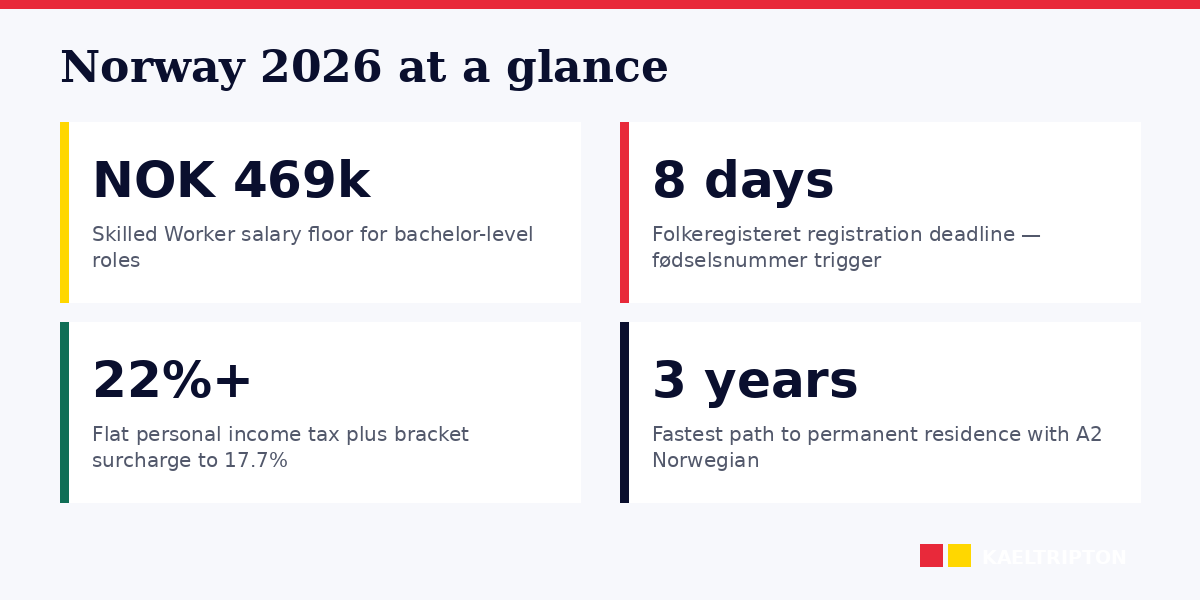
Moving to Norway from the UK in 2026 needs a residence permit for any stay over 90 days. The Skilled Worker route is the main path, with NOK 469,366 minimum annual salary for jobs requiring a bachelor's degree and NOK 513,100 for jobs requiring a master's degree. Folkeregisteret (National Population Register) registration happens within 8 days of arrival, producing your fødselsnummer (national ID number). UDI processing typically takes 8-12 weeks. Norway is outside the EU but inside the Schengen Area and EEA, which simplifies travel but adds complexity to the tax and healthcare picture. This guide covers the application sequence, post-arrival registrations, Norwegian tax residency, Folketrygd healthcare, and the path to permanent residence.
| ★ EDITOR'S VERDICT Norway is high-salary, high-tax, and heavily procedural - but fair. |
UDI processing is reliable, digital, and predictable. The Skilled Worker salary thresholds (NOK 469,366 bachelor / NOK 513,100 master) are realistic for most UK professionals. The 8-day Folkeregisteret registration window is strict but unlocks the fødselsnummer that runs everything else. BankID is non-negotiable. Expect 47% effective marginal tax at the top, but public services (healthcare, education, infrastructure) deliver accordingly. Norway rewards patience: 3 years to permanent residence with A2 Norwegian is the fastest EEA route if you commit to learning the language. |
Visa routes: which applies to UK citizens
UK citizens became third-country nationals for Norwegian immigration on 1 January 2021. Short stays under 90 days in any 180-day Schengen period need no visa. Longer stays require a residence permit through UDI (Utlendingsdirektoratet, the Norwegian Directorate of Immigration).
- Skilled Worker residence permit - for UK nationals with higher education and a concrete job offer from a Norwegian employer. 2026 salary thresholds: NOK 469,366 for positions requiring a bachelor's degree, NOK 513,100 for positions requiring a master's degree. Collective agreement rates apply where industry agreements exist. Valid 2 years initially, renewable twice for total 6-year stay.
- Self-employed permit (sole proprietorship with a company abroad) - for UK nationals with established overseas businesses serving at least one Norwegian client. Must show business plan and financial sustainability. Closest Norway offers to a digital nomad route.
- Job seeker residence permit - 6 months to find work in Norway. Available only to skilled workers from visa-free countries (UK qualifies). Minimum financial requirement NOK 25,839/month (NOK 155,034 for full 6 months). Cannot bring family on this permit.
- Family immigration - for spouses, registered partners and dependants of Norwegian residents. Sponsor income requirement approximately NOK 325,400/year.
- Study permit - for Norwegian university, vocational school, or approved language programme. Norwegian universities charge international students tuition from autumn 2023 onwards for non-EU/EEA nationals.
- EEA-EFTA Separation Agreement rights - for UK nationals who were lawfully resident in Norway before 31 December 2020. No new visa needed; existing rights protected but you must hold a valid residence card (oppholdskort).
There is no Norwegian equivalent of the EU Blue Card. Norway is outside the EU legal framework and uses its own national permits throughout.
The application sequence
Eight to twelve weeks before travel
- Secure a job offer (Skilled Worker route) or register a company abroad and identify at least one Norwegian client (Self-Employed route)
- Apply online through UDI.no - the entire process is digital
- Book an appointment at a Norwegian Embassy or Consulate in the UK (London or Edinburgh) for biometric intake within 21 days of submitting the online application
- Attend with passport, job offer or business plan, academic qualifications (higher education diplomas authenticated or apostilled), UK ACRO criminal record check, proof of accommodation, health insurance for the transition period
- Fee: NOK 5,400 for Skilled Worker permit in 2026; fees may change each January
On arrival
- Report to the police within 7 days of arrival to have your residence permit registered and order your residence card. Book the appointment online before travel.
- Register at Folkeregisteret at your local Norwegian Tax Administration (Skatteetaten) office. This triggers your fødselsnummer (11-digit national identity number) if you intend to stay over 6 months, or a D-number for shorter stays. Fødselsnummer typically issued 2-3 weeks after your police appointment.
- Apply for a tax deduction card (skattekort) online at skatteetaten.no using MinID or BankID. Without a tax card your employer must deduct 50% of gross salary.
- Open a Norwegian bank account. DNB and Nordea are the most expat-friendly. You need the fødselsnummer, passport, Norwegian address, and employment contract. Typically 1-2 weeks processing.
- Set up BankID via your Norwegian bank. BankID is Norway's digital identity used to log in to virtually every public service - skatteetaten.no, helsenorge.no, NAV.no, Altinn.
- Register with a GP (fastlege) via helsenorge.no using your fødselsnummer. You are assigned based on address; you can change within the municipality.
Norwegian tax residency
You become Norwegian tax resident if you stay in Norway more than 183 days in any 12-month period, or if your main home moves to Norway. Once resident, worldwide income is taxable.
Norway uses a flat-plus-progressive structure in 2026:
- Flat personal income tax: 22% on net general income (after deductions)
- Bracket tax (trinnskatt): progressive surcharge on personal income ranging from 0% up to NOK 217,400, through 1.7% / 4.0% / 13.7% / 16.7% / 17.7% at the top bracket of NOK 1,410,750
- National Insurance contribution (trygdeavgift): 7.8% on employment income, 11.0% on self-employment
- Wealth tax (formuesskatt): 0.7% municipal plus 0.4% state on net wealth over NOK 1.7 million per person (2026 threshold); additional state rate of 1.1% above NOK 20 million
Effective marginal rate on salary reaches approximately 47.4% at the top. Norway is not a low-tax destination, but the delivery of public services in return is among Europe's best. The UK-Norway double taxation agreement prevents double taxation. UK state pensions are taxable in Norway for Norwegian residents. UK government service pensions remain UK-taxable.
First Norwegian tax return (skattemelding) arrives pre-filled in your Altinn inbox in March each year. Most employees simply verify and submit. Self-employed and foreign-income earners supplement with additional forms. Filing deadline is 30 April.
Folketrygd: Norway's welfare and healthcare system
Folketrygden is Norway's National Insurance Scheme. Once resident for more than 12 months (or employed on a qualifying permit from day 1), you are enrolled automatically and gain full access to:
- GP (fastlege) appointments - small co-payment of NOK 250-450 per visit in 2026
- Specialist and hospital treatment - co-payment with annual exemption card (frikort) kicking in at approximately NOK 3,165 out-of-pocket in 2026
- Prescription medications - partial coverage, generic alternatives encouraged
- Sickness benefits, parental leave, pension accrual
Dental care for adults is not part of Folketrygden and is paid privately (typical NOK 400-2,000 per visit). Many employers offer supplementary private health insurance for faster specialist access; typical cost NOK 3,000-6,000 per year.
UK state pensioners qualify for S1 form healthcare - the UK funds their Norwegian care. Apply through NHS Overseas Healthcare Services before leaving. Working-age movers are covered via Folketrygden automatically once enrolled.
Cost of living: high but proportional
Norway consistently ranks among the most expensive countries in Europe. Rough 2026 monthly budgets for a single professional:
- Oslo one-bedroom rental central: NOK 15,000-22,000 (approximately £1,120-1,645)
- Bergen/Stavanger one-bedroom rental: NOK 11,000-16,000 (£820-1,200)
- Groceries single person: NOK 4,000-5,500 (£300-410)
- Public transport pass Oslo: NOK 850 (£64)
- Utilities: NOK 1,500-3,000 in summer, NOK 3,000-6,000 in winter
- Alcohol costs roughly three times UK prices; eating out similarly elevated
Norwegian salaries are correspondingly high. A software engineer on NOK 750,000 has purchasing power comparable to a UK engineer on £55,000-£60,000 after differences in tax, healthcare contribution and cost of living.
Permanent residence and citizenship
Permanent residence permit (permanent oppholdstillatelse) is available after 3 years of continuous legal residence on qualifying permits. Requirements from July 2025 onwards:
- 3 years of qualifying permits with valid status throughout
- Norwegian language test at A2 level minimum
- Social studies test pass
- Financial self-sufficiency for the past 12 months
- No serious criminal record
Norwegian citizenship is available after 8 of the last 11 years of lawful residence for most applicants. B1 Norwegian and a citizenship test are required. Norway recognises dual citizenship with the UK since January 2020, so British citizenship does not need to be relinquished.
A real 2026 scenario: renewable energy engineer from Glasgow to Stavanger
A 33-year-old renewable energy engineer from Glasgow accepts an offshore wind position at Equinor's Stavanger headquarters on NOK 820,000 per year.
March 2026. Signs contract. Employer provides documentation for UDI application. She submits online via UDI.no, books biometric appointment at Norwegian Consulate in Edinburgh for mid-April.
April 2026. Attends Edinburgh appointment with passport, contract, apostilled Master's certificate, ACRO check, health insurance. Fee NOK 5,400.
June 2026. Permit approved after 9 weeks. Flies to Stavanger. Books police appointment on arrival day, attends within 5 days. Orders residence card.
Week 2 in Stavanger. Registers at Folkeregisteret. Fødselsnummer arrives 18 days later. Opens DNB account. Sets up BankID same week. Registers with fastlege.
August 2026. First paycheque processed with correct skattekort. Settles into pattern. NOK 820,000 gross leaves roughly NOK 497,000 net after tax and National Insurance (approximately 39% effective rate), comparable to £37,000 UK take-home. Stavanger costs roughly 70% of London, so real purchasing power is meaningfully better.
First-year total admin costs: UDI fee NOK 5,400, police residence card NOK 200, apostille and translation approximately £180, transition health insurance NOK 3,500. Total approximately £650 in one-off admin spend.
Frequently asked questions
Do I need an IDP to drive in Norway on a UK licence?
No. UK photocard licences are accepted in Norway. You can drive on a UK licence for the first year; after 12 months of residence you must exchange it for a Norwegian førerkort. The exchange is free under the UK-Norway reciprocal agreement and requires no driving test.
Can I get a Norwegian job from the UK without visiting first?
Yes, though it's unusual. Most Norwegian employers prefer in-country interviews. Major international employers (Equinor, Telenor, DNB, major tech scale-ups) do hire directly from the UK, particularly for specialist roles in energy, tech and finance. Remote interview rounds are common for the first stages.
Does Norway recognise UK academic qualifications?
Yes for most professions. NOKUT (Norwegian Agency for Quality Assurance in Education) handles formal qualification recognition for regulated professions (medicine, nursing, law, teaching, architecture). Most tech, engineering, and business roles don't require formal recognition - the employer's assessment is sufficient. NOKUT application fee is typically NOK 3,820 and takes 3-6 months.
What is the difference between fødselsnummer and D-number?
Fødselsnummer is the 11-digit national identity number for residents staying over 6 months. D-number is a temporary identity number for shorter stays (under 6 months) and for workers who haven't yet met the residence threshold. If you are granted a Skilled Worker permit for 2+ years, you receive a fødselsnummer directly.
Is Norway in the EU for tax purposes?
No. Norway is in the EEA and Schengen but not the EU. This means you have EEA single-market rights for work but Norway operates its own national tax system outside EU harmonisation. The UK-Norway double taxation treaty governs cross-border tax between the two countries; the EU's tax coordination arrangements don't apply to Norway directly.
What about Norwegian language requirements?
Not required for the initial Skilled Worker permit. For permanent residence, Norwegian A2 level proficiency plus a social studies test are required (tightened from July 2025). For Norwegian citizenship, B1 level Norwegian is required. Integration is heavily Norwegian-focused - even in multinational Oslo employers, basic Norwegian substantially improves career and social prospects.
Can I bring my UK car to Norway?
Yes under transfer-of-residence rules, but Norway has substantial import tax (avgift) on most vehicles. The rules favour cars under 3 years old for tax-free import; older cars often incur substantial fees. Electric vehicles benefit from reduced import tax. Many UK movers sell their car in the UK and buy locally in Norway - the used car market is well-developed and inclusive of EV options.
Sources
- UDI (Utlendingsdirektoratet), Skilled Worker residence permit - udi.no
- GOV.UK, Living in Norway and Foreign travel advice - Norway
- Skatteetaten (Norwegian Tax Administration), Tax deduction card and tax residency rules 2026
- Norwegian Folkeregisteret (National Population Register), Registration procedure for foreign residents
- NHS Business Services Authority, S1 certificates for UK pensioners moving to the EEA
- HMRC, Double Taxation Convention with Norway
- UK-EEA EFTA Separation Agreement (2020), citizens' rights provisions
- NOKUT (Norwegian Agency for Quality Assurance in Education), Recognition of foreign qualifications


