

For UK entry, a passport must be valid for the whole of the stay. That is the entire rule. For travel to Schengen, a passport must have been issued within the last 10 years and remain valid for at least 3 months after intended departure. EES is live since 12 October 2025. ETIAS is expected Q4 2026.
Most British and foreign passports clear UK entry without fuss. The stricter rules only bite on onward travel to Schengen countries, where the 10-year and 3-month rules catch out thousands of travellers each year. Here’s how to check your passport properly - and what the EU Entry/Exit System, live since October 2025, changes at the border.
For UK entry: your passport must be valid for the whole of your stay. That is the entire rule. For onward travel to Schengen: passport must have been issued within the last 10 years and valid for at least 3 months after intended departure. EES is live at Schengen borders since 12 October 2025; ETIAS (€20, 3 years) expected Q4 2026. Renew early if you’re close to either Schengen limit. |
The one rule that governs UK entry
The UK’s own rule is simple and sits on the GOV.UK page for the Standard Visitor visa: your passport or travel document must be valid for the whole of your stay in the UK. That is the entire requirement for entering England, Scotland, Wales and Northern Ireland. No six-month buffer, no three-month rule, no issue-date cap. Valid on the day you leave the UK - that is the bar.
If your passport expires the day after your return flight, you can legally enter the UK. If it expires two days before your return flight, you cannot, because the passport will not be valid for your whole stay. Airlines enforce this on boarding - they will refuse to carry you to the UK if your passport expires during your intended visit.
There is one subtle wrinkle: if you are entering on a Standard Visitor visa or ETA, the airline’s automated permission-to-travel check links your visa or ETA to your specific passport number. Travelling on a different passport to the one you used to apply will get you refused at the gate, regardless of the new passport’s expiry date.
Before you panic - who this affects
This guide is written for three groups: British citizens travelling onwards from the UK to Europe, foreign visitors entering the UK, and UK residents who hold a foreign passport and want to visit their home country via a European connection. The rules differ for each.
If you are a British citizen only flying domestically or to Ireland, passport validity is a non-issue - the Common Travel Area lets British citizens use any form of photo ID or an expired-but-current passport for Irish travel, though airlines still prefer a valid passport.
The Schengen rules that do bite - the 10-year and 3-month rules
If you are leaving the UK for a Schengen country, two passport rules apply. The EU’s own “Your Europe” portal states them plainly:
- Your passport must have been issued within the last 10 years on the day you enter the Schengen Area.
- Your passport must be valid for at least 3 months after the date you intend to leave the Schengen Area.
Both rules must be satisfied on the day of Schengen entry. They are not UK rules - the UK does not care about the 10-year issue date of a British passport - they are EU rules that apply to non-EU passport holders, and British citizens have been non-EU since 1 January 2021.
The 10-year rule catches British citizens who renewed early. Before September 2018, the Passport Office added unused months from an old passport to a new one, meaning British passports often had validity periods over 10 years. Holding one of those extended passports, you may be turned away at a Schengen border even though the passport is still marked as “valid” - because the issue date was more than 10 years ago.
Home Office figures cited in 2025 suggested over 12 million British passports in circulation could be affected by the 10-year rule. The Passport Office stopped carrying over surplus months in September 2018, so passports issued from that date onwards will not trigger this issue.
Worked examples - the 10-year and 3-month rules in practice
Example one. Your passport was issued on 1 March 2016 and expires on 1 July 2026 (an older passport with carried-over months). You plan to fly to Spain on 1 April 2026 for a week. The 10-year rule says your passport must have been issued within the last 10 years on the day of Schengen entry. 1 April 2026 minus 10 years is 1 April 2016. Your passport was issued on 1 March 2016 - eleven days too early. You will be refused boarding.
Example two. Your passport was issued on 1 June 2018 and expires on 1 August 2026. You plan to fly to France on 15 June 2026 and return on 29 June 2026. The 10-year rule is fine (issued June 2018, well within 10 years of June 2026). The 3-month rule requires validity until at least 29 September 2026 - you have validity until 1 August 2026. That is only 33 days of buffer. You will be refused boarding.
Example three. Your passport was issued on 1 January 2025 and expires on 1 January 2035. Neither rule is at risk for any trip before roughly October 2034. You can travel without worrying.
Saga magazine reported in March 2026 that UK passport renewal fees have risen to £94.50 for a standard online adult application. That is the current Passport Office fee and is the only authoritative figure - third-party services charging more are adding service fees.
The EU Entry/Exit System - EES, live since 12 October 2025
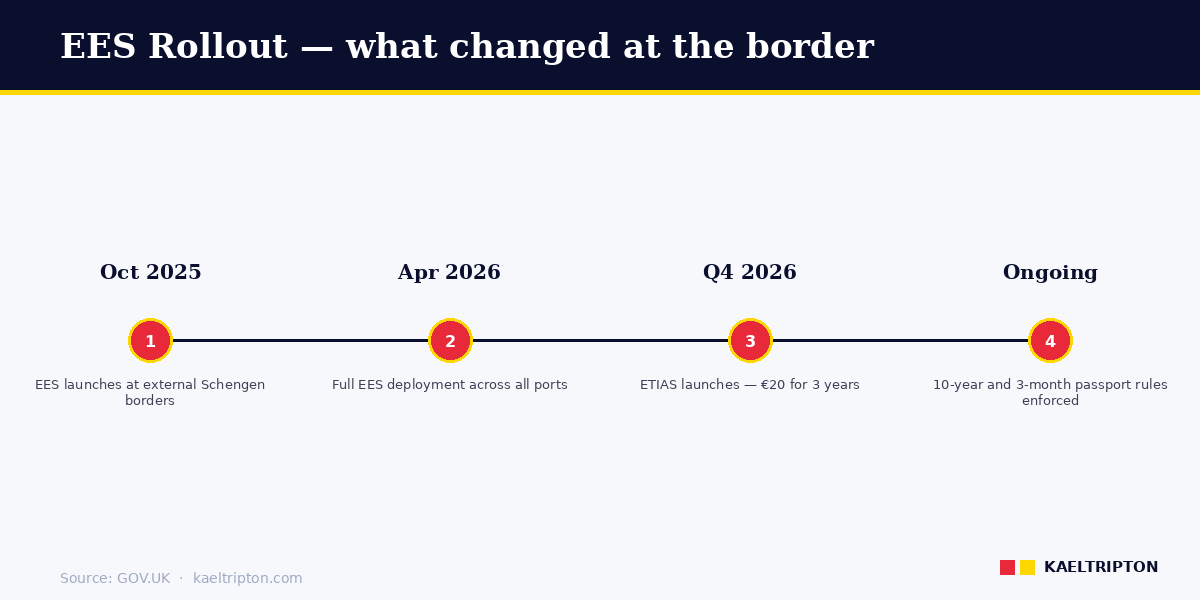
The EU Entry/Exit System (EES) began a phased rollout on 12 October 2025 and is expected to be fully operational at all Schengen external borders by 10 April 2026. EES replaces the manual passport stamp with a digital record. It applies to non-EU passport holders - including British citizens - entering or leaving the Schengen Area.
On your first EES entry, biometric data is collected: a facial image and four fingerprints. Subsequent entries and exits are logged against that biometric profile. Your passport is no longer stamped. The EES record counts the days you spend inside the Schengen Area and enforces the 90-in-180 rule automatically.
Practical impact on passport validity:
- Your passport needs a valid readable chip - damaged or worn passports can fail the electronic read at the kiosk and send you to manual processing.
- If you renew your passport, the biometric link is tied to your new passport number on next entry. Your old biometric profile is re-associated.
- The 10-year and 3-month rules are checked by EES automatically, so airlines and border systems are less likely to miss marginal cases than they were under pure stamp-based processing.
ETIAS - the next change, expected late 2026
The European Travel Information and Authorisation System (ETIAS) is the EU’s counterpart to the UK ETA and the US ESTA. It is expected to launch during the last quarter of 2026 after several delays. When live, British citizens and other non-EU visa-exempt travellers will need ETIAS clearance before travelling to any Schengen country.
The expected fee is €20 (around £17 at current rates) for applicants aged 18 to 70. ETIAS is valid for three years or until your passport expires, whichever comes first. Applications will be online, with most decisions returned within minutes. The launch date is set by the European Commission and has slipped twice already - confirm the live date on the official ETIAS portal before assuming a specific month.
Until ETIAS goes live, British citizens travel to Schengen on passport alone. Once live, you’ll need to apply in advance, paying €20, and the authorisation will be linked to your passport number - so if you renew your passport, you reapply.
UK passport holders in the EU - residents and dual nationals
If you are a British citizen with settled or residence status in an EU country - typically under a post-Brexit Withdrawal Agreement scheme such as France’s WARP card or Spain’s TIE - you hold residence rights independent of your passport validity for travel purposes. Your passport must still meet the 10-year and 3-month rules for Schengen border crossings elsewhere in the Schengen Area, but your own country of residence accepts your residence document as proof of your right to return.
Dual nationals - British-French, British-Irish, British-Italian and similar - have the simplest path: travel on the EU passport when entering the Schengen Area and on the UK passport when entering the UK. The UK Home Office has explicitly advised dual nationals since October 2024 to use their UK passport for UK entry to avoid ETA complications at UK borders.
Foreign nationals entering the UK - what passport checks apply
If you are a foreign national holding a Standard Visitor visa or ETA, your passport must simply be valid for your whole stay. The UK does not impose the 10-year or 3-month rules that Schengen applies to its visitors.
But two separate issues can trip you up at a UK border:
- Passport linked to your visa or ETA. The digital permission is tied to a specific passport number. If you renew your passport after applying for your visa but before travelling, you must update your UKVI account so the eVisa is linked to the new passport, and carry both passports (or a CoE) at the border.
- Damaged passports. UK Border Force treats heavily damaged passports - water damage, torn pages, missing corners - as suspicious. They can refuse entry on the basis that they cannot verify the document’s authenticity. Replace a damaged passport before travelling.
Emergency travel documents
If you are a British citizen abroad and your passport is lost, stolen or damaged, an Emergency Travel Document (ETD) from the nearest UK embassy or high commission gets you home. The ETD is single-use, covers a specific itinerary, and costs £100. It works for UK entry but not all third countries accept it for onward travel - check with the airline for any connecting flights.
Foreign nationals in a similar position abroad must contact their own embassy. The UK will generally admit someone holding a valid ETD issued by their home country, provided their UK visa or ETA is linked to the emergency document or they are able to prove identity through a secondary document.
Children’s passports - separate rules
UK children’s passports are issued for five years rather than ten. The same 3-month Schengen rule applies to children. The 10-year rule is effectively never triggered because children’s passports are replaced every five years.
Applying for a child’s passport requires consent from everyone with parental responsibility. If you are divorced or separated, obtaining the other parent’s signature can take longer than the passport itself - build in time. The standard online application fee for a child is £61.50.
When to renew - a practical rule of thumb
If you travel to Europe once a year and your passport has less than nine months of validity and less than 11 years since issue, renew now. The Passport Office standard processing time is three weeks, but it can extend to several weeks in summer peak. Urgent passport appointments (the “Premium” same-day service and the “Fast Track” one-week service) are available at a premium at participating UK Passport Offices.
If you are not travelling, renewal is not urgent. There is no advantage to holding a newly-issued passport for its own sake, and since September 2018 the Passport Office no longer carries over unused months - renewing early is now a direct loss of validity.
Checking online - the tools that actually work
The authoritative sources for passport rules:
- GOV.UK - Foreign travel advice gives per-country entry requirements including passport rules.
- GOV.UK - Travelling to the EU and Schengen area confirms the 10-year and 3-month rules for British citizens.
- The destination country’s embassy website in London - authoritative on any deviation from standard Schengen practice.
Third-party sites often repeat the old “six months before expiry” rule, which is the rule for some non-Schengen countries (Thailand, Egypt, Indonesia among others) but is not the Schengen rule. For Schengen, the specific rule is 3 months after intended departure.
Edge case - using a second nationality passport on outbound travel
If you hold a British passport and a non-EU, non-British second nationality (say, Indian or Pakistani), you can choose which to travel on. Travel on the British passport for UK entry and departure; travel on either passport for the destination country, depending on visa requirements. An Indian passport holder travelling to Dubai on an Indian passport enjoys visa-on-arrival; travelling on a British passport gets a 30-day stamp at no cost and sometimes faster clearance.
The critical point: the passport you check in with at departure must match the permission that admits you at the destination. Airlines scan your passport at check-in and transmit it to the destination’s border system - mismatches between the passport used and the visa or authorisation issued cause boarding refusals.
Edge case - paper driving licence as a travel document
A driving licence is not a travel document. The paper UK driving licence, still held by many older drivers, is not valid for any form of air or sea travel internationally. For Common Travel Area travel between the UK and Ireland, a UK photocard driving licence is sometimes accepted by airlines as photo ID but never by immigration.
If you are flying from the UK to Ireland, the UK carrier will require photo ID at check-in; a UK photocard driving licence normally suffices for UK citizens. Non-UK-citizens flying this route should always carry their passport.
Cruise passengers - the one category that often escapes EES
GOV.UK guidance specifically addresses cruise travellers: if your cruise starts and finishes outside the Schengen Area (for example, at a UK port or an Icelandic port), you are normally exempt from EES entry and exit checks even if your ship docks at Schengen ports along the way. This is because the ship’s manifest and port authority handle clearance collectively, not through the EES kiosks at terminal buildings. The cruise operator will typically collect passports at embarkation and return them at disembarkation.
If, however, you disembark a cruise in a Schengen country and then travel onward independently - say you end a Mediterranean cruise in Barcelona and fly home from Madrid the next week - you are treated as any other land or air traveller, and both EES biometric registration and passport validity rules apply in full from the point you leave the ship and enter Schengen territory on your own.
For ferry crossings within Europe (Dover to Calais, Holyhead to Dublin, Hull to Rotterdam, Harwich to the Hook of Holland), standard border checks and EES apply at the arriving Schengen port. Passport validity rules are enforced at check-in by the ferry operator, not just at the arrival border - so a ferry crew will refuse to board a passenger whose passport fails the Schengen rules, mirroring airline practice.
The cost of getting it wrong - no compensation
If an airline refuses to board you because your passport fails the 10-year or 3-month rule, you have no right to compensation. Passport validity is the traveller’s responsibility under the airline’s conditions of carriage, and under EC 261 (the EU compensation regulation). You will lose the flight, any connecting flights, and typically your accommodation if non-refundable. Travel insurance policies vary - some cover trip interruption caused by a refused boarding, but many exclude it because it is classed as a documentation failure rather than an insured peril.
Check your policy wording before assuming you are covered. The Financial Conduct Authority (FCA) requires insurers to state cover and exclusions clearly, and a specific “documentation failure” exclusion is common.
Related guides
- British Passport Holders in the EU 2026
- Great Britain Visa 2026 - Entry Requirements
- UK Visitor Visa 2026 - Tourist Visa Application Guide
- European Driving Permit 2026
Disclaimer
This guide reflects UK and EU rules as published on GOV.UK and the EU “Your Europe” portal in April 2026. Passport, visa and border rules change. Always check the official sources for your specific trip before travelling. This article is not legal advice.
Frequently asked questions
Does my passport need six months’ validity to enter the UK?
No. That rule applies to some non-Schengen countries but is not a UK rule. The UK requires your passport to be valid for the whole of your stay - nothing more. The six-month rule people remember usually came from travel to the US, Thailand or parts of Asia.
What does the 10-year rule mean for my Schengen trip?
Your passport must have been issued within the last 10 years on the day you enter any Schengen country. If it was issued more than 10 years ago, even if it is still marked as valid, you will be turned away. This catches older British passports that had extra months carried over from a previous passport.
Do I need a new passport if I’m travelling only to Ireland?
If you are a British or Irish citizen, no. The Common Travel Area accepts UK photocard driving licences as airline ID and you do not need a passport for immigration purposes. Airlines may still ask for a passport for their own records - check your carrier’s rules.
What changes with the EU Entry/Exit System?
EES replaces the passport stamp with a digital biometric record. On first entry from 12 October 2025, you’ll give fingerprints and a photo. Subsequent entries and exits are logged automatically. Passport validity rules are unchanged - the 10-year and 3-month rules still apply - but the system now checks them automatically.
My passport is slightly damaged - will I be let in?
Minor wear is fine. Water damage, torn pages or a damaged chip can cause problems at both UK and Schengen borders. Replace a damaged passport before travelling. Border Force can refuse entry on the basis that they cannot verify the document.
Does the 10-year rule apply to children’s passports?
Effectively no - children’s UK passports are issued for five years, so the 10-year rule is never triggered in practice. The 3-month Schengen rule still applies to child passports.
Can I use an expired passport to prove identity in the UK?
Not for travel. For domestic ID checks - voting, banking, age verification - some expired passports are accepted for a limited period. For anything at a border, the passport must be valid.
Sources
- GOV.UK - Travelling to the EU and Schengen area
- GOV.UK - Foreign travel advice
- European Union - Travel documents for non-EU nationals
- Home Office - Written Statement HCWS1361 (25 February 2026): ETA enforcement and eVisa rollout
- UK Passport Office - current fees and processing times (GOV.UK)
- European Commission - EES rollout schedule (from 12 October 2025)


