

If you want to marry or register a civil partnership in the UK as a visitor, you need the Marriage Visitor visa - not the Standard Visitor visa. Both cost £135 and last 6 months, but only one permits you to legally go through with the ceremony. This guide covers the rules, the notice period, and the pitfalls that lead to refusals.
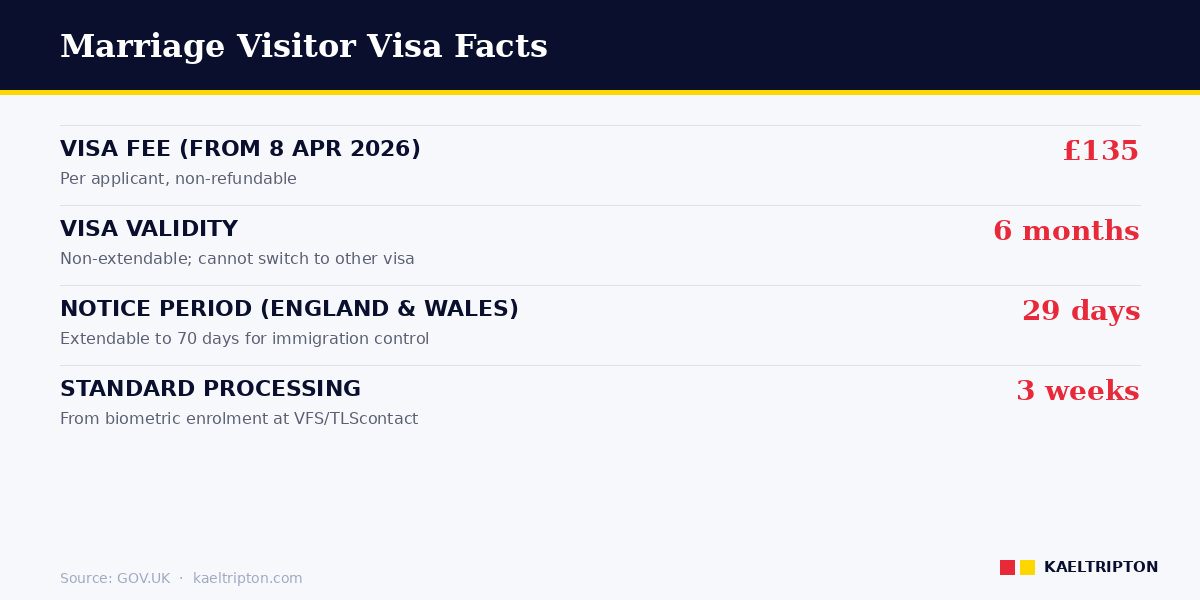
The Marriage Visitor visa is £135, lasts 6 months, and cannot be extended or switched to any other UK visa while in the UK. Both partners apply separately if both are foreign nationals. The ceremony must happen within the 6-month window at a licensed UK venue. Notice at a register office is 29 days in England, Wales and Scotland; 28 days in Northern Ireland; extendable to 70 days in E&W for those subject to immigration control. |
UK visa fees: key facts (checked 16 October 2026) Current Home Office fees (most rose on 8 April 2026). Fees are per person and paid when you apply; the health surcharge is paid on top for each year of the visa.
|
The Marriage Visitor visa in one sentence
The UK Marriage Visitor visa allows foreign nationals to enter the UK for up to 6 months specifically to marry, register a civil partnership, or give notice of intention to do so. It costs £135 (from 8 April 2026, up from £127), cannot be extended, and does not permit switching to any other UK visa category. You must leave the UK by the end of the 6-month period.
The Standard Visitor visa does not allow you to marry in the UK - this is the single most-missed distinction. Couples who arrive on a Standard Visitor visa and try to give notice at a register office are refused. The Home Office caseworker guidance and Appendix V of the Immigration Rules are explicit: marriage-intent visits require the dedicated category.
Who needs this visa
You need a Marriage Visitor visa if you are a foreign national planning to marry or register a civil partnership in the UK and you intend to leave afterwards. Three categories:
- Visa nationals (Indian, Pakistani, Nigerian, Chinese, etc.): must apply for a Marriage Visitor visa before travelling.
- Non-visa nationals (US, Canadian, Australian, EU, etc.): must also apply for a Marriage Visitor visa - the ETA does not cover marriage purposes.
- EEA/Swiss nationals without settled or pre-settled status: since 1 January 2021, EEA nationals no longer have automatic rights and need a Marriage Visitor visa.
Irish citizens are exempt under the Common Travel Area. British citizens and those with UK settled status do not need any visa to marry in the UK.
If your plan is to marry and then remain in the UK, the Marriage Visitor visa is the wrong route. You need either a Fiancé(e) visa (to enter, marry, and switch to a Spouse visa) or to marry in your home country and apply for a Spouse visa (Family visa category) to enter. These routes cost significantly more and require more evidence - but they permit staying.
Eligibility requirements
The Home Office eligibility rules for the Marriage Visitor visa come from Appendix V of the Immigration Rules. You must:
- Be 18 or older on the date of application.
- Be legally free to marry or enter a civil partnership (divorced, widowed, or never married) - and able to prove it.
- Have a genuine relationship with your intended partner.
- Have wedding or civil partnership arrangements already made at a licensed UK venue, with the ceremony scheduled within the 6-month visa validity.
- Demonstrate you can financially support yourself without accessing public funds.
- Intend to leave the UK at the end of your stay.
- Not make the UK your main home through frequent or successive visits.
Caseworkers assess these on the balance of probabilities. “Genuine relationship” is the most scrutinised element - sham marriages for immigration advantage trigger both refusal and 10-year bans.
The notice period - the rule couples miss most
Before you can marry in the UK, you must give notice at a register office. This is a legal requirement under the Marriage Act 1949 in England and Wales, separate from the visa itself.
| Region | Minimum notice period | How you give notice |
|---|---|---|
| England and Wales | 29 days (extendable to 70 days for those subject to immigration control) | In person at a local register office; both partners must attend |
| Scotland | 29 days | By post to the registrar |
| Northern Ireland | 28 days | In person or by post |
For couples subject to immigration control (most Marriage Visitor visa holders), the standard 29-day notice period in England and Wales can be extended to 70 days while the registrar refers the case to the Home Office. Build this into your timeline. A 6-month visa with 70 days already consumed by notice leaves you roughly 4 months to plan and hold the ceremony.
Contact the register office in the area where you plan to marry, not where you’re staying. For destination weddings at country houses or historic venues, the local register office has jurisdiction over the ceremony location, not your London hotel.
Supporting documents
Beyond the standard Visit visa documents (passport, bank statements, employment letter, return ticket), the Marriage Visitor visa requires specific evidence of wedding intent:
- Proof of booking at a licensed UK venue: venue contract, payment receipts, correspondence with the venue coordinator. Dates must fall within your 6-month visa validity.
- Proof of relationship: photographs spanning your relationship history, correspondence (WhatsApp threads, emails), evidence of cohabitation if applicable, joint travel records, proof of meetings and time spent together.
- Legal freedom to marry: decree absolute if divorced, death certificate if widowed, equivalent documentation for civil partnerships.
- Register office correspondence if you’ve already begun the notice process, or evidence you’ll give notice on arrival (a booking confirmation with the register office is strong).
- Financial documents: bank statements covering 3-6 months; proof that wedding costs have been paid or committed.
- Return travel: flight bookings showing your departure by the visa end date.
What the visa permits
Within the 6-month Marriage Visitor visa window, you can:
- Marry or register a civil partnership at a licensed UK venue.
- Give notice of marriage or civil partnership at a register office.
- Attend pre-wedding events - engagement celebrations, stag/hen parties, rehearsal dinners.
- Participate in the ceremony and immediate post-wedding celebrations.
- Carry out the same activities as a Standard Visitor: tourism, visiting family, short-term study up to 6 months.
What you cannot do:
- Work - paid or unpaid - for any UK employer.
- Extend the visa beyond 6 months.
- Switch to another UK visa category while in the UK. If you want to remain after marriage, you must leave and apply for a Spouse visa from overseas.
- Access public funds or NHS services beyond emergency treatment.
- Make the UK your home through frequent or successive visits.
Scenario - the destination wedding
Consider a realistic case. An American bride from Chicago and her French fiancé (both non-visa nationals) plan to marry at a country house hotel in the Cotswolds in June 2026. The venue was booked in December 2025 with a £5,000 deposit.
Both apply for Marriage Visitor visas in February 2026, three months before the ceremony. They include venue contracts, deposit receipts, correspondence with the Cotswold register office confirming an appointment for notice on 10 April, photographs from their 4-year relationship, bank statements showing wedding costs prepaid, return flights departing 25 June. Both approved within 3 weeks.
They arrive 5 April, give notice 10 April, wait 29 days for the standard notice period (not extended because their documentation was clean), marry 12 May, and depart 22 June as planned.
Teaching point: booking the ceremony venue early and providing proof of the booking is the single strongest document for a Marriage Visitor visa. Caseworkers look for evidence the wedding is actually happening - not just planned.
Scenario - the notice-extension trap
A second realistic case. A bride from Lahore and her British citizen fiancé plan a London wedding in May 2026. She applies for a Marriage Visitor visa. Her documentation is incomplete on relationship evidence (few photographs, limited written correspondence, no cohabitation history - they met online and have visited in person only twice).
She arrives in April. At the register office on 15 April for notice, the registrar refers the case to the Home Office under the Referral and Investigation Scheme - a standard check for sham-marriage risk where the evidence is thin. The notice period extends from 29 to 70 days. Her wedding, booked for 20 May, is now legally impossible within the extended window.
Teaching point: the notice-extension risk is real for couples with limited relationship evidence. Build 70 days of notice into your planning by default if you are subject to immigration control, even if the standard is 29 days.
Fees and processing
The Marriage Visitor visa fee is £135 per applicant (from 8 April 2026). Both partners pay separately if both are foreign nationals. Priority service (+£500, 5-working-day target) and Super Priority service (+£1,000, next-working-day target) are available at most major visa application centres.
Standard processing from biometric enrolment is 3 weeks. Peak-season processing can extend to 4-5 weeks.
Apply at least 3 months before your wedding date. This gives you room for standard processing, any additional checks, and time to arrive in the UK for notice. Applying the earliest permitted (3 months before travel) aligns well with typical wedding planning timelines.
When to choose a different visa route
If you plan to marry and remain in the UK, the Marriage Visitor visa is wrong for you. Alternatives:
- Fiancé(e) visa: for entering the UK to marry and switch to a Spouse visa. £2,064 fee, 6-month initial visa, requires meeting Spouse visa financial thresholds (£29,000 per year for the sponsoring partner as of 2026).
- Marry abroad, apply for Spouse visa: cheaper and simpler if your wedding venue is flexible. Standard Spouse visa fees apply.
- Marry as a British or settled-status partner: if you already have UK leave to remain, no Marriage Visitor visa is needed.
The Marriage Visitor visa is explicitly for couples who will leave the UK after the ceremony. If that’s not your plan, the Home Office will notice during review and refuse.
Related guides
- UK Visitor Visa 2026: Tourist Visa Application Guide
- UK Visa from India 2026
- UK Visa Application Status Check 2026
- UK Visa Refusal Reasons 2026
Disclaimer
Rules and fees in this guide reflect Home Office practice published on GOV.UK as of April 2026. Immigration rules and notice-period requirements can change. Always verify the current position at gov.uk/marriage-visa before applying. This article is not legal advice.
Frequently asked questions
How much is the UK Marriage Visitor visa?
£135 per applicant (from 8 April 2026, up from £127). The fee is non-refundable. Priority service adds £500 for a 5-working-day target; Super Priority adds £1,000 for next-working-day. Both partners pay separately if both are foreign nationals.
Can I use a Standard Visitor visa to marry in the UK?
No. The Standard Visitor visa explicitly does not permit marrying or registering a civil partnership in the UK. You must apply for a Marriage Visitor visa. Attempting to marry on a Standard Visitor visa leads to the register office refusing to process your notice, and can affect future UK visa applications.
How long is the Marriage Visitor visa valid?
6 months from arrival. The visa cannot be extended and cannot be switched to another visa category while in the UK. You must leave the UK by the end of the 6-month period. If you want to remain after marriage, apply for a Spouse visa from overseas after leaving.
How much notice do I need to give to marry in the UK?
29 days in England, Wales and Scotland; 28 days in Northern Ireland. For couples subject to immigration control, the notice period in England and Wales can extend to 70 days while the Home Office reviews the case under the Referral and Investigation Scheme. Build this into your timeline when planning the ceremony.
Do both partners need a Marriage Visitor visa?
Only foreign nationals need the visa. British citizens, those with UK settled status, and Irish citizens do not need any visa to marry in the UK. If you’re marrying a UK citizen, only you (the foreign national) applies. If both partners are foreign nationals, both apply separately.
Can I bring guests to my UK wedding?
Guests who need a UK visa (visa nationals) apply for a Standard Visitor visa for short visits around the wedding. Non-visa nationals apply for an ETA. Guests do not need a Marriage Visitor visa unless they themselves are the bride or groom. Plan guest visa applications 2-3 months before the wedding to allow for standard processing.
What happens if my UK Marriage Visitor visa is refused?
Common refusal reasons include weak relationship evidence, unclear venue booking, insufficient funds, or suspected sham marriage. There is no appeal for Marriage Visitor visa refusals. You can reapply, addressing the refusal letter’s specific points. If the refusal involved a suitability issue, consider consulting an OISC-regulated immigration adviser before reapplying.
Sources
- GOV.UK - Marriage Visitor visa: Overview
- GOV.UK - Marriages and civil partnerships in England and Wales
- GOV.UK - Immigration Rules: Appendix V Visitor
- Home Office - Visit: Caseworker Guidance (25 February 2026)
- Marriage Act 1949 (legislation.gov.uk) - statutory basis for notice periods
- Home Office - Immigration fee changes, 8 April 2026 (£127 → £135 for visit visas)


