

The UK offers two paid faster-decision services on top of standard visa processing. Priority adds £500 for a target 5-working-day decision. Super Priority adds £1,000 for next-working-day. Neither guarantees approval - they accelerate decision time, not outcome. This guide covers when they’re worth paying, where they’re available, and the specific limitations.
UK visa Priority service adds £500 for a 5-working-day target; Super Priority adds £1,000 for next-working-day. Both accelerate decision time, not outcome - a weak application is refused faster, not more kindly. Worth paying when travel is close to the standard 3-week window or during summer peak delays. Not worth paying for complex applications likely to face caseworker review regardless. |
UK visa fees: key facts (checked 16 October 2026) Current Home Office fees (most rose on 8 April 2026). Fees are per person and paid when you apply; the health surcharge is paid on top for each year of the visa.
|
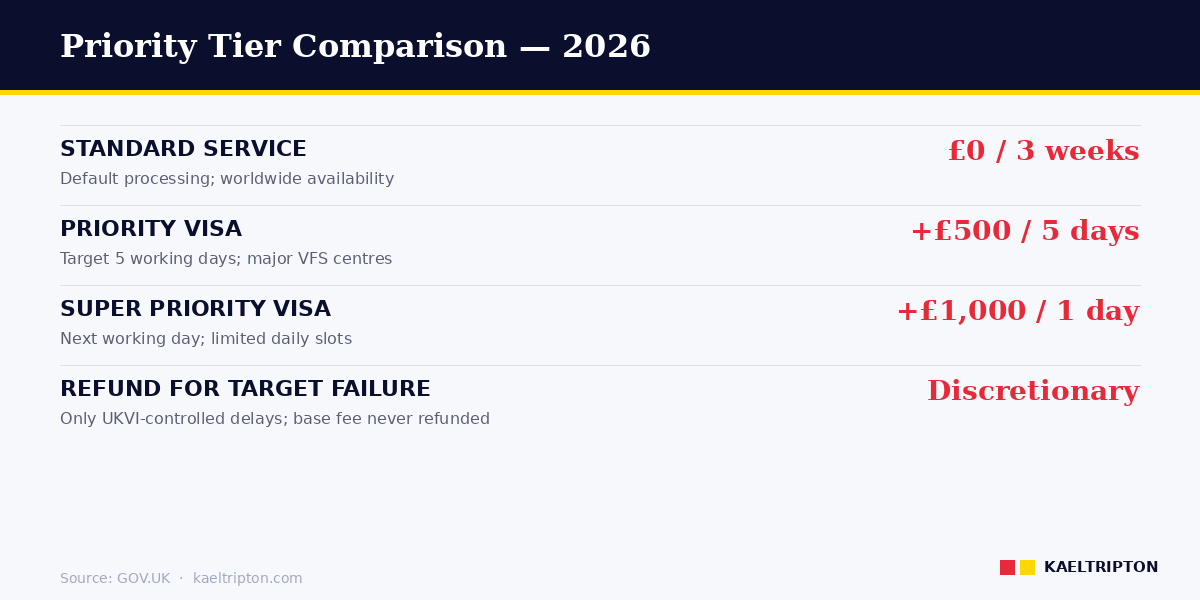
The two tiers, in one table
| Service | Additional fee | Target decision time | Availability |
|---|---|---|---|
| Standard | £0 | 3 weeks (visit visas) from biometric enrolment | Worldwide |
| Priority Visa | +£500 | 5 working days from biometric enrolment | Major VFS and TLScontact centres; not every country |
| Super Priority Visa | +£1,000 | Next working day from biometric enrolment | Limited to major centres (Delhi, Mumbai, Lagos, etc.); limited daily slots |
Both are paid to UKVI through the GOV.UK application flow, not to the partner visa application centre. The fees stack on top of the standard visa fee: a 6-month Standard Visitor visa with Super Priority costs £135 + £1,000 = £1,135 plus VFS service fees.
GOV.UK’s authoritative page at gov.uk/faster-decision-visa-settlement lists current availability and fees. Availability changes by country and visa category; always check before assuming the service is offered at your visa application centre.
What “target” actually means
Both priority services are marketed against target decision times, not guaranteed ones. The target is met in most cases but not all. UKVI reserves the right to take longer in complex cases requiring additional checks - previous refusals, criminal record history, unusual travel patterns, potential fraud indicators.
If a Super Priority case cannot be decided by the next working day for complexity reasons, UKVI continues processing at standard pace without refunding the £1,000 fee automatically. You may apply for a refund if UKVI fails to meet the target for reasons within their control - but refunds for complexity-driven delays are discretionary and rare.
Priority service - the 5-working-day option
Priority Visa is the middle tier. You pay £500 extra during the online application. Once you complete biometrics at the visa application centre, UKVI aims to decide within five working days.
Weekends and UK public holidays don’t count toward the five days. A priority application with biometrics completed on a Thursday gets a target decision by Wednesday of the following week, barring UK bank holidays.
Priority is widely available at major VFS Global and TLScontact centres. In India: Delhi, Mumbai, Bengaluru, Chennai, Hyderabad and some regional centres. In Nigeria: Lagos. In Pakistan: Islamabad, Karachi, Lahore. In the Gulf: Dubai, Abu Dhabi, Riyadh. In the US and Canada: major cities. Smaller VFS centres may not offer Priority - your booking flow will show available services.
Super Priority - the next-working-day option
Super Priority Visa adds £1,000 on top of the visa fee. Target: decision by end of the next working day after biometric enrolment.
Super Priority slots are limited. A typical major VFS centre offers 20-50 Super Priority biometric appointments per day, all in early-morning slots. Demand often exceeds supply - particularly in peak seasons (April-August for summer travel from India, September-October for business travellers to London conferences). Book the biometric appointment first; confirm slot availability before committing to travel dates.
Super Priority is available in fewer countries than Priority. Delhi, Mumbai, Lagos, Islamabad, Riyadh, Dubai typically have it. Many smaller posts do not. The GOV.UK faster-decision page and the VFS country-specific portal confirm daily availability.
When Priority or Super Priority is worth paying
Three scenarios genuinely justify the cost:
Scenario 1 - confirmed travel date close to the standard service standard. Your business-critical UK meeting is in 10 working days and VFS biometrics are booked for Monday. Standard processing targets 3 weeks. Priority at £500 targets 5 working days - you’re safe. Super Priority at £1,000 targets next-day - you’re absolutely safe. The £500 differential buys certainty margin.
Scenario 2 - travel during a UKVI delay period. Current published processing times on GOV.UK regularly stretch beyond the 3-week standard during summer peaks. When the standard is running at 4-5 weeks and you have 3 weeks before travel, Priority rebaseeline you to the 5-working-day target. This is the most common good reason to pay.
Scenario 3 - business-urgent visit with no alternative. A family medical emergency, a signed business contract requiring UK presence within days, a wedding or funeral with a fixed date. Super Priority at £1,000 is often cheaper than losing the underlying opportunity.
When Priority or Super Priority is NOT worth paying
Three scenarios where paying is usually waste:
- Travel more than 4 weeks away. Standard processing within 3 weeks handles this comfortably. Paying £500 for certainty you already have is throwing money away.
- Complex application more likely to face caseworker review. Previous refusals, criminal history, or unusual travel patterns can trigger detailed review that exceeds Priority targets regardless of fee paid. You get refused faster, not more kindly.
- Seasonal peak with uncertain slot availability. If Super Priority slots are booked out and you take the next available Priority biometric in 10 days, you’ve lost the time advantage the service was meant to buy.
Scenario - the Delhi-to-London business traveller
Consider a realistic case. A fintech executive in Gurugram is invited to a London board meeting on 15 June 2026. She needs to arrive by 14 June. Today is 20 May.
She checks GOV.UK current processing: standard 3 weeks from biometrics. She books a VFS Delhi biometric for 25 May. Standard processing target: 15 June - the day of her meeting. Too tight.
She upgrades to Priority at £500. Target decision by 2 June (5 working days from 25 May). She flies 13 June with eVisa confirmed. Total extra cost: £500 for margin of safety.
Teaching point: Priority trades money for timing certainty. It works best when you know the standard service standard is tight for your travel date. Pay only if the certainty is worth the money to your specific trip.
Scenario - when Super Priority backfires
A second realistic case. A software developer in Mumbai books a Super Priority visa in June 2026 for an early-July London conference. He has a previous US visa refusal from 2022 he chose not to declare on the UK form. Mumbai VFS biometric is 5 June. Decision target: 6 June.
UKVI cross-references refusal databases as part of Super Priority caseworker review. The undisclosed US refusal is flagged. Decision: refused on suitability grounds (concealment) with a 10-year ban. Decision arrives 6 June, meeting the Super Priority target. His £1,000 extra fee is not refunded because UKVI met the service standard. He’s refused, banned for 10 years, and £1,135 out of pocket.
Teaching point: Super Priority does not protect against refusal reasons. Pay for faster processing only when your underlying application is strong. On a weak application, the faster service delivers a faster refusal and a non-refundable fee.
Booking mechanics
Priority and Super Priority are selected during the online visa application journey at GOV.UK, before you pay. The service fee is added to your visa fee total. Once paid and biometrics booked, the service level is locked in.
Downgrading is not possible. If you paid Super Priority and later realise standard would have sufficed, the extra fee is not refunded. Upgrading mid-process is not supported either - you complete the service tier you selected.
If you paid Priority or Super Priority but the available VFS biometric slot is weeks away, your money has been effectively downgraded - the service timer starts at biometric enrolment, not at fee payment. Book the biometric first; then decide service level.
Refund when UKVI fails to meet target
If UKVI fails to meet the Priority or Super Priority target for reasons within its control, you may apply for a refund of the additional fee. Reasons within control: UKVI administrative delay, lost documents at UKVI, UKVI system failure.
Reasons not within control (no refund): complexity requiring additional checks, requests for additional documents from you, UK public holidays, fraud-indicator investigation.
Apply for refund through the GOV.UK contact service with your GWF number and application date. Refund decisions are discretionary and typically take 4-8 weeks.
Standard visa fee is never refunded for priority failures
An important distinction: even when a Priority or Super Priority service fails to meet target and you receive a refund of the additional fee, the underlying standard visa fee (£135 for Standard Visitor, higher for longer visas) is never refundable. UK visa fees are non-refundable regardless of outcome - approval, refusal, or paid-service underperformance.
Budget accordingly. If you’re unsure whether your application will succeed, paying £135 + £1,000 Super Priority is a £1,135 bet on a decision that might still be refusal.
Related guides
- UK Visa from India 2026
- UK Visa Application Status Check 2026
- UK Visa Refusal Reasons 2026
- UK Visitor Visa 2026: Tourist Visa Application Guide
Disclaimer
Fees and service availability in this guide reflect Home Office and UKVI practice published on GOV.UK as of April 2026. Service fees are set by the Home Office and can change at each annual revision. Always check the current position at gov.uk/faster-decision-visa-settlement before applying. This article is not legal advice.
Frequently asked questions
How much does UK visa priority service cost?
£500 for Priority Visa (5-working-day target) or £1,000 for Super Priority Visa (next-working-day target). These fees stack on top of the standard visa fee. A 6-month Standard Visitor visa with Super Priority costs £135 + £1,000 = £1,135, plus any VFS or TLScontact service charges.
Is UK visa priority service worth paying for?
Worth it when your travel date is close to the standard processing window (3 weeks for visit visas), during summer peak delays when standard is running longer than target, or for business-urgent trips where losing the underlying opportunity would cost more than £500. Not worth it for travel more than 4 weeks away or for complex applications likely to face caseworker review.
Does priority service guarantee visa approval?
No. Priority and Super Priority accelerate decision time, not outcome. A weak application receives a faster refusal, not a more favourable one. Pay for faster processing only when your underlying application is strong and documentation complete.
Can I get a refund if UKVI doesn’t meet the priority target?
You can apply for a refund of the additional fee (£500 or £1,000) if UKVI failed to meet the target for reasons within its control - administrative delays or system failures. Delays from complexity, additional checks, or requests for more documents are not refundable. The underlying standard visa fee is never refunded regardless of outcome.
Where is UK visa priority service available?
Priority is available at major VFS Global and TLScontact centres in most countries with significant application volume. Super Priority has narrower availability - Delhi, Mumbai, Lagos, Islamabad, Riyadh, Dubai and similar major posts. Smaller VFS centres may not offer either. Check the booking flow during online application.
How many working days is 5 working days?
Weekends (Saturday and Sunday) and UK public holidays don’t count. A Priority application with biometrics enrolled on Monday 8 June 2026 has a target decision by Monday 15 June (5 UK working days later, assuming no UK bank holidays fall in the window). Biometric enrolment date, not online submission, starts the clock.
Can I upgrade from Standard to Priority after submitting?
No. Service level is selected during the online application before payment. Upgrading mid-process is not supported. If you realise standard processing will miss your travel date, the options are limited - contact UKVI by paid enquiry service to check current actual processing time versus published target, or consider rebooking travel to a later date.
Sources
- GOV.UK - Get a faster decision on your visa or settlement application
- GOV.UK - Visa processing times: applications outside the UK
- GOV.UK - Apply for a Standard Visitor visa
- Home Office - Immigration fee changes, 8 April 2026
- VFS Global UK services - Country-specific VFS portals


