

Who needs a Great Britain visa in 2026, who needs an ETA, and what has changed after the Home Office’s 25 February 2026 enforcement date. A no-nonsense guide to entering England, Scotland and Wales legally - built entirely from GOV.UK and Home Office published guidance.
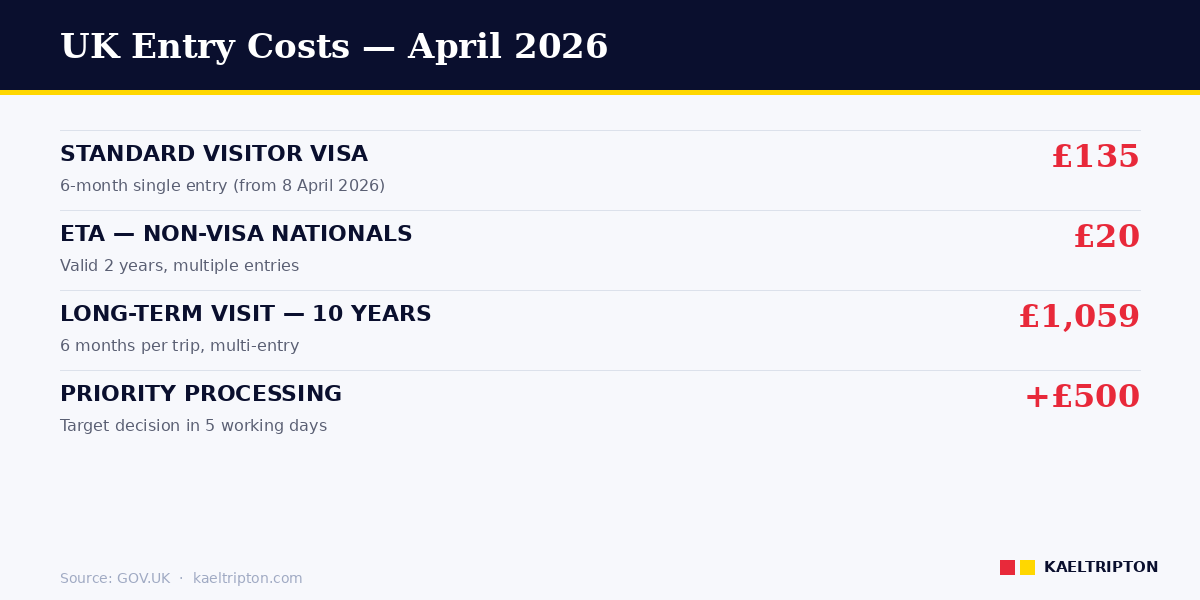
Visa nationals: apply online at gov.uk/standard-visitor, pay £135 (rose from £127 on 8 April 2026), attend VFS biometrics, wait ~15 working days. Non-visa nationals: apply for an ETA at £20 (rose from £16 on 8 April 2026). Irish citizens: no visa, no ETA. From 25 February 2026, most visas are eVisas linked to your passport - no sticker - so carry the passport you applied with. |
★ Featured Partner · Sponsored Travel eSIM data from $2.99 Slashtel sells travel eSIMs for 300+ destinations with the QR code delivered by email in about a minute. Keep your home number and WhatsApp active, and top up over WhatsApp. No physical SIM, no roaming bill shock. See eSIM plans →Slashtel is a trading name of Kael Tripton Ltd. This is a sponsored placement for a sister brand. |
UK visa fees: key facts (checked 16 October 2026) Current Home Office fees (most rose on 8 April 2026). Fees are per person and paid when you apply; the health surcharge is paid on top for each year of the visa.
|
What “Great Britain” actually means for visa purposes
Great Britain is the island containing England, Scotland and Wales. The United Kingdom adds Northern Ireland to that list. For visa purposes, these distinctions matter less than travellers think: a visa or permission to travel that admits you to the UK admits you to all four nations. The Common Travel Area - between the UK, Ireland, Jersey, Guernsey and the Isle of Man - adds a layer of nuance, but the headline is simple: if you have lawful permission to enter the UK, you can visit London, Edinburgh, Cardiff and Belfast on the same trip.
Three documents govern entry in 2026: a Standard Visitor visa for visa nationals, an Electronic Travel Authorisation (ETA) for most non-visa nationals, or free entry under the Common Travel Area for Irish citizens. Which one you need depends on your passport - not where you’re flying from.
The visa national list - do you actually need a visa?
The Home Office maintains a “Visa National List” at Appendix Visitor of the Immigration Rules. If your passport is on that list, you must apply for a Standard Visitor visa before travelling. If your passport is not on the list, you usually travel under an ETA or, as an Irish citizen, with no documentation at all beyond the passport.
The list covers over 100 countries including India, Pakistan, Nigeria, China, Russia, Turkey, Iran, Egypt, Indonesia, the Philippines, South Africa and most of sub-Saharan Africa. It excludes the United States, Canada, Australia, New Zealand, Japan, South Korea, Singapore, the EU and EEA countries, Switzerland, the GCC states, Taiwan and most of Latin America. Those “excluded” countries are the non-visa nationals - they now need an ETA.
Check your passport against the live list via the GOV.UK tool at gov.uk/check-uk-visa. The tool is authoritative. Travel agents, airline check-in staff and third-party websites are not.
Standard Visitor visa - fees, duration, what it allows
The Standard Visitor visa is the workhorse of UK entry for visa nationals. As of April 2026, the published Home Office fees (which rose on 8 April 2026) are:
| Visa type | Fee | Maximum stay per visit |
|---|---|---|
| Standard Visitor (up to 6 months) | £135 | 6 months |
| Long-term visit - 2 years | £475 | 6 months per trip |
| Long-term visit - 5 years | £848 | 6 months per trip |
| Long-term visit - 10 years | £1,059 | 6 months per trip |
| Marriage Visitor | £135 | 6 months - for ceremony only |
| Visitor in Transit | £74.50 | 48 hours landside |
The long-term visas are popular with frequent family visitors from India, Nigeria and Pakistan. They do not let you live in the UK - each individual visit must end within six months, and the Home Office reserves the right to cancel a long-term visa if travel history suggests the holder is effectively residing in the UK through successive visits. That enforcement note is from the official Apply for a Standard Visitor visa page.
What you can and cannot do as a Standard Visitor
Permitted activities cover tourism, visiting family and friends, attending business meetings and conferences, private medical treatment, study on accredited courses lasting up to six months, and certain “permitted paid engagements” as an expert in your profession. The full permitted-activity table sits in Appendix V of the Immigration Rules; it runs to several pages and caseworkers refer to it line by line.
The prohibited activities are tighter than most applicants expect. You cannot take up paid or unpaid work for a UK employer. You cannot be self-employed in the UK. You cannot marry or give notice of marriage on a Standard Visitor visa - that requires a Marriage Visitor visa. You cannot access NHS services other than emergency treatment (you are expected to have travel insurance or pay privately). And you cannot study on courses lasting more than six months except in narrow circumstances like recreational evening classes.
The most misunderstood restriction is on work. “Working remotely from the UK for my home-country employer” is a grey area the Home Office has tightened. Short bursts of incidental remote work are generally accepted; extended remote working from the UK for a foreign employer is not. Border Force officers have refused entry to visitors whose social media showed them running businesses from UK hotels.
The eVisa transition - what changed on 25 February 2026
The Home Office’s written ministerial statement of 25 February 2026 (HCWS1361) marked the UK’s move to a fully digital immigration system. From that date, most visa nationals applying for a visit visa now receive an eVisa linked to their passport rather than a physical visa sticker (“vignette”) in their passport.
Practically, this means:
- Your visa is linked to a specific passport. If you renew your passport before travelling, you must update your UKVI account so the eVisa is re-linked.
- Airlines perform automated permission-to-travel checks against Home Office systems before boarding. They receive either a “valid permission found” message or a refusal to board.
- There is no more paper sticker to lose, but there is also no visible evidence in your passport - everything hinges on the digital record matching the passport you travel on.
If you are a dual national, the Home Office has been publishing explicit guidance since October 2024 advising you to travel on your UK passport or on a certificate of entitlement (CoE) linked to your foreign passport. Travelling on your foreign passport alone, even where you are entitled to enter the UK, triggers the same carrier checks that non-UK nationals face and can cause boarding refusals.
The ETA - what non-visa nationals now need
The Electronic Travel Authorisation applies to most non-visa nationals from October 2023 onwards (with full enforcement from 25 February 2026). On 8 April 2026, the ETA fee rose from £16 to £20. It is valid for two years or until your passport expires, whichever comes first, and permits multiple visits of up to six months each during that validity period.
Applying for an ETA is a GOV.UK app or web form. Most decisions are automated and delivered within minutes. Decisions that require caseworker review can take up to three working days. You apply before you book, or at least before you fly - airlines will not board you without a “valid permission” response.
Nationals of the USA, Canada, Australia, New Zealand, Japan, South Korea, the EU, EEA, Switzerland, the GCC states and Taiwan are the main ETA populations. British and Irish citizens are exempt. Holders of valid Standard Visitor visas or longer-term UK visas do not need an ETA - your existing visa is your permission to travel.
Irish citizens and the Common Travel Area
Ireland sits outside the Schengen Area and inside the Common Travel Area with the UK. Irish citizens do not need any form of UK visa or ETA to enter, live, work or study in the UK - the right is statutory and predates UK and Irish EU membership. You can arrive on an Irish passport card or passport and be admitted without a stamp. The reciprocal arrangement works the other way for UK citizens visiting Ireland.
Travellers arriving in the UK from Ireland (say, a ferry from Dublin to Holyhead) are not subject to routine immigration controls on the UK side, but Border Force officers do carry out intelligence-led checks at sea and air ports. If you are a third-country national, arriving from Ireland does not exempt you from needing the correct UK permission.
Supporting documents - what caseworkers actually look at
Standard Visitor visa decisions are made largely on paper and uploaded documents. Unlike a US consular interview, there is usually no face-to-face officer asking questions. The written record has to speak for itself.
Caseworkers assess whether you are a “genuine visitor” under paragraph V 4.2 of Appendix V. The official Home Office caseworker guidance (published 25 February 2026) directs officers to weigh your stated purpose, personal circumstances, travel history, immigration compliance record and funds. Standard of proof: balance of probabilities.
The documents that typically build a convincing file are bank statements covering three to six months showing a settled financial pattern, an employer letter confirming employment and leave dates, hotel bookings and a flight itinerary, an invitation letter if you are visiting family, and travel insurance. For business visits, add an invitation from the UK host and a day-by-day schedule of meetings. For academic visits, add conference registration and any funding confirmations.
Edge case - refused before, applying again
A previous refusal is not an automatic bar to a new visa, but it must be declared. Lying about a refusal - or hiding it - is itself grounds for refusal and can trigger a 10-year ban. Home Office guidance instructs caseworkers to examine what has changed since the previous refusal: improved finances, a different travel purpose, stronger ties to the home country, or evidence that addresses the original refusal reason.
A cover letter that briefly and factually addresses the earlier refusal tends to help more than one that ignores it. Caseworkers see the refusal history anyway.
Edge case - visiting for medical treatment
Private medical treatment is a permitted Standard Visitor activity. For stays up to six months, the standard visitor fee applies. For courses of treatment running six to eleven months, the fee is £220 and you must show evidence of a UK clinician’s treatment plan and your ability to pay. NHS care is not available to visitors except for emergency treatment.
If you are applying from a country on the UK’s tuberculosis-screening list (India, Pakistan, Nigeria, Thailand and around 100 others), a TB certificate is required for any stay over six months. For standard six-month visits, TB screening is not required.
Edge case - children travelling alone or with one parent
Under-18s applying independently of a parent need a parental consent letter, the contact details of the parent(s) not travelling, and the name and address of the UK sponsor or adult accompanying them in the UK. Border Force routinely question children arriving without both parents and will refuse entry if the paperwork is unconvincing.
A long-term visit visa issued to someone under 18 ceases to be valid six months after their 18th birthday - a small detail that catches out applicants applying for multi-year visas a few months before turning 18.
Processing times and priority services
The GOV.UK standard processing time is three weeks from biometric appointment to decision. This is accurate in most low-volume posts but fluctuates in peak demand locations - India, Pakistan and Nigeria in summer often run longer.
Two paid expedited services are available where offered:
- Priority Visa Service - an extra £500. Target decision within five working days.
- Super Priority Visa Service - an extra £1,000. Target decision by end of the next working day.
Availability varies by country and visa application centre. Priority slots in Delhi, Mumbai, Lagos and Islamabad sell out in peak season; super-priority is often limited to business travellers. These services speed up the decision, not the outcome - a weak application is refused faster, not more kindly.
Refusal and reapplication
There is no right of appeal against most visitor visa refusals. The route is to reapply, addressing the reasons given in the refusal letter. Home Office refusal letters are templated but do cite the specific clauses of Appendix V that were not met - read them literally and build your next application around the specific weakness flagged.
Common refusal grounds: insufficient evidence of funds, unclear source of funds (sudden deposits are treated with suspicion), weak ties to the home country (no property, no stable employment, no dependants), inconsistencies between the application form and supporting documents, and adverse immigration history in the UK or elsewhere.
What to do at the UK border
Border Force officers can refuse entry even to a valid visa holder if the facts at the border contradict the visa application. If you applied as a tourist and arrive with a laptop, a UK client contract and no hotel booking, expect problems. The visa gives you the right to apply for entry; the border officer grants it.
Most visitors clear the border in under 15 minutes. ePassport gates (for eligible nationalities) are faster. Keep your return ticket, hotel confirmation and invitation letter accessible - digital copies on your phone are fine. The questions are short: purpose of visit, where staying, how long, who is funding the trip.
Permitted paid engagements - the narrow exception to “no work”
One genuine exception to the no-work rule exists: the permitted paid engagement. If you are a professional expert invited by a UK-based organisation, you may be paid for a specific engagement without needing a work visa. Examples from Appendix V include giving a lecture at a UK university, examining a student, participating as a guest speaker at a conference, providing advocacy in a legal case, or performing at an arts festival.
The engagement must be arranged before you travel, directly relate to your expertise and profession outside the UK, and be completed within one month of arrival. You must be invited by a UK-based organisation or a UK-based client of your overseas employer. This is a narrow route, not a back door to casual UK work. Crucially, a permitted paid engagement is declared at the border and does not require a separate visa category - but you must be able to produce the invitation letter and evidence of your profession on arrival.
Edge case - travelling with prior criminal convictions
Home Office suitability rules (Part 9 of the Immigration Rules) are strict about criminal history. A custodial sentence of 12 months or more, in any country, results in mandatory refusal. Shorter custodial sentences trigger a discretionary refusal window that narrows with time - one year for non-custodial fines, longer for suspended or community sentences.
Applicants with convictions should disclose them truthfully on the application form. Concealment is a separate ground for refusal and for a 10-year ban. Some offences considered minor in the home country - a regulatory business fine, a drunk-driving caution from years ago - must still be declared. If in doubt, consult an OISC-regulated adviser before submitting.
Family visits and sponsor letters that work
When a UK-based relative invites you, the sponsor letter is often the single most persuasive document. A good sponsor letter does four things: states the sponsor’s relationship to you, confirms the dates and purpose of your visit, states whether the sponsor is covering costs (and shows evidence if so), and gives the sponsor’s UK address where you will stay.
Attach the sponsor’s immigration status - a copy of their British passport photo page, their settled status share code, or their visa. Caseworkers assess whether the sponsor is lawfully in the UK and whether their accommodation can realistically house you. A sponsor on a student visa living in a shared room sponsoring three relatives raises questions; a British citizen homeowner sponsoring a parent for two weeks does not.
Northern Ireland - the one place this guide does not cover in detail
Strictly, the Standard Visitor visa covers the whole United Kingdom including Northern Ireland. But if you plan to enter Northern Ireland from the Republic of Ireland overland, the Common Travel Area complicates things. Visa nationals crossing the land border without a UK visa commit an immigration offence even though there are no physical border checks. If your trip involves crossing from Dublin or Dundalk into Northern Ireland, ensure your UK permission is in place before you make the crossing - no signage or checkpoint will remind you, but an ANPR or intelligence-led stop can still result in detention and removal.
Related guides
- UK Visitor Visa 2026 - Tourist Visa Application Guide
- UK Visa From India 2026 - Documents, Fees & Processing
- Is My Passport Valid for UK Travel in 2026?
- British Passport Holders in the EU 2026
Disclaimer
This guide is for general information and reflects Home Office rules and fees published on GOV.UK as of April 2026. Immigration rules change frequently. Always check the current position on gov.uk/check-uk-visa before applying. Complex cases - previous refusals, adverse immigration history, dual nationality - warrant advice from an OISC-regulated adviser or an immigration solicitor. This article is not legal advice.
Frequently asked questions
Do I need a visa for a weekend trip to London?
It depends on your passport. Visa nationals need a Standard Visitor visa even for a weekend. Non-visa nationals need an ETA (£20 from 8 April 2026). Irish citizens need nothing. Check your specific passport at gov.uk/check-uk-visa.
Can I work remotely from the UK on a Standard Visitor visa?
Short incidental work is accepted. Extended remote working from the UK for a non-UK employer is not, and the Home Office has tightened enforcement on this. If remote work is central to your trip, you may need a different visa route.
How long can I stay in the UK as a tourist?
Up to six months per visit on a Standard Visitor visa or ETA. Long-term visas (2, 5, 10 years) extend the period of validity but keep each individual visit capped at six months.
Is the ETA the same as a visa?
No. An ETA is a travel authorisation linked to your passport - you still clear immigration at the border. A visa grants leave to enter for a specified purpose. ETAs are for non-visa nationals making short visits; visas are for visa nationals or for purposes outside the permitted visitor activities.
What happens if my passport expires during my UK stay?
Your passport must be valid for the whole of your UK stay. If it expires while you are in the UK, you must renew it through your country’s embassy or high commission. Your visa or ETA remains valid but must be linked to the new passport before you fly home if border control on departure requires it.
Can I use my US or Canadian visa to transit through the UK?
Generally no. Transit through the UK usually requires either a Visitor in Transit visa (if you are a visa national and need to pass through UK immigration) or a Direct Airside Transit Visa if staying airside. Some exemptions exist for holders of valid US visas transiting to the US and similar routes - check the transit without visa concession at gov.uk.
Sources
- GOV.UK - Visit the UK as a Standard Visitor
- GOV.UK - Check if you need a UK visa
- Home Office - Written Statement HCWS1361 (25 February 2026): enforcement of ETA and move to eVisa
- Home Office - Visit: Caseworker Guidance (25 February 2026 edition)
- UK Home Office - UK Visa Requirements poster (March 2026)
- Home Office - UK Immigration fee changes, 8 April 2026


