

A UK visa refusal is rarely a dead end. Most refusals come down to a handful of recurring reasons - insufficient evidence of ties, unclear finances, document inconsistencies, undisclosed history. This guide breaks down what the Home Office caseworker guidance actually checks, how to read a refusal letter, and how to structure a successful reapplication.
Five refusal reasons cover the overwhelming majority of UK visit visa decisions: weak ties to home country, unexplained financial activity, document inconsistencies, undisclosed prior history, and prohibited-activity evidence. Read the refusal letter literally - it cites specific Appendix V paragraphs. Reapply with evidence that directly addresses those paragraphs. Concealment of prior refusals triggers a 10-year ban. |
UK visa fees: key facts (checked 16 October 2026) Current Home Office fees (most rose on 8 April 2026). Fees are per person and paid when you apply; the health surcharge is paid on top for each year of the visa.
|
How UK visa refusals work - the one-paragraph summary
A UK visa refusal letter from UKVI cites specific paragraphs of the Immigration Rules that the caseworker judged you failed to meet. There is no right of appeal for most visit visa refusals. Your route is to reapply, addressing the specific rule cited. Reapplications with meaningfully new evidence succeed regularly; reapplications that recycle the same file with minor cosmetic changes fail.
The Home Office Visit: Caseworker Guidance (25 February 2026 edition, published on GOV.UK) sets the test at paragraph V 4.2 of Appendix V: the caseworker must be satisfied, on the balance of probabilities, that the applicant is a genuine visitor who will leave the UK at the end of the visit. That single sentence drives most refusal decisions.
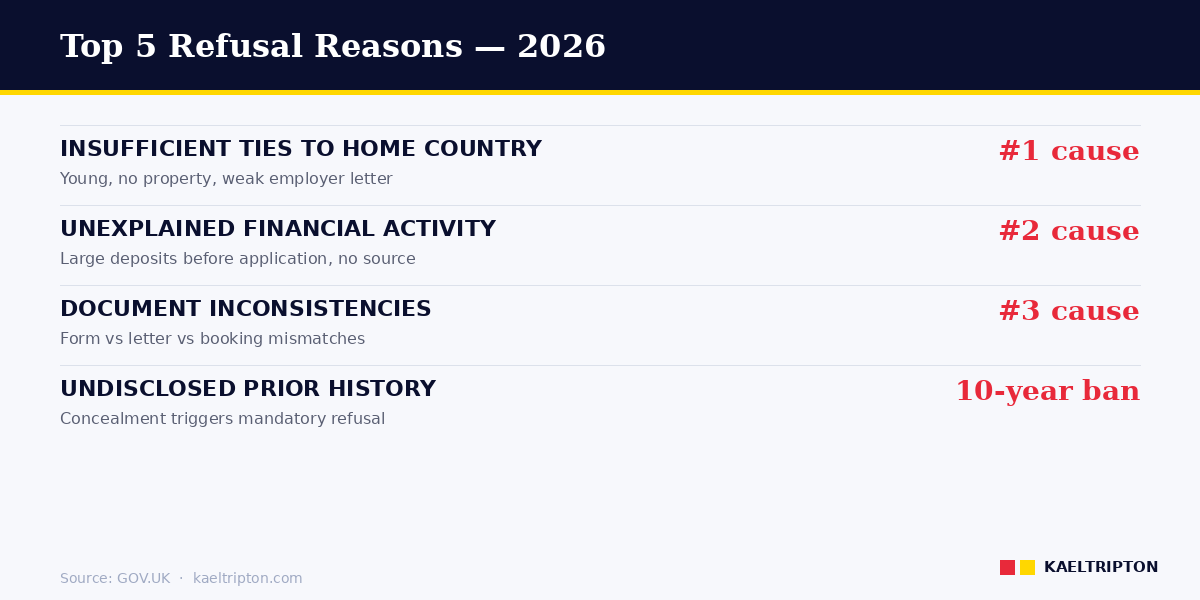
The five recurring refusal reasons
Analysed across published Home Office refusal letters, OISC-adviser case notes and Appendix V caseworker guidance, five reasons account for the overwhelming majority of UK visit visa refusals:
| Reason | What caseworkers actually flag |
|---|---|
| 1. Insufficient evidence of ties to home country | Young applicants without property, senior employment, dependants; weak reason to return |
| 2. Unexplained financial activity | Large deposits before application; balances inconsistent with income pattern; sponsor relationships without evidence |
| 3. Inconsistencies between documents | Salary on form doesn’t match payslips; travel dates mismatch bookings; purpose differs between letter and form |
| 4. Undisclosed prior history | Concealed previous refusals, overstays, or criminal convictions; triggers mandatory refusal and 10-year ban |
| 5. Prohibited activities suggested | Evidence suggesting intended UK work, long-term study, or relationship formation beyond permitted activities |
Caseworkers decide on the written file. There is no interview at the Standard Visitor visa level for most applicants. Your cover letter, bank statements, employer letter and itinerary must tell a single coherent story that passes paragraph V 4.2.
How to read a UK visa refusal letter
A UKVI refusal letter is templated but specific. It cites the paragraphs of Appendix V the caseworker applied and names the evidence gaps. Read it literally, not emotionally. Key sections:
- Paragraph references. The letter cites “V 4.2”, “V 4.3” etc. These point to specific rules in Appendix V. Look each up on gov.uk/guidance/immigration-rules/immigration-rules-appendix-v-visitor.
- Specific evidence gaps. The letter usually names what was missing or unconvincing: “you have not demonstrated sufficient ties to your country of residence”, “I am not satisfied your finances are genuinely available”, “the purpose of your visit does not match the supporting documents provided.”
- Non-appealable statement. Most visitor refusals include the standard text confirming no right of appeal, with guidance to reapply if circumstances change.
Two documents matter in decoding: your original application (what you said) and Appendix V (what the rule says). The refusal letter tells you where they didn’t match.
Reason 1 - insufficient evidence of ties
Home Office guidance asks the caseworker to weigh personal circumstances: age, family status, employment, property ownership, business commitments, dependants. An applicant with strong ties is statistically more likely to leave the UK. An applicant without them is assessed as higher risk.
What typically signals weak ties:
- Young, single, unemployed or in junior employment with no clear return reason.
- No property ownership, no long-term lease, no family dependants.
- First international trip straight to the UK, no history of returning from prior overseas travel.
- Employment letter that doesn’t confirm leave approval or a return date.
To strengthen this in a reapplication: stronger employer letter (with leave dates, direct phone, signed and on letterhead), evidence of property deeds or lease, family photographs with dependants, utility bills at your permanent address, and if possible a history of short Schengen trips that demonstrate compliant return.
Reason 2 - unexplained financial activity
The single most common root cause of refusal for financially capable applicants. Caseworkers look for a settled financial pattern consistent with your stated income. Sudden large deposits in the weeks before application trigger scrutiny.
What typically flags as unexplained:
- A balance that appeared three weeks before application with no prior history of similar amounts.
- Deposits from third parties without explanation of the relationship or source.
- Round-number credits (£500,000, 20 lakhs) that look like balance-building rather than genuine savings.
- Rapid cycling of funds between accounts close to the application date.
To address in a reapplication: show 6 months of consistent bank statements (not 3); provide source-of-funds evidence for any large deposits (sale deed for property, bonus letter from employer, probate document for inheritance); if sponsored, show the sponsor’s bank statements and an explicit relationship declaration. Avoid any further cycling - let the account sit quietly for 2-3 months before reapplying.
Reason 3 - inconsistencies between documents
Caseworkers cross-check every claim. Contradictions are a quick refusal trigger because they raise integrity concerns beyond any specific rule breach.
What typically catches applicants:
- Application form states salary of £50,000; payslip shows £45,000.
- Cover letter says visit is 15-22 June; flight booking is 17-24 June; hotel is 18-25 June.
- Employer letter addresses you as Senior Manager; application form lists Manager.
- Purpose stated at the VFS centre verbally differs from the application form.
These are fixable. In a reapplication, produce every supporting document first, then write the cover letter and application form referring to them. Cross-check every numerical claim. Have someone else read the package looking specifically for discrepancies before submitting.
Reason 4 - undisclosed prior history
This is the most dangerous category. Lying on or omitting from a UK visa application about previous refusals, overstays, criminal convictions, or adverse immigration history anywhere in the world is a separate and more serious ground for refusal. It triggers a mandatory 10-year ban from UK visas under Part 9 of the Immigration Rules.
UKVI has access to databases that include US and Schengen refusal records. A previous US visa refusal you didn’t declare will usually be discovered, even if UK-specific checks wouldn’t have spotted it.
If you’ve been refused before, declare it. A cover letter that briefly and factually addresses the earlier refusal tends to help more than one that hides it. Caseworkers see refusal history regardless. The question is whether you’ve demonstrated something meaningful has changed - new employment, stronger finances, a different travel purpose, new evidence of ties.
Reason 5 - prohibited activities suggested
The Standard Visitor visa permits tourism, business meetings, short-term study up to 6 months, private medical treatment, and permitted paid engagements. It does not permit paid or unpaid work for a UK employer, long-term study, marriage or relationship formation intended at the time of arrival, or extended residence through frequent visits.
Evidence that triggers this flag:
- Multiple visits in the preceding 12 months totalling more than 6 months - suggests living in the UK through successive visits.
- Social media showing you running business operations or working from UK addresses.
- A pattern of visiting a UK romantic partner repeatedly - the Marriage Visitor visa is the correct route for intended marriage.
- Employment contracts with UK entities found during checks.
Reapplying after this type of refusal usually requires switching visa category, not polishing the same Standard Visitor application. A skilled-worker visa for work intent, a Family Visa for partner settlement, a Student visa for long-term study.
Scenario - the first refusal, clean reapplication
Consider a realistic case. A graphic designer in Hyderabad applies for a 6-month UK visit visa in November 2025. She states a tourism purpose, shows a £500,000 bank balance that appeared in September, and provides a short employer letter confirming employment but not leave approval. She’s refused in December 2025 on two grounds: insufficient evidence of ties (no leave approval, no property, single with no dependants) and unexplained financial activity (the recent deposit).
She reapplies in May 2026. This time: her balance has sat steadily at the higher level for 8 months; she provides the sale-deed for a property she sold in September (source of the original deposit); her employer letter is on letterhead, signed, with leave dates approved and a direct phone number; she includes her lease agreement for the flat she rents; her cover letter briefly notes the previous refusal and addresses both points. Approved in June.
Teaching point: reapplications succeed when they demonstrably address every specific point in the refusal letter, not when they simply resubmit polished versions of the same file.
When to reapply and when to wait
There is no mandatory waiting period for UK visa reapplications (unless you received a 10-year ban for concealment or overstay). However, reapplying the next day with the same file and same gaps will produce the same refusal. Allow time to gather meaningful new evidence.
Useful waiting periods:
- 2-3 months if you need time to build a cleaner bank-statement pattern.
- 6 months if you need a new employer letter reflecting a promotion or established longer tenure.
- 12 months if the refusal involved a significant concern like previous overstay where demonstrable compliance with other countries’ rules strengthens your position.
When a different visa is the right answer
Some refusals signal the Standard Visitor visa was never the right category. If the refusal cites prohibited activities (work intent, marriage intent, long-term study), applying again for the same Standard Visitor visa with different evidence still fails because the underlying purpose is not permitted.
Alternative routes:
- Skilled Worker visa - for UK employment, requires employer sponsorship.
- Student visa - for courses longer than 6 months at approved institutions.
- Marriage Visitor visa - for ceremony or giving notice of marriage in the UK.
- Family visa - for joining a spouse, partner or parent with UK settled status.
When to get professional advice
For straightforward first refusals with a clear fixable reason, a well-prepared reapplication without professional help succeeds regularly. For complex cases - previous refusals, criminal history, adverse immigration history in multiple countries, dual nationality complications, refusal under Part 9 suitability rules - consult an OISC-regulated adviser or UK immigration solicitor.
Find OISC-regulated advisers through gov.uk/find-an-immigration-adviser. Unregulated immigration advisers are common and often ineffective or harmful - they charge for templates that don’t address your specific refusal reason and can’t represent you if escalation is needed.
Related guides
- UK Visitor Visa 2026: Tourist Visa Application Guide
- UK Visa from India 2026
- UK Visa Application Status Check 2026
- Great Britain Visa 2026: Entry Requirements
Disclaimer
This guide reflects Home Office caseworker guidance and Appendix V of the Immigration Rules as published on GOV.UK as of April 2026. Immigration rules are updated regularly. For complex refusals, previous overstay, criminal history, or dual nationality cases, consult an OISC-regulated immigration adviser or UK immigration solicitor. This article is not legal advice.
Frequently asked questions
Can I appeal a UK visitor visa refusal?
There is no right of appeal for most visitor visa refusals. The route is to reapply, addressing the specific paragraphs of Appendix V cited in the refusal letter. Appeals exist for some longer-stay routes (family, settlement) but not for Standard Visitor visa refusals.
How long do I have to wait before reapplying for a UK visa?
There is no mandatory waiting period unless you received a 10-year ban (typically for concealment, overstay or serious criminal conviction). However, reapplying the next day with the same file produces the same refusal. Allow 2-6 months to gather meaningful new evidence, depending on what caused the refusal.
What is the most common reason for UK visa refusal?
Insufficient evidence of ties to the home country, particularly for young single applicants without property, dependants or senior employment. Unexplained financial activity - sudden large deposits before applying - is the next most frequent cause, especially for financially capable applicants who failed to document source of funds.
Does a previous refusal reduce my chances of future approval?
Not automatically. Caseworkers look at what has changed since the previous refusal. A well-prepared reapplication that demonstrably addresses every point in the refusal letter succeeds regularly. Hiding the previous refusal - rather than addressing it - is what ruins chances, because non-disclosure is a separate and more serious ground for refusal.
Can I reapply with a different visa category?
Yes. Some refusals signal the Standard Visitor visa was never the right route. If the refusal cites prohibited activities like work intent or marriage intent, applying for a Skilled Worker, Marriage Visitor, or Family visa is often the correct next step rather than reapplying for the same Standard Visitor.
Do I need an immigration lawyer to reapply?
Not for straightforward first refusals with clear fixable reasons. For complex cases - previous refusals, criminal history, adverse immigration history abroad, Part 9 suitability issues - consult an OISC-regulated adviser through gov.uk/find-an-immigration-adviser. Unregulated advisers often charge for templates that don’t address specific refusal reasons.
How do I know which Appendix V paragraph was cited in my refusal?
Read the refusal letter literally. It cites specific paragraphs like “V 4.2”, “V 4.3”, “V 4.5”. These map to rules on Appendix V: Visitor at gov.uk/guidance/immigration-rules/immigration-rules-appendix-v-visitor. Reading the cited paragraph tells you exactly what evidence the caseworker judged insufficient.
Sources
- Home Office - Visit: Caseworker Guidance (25 February 2026 edition, published on GOV.UK)
- GOV.UK - Immigration Rules: Appendix V Visitor
- GOV.UK - Visit the UK as a Standard Visitor
- GOV.UK - Find a registered immigration adviser
- GOV.UK - Immigration Rules Part 9: Grounds for Refusal
- Home Office - Written Statement HCWS1361 (25 February 2026): ETA enforcement and eVisa rollout


