

The UK’s Electronic Travel Authorisation is now fully enforced. Since 25 February 2026, carriers must check for valid permission to travel before boarding. The ETA fee rose to £20 on 8 April 2026. This guide covers who needs one, who doesn’t, how to apply, and what changed this year.
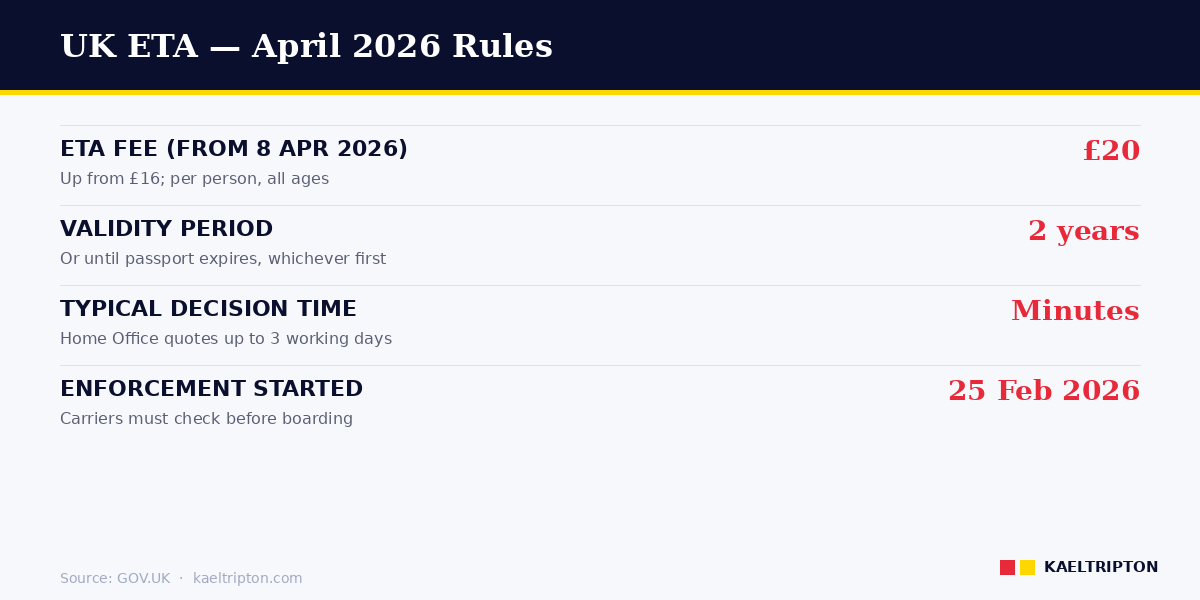
UK ETA is the travel authorisation for non-visa nationals - £20 as of 8 April 2026 (up from £16), valid 2 years or until passport expiry, permits multiple visits up to 6 months each. Enforcement started 25 February 2026: airlines now check permission before boarding, not just at the border. British and Irish citizens exempt; visa nationals (Indian, Pakistani, Nigerian, Chinese etc.) still apply for a Standard Visitor visa. |
The ETA in one sentence
The UK ETA is a digital travel authorisation required for most non-visa nationals entering the UK for up to 6 months. It costs £20 (up from £16 on 8 April 2026), is valid for 2 years or until your passport expires (whichever comes first), and permits multiple visits within that validity period. It is not a visa - you still clear immigration at the border.
Enforcement began on 25 February 2026 per the Home Office written ministerial statement HCWS1361. From that date, airlines and ferry operators must check ETA validity before boarding passengers bound for the UK. Travellers without valid permission are refused boarding, not just entry.
Who needs a UK ETA
You need an ETA if you are a non-visa national planning a short visit to the UK. The Home Office’s visa national list at Appendix Visitor of the Immigration Rules defines who is and isn’t a visa national. Broadly:
| Category | Needs ETA? | Notes |
|---|---|---|
| US, Canadian, Australian, New Zealand, Japanese citizens | Yes | Short visits up to 6 months |
| EU, EEA, Swiss citizens | Yes | From April 2025 after phased rollout |
| GCC nationals (Saudi, UAE, Qatar, Kuwait, Bahrain, Oman) | Yes | Since October 2023 |
| Indian, Pakistani, Nigerian, Chinese citizens | No - need visa instead | Visa nationals apply for Standard Visitor visa (£135) |
| British and Irish citizens | No | British passport holders exempt; Irish citizens under Common Travel Area |
| Holders of valid UK visas | No | Existing visa is the permission to travel |
The authoritative check is the GOV.UK tool at gov.uk/check-uk-visa. Enter your nationality, purpose and length of visit; the tool returns whether you need an ETA, a visa, or nothing.
ETA fees as of April 2026
The ETA fee rose from £16 to £20 on 8 April 2026, as part of the Home Office’s annual immigration fee revision. The fee applies per person. Children of any age need their own ETA at the same £20 rate. Families applying together still pay individually.
Payment is by credit or debit card during the online application. There are no regional fee variations - a US applicant and an Indian-origin Canadian applicant pay the same £20.
How to apply - the GOV.UK route
All ETA applications go through the official UK Government app or website at gov.uk/guidance/apply-for-an-electronic-travel-authorisation-eta. Third-party sites offering to “process” your ETA are either charging commission for a government service that costs £20 flat, or are outright fraudulent.
The process:
- Download the UK ETA app from the Apple App Store or Google Play, or use the web application.
- Scan the photo page of your passport using the app’s biometric reader.
- Take a selfie - the app matches this against the passport photo.
- Answer personal questions - address, contact details, any criminal convictions, previous UK refusals.
- Pay £20 by credit or debit card.
- Receive confirmation, typically within minutes.
Most decisions are automated and return within three working days. Some applications require caseworker review - for applicants with previous refusals, criminal records, or unclear answers - and take longer. You apply before you book travel, or at minimum before your flight, because airlines check ETA validity at check-in.
What the ETA allows and doesn’t
A valid ETA permits:
- Visits to the UK for tourism, business meetings, short-term study (up to 6 months), visiting family and friends, or private medical treatment.
- Multiple entries within the ETA’s 2-year validity.
- Stays of up to 6 months per entry.
It does not permit:
- Paid or unpaid work for a UK employer.
- Long-term study (more than 6 months).
- Marrying or giving notice of marriage in the UK (requires Marriage Visitor visa).
- Living in the UK through frequent or successive visits.
- Access to NHS services beyond emergency treatment.
The ETA is a travel authorisation, not a work authorisation. Paid remote work for a non-UK employer during an ETA visit is a grey area the Home Office has tightened - incidental check-ins are tolerated, extended working holidays are not.
ETA validity and passport renewal
An ETA is valid for 2 years from issue, or until the linked passport expires, whichever comes first. If you renew your passport during the ETA’s 2-year window, the ETA does not automatically transfer to the new passport. You must either apply for a new ETA linked to the new passport (£20 again) or travel on both passports - old passport to show the ETA, new passport for current validity.
In practice, most travellers apply for a fresh ETA with the new passport. The administrative friction of carrying two passports often outweighs the £20 saving.
Scenario - the American tourist in 2026
A US citizen in Portland plans a 10-day London trip in June 2026. She’s never been to the UK before. She checks gov.uk/check-uk-visa on her laptop, confirms she needs an ETA, downloads the app the next day. She scans her passport, takes a selfie, completes the form in about 8 minutes, and pays £20. Confirmation arrives the same evening.
She travels in June. At Heathrow she uses the ePassport gate (US citizens qualify) and clears immigration in 2 minutes. Her ETA is auto-validated by the gate against her passport.
Teaching point: the ETA is a one-time small effort, valid 2 years, usable for multiple UK trips. Americans visiting London once often don’t appreciate the multi-visit value. If you return to the UK within 2 years, the same ETA covers it.
Scenario - the Canadian business traveller
A management consultant from Toronto visits London twice a year for client meetings. In 2024 she used the visa-free regime. In 2025 she applied for an ETA at the then-£16 fee for her January 2026 trip. When that trip concluded she still had roughly 19 months of ETA validity remaining.
Her next trip is May 2026. The same ETA covers it - no new application needed. She saves the £4 increase from the April 2026 fee rise simply by having applied before 8 April.
Teaching point: applying before an announced fee rise is a legitimate arbitrage if you know you’ll be travelling within the validity window. ETA applications don’t require a confirmed booking.
What the 25 February 2026 enforcement means
Before 25 February 2026, ETA requirements were in force but carrier checks were not uniformly enforced. After that date, airlines and ferry operators that carry a passenger without valid UK permission to travel are liable for penalties. Practically, this means:
- Airlines now run automated permission-to-travel checks at check-in. The Home Office systems return either “0A: Valid Permission to Travel Found” (boarding OK) or a refusal message.
- Passengers without valid ETA or visa are refused boarding. The onward-journey disruption is the passenger’s problem; airlines won’t be liable.
- Dual nationals travelling on a non-UK passport need an ETA linked to that passport, or must travel on a valid UK passport.
The Home Office has been publishing explicit guidance for dual nationals since October 2024 recommending travel on UK passport or Certificate of Entitlement. Arriving at the gate on a US passport without an ETA - because you assumed your British parentage would clear the way - now means a boarding refusal.
Refusals and reapplication
Most ETA refusals are for applicants with previous UK visa refusals, adverse immigration history, or criminal records that triggered caseworker review and failed. Straightforward refusals of clean-record applicants are rare.
There is no appeal against an ETA refusal. You can apply again - typically after addressing whatever caused the refusal - but for complex cases (previous refusal, criminal history) applying for a Standard Visitor visa (£135, but with fuller review) is often more likely to succeed than reapplying for an ETA with the same facts.
Transit through UK airports
If you’re passing through the UK airside - not going through UK border control - you generally don’t need an ETA. A transfer at Heathrow from a New York flight to a Mumbai flight, staying within the international transit area, doesn’t require permission to enter the UK.
However, if your transit involves collecting baggage and re-checking through a UK arrivals process (common at some UK airports and with some airline combinations), you do cross the UK border and do need an ETA. Check with your airline if uncertain - they’ll know whether your specific connection is airside-only or requires border crossing.
Direct Airside Transit Visas (DATV) exist for some visa nationals but not for the non-visa nationals the ETA covers. If your itinerary involves landing and moving between UK airports (for example, Heathrow to Gatwick via central London), that’s a UK entry requiring an ETA.
ETA and the EU Entry/Exit System
Travellers entering the UK from a Schengen country or returning to Schengen from the UK navigate two separate systems. The UK ETA handles UK entry for non-visa nationals. The EU Entry/Exit System (EES), live at Schengen external borders since 12 October 2025, handles Schengen entry for non-EU nationals including British citizens.
Neither system replaces the other. A US tourist flying London-to-Paris needs both a valid UK ETA and EES biometric registration at the French border. A British citizen flying Paris-to-London needs no UK permission (British passports are exempt) but needs EES registration on exit from Schengen.
The ETIAS - the EU’s equivalent of the ETA - is expected to launch in late 2026 at €20 for 3 years. Once live, it will add another layer for British and other non-EU travellers entering Schengen.
Related guides
- UK Visitor Visa 2026: Tourist Visa Application Guide
- Great Britain Visa 2026: Entry Requirements
- UK Visa Application Status Check 2026
- Is My Passport Valid for UK Travel 2026?
Disclaimer
Rules and fees in this guide reflect Home Office and UKVI practice published on GOV.UK as of April 2026. Fee structures can change at each annual revision. Always check the current position at gov.uk/check-uk-visa before applying. This article is not legal advice.
Frequently asked questions
How much is a UK ETA?
£20 per person as of 8 April 2026 (up from £16). Children of any age pay the same rate. Valid for 2 years or until your passport expires, whichever comes first, and permits multiple UK visits within that period.
Who needs a UK ETA?
Most non-visa nationals visiting the UK for short stays: US, Canadian, Australian, New Zealand, Japanese, South Korean, EU/EEA, Swiss, GCC nationals, Taiwanese and similar. Visa nationals (Indian, Pakistani, Nigerian, Chinese, etc.) apply for a Standard Visitor visa instead. British and Irish citizens are exempt.
How long does it take to get an ETA?
Most decisions are automated and return within minutes, though the Home Office quotes up to three working days. Applications requiring caseworker review (previous UK refusals, criminal records) can take longer. Apply before you fly; airlines check ETA validity at check-in.
Can I work on a UK ETA?
No. The ETA permits tourism, business meetings, short-term study (up to 6 months), private medical treatment, and family visits. Paid or unpaid employment for a UK employer is not permitted. Extended remote work for a non-UK employer is a grey area the Home Office has tightened - incidental work is tolerated, extended working holidays are not.
Do children need their own ETA?
Yes. Every traveller, regardless of age, needs their own ETA at the same £20 rate. There is no family discount. Parents apply on behalf of under-18s.
What happens if I try to travel without an ETA?
You’ll be refused boarding. Since 25 February 2026, airlines must verify UK permission to travel before allowing a passenger to board. Automated checks against Home Office systems either return “Valid Permission to Travel Found” or a refusal. Refused passengers cannot board and lose any travel arrangements.
Does my ETA transfer to a new passport?
No. If you renew your passport during the ETA’s 2-year validity, you must either apply for a new ETA (£20) linked to the new passport, or travel with both passports - old passport to show the ETA, new passport for validity. Most travellers apply fresh; it’s simpler.
Sources
- GOV.UK - Apply for an Electronic Travel Authorisation (ETA)
- GOV.UK - Check if you need a UK visa
- Home Office - Written Statement HCWS1361 (25 February 2026): ETA enforcement and eVisa rollout
- Home Office - Immigration fee changes, 8 April 2026 (ETA £16 → £20)
- UK Home Office - UK Visa Requirements poster (March 2026)


