

India is the single largest source country for UK Standard Visitor visa applications. In 2026, the process is entirely digital - online application, VFS biometrics, eVisa outcome - and the cost base is higher than it was twelve months ago. This guide covers what has changed, what Home Office caseworkers actually look for, and how to avoid the refusal patterns that catch Indian applicants repeatedly.
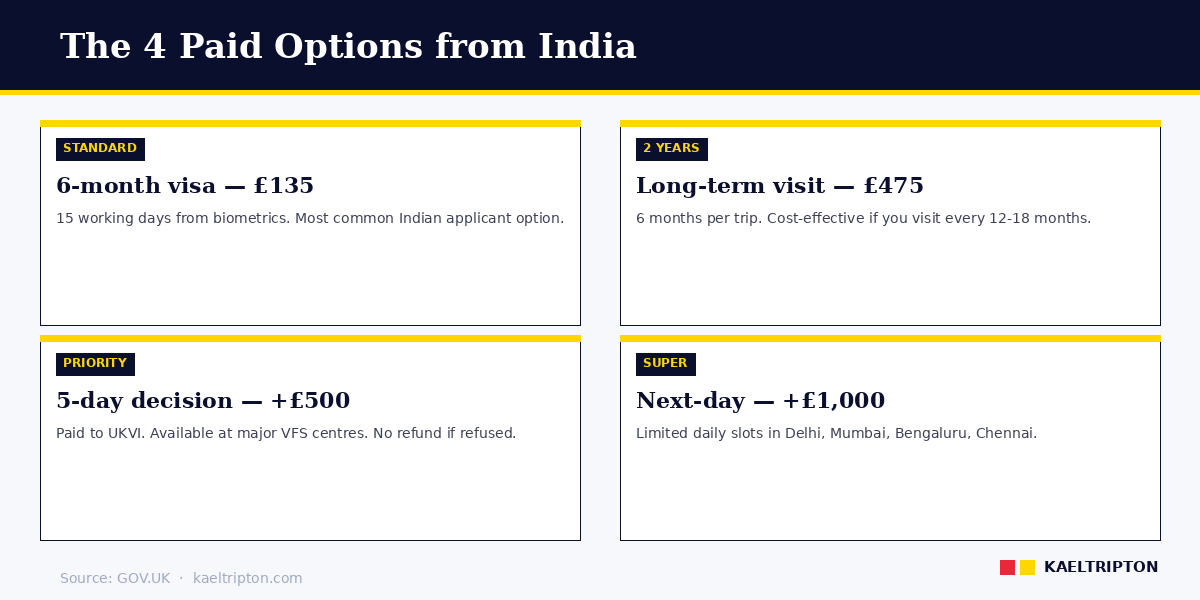
Standard Visitor visa from India: £135 (up from £127 on 8 April 2026), 15 working days from VFS biometrics. Priority adds £500 (5 working days), Super Priority £1,000 (next working day). From 25 February 2026, most visas are eVisas linked to your passport. The refusal killer: unexplained large deposits. Build a consistent 6-month bank statement pattern, not a balance spike. |
UK visa fees: key facts (checked 16 October 2026) Current Home Office fees (most rose on 8 April 2026). Fees are per person and paid when you apply; the health surcharge is paid on top for each year of the visa.
|
The headline numbers for 2026
The UK Standard Visitor visa fee from India, as of April 2026, is:
| Visa option | Home Office fee | Approx. INR equivalent |
|---|---|---|
| Standard Visitor (up to 6 months) | £135 | ₹14,400 |
| Long-term visit - 2 years | £475 | ₹50,700 |
| Long-term visit - 5 years | £848 | ₹90,500 |
| Long-term visit - 10 years | £1,059 | ₹113,100 |
| Priority processing (on top) | +£500 | +₹53,400 |
| Super Priority (on top) | +£1,000 | +₹106,800 |
The 6-month visa fee rose from £127 to £135 on 8 April 2026 as part of the Home Office’s annual immigration fee revision. Applications submitted on or after 8 April 2026 pay the new fee regardless of travel date. INR equivalents fluctuate with the Home Office’s exchange rate policy - always check the authoritative live figure at visa-fees.homeoffice.gov.uk.
Separate from the Home Office fee, VFS Global (the commercial partner handling biometric submission in India) charges service fees typically in the ₹3,000 to ₹5,000 range, plus optional add-ons such as SMS tracking, premium lounge access and courier passport return.
Processing times - what “15 working days” actually means
The standard UKVI target for Indian applicants is 15 working days (three weeks) from biometric enrolment - not from online submission. The clock starts the day you submit fingerprints at a VFS centre. Weekends and UK/India public holidays do not count. During peak application seasons (April to August, when summer family visits dominate), actual processing often extends to 20 to 25 working days.
Paid expedited options, where available at your VFS centre, cut this substantially:
- Priority Visa: target five working days from biometrics. Extra £500.
- Super Priority Visa: target next working day. Extra £1,000.
Both services speed up the decision; they do not influence its outcome. A weak application is refused faster, not more kindly. Availability is concentrated in Delhi, Mumbai, Bengaluru and Chennai VFS centres; smaller VFS sites may offer priority only on certain days. Super Priority slots sell out early in the week - book the biometric appointment before committing to travel dates.
How to apply - the correct GOV.UK route
Every UK Standard Visitor application starts at gov.uk/standard-visitor/apply-standard-visitor-visa. There is no other official website. Third-party sites that offer to “process” UK visas from India are either advisory (charging for guidance, which is legal but optional) or fraudulent (charging for a service that does not exist).
The process:
- Create a UKVI account on GOV.UK using an email address you check regularly.
- Fill the online application form. Answer every question accurately - contradictions between the form, your supporting documents and your cover letter are the single most common cause of refusal.
- Pay the fee online in GBP. Your card will be charged in INR at your bank’s exchange rate.
- Book a VFS biometric appointment at the VFS website (you will be redirected automatically).
- Attend the VFS appointment with your passport, printed application summary and supporting documents. Biometrics (fingerprints, photo) are collected in minutes.
- Wait for the decision by email. Collect your passport from VFS when notified.
From 25 February 2026, most new Standard Visitor visas issued to Indian applicants are eVisas linked to the passport, not physical vignette stickers. The Home Office’s written statement of that date (HCWS1361) marked the full transition. You will not see a sticker in your passport; airlines check permission electronically at boarding.
The “genuine visitor” test - what caseworkers assess
The Home Office Visit caseworker guidance (February 2026 edition) sets the test bluntly at paragraph V 4.2 of Appendix V: the caseworker must be satisfied, on the balance of probabilities, that the applicant is a genuine visitor who will leave the UK at the end of the visit. Five factors weigh most heavily:
- Personal circumstances - age, family status, employment, property, dependants.
- Stated purpose of visit - consistent with a genuine visitor activity.
- Travel history - previous UK visits complied with, Schengen or US travel showing return compliance.
- Adequate funds - to cover the whole trip without working illegally or relying on public funds.
- Ties to India - reasons to return. Employment, property, business, immediate family.
The caseworker does not interview you. They review your written file. Your cover letter, bank statements, employer letter and itinerary must tell a single coherent story.
Financial evidence - what actually convinces
Home Office guidance asks whether you can support yourself for the whole trip without recourse to public funds and without working illegally. There is no published rupee figure that “passes”. Officers weigh balance against consistency and provenance:
- A steady ₹80,000-per-month salary credit for six months, with rent, EMI and utility debits, builds a credible picture.
- A ₹40 lakh balance that appeared three weeks before application, with no prior pattern, will be questioned.
- Sudden large deposits shortly before applying are the single most frequent cause of refusal among financially capable applicants. If you received a legitimate bonus, property sale proceeds or inheritance, include one line of evidence (sale deed, bonus letter, probate) alongside the deposit.
The common informal rule is to show bank statements covering at least three months - caseworkers often look for six. Statements should be genuine bank-issued PDFs, not screenshots or third-party compilations. Any pattern that looks coached (round-number deposits, “balance builders” from family members, rapid cycling of funds between accounts) triggers scrutiny.
Employer letter - the template that works
For a salaried applicant, the employer letter is usually the strongest single document. A persuasive letter includes:
- Company letterhead with registered address and contact details of a signatory.
- Your full name, designation, date of joining and current gross annual salary.
- Confirmation that leave for your proposed UK travel dates has been approved.
- A statement that your position is being held open and you are expected to return to work.
- Signatory name, designation and direct phone number - caseworkers occasionally call to verify.
For self-employed applicants, the equivalents are: business registration documents, GST returns for the last three years, Income Tax Returns (ITRs) for the last three assessment years, and bank statements for both personal and business accounts.
Sponsor letters - when family in the UK invites you
If a UK-based relative invites you, the sponsor’s documents carry meaningful weight. Include:
- Sponsor’s UK immigration status (British passport photo page, BRP, or settled status share code).
- Sponsor’s relationship to you (birth certificate, marriage certificate, photographs if helpful).
- Sponsor’s address proof (utility bill, council tax statement).
- Sponsor’s bank statements (three to six months) if they will cover your costs.
- An invitation letter stating the dates, purpose, accommodation arrangement and whether costs are shared.
A common mistake: providing sponsor documents without explicitly stating the sponsor is covering costs. Caseworkers should not have to guess the financial arrangement - state it plainly.
Common refusal reasons for Indian applicants
Based on published Home Office refusal letters and patterns reported by UK immigration lawyers, the recurring refusal reasons for Indian applicants are:
- Insufficient evidence of ties to India. Young single applicants without property, without senior employment, without dependants, are assessed as higher risk. Counter with strong employer letter, lease or property deed, family responsibilities.
- Unexplained financial activity. Deposits that look like balance-building. Counter with documented source of funds.
- Weak travel history. First international trip straight to the UK is a higher risk profile than an applicant with Schengen or Southeast Asia travel history showing compliance. Counter with strong purpose documentation.
- Inconsistencies between documents. Salary on application form does not match payslips; travel dates on cover letter do not match flight bookings; purpose stated verbally at VFS does not match the written application. Triple-check before submitting.
- Previous refusals, overstays or immigration breaches anywhere. Must be declared. Concealment is a separate ground for refusal and a 10-year ban.
What Indian applicants can and cannot do in the UK
Standard Visitor activities cover tourism, family visits, business meetings and conferences, private medical treatment, study on courses up to six months (including yoga teacher training, fitness certifications, English language short courses), and permitted paid engagements as a professional expert.
Indian applicants cannot:
- Take up employment or unpaid work for a UK-based employer.
- Study on courses longer than six months without a separate Student visa.
- Marry or give notice of marriage (a Marriage Visitor visa is needed).
- Live in the UK through frequent or extended visits.
- Access the NHS beyond emergency treatment.
The most common breach involves remote work. Working remotely for an Indian employer from a UK hotel or relative’s home is grey area that the Home Office has tightened. Incidental check-ins are tolerated; a six-week working holiday operating from the UK is not.
The long-term visit visa - when it pays off
For frequent family visitors, the 2, 5 or 10-year long-term visit visa can be cheaper than repeated 6-month applications:
| If you visit this often | Cheapest option |
|---|---|
| Once every 2-3 years | Single 6-month visa each trip (£135) |
| Once a year for 2-3 years | 2-year visa (£475 ≈ £238/year) |
| Once a year for 5+ years | 5-year visa (£848 ≈ £170/year) |
| Multiple trips over 10 years | 10-year visa (£1,059 ≈ £106/year) |
Each long-term visit still caps individual visits at 6 months, and the visa is cancelled if travel history shows you are effectively residing in the UK. Long-term visas are most often approved for applicants with a demonstrated multi-year pattern of compliant short visits.
Children travelling with one or both parents
Under-18s need their own application and their own Standard Visitor fee of £135. If travelling with both parents, the children’s applications reference the parents’ applications and the evidence overlaps. If travelling with one parent, a notarised consent letter from the non-travelling parent is required - this is frequently overlooked.
Birth certificates, school letters confirming the child’s enrolment and return date, and evidence of the accompanying parent’s custody arrangement (if divorced) all strengthen the application.
Tuberculosis certificate - only for longer stays
India is on the UK’s TB-screening country list. A TB-free certificate from an approved clinic is mandatory for any UK visa granting stay of more than six months, including long-term student and work visas. For standard 6-month visitor visas, TB screening is not required.
Approved TB clinics in India are listed at gov.uk/tb-test-visa/approved-clinics. Clinics are concentrated in major cities; smaller cities may involve travel. The certificate is valid for six months from issue.
Edge case - applying while a previous visa is still valid
If you hold a valid long-term visit visa and want to convert to a different category (student, work), the new application is made from India in the usual way. Your existing visit visa continues to be valid until its expiry date - applying for a different visa does not cancel it.
Applying for a new visitor visa while holding a valid long-term one is generally a waste: caseworkers will usually refuse the duplicate, and any fee is non-refundable. Use the visa you have.
Edge case - recent travel to “sensitive” countries
Recent travel to countries on the UK’s watchlist (Iran, Syria, Afghanistan, North Korea, parts of Yemen, Libya) does not automatically disqualify an application but does trigger additional security review. Declare these trips truthfully. Non-disclosure becomes a separate and more serious ground for refusal if detected.
VFS centres in India - where and how
VFS Global operates 14 Visa Application Centres across India on behalf of UKVI. The major ones are in Delhi (Shivaji Stadium and Vasant Kunj), Mumbai (Trade Centre and Lower Parel), Bengaluru, Chennai, Hyderabad, Kolkata, Ahmedabad, Chandigarh, Jalandhar, Pune, Cochin, Goa, Jaipur and Puducherry. Appointment slots are bookable online through the VFS website after you complete your GOV.UK application and pay.
Standard appointments are free. Premium appointment options include:
- Prime Time appointment - evening and weekend slots for an additional fee.
- Premium Lounge - separate fast-track processing area, typically ₹7,500.
- Courier passport return - pay to have the decided passport delivered to your address rather than collecting it from VFS, around ₹900.
- SMS tracking - updates on application progress, around ₹500.
None of the premium services influences the visa decision itself. They trade convenience for money. The only paid service that affects the timeline is Priority or Super Priority processing, which is paid to UKVI (not VFS) through the GOV.UK online application.
The cover letter - what to include and what to avoid
A well-written cover letter is optional but widely recommended by UK immigration lawyers. It should be one to two pages and cover:
- Your stated purpose of visit, specific dates and high-level itinerary.
- Your employment or business situation in India and why you will return.
- The source of funds being relied on and a brief note on any unusual financial activity.
- Your accommodation arrangements in the UK (hotel, family, mix).
- Any sponsor relationship, with the sponsor’s details cross-referenced.
- Any previous UK refusals, addressed factually.
Avoid: emotional appeals (“I have always dreamed of visiting London”), irrelevant detail (educational history from two decades ago), and exaggerated claims about return intent. Caseworkers read hundreds of applications a week; plain, factual, well-organised letters land better than elaborate narratives.
Visiting as a student already in the UK on a tier 4 visa
If your child or partner is studying in the UK and you want to visit them, you apply as a Standard Visitor in the same way as any other applicant. Include the student’s Confirmation of Acceptance for Studies (CAS), their current immigration status, their Biometric Residence Permit (BRP) or eVisa evidence, and a letter from them inviting you.
Students on Tier 4 or Student visas can host visiting family without their own immigration status being affected, provided the accommodation arrangement is workable and temporary. Caseworkers occasionally refuse parent-visitor applications where the student’s accommodation (a shared dorm room) cannot realistically house the visitor - in such cases, a hotel booking near the student’s university is a stronger document than a claim of staying in the dorm.
What happens after approval
Approval arrives by email. Your passport, if collected in person, is returned via the VFS centre - typically within 2 to 3 working days of the decision email. If you paid for courier return, it arrives at your address within 5 to 7 working days. No physical visa sticker appears in your passport (since the eVisa transition on 25 February 2026). Instead, the Home Office sends a decision letter confirming the eVisa is active, with a reference to the UKVI account where you can view your status and share permission details with carriers.
Check before you fly: log into your UKVI account, verify the eVisa shows “active”, and confirm it is linked to the passport you will travel on. If you renewed your passport between applying and travelling, update the account before the flight - airlines will refuse boarding if the Home Office system does not return “0A: Valid Permission to Travel Found” on your check-in scan.
Related guides
- UK Visitor Visa 2026 - Tourist Visa Application Guide
- Great Britain Visa 2026 - Entry Requirements
- Is My Passport Valid for UK Travel 2026?
- UK Immigration & Visa Application 2026
Disclaimer
This guide reflects Home Office rules and fees published on GOV.UK as of April 2026. Immigration rules change regularly. Always check the current position at gov.uk/check-uk-visa before applying. Complex cases - previous refusals, adverse immigration history, dual nationality, or travel to watchlist countries - warrant advice from an OISC-regulated adviser or UK immigration solicitor. This article is not legal advice.
Frequently asked questions
How much is the UK visa fee from India in 2026?
£135 for a 6-month Standard Visitor visa (up from £127 on 8 April 2026). Long-term visas cost £475 (2 years), £848 (5 years) or £1,059 (10 years). Priority processing adds £500; Super Priority adds £1,000. Plus VFS service fees of around ₹3,000 - ₹5,000.
How long does UK visa processing take from India?
Standard processing is 15 working days from biometrics at VFS. Priority is 5 working days (+£500). Super Priority is next working day (+£1,000). Peak season (summer) can extend standard processing to 20-25 working days.
Do I need a TB test for a UK visitor visa from India?
No, not for visits of 6 months or less. TB testing is only required for visas granting more than 6 months of stay, such as student, work or long-stay medical visas.
Can I work remotely from the UK on a Standard Visitor visa?
Short incidental work (checking emails, a few calls) is generally accepted. Extended remote working from the UK for your Indian employer is not, and the Home Office has tightened enforcement. If remote work is central to your trip, you may need a different visa route.
What are the most common reasons for UK visa refusal from India?
Unexplained large deposits in bank statements; weak ties to India (no property, no stable employment); inconsistencies between the application form, cover letter and supporting documents; and undisclosed prior refusals or overstays. Applications from first-time international travellers with modest documentation face the highest refusal rate.
Can I appeal a UK visitor visa refusal?
There is no right of appeal for most visitor visa refusals. The route is to reapply, addressing the refusal letter’s specific reasons. Reapplications with meaningfully new evidence (improved financial pattern, stronger employer letter, additional travel history) are often approved.
Does my UK visa appear in my passport?
For most Indian applicants from 25 February 2026, no. Your visa is an eVisa linked to your passport number - no physical sticker. Airlines check permission electronically. Carry the same passport you applied with; update your UKVI account if you renew your passport.
Sources
- GOV.UK - Apply for a Standard Visitor visa
- GOV.UK visa fees tool - UK visa fees for India (INR)
- Home Office - Written Statement HCWS1361 (25 February 2026): ETA enforcement and eVisa rollout
- Home Office - Visit: Caseworker Guidance (25 February 2026 edition)
- GOV.UK - TB test for a UK visa: approved clinics in India
- GOV.UK - Immigration fee changes, 8 April 2026


