

Applying for a UK visa in 2026 means navigating a system that became measurably more expensive on 8 April 2026, when the Home Office raised almost every immigration and nationality fee by between 6% and 7%. A six-month visitor visa now costs £135. A Skilled Worker visa of up to three years from outside the UK costs £819. Indefinite Leave to Remain has crossed the £3,200 mark for the first time, reaching £3,226 per applicant.
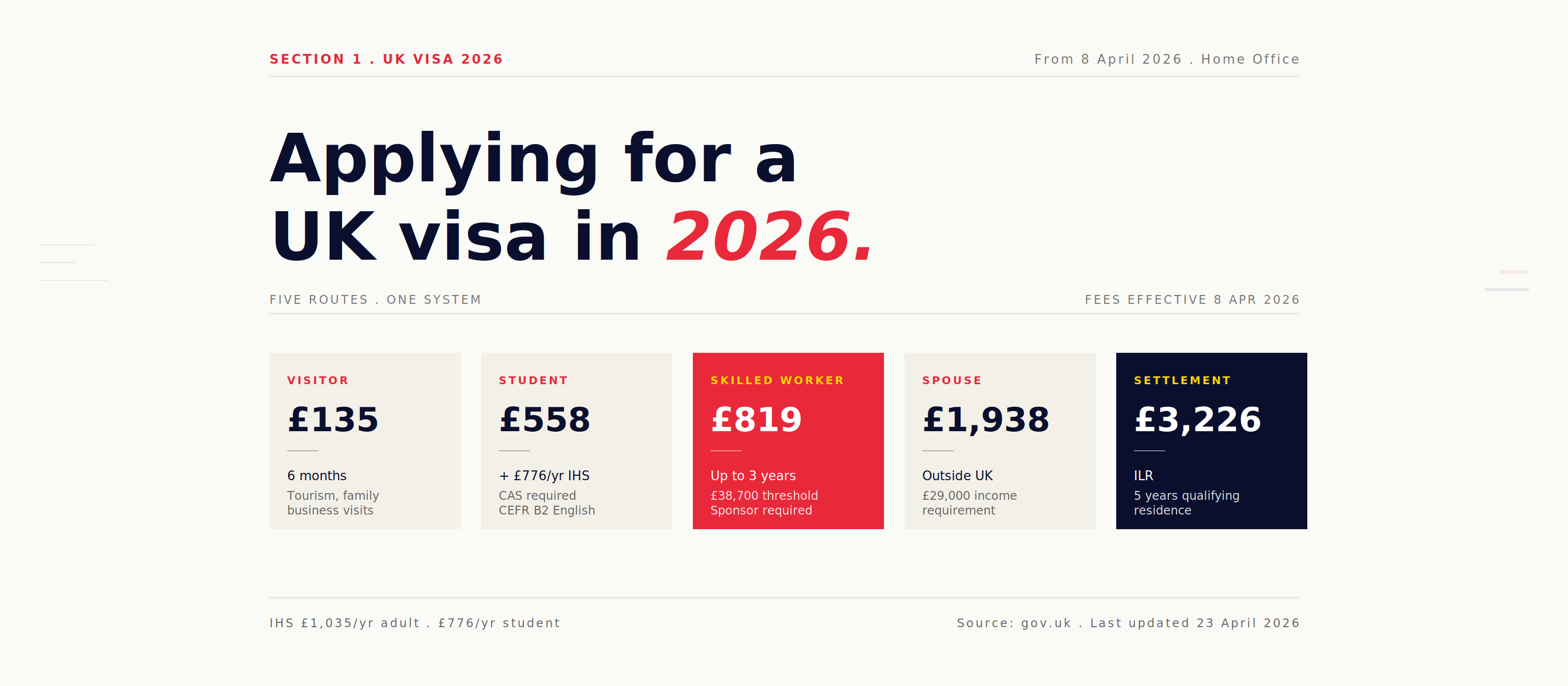
This guide walks through the full UK visa application process as it stands in April 2026: which route to choose, what each costs, how long it takes, what documents the Home Office actually wants, and where applications most commonly fail. Whether the purpose is visiting family, taking up a sponsored job, starting a degree, or joining a spouse, the mechanics share a common spine: pick the correct route, submit online, pay the fees plus the Immigration Health Surcharge (IHS), enrol biometrics, and wait for a decision.
|
KEY FACTS (VERIFIED 23 APRIL 2026) Standard Visitor visa (6 months): £135 application fee. Most visitors decided within 3 weeks of biometric appointment. Skilled Worker visa (up to 3 years, outside UK): £819 main application. Add £1,035 per year IHS and the salary threshold of £41,700 applies from January 2026 for most routes. Student visa: £558 application. £776 per year IHS (student rate). Valid for course duration plus short wrap-up period. Indefinite Leave to Remain (ILR): £3,226 per applicant from 8 April 2026 (previously £3,029). Naturalisation as British citizen: £1,709 adult, £1,000 child (reduced from £1,214). |
UK visa fees: key facts (checked 16 October 2026) Current Home Office fees (most rose on 8 April 2026). Fees are per person and paid when you apply; the health surcharge is paid on top for each year of the visa.
|
Which UK visa do you actually need?
The first mistake most applicants make is choosing a route that does not fit their circumstances. The Home Office does not correct the route for you. An incorrectly categorised application is refused, the fee is not refunded, and the refusal sits on the applicant's immigration record. The UK visa system in 2026 breaks into five broad families.
Visitor visas cover short stays of up to six months for tourism, family visits, business meetings, private medical treatment, or as an academic visitor. The standard visitor visa is £135 for six months, with longer-validity options at £509 (two years), £918 (five years), and £1,147 (ten years). Visitors cannot work in the UK, cannot study beyond six months, and cannot claim public funds. Nationals of around 60 countries do not need a visitor visa at all: from 2 April 2025, the UK's Electronic Travel Authorisation (ETA) replaced the old visa-waiver system for most visa-exempt travellers. The ETA costs £20 (up from £16 on 9 April 2026) and lasts two years.
Work visas are the largest and most complex family. The Skilled Worker route is the flagship: it requires sponsorship by a licensed UK employer, a genuine job at RQF Level 3 (A-level equivalent) or above, and a salary of at least £38,700 or the going rate for the occupation, whichever is higher. Other work routes include the Health and Care Worker visa (now £324 main fee for up to 3 years), Senior or Specialist Worker (Global Business Mobility), Graduate visa (post-study work for up to 2 years, 3 for PhDs), Global Talent, Innovator Founder, Scale-up, and the Youth Mobility Scheme. Each has distinct sponsorship, salary, and evidentiary rules.
Study visas are dominated by the Student route, which requires a Confirmation of Acceptance for Studies (CAS) from a licensed sponsor university or college, proof of English at CEFR B2, and financial evidence covering tuition plus maintenance of £1,483 per month in London or £1,136 per month outside London for up to nine months. The Child Student route covers independent school pupils aged 4 to 17.
Family visas cover spouses, partners, unmarried partners (after two years cohabiting), parents, and adult dependent relatives of British citizens or UK settled persons. The spouse visa application fee is £1,938 from outside the UK or £1,321 from inside, plus IHS, plus proof that the sponsor meets the minimum income requirement of £29,000 (raised from £18,600 in April 2024).
Settlement and citizenship routes include Indefinite Leave to Remain (settlement) for those who have completed a qualifying period of continuous residence, usually five years, and Naturalisation for those holding ILR (or married to a British citizen) who meet residence and Life in the UK Test requirements.
The 2026 fee schedule: what you actually pay
Home Office fees are only one line on the receipt. A Skilled Worker visa for three years at £819 is not an £819 application; by the time IHS, biometrics, and sponsor-side charges are totalled, the real cost is several multiples higher. The table below shows the full cost stack for the most common routes as of 8 April 2026.
| Route | Application fee | IHS (per year) | Typical decision time |
|---|---|---|---|
| Visitor (6 months) | £135 | N/A (not payable for less than 6 months) | 3 weeks |
| Skilled Worker (up to 3 years, outside UK) | £819 | £1,035 adult | 3 weeks |
| Skilled Worker (over 3 years, outside UK) | £1,618 | £1,035 adult | 3 weeks |
| Health and Care Worker (up to 3 years) | £324 | Exempt | 3 weeks |
| Student (outside or inside UK) | £558 | £776 student rate | 3 weeks |
| Spouse / Partner (outside UK) | £1,938 | £1,035 adult | 12 weeks (settlement stream) |
| Graduate visa (post-study) | £880 | £1,035 adult | 8 weeks |
| Indefinite Leave to Remain (ILR) | £3,226 | N/A | 6 months (standard) |
| Naturalisation (adult) | £1,709 | N/A | 6 months |
The Immigration Health Surcharge is charged upfront for the full duration of the visa. A three-year Skilled Worker visa therefore triggers £3,105 of IHS in a single payment (£1,035 × 3 years), on top of the £819 application fee. Dependants pay their own application fee plus their own IHS. A family of four on a three-year Skilled Worker route pays two adult IHS amounts (£3,105 × 2 = £6,210) plus two child IHS amounts at the £776 rate (£2,328 × 2 = £4,656), totalling £10,866 in IHS alone.
Biometric enrolment adds £19.20 per applicant at a UK Visa and Citizenship Application Services (UKVCAS) centre. The UK Immigration: ID Check app replaces this for eligible visa types where the applicant holds a biometric passport. Priority service (5 working days) adds £500 per applicant. Super Priority (next working day where available) adds £1,000.
Step by step: the 2026 UK visa application process
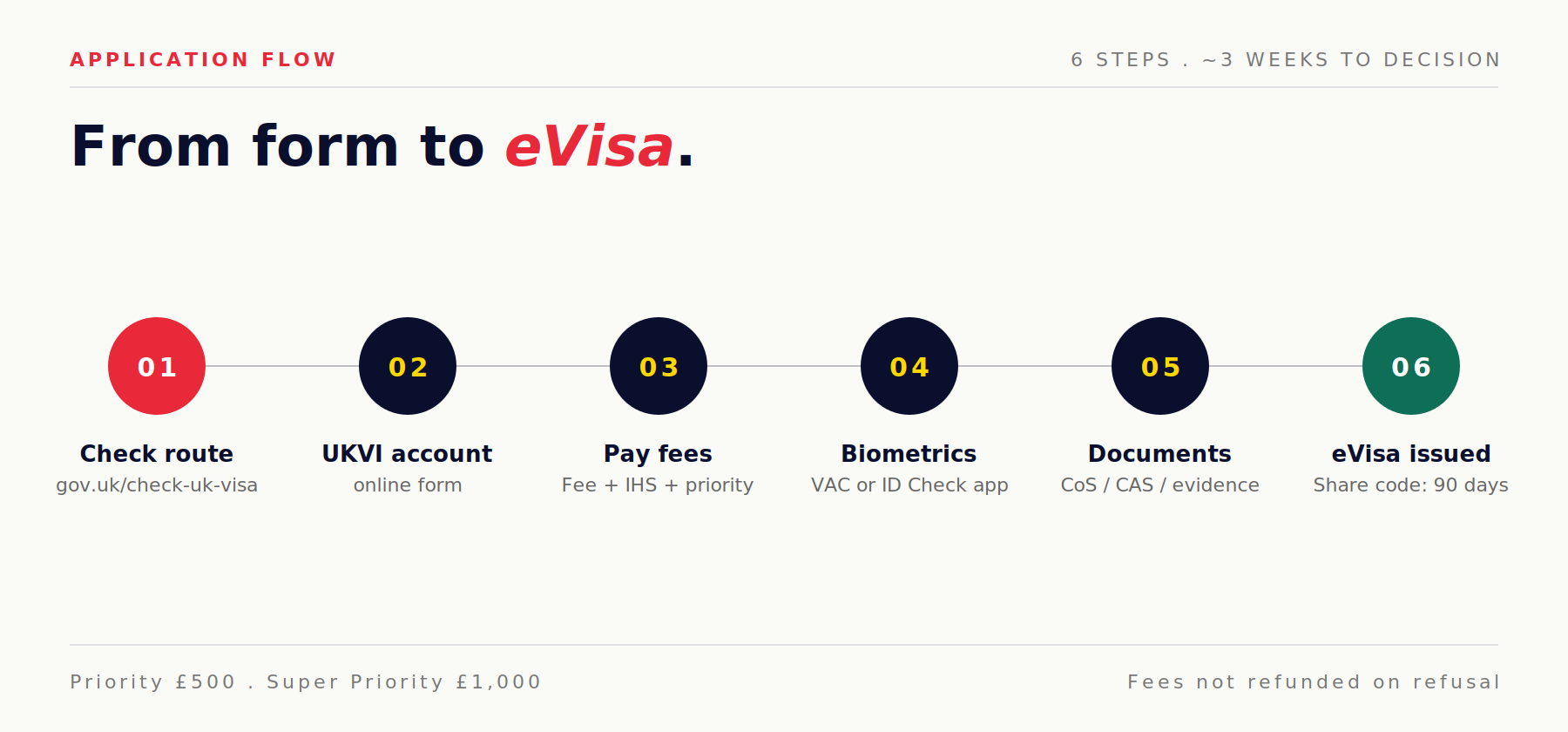
Every UK visa application in 2026 follows the same six-step structure, regardless of route. The specifics of supporting documents change, but the sequence and digital platform do not.
Step 1: Select the correct route on gov.uk. The starting point is gov.uk/browse/visas-immigration. The Home Office's "Check if you need a UK visa" tool (gov.uk/check-uk-visa) asks a short series of questions about purpose, nationality, and duration, then points to the correct application form. Do not rely on third-party summaries; the tool reflects the current rules, not last year's rules.
Step 2: Create a UKVI account and complete the online form. The Home Office processes nearly all applications digitally. The form auto-saves and can be revisited. Answer every question truthfully: the Home Office cross-checks biographical data against prior applications, travel history (via airline API data and the new Entry/Exit System records from partner countries), and where available, overseas tax records. Inconsistencies between this application and any previous one trigger manual caseworker review and significant delays.
Step 3: Pay the fees online. Application fee, IHS, and any priority fees are all paid at the end of the form before submission. The application is not lodged until payment clears. Use a card registered to the applicant or sponsor; declined cards create re-submission delays.
Step 4: Book and attend a biometric appointment. For applications made outside the UK, this takes place at a Visa Application Centre (VAC) run by TLScontact, VFS Global, or a similar Home Office partner. For inside-UK applications, biometrics are captured at a UKVCAS centre or, increasingly, via the UK Immigration: ID Check mobile app. Bring the original passport, confirmation of appointment, and any supporting documents listed on the application checklist.
Step 5: Upload supporting documents. The required bundle depends entirely on route. A Skilled Worker application needs the Certificate of Sponsorship reference number, a current CV if new to the role, English language evidence (typically IELTS for UKVI or equivalent), and financial evidence of at least £1,270 held for 28 consecutive days (unless the employer certifies maintenance). A Student application needs the CAS, academic transcripts, English evidence, and maintenance funds. A Spouse application needs relationship evidence, six months of sponsor payslips, P60s, tenancy or mortgage paperwork, and English test results.
Step 6: Wait for a decision and collect the BRP or receive the eVisa. The Home Office is progressively migrating from physical Biometric Residence Permits (BRPs) to digital eVisas. By 2026, most new grants are issued as eVisas linked to the UKVI account. The applicant views and proves their status by generating a share code from gov.uk/view-prove-immigration-status, valid for 90 days.
Scenario: what the 60-day curtailment letter actually looks like in practice
Aleksandr holds a three-year Skilled Worker visa granted in November 2024, sponsored by a mid-sized logistics company in Coventry. On 4 March 2026 he receives an email from his HR department that the company's sponsor licence has been revoked following a Home Office compliance visit the previous month. Fourteen working days later, on 24 March 2026, a Home Office curtailment letter arrives at his home address.
The letter explains the legal position documented on gov.uk at gov.uk/employee-lose-sponsor-licence and under Immigration Rules Part 9 (paragraph 9.25.1). His Certificate of Sponsorship is cancelled automatically when the licence is revoked. His visa, originally valid until November 2027, is shortened ("curtailed") to 60 days from the date of the letter. His leave now expires on 23 May 2026. He has three legal options within that window: find a new sponsor and apply for a fresh Skilled Worker visa, switch to a different visa route he qualifies for (spouse, Global Talent, Graduate if he has a recent UK degree), or leave the UK before the expiry date.
The timing gotcha bites immediately. Aleksandr's old visa is still valid for another 60 days, but his right to work ends the day the licence was revoked on 4 March 2026 (the 20-day written response window applies to the sponsor, not the worker). His employer must tell the Home Office within 10 working days once they have stopped sponsoring him. He keeps the right to rent, access NHS services, and remain in the UK legally until 23 May 2026, but he cannot undertake any paid employment during that window until he secures new sponsorship and a fresh visa grant.
Aleksandr's sponsoring lawyer confirms the sequence. He must find a role with a company holding an A-rated sponsor licence (the public register is at gov.uk/government/publications/register-of-licensed-sponsors-workers), have them assign him a fresh Certificate of Sponsorship, then apply for a new Skilled Worker visa from inside the UK under the switching provisions. The in-country switching fee from 8 April 2026 is £943 for up to 3 years or £1,865 for over 3 years, plus the full Immigration Health Surcharge upfront for the new visa duration, plus priority service (£500) if he wants a decision within five working days. Total cost if he upgrades to priority: close to £5,000 out of pocket plus the new employer's Immigration Skills Charge.
He secures a new role on 14 April 2026, the new employer assigns a CoS on 21 April, and his fresh Skilled Worker visa is granted via priority on 28 April 2026, three weeks before his 60-day window closes. The lesson is that the 60 days is counted from the curtailment letter date, not from the licence revocation date or the worker's last day of paid employment. Workers in this position should start job hunting the day they learn of the sponsor compliance issue, not wait for the letter. The gov.uk guidance notes that if the worker was complicit in the compliance breach, the 60-day grace does not apply at all and the visa is withdrawn immediately.
Why applications are refused: the top five failure patterns
Home Office refusal letters tend to cite the same handful of reasons in different wording. Knowing these before applying saves the fee and the weeks lost to re-applying.
Financial requirement not met. For Skilled Worker applications where the employer does not certify maintenance, the applicant must show £1,270 held in a personal account for 28 consecutive days, with the balance never dropping below that figure. A single day below the threshold inside the 28-day window invalidates the evidence. For Student applications, the maintenance figure is higher, and for Spouse applications, the £29,000 minimum income threshold must be evidenced through payslips and bank statements that exactly match the claimed employer and dates.
English language evidence in the wrong format. The Home Office accepts a narrow list of Secure English Language Tests (SELTs) at specified levels. Standard IELTS is not accepted for UKVI purposes; only IELTS for UKVI is valid. From 8 January 2026, first-time Skilled Worker applicants must demonstrate CEFR B2 (increased from B1), and the test certificate must be dated within two years of the application.
Genuine vacancy or genuine student concerns. The Home Office may refuse a Skilled Worker application if the caseworker is not satisfied the role is genuine, typically where the salary and job description do not align with standard occupational coding, or where the sponsor has a history of over-recruiting on a given SOC code. Student applications can be refused on Genuine Student grounds if the course does not represent academic progression or if the applicant cannot articulate study intent at credibility interview.
Document authenticity issues. Translations must be certified. Degree certificates from unrecognised institutions fail. Bank statements must bear the bank's stamp or a verifiable online issuance indicator. The Home Office operates a document verification team that checks with issuing institutions directly where the caseworker has doubts.
Immigration history. Prior refusals, overstaying, or breach of conditions on a previous UK visa can trigger mandatory or discretionary grounds for refusal. The Immigration Rules' general grounds for refusal (Part 9) apply across all routes. Applicants with deportation orders, travel bans, or unspent serious criminal convictions will not be granted any route without exceptional compelling circumstances.
Dependants, family members, and bringing them together
A dependant is a partner or child under 18 accompanying or joining a main visa holder. Dependants apply in parallel with the main applicant or separately as "joining family members" once the main visa is granted.
Dependant visa fees mirror the main applicant's fee on most routes: a Skilled Worker dependant pays the same £819 or £1,618 depending on duration. Each dependant pays their own IHS at full adult rates (£1,035) or the under-18 rate (£776). Children are not given multi-applicant discounts. A family of four applying together on a three-year Skilled Worker route faces a combined Home Office bill of approximately £14,500 before the Immigration Skills Charge paid by the employer.
Student dependants face a tighter rule change introduced in January 2024 and carried into 2026: only students on postgraduate research courses (PhD, research masters) can bring dependants. Taught masters students cannot. Undergraduate international students cannot. This rule was retained by the 2024 Labour government as part of the migration-reduction policy suite.
From visa to settlement: the path to ILR and citizenship
Most work and family routes lead to Indefinite Leave to Remain after a qualifying period. Skilled Worker visa holders qualify after five years of continuous residence in the UK. Spouses of British citizens qualify after five years on the partner route. Global Talent and Innovator Founder routes can qualify in three years in some circumstances. The ILR application from 8 April 2026 costs £3,226 per applicant, with no family discount.
Continuous residence means no more than 180 days outside the UK in any rolling 12-month period during the qualifying five years. Excess absences restart the clock. The Life in the UK Test (£50) and English language evidence at CEFR B1 or above are required for most ILR categories. Save the test certificate: it is also valid for the subsequent Naturalisation application.
The UK government announced in 2025 a proposed Earned Settlement reform that would extend the ILR qualifying period to 10 years for most routes, alongside new English and contribution requirements. Implementation details and timing remain under consultation as of April 2026. Applicants close to their existing five-year anniversary should track these proposals, because filing under current rules may be significantly cheaper and faster than waiting.
Priority services and processing times in 2026
Standard processing times published by the Home Office (gov.uk/visa-processing-times) are target windows, not guarantees. The published target for most work and study routes from outside the UK is three weeks from biometric appointment to decision. Family and settlement applications typically target 12 weeks. In-country extensions target eight weeks for Skilled Worker, longer for spouse.
Priority service (£500) aims for a decision within five working days where available. Super Priority (£1,000) targets the next working day, typically only offered in-country and for a narrow subset of routes. Priority fees were not raised on 8 April 2026, but the underlying application fees were, which means the relative value of priority is slightly higher than last year.
Decision times extend when the Home Office escalates an application for additional checks, typically for document verification, criminality checks, or complex family relationships. Applicants see a generic "further checks" email but are not told what is being checked or for how long. In practice, an escalated Skilled Worker application may take six to eight weeks rather than three.
WHAT TO DO NEXT If you are starting an application: go to gov.uk/check-uk-visa to confirm your route, then gov.uk/browse/visas-immigration for the correct application form. Budget for the full fee stack, not just the headline application fee. If you are extending or switching in-country: apply before your current visa expires. A Skilled Worker extension from inside the UK costs £943 for up to 3 years or £1,865 for over 3 years, plus IHS. If you are approaching five years of qualifying residence: start ILR preparation at least four months before the anniversary. Book your Life in the UK Test and gather the last 60 months of evidence. |
This article is for informational purposes only and does not constitute financial advice. Always verify rates with official sources before making any financial decision.
Frequently asked questions
How much does a UK visa cost in 2026?
The application fee alone ranges from £135 for a six-month visitor visa to £3,226 for Indefinite Leave to Remain. Most work and study routes sit between £558 (Student) and £1,618 (Skilled Worker over 3 years, outside UK). The Immigration Health Surcharge adds £1,035 per year for adults or £776 per year for students and under-18s, paid upfront. Total cost for a three-year Skilled Worker with family of four can exceed £14,500.
How long does a UK visa application take?
Standard processing targets are three weeks for most work and study routes from outside the UK, 12 weeks for family and settlement applications. Priority service at £500 targets five working days. Super Priority at £1,000 targets the next working day. Applications flagged for further checks can take six to eight weeks or longer.
Can I apply for a UK visa online from any country?
Yes, all UK visa applications are submitted online through the UKVI account system on gov.uk, from almost every country. The biometric appointment must be attended in person at a Visa Application Centre operated by TLScontact, VFS Global, or the Home Office's local partner in your country of residence.
Do I need a UK visa if I hold a Schengen visa?
A Schengen visa does not grant entry to the UK. The UK is outside the Schengen area and operates a separate visa and Electronic Travel Authorisation (ETA) system. Check gov.uk/check-uk-visa based on your nationality and purpose. Some visitors may need only the £20 ETA rather than a full visitor visa.
What is the Immigration Health Surcharge and who pays it?
The IHS is a charge that gives visa holders access to the NHS during their stay. It is £1,035 per year for adults and £776 per year for students, under-18s, and Youth Mobility Scheme applicants. It is paid upfront for the full duration of the visa. Health and Care Worker visa holders are exempt. Visitors on stays of less than six months do not pay IHS.
Can I work in the UK on a visitor visa?
No. Standard visitors cannot take employment in the UK. Permitted visitor activities include business meetings, negotiation, conferences, and short-term intra-corporate work as listed in Appendix Visitor of the Immigration Rules. Paid engagement requires a specific visa route such as the Creative Worker, Temporary Worker, or Skilled Worker route depending on the nature of the work.
What happens if my UK visa application is refused?
The refusal letter explains the grounds. Most work and study refusals carry an administrative review route (£80 fee) rather than a full appeal. Family and human-rights-based refusals usually carry an appeal right to the First-tier Tribunal. Fees are not refunded on refusal. A fresh application is possible at any time but must address the refusal grounds with new or stronger evidence.
Can I get a UK visa without a job offer?
Yes, several routes do not require a job offer. The Global Talent visa is for leaders or potential leaders in academia, research, arts, culture, or digital technology with an endorsement from a recognised body. The High Potential Individual visa is for recent graduates of top global universities. The Innovator Founder visa is for those launching an innovative UK business. The Youth Mobility Scheme covers nationals of certain countries aged 18 to 30 (35 for some).
Sources and verification
All fees and rules in this guide reflect the Home Office schedule and Immigration Rules in force as of 23 April 2026.


