

Comprehensive Sickness Insurance (CSI) was a historical UK requirement under the old EEA Regulations (before EUSS) for EU students and economically inactive self-sufficient persons claiming permanent residence. Tens of thousands of EU citizens in the UK never held CSI because the NHS was considered equivalent by the European Commission - but UK courts and the Home Office historically disagreed, causing major issues for permanent residence applications. EUSS removed the CSI requirement entirely when it launched in 2019. However, the legacy of historical CSI gaps still affects current 2026 decisions - particularly for British citizenship applications under the "good character" and "lawful residence" tests. This guide explains what CSI was, why it mattered, how EUSS changed things, and what CSI gaps mean today for ILR and citizenship.
| ★ EDITOR'S VERDICT CSI is historical. EUSS removed it. Only British citizenship applications still see the legacy. |
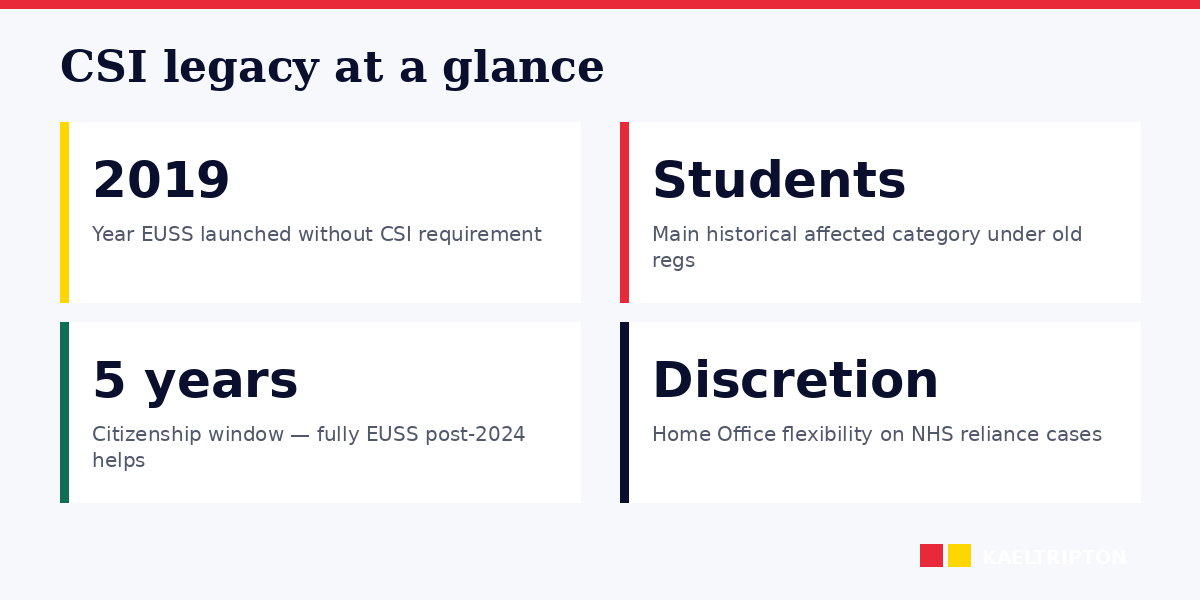
Comprehensive Sickness Insurance was required under old EEA Regulations for students and self-sufficient persons claiming permanent residence. Most EU citizens relied on the NHS instead. EUSS launched in 2019 without any CSI requirement - settled and pre-settled status require only residence, not private medical insurance. The legacy issue affects only British citizenship applications where the 5-year lawful residence test falls partly before EUSS began. As years pass post-2019, this window naturally resolves. Home Office discretion is typically applied generously for NHS-reliance cases. Specialist advice recommended for any CSI-flagged citizenship application. |
What CSI was under the old system
Before Brexit and before EUSS, EU citizens' UK residence rights were governed by the Immigration (European Economic Area) Regulations 2016 (and predecessor regulations). Under those rules, EU citizens had a "right to reside" as:
- Workers - employed or self-employed
- Students - enrolled in a UK educational institution
- Self-sufficient persons - not working, not studying, but with resources not to be a burden on the UK welfare system
- Jobseekers - looking for work
- Family members of any of the above
For students and self-sufficient persons specifically, the EEA Regulations required "comprehensive sickness insurance" - a private policy covering medical treatment costs in the UK, sufficient to avoid reliance on the NHS.
Why most EU citizens didn't have CSI
The practical reality for decades: most EU students and self-sufficient persons in the UK relied on the NHS for any medical treatment, exactly like British citizens. They didn't hold private medical insurance because:
- The NHS was available to them as UK residents
- Private insurance was expensive (£500-£2,000+ per year) and seemed redundant
- The European Commission historically took the view that NHS access was sufficient to meet CSI requirements
- UK guidance was unclear or inconsistent on whether CSI was mandatory in practice
The Home Office's formal position, however, was that NHS access alone was not equivalent to CSI. This created a gap between the lived experience of EU citizens (who believed the NHS was sufficient) and the legal requirement the Home Office applied when assessing permanent residence applications.
The permanent residence bottleneck
Under the old EEA Regulations, permanent residence required 5 years of continuous lawful residence. If someone was a "student" or "self-sufficient person" during any part of those 5 years without CSI, that period didn't count as lawful residence.
Practical consequence: an EU national who:
- Studied in the UK 2015-2018 (student period, no CSI)
- Worked 2018-2020 (worker period, no CSI issue)
Could not claim 5 years of continuous permanent residence because 3 years of student period were considered unlawful without CSI. This affected hundreds of thousands of EU citizens applying for permanent residence certificates and subsequently British citizenship (which required 12 months post-permanent residence).
High-profile campaigns by the3million, Here for Good, and individual litigation highlighted the problem. The European Commission pursued an infringement case against the UK arguing CSI requirement violated EU free movement law.
EUSS: the CSI requirement removed entirely
When the EU Settlement Scheme launched in March 2019 (fully from August 2018 private beta), it deliberately did not include a CSI requirement. The Home Office rationale: EUSS was a new status, not a continuation of EEA regulations, and CSI was not relevant to EUSS eligibility.
Practical consequence for EU citizens:
- For settled status: 5 years of continuous UK residence, no CSI requirement, no distinction between student/worker/self-sufficient periods
- For pre-settled status: less than 5 years residence, no CSI
- For family members: residence requirements only, no CSI
This was the right solution for forward-looking EUSS applications. But it created a complication for the backward-looking paths still affected by CSI legacy.
Where CSI still matters in 2026: British citizenship
British citizenship applications through naturalisation require:
- Indefinite Leave to Remain (including settled status under EUSS)
- 12 months of ILR/settled status before applying (or 5 years for marriage routes)
- 5 years of continuous UK residence before ILR grant
- "Good character" test
- "Lawful residence" for the entire 5-year qualifying period before the citizenship application
The lawful residence test for citizenship is where CSI legacy bites. Home Office guidance requires the 5 years before the citizenship application to be lawful residence - and for periods before EUSS started (pre-March 2019 or pre-August 2018 depending on circumstances), lawful residence is typically assessed under the old EEA Regulations, including CSI requirements.
A Spanish woman who applied for settled status in 2020 after 7 years of UK residence (2 years student, 5 years worker) would face this:
- For EUSS settled status: fully qualified. No CSI issue.
- For British citizenship in 2025: the Home Office may consider whether her 2013-2015 student period (without CSI) affects the lawful residence test. Her more recent work years likely establish lawful residence, but the student gap could cause issues.
How the Home Office handles CSI in 2026 citizenship applications
Home Office discretion is the key. Guidance from 2020 onwards (reflected in the Nationality Instructions to caseworkers) confirms that CSI gaps should generally be treated flexibly:
- Where the applicant relied on the NHS during student/self-sufficient periods, this is usually not held against them
- Caseworkers can exercise discretion to disregard CSI gaps in the lawful residence assessment
- The fact of holding settled status implies the Home Office has accepted the applicant's overall residence
- Exceptional cases (deception, fraud) still fail, but ordinary NHS reliance does not
In practice, most 2026 citizenship applications from EU citizens with historical CSI gaps are granted without issue, particularly when the applicant can demonstrate they paid taxes, worked legally, and generally contributed to UK society.
Problem applications: where the applicant specifically documented private medical insurance and then let it lapse, or where other suitability issues exist in combination with CSI gaps. Cases with only CSI gaps typically succeed.
What to do if CSI is flagged in your citizenship application
If a caseworker raises CSI concerns:
- Respond to the query with context - explain NHS use during student period, reliance on understanding that NHS was sufficient, subsequent lawful work/residence
- Submit supporting evidence - NHS registration records, any private insurance that was held, UK tax records showing economic contribution
- Reference Home Office discretion - cite the Nationality Instructions flexibility on CSI in historical contexts
- If refused, consider appeal or fresh application - citizenship refusals have limited appeal rights but administrative review or judicial review may be options
Specialist immigration advice strongly recommended for CSI-adjacent citizenship complications. The issue has created enough case law and guidance nuance that self-representation is risky.
Who specifically is affected in 2026
CSI legacy primarily affects:
- EU citizens who lived in the UK as students before August 2018 and are now applying for British citizenship
- EU citizens who were self-sufficient (not working, not claiming benefits) during their pre-2018 UK residence
- Family members of EU students or self-sufficient persons during the historical period
Not affected:
- EU citizens who worked continuously in the UK during their qualifying period
- EU citizens applying for settled status only (not citizenship)
- EU citizens whose UK residence began after EUSS launched (2018-2019 onwards)
- Non-EU family members whose historical residence wasn't under EEA Regulations
A real 2026 scenario: Italian graduate applying for citizenship
An Italian national studied at Leeds University 2014-2017 (no CSI, relied on NHS). Worked in London 2017-2023. Applied for EUSS in 2021 based on 7 years residence, granted settled status. Now applies for British citizenship in March 2026.
Application evidence: passport, settled status eVisa, UK tax records 2017-2025, National Insurance contributions, B1 English certificate, Life in the UK test pass.
Caseworker review: lawful residence test covers 2021-2026 (the 5 years before citizenship application). This period is post-EUSS, fully lawful as settled status. Student period 2014-2017 falls outside the 5-year window for citizenship so is not assessed.
Outcome: citizenship granted without CSI issues being raised. The 5-year window rule typically means pre-EUSS gaps are outside the relevant assessment window for most current applicants.
Alternative scenario: if this applicant had applied for citizenship in 2020 (just after getting settled status), the 5-year lawful residence window would have fallen within 2015-2020 - overlapping with the student period. CSI concerns might have been raised. The passage of time after settled status mitigates the legacy issue.
Frequently asked questions
Do I need to have CSI now under EUSS?
No. EUSS has no CSI requirement. Settled and pre-settled status holders have full NHS access and do not need private medical insurance for their UK immigration status. CSI is a historical legacy issue only.
Can CSI affect my settled status?
No. EUSS settled status was granted based on residence alone without CSI consideration. Once you hold settled status, CSI cannot be retroactively used to challenge it. The issue only arises for British citizenship applications where historical lawful residence is part of the assessment.
I was a student before EUSS - is my settled status at risk?
No. Your settled status is secure. The CSI legacy only becomes relevant if and when you apply for British citizenship, and even then Home Office discretion typically accepts NHS reliance as adequate historical coverage.
What if I held CSI during my student years?
That's ideal. If you held valid private medical insurance during student or self-sufficient periods, document it with the original policy documents. This fully satisfies the historical requirement and removes any CSI-related concern for citizenship applications.
Does CSI affect EU citizens who arrived after 2018?
Generally no. EUSS launched fully in March 2019 and EU citizens arriving after that point (and during 2018 private beta) typically proceeded under EUSS rules rather than EEA Regulations. CSI wasn't part of their framework.
Can I challenge a citizenship refusal based on CSI?
Citizenship refusals have limited appeal rights. Administrative review may be possible. Judicial review is available in narrow circumstances. Specialist immigration advice is essential - CSI-related citizenship refusals often succeed on review when the applicant's overall contribution to the UK is strong.
Is the CSI problem going to disappear over time?
Partly yes. As more years pass since EUSS launch, the 5-year lawful residence window for citizenship applications increasingly falls entirely within the EUSS era, making pre-EUSS CSI gaps irrelevant. By 2029-2030, most EUSS holders applying for citizenship will have 5+ years entirely under EUSS, eliminating the issue.
Sources
- Immigration (European Economic Area) Regulations 2016 (as amended) - historical CSI requirement
- Immigration Rules, Appendix EU (EUSS rules with no CSI requirement)
- Home Office, Nationality Instructions: naturalisation as a British citizen
- Directive 2004/38/EC (Free Movement Directive) - EU-level CSI requirement
- European Commission infringement case against UK on CSI interpretation
- the3million.org.uk, Comprehensive Sickness Insurance FAQ
- Here for Good, CSI and the EU Settlement Scheme
- Home Office, EEA Regulations historical guidance


