

Settled status under the EU Settlement Scheme isn’t the end of the road for EU citizens who want to stay long-term. British citizenship is the next step - and for most EUSS holders, it’s accessible through a relatively clear route. This guide covers the 12-month wait after settled status, the Life in the UK test, language requirements, fees, and the specific nuances for EU citizens.
EU citizens with settled status can apply for British citizenship after holding settled status for 12 months. Fee £1,500 plus £50 Life in the UK test, £130 ceremony, £94.50 passport. Required: 5 years UK residence (max 450 days abroad in total, max 90 days in final 12 months), Life in the UK test pass, English at CEFR B1, and good character. Dual citizenship permitted by UK - check your home country’s rules. |
The route in one paragraph
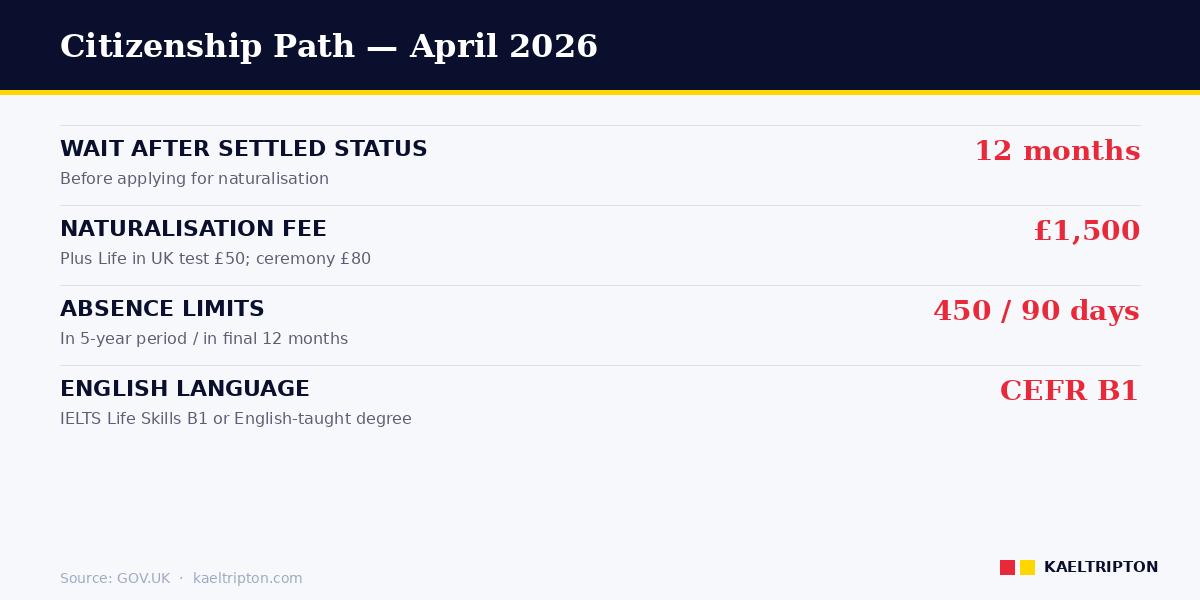
An EU citizen with settled status under the EUSS can apply for British citizenship by naturalisation after holding settled status for 12 months, provided they also meet standard naturalisation requirements: 5 years of lawful UK residence (which the EUSS qualifying period covers), fewer than 450 days abroad in the 5-year qualifying period and fewer than 90 days in the final 12 months, good character, Life in the UK test pass, and English language qualification. The fee is £1,500 as of April 2026. Processing takes 3 to 6 months typically.
Dual citizenship is allowed. EU countries vary: Germany, Italy, Portugal and most others permit dual citizenship with the UK; Spain traditionally required renunciation but reformed recently; check your specific country’s rules.
The 12-month wait rule
Settled status becomes the foundation for British citizenship after you’ve held it for at least 12 months. This is the single most distinctive rule for EU-citizen naturalisation applicants.
The 12 months runs from the grant of settled status, not from entry to the UK or from pre-settled status. An EU citizen who received pre-settled status in 2020, converted to settled status in January 2025, becomes eligible to apply for British citizenship from January 2026 at the earliest.
The auto-conversion process that began in January 2025 has created a wave of newly-eligible applicants in 2026. If your settled status was granted automatically from HMRC/DWP records in early 2025, you can apply for citizenship from early 2026.
The residence requirement
Standard naturalisation requires 5 years of lawful UK residence. Settled status is lawful residence, and the 5-year period typically overlaps with the period the applicant was building EUSS qualifying residence.
Absence limits within the 5-year qualifying period:
- No more than 450 days abroad in the full 5-year period.
- No more than 90 days abroad in the final 12 months before application.
These limits are stricter than the EUSS continuous-residence tests. An applicant who qualifies comfortably for settled status may still fall foul of the citizenship residence limits if they spent significant time abroad. The Home Office can exercise discretion on absences in specific circumstances, but routine business travel or extended family visits exceeding the limits will usually require the 5-year clock to reset.
Count absences carefully. Day of departure and day of return each count as full days abroad under Home Office counting rules.
The Life in the UK test
All citizenship applicants under 65 must pass the Life in the UK test. It’s a 24-question multiple-choice test covering British history, culture, government, geography and customs. Pass mark is 75% (18 correct out of 24).
The test is based on the official handbook Life in the United Kingdom: A Guide for New Residents, published by TSO (The Stationery Office). Buy or borrow a copy - test questions come exclusively from this source. The test is not common-sense-answerable; you must prepare from the handbook.
Booking and fees:
- Book the test at gov.uk/life-in-the-uk-test.
- Fee: £50 per attempt.
- Centres across the UK in most major cities. You can retake the test as many times as needed if you fail.
- The test must be booked online; walk-ins are not accepted.
The test is valid indefinitely once passed. You don’t retake it if you later apply for Indefinite Leave to Remain or other UK immigration routes - the same pass certificate applies.
The English language requirement
Citizenship applicants must demonstrate English language ability at CEFR Level B1 (intermediate) in speaking and listening. Three routes to meet this requirement:
- Academic qualifications in English - a degree or master’s degree taught in English from a recognised institution. Confirmed by UK NARIC / Ecctis assessment if from an overseas institution.
- Approved English language test - IELTS Life Skills B1, Trinity ISE II, or similar. The Home Office maintains a list of approved tests at gov.uk/english-language.
- Nationality of a majority English-speaking country - citizens of the US, Canada, Australia, New Zealand, Ireland and others are exempt. Not applicable to most EU citizens, who typically need to pass a test or evidence an English-taught degree.
For EU citizens whose degrees were taught in their home language, an approved English test is usually the path. The IELTS Life Skills B1 test costs around £150 and is specifically designed for UK immigration purposes - it covers only speaking and listening, not reading or writing.
Good character requirement
The British Nationality Act 1981 requires naturalisation applicants to be of “good character.” Home Office guidance interprets this broadly. Factors that can lead to refusal:
- Criminal convictions, particularly within the last 10 years. Unspent convictions on the Rehabilitation of Offenders Act 1974 test are particularly concerning.
- Deception in any UK or foreign immigration application (including pre-EUSS applications).
- Tax non-compliance - persistent late payment, undeclared income, or HMRC penalties.
- Serious traffic offences - multiple speeding tickets may not fail, but drink-driving and dangerous driving typically do.
- Any involvement in immigration or visa fraud.
Good character assessments are holistic. A single minor offence 8 years ago followed by clean conduct usually passes; a pattern of recent minor offences may fail. If in doubt, consult an OISC-regulated immigration adviser before applying - the £1,500 fee is non-refundable on refusal.
Fees and application process
| Cost item | Fee (April 2026) |
|---|---|
| Naturalisation application (Form AN) | £1,709 |
| Life in the UK test | £50 per attempt |
| English language test (IELTS Life Skills B1) | ~£150 |
| Citizenship ceremony | £130 (collected at local council) |
| Priority service (optional) | +£500 (5 working days target) |
The application is online at gov.uk/apply-citizenship-indefinite-leave-to-remain. You upload supporting documents (passport, settled status evidence, Life in the UK pass certificate, English language evidence, two referee declarations). Biometric enrolment follows, usually at a UKVCAS centre in the UK.
Standard processing is 3 to 6 months. Priority service targets 5 working days but availability varies.
The citizenship ceremony
Approved applicants are invited to a citizenship ceremony at their local council, typically within 3 months of approval. At the ceremony you swear an oath of allegiance to the King and pledge loyalty to the UK. Ceremonies are held in local register offices, town halls, or municipal buildings; some are secular, others religious (you choose).
After the ceremony you receive a certificate of naturalisation. With that certificate, you can apply for a British passport at the usual cost (£94.50 online as of April 2026).
Dual citizenship - country by country
The UK permits dual citizenship. Whether your EU home country also permits it depends on that country’s law. A quick survey:
| Country | Dual citizenship with UK permitted? |
|---|---|
| Germany | Yes, since 27 June 2024 reform (was restricted before) |
| Italy, Portugal, Ireland, France, Poland | Yes, generally permitted |
| Spain | Permitted for Spanish citizens from Ibero-American countries; restricted for others but there are recent reforms - check current rules |
| Netherlands | Restricted but exceptions for spouses of Dutch citizens, those recognising it is not in their power to renounce |
| Austria | Restricted - typically requires renunciation of Austrian citizenship |
Check your home country’s embassy in London for authoritative current guidance. The UK doesn’t check whether your home country permits dual citizenship - that’s between you and your home country’s rules. But retaining an EU passport has practical value (continued EU freedom of movement), so understanding the position matters.
Scenario - the Polish teacher
Consider a realistic case. A Polish primary school teacher moved to Oxford in 2016. She applied for pre-settled status in 2020 and received settled status in 2022 after the full 5-year qualifying period. She decides in 2026 to apply for British citizenship.
Her timeline:
- April 2026: She holds settled status for over 12 months - eligible for naturalisation.
- May 2026: She books the Life in the UK test. Buys the handbook, studies for 2 weeks. Passes on first attempt.
- June 2026: Her Polish degree was taught in English (PhD in applied linguistics) - her Ecctis assessment confirms English B1+ met without a separate test.
- July 2026: She submits Form AN online, pays £1,500, uploads documents.
- October 2026: Decision approved. Invitation to citizenship ceremony at Oxfordshire County Council.
- November 2026: Ceremony at County Hall. Receives certificate of naturalisation.
- December 2026: Applies for British passport. Issued 3 weeks later.
Total elapsed time from application to passport: about 6 months. Total cost: £1,500 (fee) + £50 (Life in the UK) + £80 (ceremony) + £94.50 (passport) = £1,724.50. She retains her Polish citizenship alongside.
When not to pursue citizenship
Citizenship isn’t automatically the right move for every EUSS holder. Reasons to hold off:
- You plan to leave the UK within a few years. The UK fee is substantial, and if you won’t use UK citizenship for life, it’s questionable value.
- Your home country restricts dual citizenship and you’d lose that citizenship by naturalising. Austria and some others have strict rules. Check before applying.
- Your finances are complex and you want to avoid HMRC scrutiny of the tax-compliance aspect of the good-character test. Address tax issues first, then apply.
- You have minor criminal matters that are unresolved. Wait for resolution and a period of clean conduct before applying.
Settled status itself is indefinite leave to remain - you can stay in the UK permanently without ever becoming British. The differences: citizens can vote in UK general elections, hold a UK passport, pass citizenship to children automatically if born abroad, and are not subject to any immigration rules.
Related guides
- How to Apply for Settled Status UK 2026
- EU Settled Status Auto-Extension 2026
- EU Settlement Scheme 2026: Complete Guide
- Pre-Settled Status Explained 2026
Disclaimer
This guide reflects Home Office naturalisation rules and fees published on GOV.UK as of April 2026. Citizenship fees and requirements are updated periodically. Always check the current position at gov.uk/apply-citizenship-indefinite-leave-to-remain before applying. For complex cases (criminal history, tax issues, absence limits, dual-citizenship concerns), consult an OISC-regulated immigration adviser. This article is not legal advice.
Frequently asked questions
How long after settled status can I apply for British citizenship?
12 months. You must hold settled status for at least 12 months before applying for naturalisation. The 12 months starts from the grant of settled status, not from pre-settled status or from entry to the UK.
How much does it cost for an EU citizen to become British?
The main fee is £1,709 for the naturalisation application (Form AN). Add £50 for the Life in the UK test, around £150 for an English language test if needed, £130 for the ceremony, and £94.50 for the passport if you want one. Total typically around £1,700 - £1,900.
Can I keep my EU passport if I become British?
The UK permits dual citizenship. Whether your home country permits it depends on that country’s law. Most EU countries permit dual citizenship with the UK, including Germany (since June 2024 reform), Italy, Portugal, Ireland, France and Poland. Austria and the Netherlands are more restrictive. Check with your home country’s embassy in London.
Do I need to take an English language test?
Yes, unless your academic qualifications demonstrate English at CEFR Level B1 or higher, or you’re a national of a majority English-speaking country. Most EU citizens take IELTS Life Skills B1 (around £150). Degrees taught in English from recognised universities may qualify instead - confirmed through an Ecctis assessment.
What is the Life in the UK test?
A 24-question multiple-choice test covering British history, culture, government and customs. Pass mark 75% (18 out of 24). Fee £50 per attempt, unlimited retakes. Questions come only from the official handbook “Life in the United Kingdom: A Guide for New Residents”. Valid indefinitely once passed.
How much time abroad can I have while still qualifying?
No more than 450 days abroad in the 5-year qualifying period, and no more than 90 days in the final 12 months before application. These are stricter than the EUSS continuous-residence limits. If you exceeded these, you may need to wait until you can complete a 5-year period within the limits.
How long does the naturalisation decision take?
Standard processing is 3 to 6 months from complete application. Priority service is available for +£500 with a 5-working-day decision target, though availability varies by application centre. After approval, the citizenship ceremony follows within about 3 months at your local council.
Sources
- GOV.UK - Apply for citizenship if you have indefinite leave to remain
- GOV.UK - British citizenship: Overview
- GOV.UK - Life in the UK Test
- GOV.UK - English language requirement for citizenship
- British Nationality Act 1981 (legislation.gov.uk)
- Home Office - Nationality: good character requirement guidance


