The EU Settlement Scheme deadline passed on 30 June 2021, but late applications remain possible if you can show reasonable grounds for the delay. Since August 2023, the Home Office assesses reasonable grounds first — before even considering eligibility. This guide covers what actually counts as reasonable grounds, what evidence works, and the higher rejection risk late applicants now face.
Late EUSS applications are still accepted, free, but risky since August 2023: the Home Office assesses reasonable grounds first and rejects-as-invalid if not accepted — no appeal route, only judicial review. Accepted grounds include serious illness, lack of capacity, child not applied for, domestic abuse, EEA permanent residence document confusion. ‘Didn’t know’ rarely works alone. Professional help recommended for complex cases. |
The one-paragraph summary
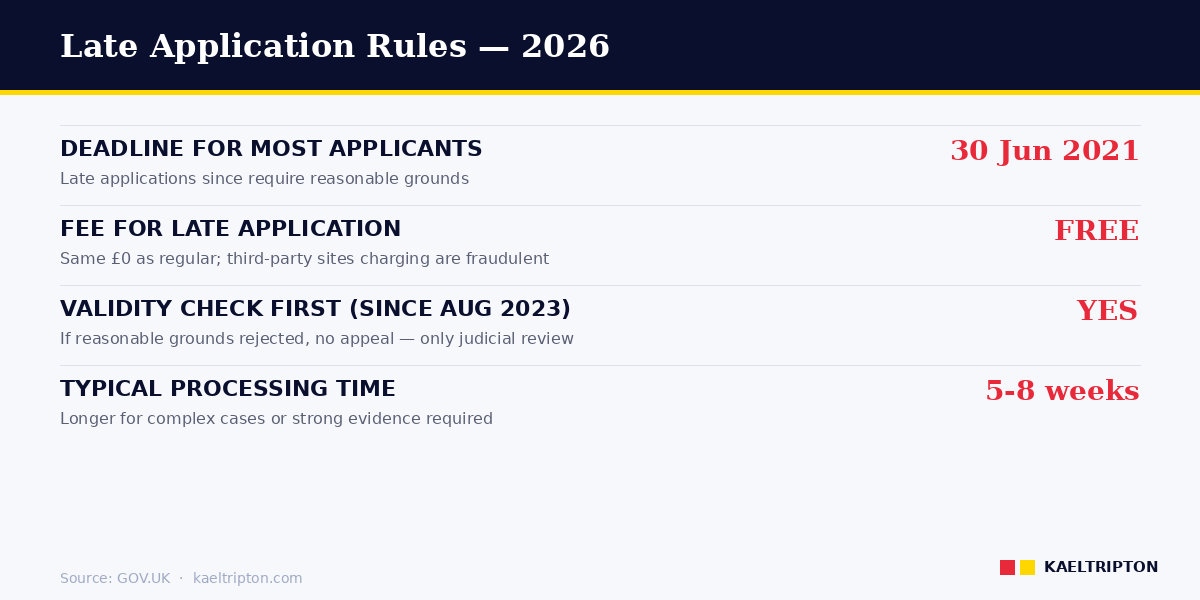
The EU Settlement Scheme’s main application deadline was 30 June 2021. Applications after that date are “late applications” and require the applicant to demonstrate reasonable grounds for missing the deadline and for any further delay since. Since 9 August 2023, the Home Office assesses reasonable grounds first: if not accepted, the application is rejected as invalid with no right of appeal or administrative review. If accepted, the application proceeds to eligibility assessment. There is no fee for late EUSS applications.
The legal basis sits in Appendix EU to the Immigration Rules, updated multiple times since 2021. The Home Office’s published caseworker guidance — “EU Settlement Scheme: EU, other EEA and Swiss citizens and their family members” — sets out the framework caseworkers apply.
Who can still apply late
You may be eligible for a late EUSS application if all three of these apply:
- You’re an EU, EEA or Swiss citizen (or their qualifying family member).
- You were resident in the UK by 11pm GMT on 31 December 2020 (the end of the Brexit transition period).
- You can show reasonable grounds for not applying before 30 June 2021 and for the entire period since.
The reasonable grounds requirement covers the full gap from the missed deadline to the date of application. An applicant who had a genuine reason for missing 30 June 2021 but no ongoing reason for delays beyond that date may still be rejected. The Home Office wants to see a coherent explanation covering the whole period.
What counts as reasonable grounds
The Home Office caseworker guidance lists accepted examples. There is no closed list — caseworkers assess each case on its facts — but recurring accepted grounds include:
| Reasonable ground | Typical evidence |
|---|---|
| Serious medical condition preventing application | GP letters, hospital discharge summaries, mental health service referrals |
| Lack of physical or mental capacity | Social services records, care plan documentation, court of protection orders |
| Being a child whose parent or guardian didn’t apply | Birth certificate, evidence of parental awareness, letter from school or social worker |
| Victim of domestic abuse, modern slavery or trafficking | Police reports, specialist charity referrals, medical records, court orders |
| Serious care responsibilities for a family member | Carer’s Allowance records, medical evidence of the cared-for person’s condition |
| Held a permanent residence document under EEA Regulations | Copy of the document plus explanation of confusion it caused |
| Came to the UK on a different visa and became EUSS-eligible during stay | Copy of original visa, evidence of qualifying residence thereafter |
| Other compelling practical or compassionate reason | Case-specific supporting evidence |
What does not usually work:
- “I didn’t know I had to apply” — rarely accepted alone, except where supported by other barriers like mental health or literacy issues.
- “I forgot” — not accepted.
- “I was busy with work” — not accepted.
- “COVID made it hard” — weakened as the pandemic receded; accepted in 2021-2022 more than in 2025-2026.
The August 2023 procedural change — why it matters
Before 9 August 2023, the Home Office assessed late applications by looking at both reasonable grounds and underlying eligibility together. Refusal on eligibility grounds carried a right of appeal.
Since 9 August 2023, the process splits into two stages:
- Validity stage: The Home Office decides whether your reasonable grounds are accepted. If not accepted, the application is rejected as invalid — not refused. Rejection as invalid carries no right of appeal or administrative review.
- Eligibility stage: If reasonable grounds are accepted, the application proceeds to eligibility assessment. Refusal at this stage carries appeal rights.
This change made late applications riskier. A rejected-as-invalid application leaves the applicant in immigration limbo — no status, no appeal route, and the only remaining remedy is judicial review (expensive and rare). Preparing the late application carefully has become critical.
What happens while a late application is pending
During the validity assessment phase, you don’t have any confirmed rights. Employers, landlords and government agencies cannot verify you under the EUSS.
Once reasonable grounds are accepted and the application is “valid,” you receive a Certificate of Application (CoA). The CoA provides interim rights while the eligibility decision is pending:
- Right to work and rent, subject to Home Office confirmation through the Employer Checking Service.
- Access to healthcare and certain public services.
- Protection from enforcement action while the decision is outstanding.
The gap between application and receiving a CoA can be weeks, occasionally months. During that period, you are effectively without status. Employers and landlords relying on the Employer Checking Service or Landlord Checking Service receive a “Positive Verification Notice” confirming your temporary rights once the CoA is issued.
How to apply — the process
Late applications go through the same GOV.UK channel as regular applications:
- Go to gov.uk/settled-status-eu-citizens-families.
- Start the application online. Identity verification with your passport or national ID card.
- Upload evidence of UK residence covering your qualifying period — tax records, tenancy agreements, NHS registrations, bank statements, utility bills.
- Critically: upload a covering letter fully explaining your reasonable grounds and why the delay extended to the date of application.
- Upload supporting evidence for the reasonable grounds — medical records, charity referrals, school letters, police reports, as appropriate.
- Submit. There is no fee.
The Home Office typically issues decisions within 5 to 8 weeks for straightforward late applications. Complex cases take longer.
Scenario — the overlooked teenager
Consider a realistic case. An Italian family moved to Manchester in 2018. The parents applied to the EUSS in 2020 and received settled status. Their 12-year-old son was included in the mother’s application but for procedural reasons the teenager’s status was never granted separately. No one noticed until 2025 when he applied for a part-time job and could not provide a share code.
He applies late to the EUSS in July 2025 — 4 years after the deadline. His reasonable grounds: he was a child whose parents reasonably believed his status was granted alongside theirs. Supporting evidence: a letter from the mother explaining the situation, her own settled-status grant confirmation, school attendance records showing continuous UK residence, NHS registration, and emails between his mother and the EUSS resolution centre from 2020 suggesting the son’s application was included.
The Home Office accepts the reasonable grounds and grants settled status in September 2025.
Teaching point: children whose parents reasonably believed their status was granted are a well-recognised category of reasonable grounds. The key evidence is the parent’s understanding at the time, not the child’s own awareness.
Scenario — the rejected-as-invalid case
A second case. A Polish construction worker moved to Leeds in 2019. He applied to the EUSS in 2024 with the explanation that he “didn’t know about the deadline” and was “working hard and had no time”. No supporting evidence beyond his statement. No medical issues, no literacy barriers, no other factors.
The Home Office rejects the application as invalid in late 2024 — the reasonable grounds are not accepted. He has no right of appeal.
His options: submit a fresh late application with new evidence (perhaps demonstrating a specific barrier he didn’t articulate first time), or pursue judicial review if he can argue the rejection was legally flawed. The charity Here for Good has published template pre-action protocol letters for rejected late applicants seeking to challenge invalidity decisions.
Teaching point: simple “didn’t know” explanations rarely survive the post-August-2023 stricter test. Additional factors — language barriers, mental health, lack of advice, family circumstances — need to be specifically articulated and evidenced.
The role of joining family members
Family members joining an EUSS status holder from abroad have different deadlines and rules. Non-EU family members who arrive in the UK after 31 December 2020 must apply to the EUSS within 3 months of arrival (subject to reasonable-grounds tests for any delay).
Specific joining-family routes have closed at various dates. The Surinder Singh route for family members of British citizens returning from the EU closed to new applications on 8 August 2023. The Zambrano route has similar closure provisions.
If you’re a joining family member, the rules are complex and case-specific. Consult an OISC-regulated adviser before applying late.
Evidence strategy — the covering letter
The single most important document in a late application is the covering letter. It should:
- Be written by the applicant (or on their behalf) in their own voice.
- Be structured chronologically — what happened on 30 June 2021, why you couldn’t apply, what happened between then and now.
- Directly address every period of delay with specific reasons.
- Reference each piece of supporting evidence by name.
- Acknowledge the post-August-2023 stricter test and explain why the grounds still qualify.
The covering letter is not a legal document but it’s what the caseworker reads first. Vague or minimal letters fail; specific, evidence-referenced letters with a clear timeline pass.
When to get professional help
Late EUSS applications carry real risk of rejection-as-invalid. Professional advice is strongly recommended if:
- Your reasonable grounds are complex or contested.
- You have a previous EUSS refusal.
- You have criminal convictions affecting the suitability requirement.
- You are a non-EU family member with derivative or retained rights.
- You are applying years after the deadline (the longer the delay, the more compelling the explanation needs to be).
- You have already been rejected as invalid and want to pursue judicial review.
Free or low-cost help is available from: the3million (EU citizen advocacy), Settled.org.uk (Home Office-recognised support), Citizens Advice, and Here for Good (specialised late-application pre-action protocols). OISC-regulated paid advisers can be found at gov.uk/find-an-immigration-adviser.
Related guides
- How to Apply for Settled Status UK 2026
- EU Settlement Scheme 2026: Complete Guide
- EU Settled Status Family Members 2026
- EU Settled Status Auto-Extension 2026
Disclaimer
This guide reflects Home Office EUSS caseworker guidance and Appendix EU to the Immigration Rules as published on GOV.UK as of April 2026. Late application rules have tightened since August 2023 and continue to evolve. Always check the current position at gov.uk/settled-status-eu-citizens-families before applying. For complex cases, consult an OISC-regulated immigration adviser or a specialist charity like the3million or Settled.org.uk. This article is not legal advice.
Frequently asked questions
Can I still apply to the EU Settlement Scheme after the deadline?
Yes, late applications are accepted if you can show reasonable grounds for missing the 30 June 2021 deadline and for any delay since. Since 9 August 2023, the Home Office assesses reasonable grounds first — if not accepted, the application is rejected as invalid with no right of appeal. There is no fee.
What counts as reasonable grounds for a late EUSS application?
Accepted examples include: serious medical conditions, lack of capacity, being a child whose parent didn’t apply, victim of domestic abuse or modern slavery, serious care responsibilities, or holding an EEA permanent residence document. “Didn’t know” or “was busy” are rarely accepted alone, though they may support a broader case.
What happens if the Home Office rejects my late application as invalid?
You have no right of appeal or administrative review. You can submit a fresh late application with new or stronger evidence, or pursue judicial review if you can argue the rejection was legally flawed. The charity Here for Good has template pre-action protocol letters for invalidity challenges.
Do I have rights to work while my late application is pending?
Not until the Home Office accepts your reasonable grounds and issues a Certificate of Application (CoA). The gap between submission and CoA can be weeks or months. Once issued, the CoA provides interim rights subject to confirmation through the Employer Checking Service.
Is there a fee for a late EUSS application?
No. All EUSS applications, including late ones, are free. Don’t pay third-party websites that claim to “process” your application — they’re either charging for guidance (legal but optional) or fraudulent. Apply only through gov.uk/settled-status-eu-citizens-families.
How long does a late EUSS application take?
Typically 5 to 8 weeks from submission to decision for straightforward cases. Complex cases (strong reasonable-grounds evidence required, suitability issues, derivative rights) can take 3 to 6 months. The Home Office does not publish a specific processing time for late applications.
What if I held a permanent residence document under the old EEA Regulations?
Holding a valid EEA permanent residence document issued before 2021 is recognised in Home Office caseworker guidance as a reasonable ground for a late EUSS application. You should still explain the confusion it caused — many holders reasonably believed the document meant they did not need to apply to the new scheme. Provide the document and a covering letter explaining your understanding.
Sources
- GOV.UK — EUSS eligibility (including late applications)
- GOV.UK — EUSS caseworker guidance (Appendix EU, July 2025 update)
- Independent Monitoring Authority — Reasonable grounds for late applications
- Appendix EU to the Immigration Rules
- the3million (EU citizen advocacy)
- Here for Good (specialised late-application support)


