

The UK’s EU Settlement Scheme underwent two major changes in 2024 and 2025. Pre-settled status extensions jumped from 2 years to 5 years. Auto-conversion to settled status began in January 2025. This guide covers what the Home Office actually does automatically, what you need to check yourself, and what happens if the checks fail.
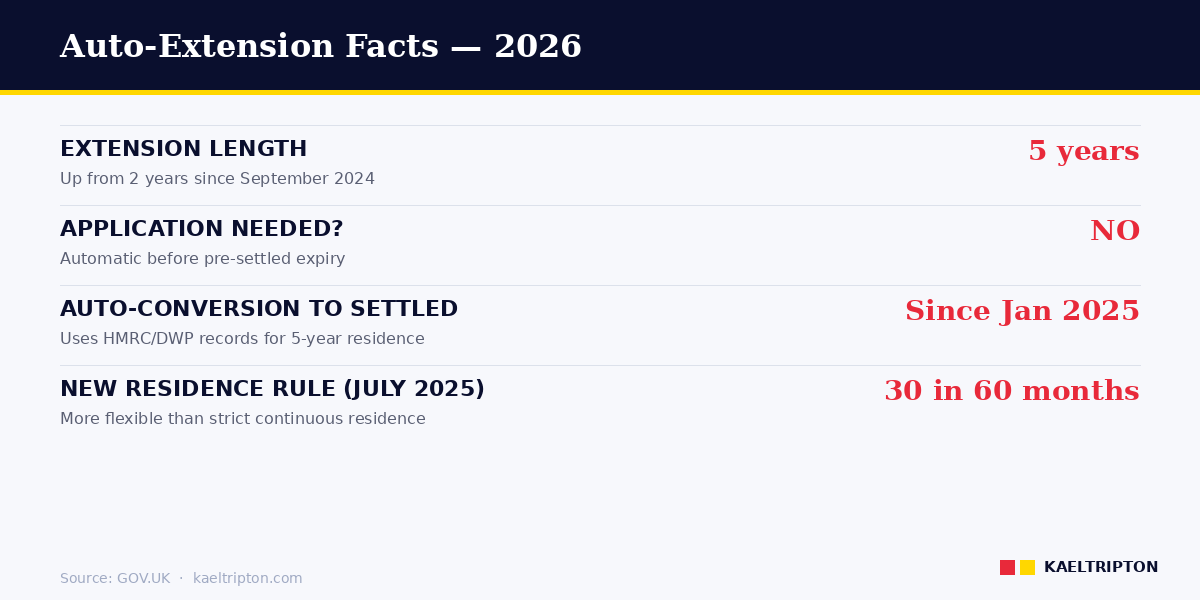
Pre-settled status is now extended automatically by 5 years before expiry (up from 2 years since September 2024). From late January 2025, the Home Office began automatically converting eligible pre-settled holders to settled status using HMRC and DWP records. If auto-conversion fails, apply manually with supporting documents. Check your UKVI account periodically to confirm status updates. |
The two changes in one paragraph
Since September 2024, pre-settled status in the UK has been automatically extended by 5 years (up from 2 years) if the holder has not converted to settled status before expiry. From late January 2025, the Home Office also began automatically converting eligible pre-settled status holders to settled status - indefinite leave to remain - by checking HMRC and DWP records for 5 years of continuous UK residence. The pre-settled expiry date is no longer shown to employers or landlords checking online status since 13 June 2024.
The legal driver is the December 2022 High Court judgment in the Independent Monitoring Authority’s judicial review. The court ruled that EU citizens who had acquired permanent residence rights under the Withdrawal Agreement could not lose those rights just because they failed to submit a second EUSS application before their pre-settled status expired.
The 5-year extension - what it means
Before September 2024, pre-settled status was automatically extended by 2 years shortly before expiry if the holder had not switched to settled status. The Home Office confirmed in its 21 May 2024 press release that this would change: extensions are now for 5 years.
Practical implications:
- If your pre-settled status was due to expire in 2024 or later and you have not upgraded to settled, the Home Office grants an automatic 5-year extension shortly before the expiry date.
- You don’t need to apply for the extension. It happens automatically. An email to your registered UKVI account confirms the new expiry date.
- A person who already received a 2-year extension before September 2024 will not have that automatically upgraded to 5. They may receive a further 5-year extension at the end of the 2-year period.
Check your current pre-settled status expiry by signing into your UKVI account at view-immigration-status.service.gov.uk/status. If it’s been recently extended, the new expiry date should show.
Auto-conversion to settled status - from January 2025
The Home Office began automatically converting eligible pre-settled status holders to settled status (indefinite leave to remain) from late January 2025. Per the GOV.UK publication at gov.uk/government/publications/eu-settlement-scheme-euss-status-automation, the process works as follows:
- The Home Office emails you to let you know you may be eligible for auto-conversion.
- They check your pre-settled status record against government-held data - HMRC earnings records (PAYE, self-employment), DWP benefit records, and criminal conduct databases.
- If the records establish 5 years of continuous UK residence and no adverse findings, settled status is granted automatically.
- You receive email confirmation. Your UKVI account updates to show settled status instead of pre-settled.
You don’t need to do anything. No forms, no supporting documents. The Home Office expects to be able to auto-convert a majority of pre-settled holders over time, though the expansion is phased.
When auto-conversion fails - what happens
Auto-conversion won’t succeed in every case. The Home Office email will tell you if they cannot grant settled status automatically. Common reasons the automation fails:
- Gaps in HMRC/DWP records. Self-employed workers with inconsistent tax records, people who worked abroad for periods, students not employed in the UK, stay-at-home parents without benefit claims - all may show as gaps even when they’ve been continuously resident.
- Absence from the UK beyond the allowed thresholds. Continuous residence for settled status originally required not being absent for more than 6 months in any 12-month period. In July 2025, this was relaxed: you now qualify for settled status with evidence of 30 months of residence in the last 60 months.
- Criminal conduct flags. Any conviction or ongoing criminal matter triggers a caseworker review rather than auto-grant.
- Complex family or derivative rights cases. Family members of EU citizens, retained rights, or Zambrano-type cases typically require manual review.
If auto-conversion fails but you believe you qualify, you can make a manual EUSS application for settled status with supporting evidence. Apply at gov.uk/settled-status-eu-citizens-families.
Scenario - the university teacher
Consider a realistic case. A Spanish university lecturer arrived in Edinburgh in 2017. She applied for pre-settled status in 2020, receiving it with a 5-year expiry in mid-2025. She plans to stay in the UK indefinitely.
In April 2025, she receives an email from the Home Office noting she may be eligible for auto-conversion to settled status. The Home Office checks her HMRC records and sees 8 years of continuous PAYE employment at the university. On 12 May 2025, her UKVI account updates: pre-settled status has been converted to settled status. No application made, no documents uploaded, no fee paid.
Teaching point: for people with clean employment histories, auto-conversion is invisible and seamless. You simply get an email confirming the upgrade.
Scenario - the freelance translator
A second case. A French freelance translator moved to London in 2018. She registered as self-employed in 2019 and has been filing Self Assessment returns since, but her income is variable and modest. Some years she earned £15,000; other years £8,000. Her pre-settled status expires in 2026.
In March 2026, she receives an email from the Home Office saying they cannot automatically grant her settled status because HMRC records don’t conclusively establish 5 years of continuous residence. The automation flags her low earnings some years and gaps in VAT registration.
She applies manually for settled status through the EUSS, uploading her Self Assessment returns, bank statements showing consistent UK income and expenses, utility bills, tenancy agreements, and council tax statements for the full 5-year period. Approved manually 6 weeks later.
Teaching point: the automation is designed to catch clear cases. Borderline cases still need manual applications with supporting evidence. Build a document file for each year of residence in case you need it.
The expiry-date visibility change
Since 13 June 2024, employers and landlords checking an EU settled-status share code no longer see a pre-settled status expiry date. This solved a specific practical problem: employers were refusing to hire pre-settled holders whose status was due to expire in months, treating the expiry as a cliff-edge risk.
Employer and landlord guidance was updated on 21 June 2024 to confirm that no follow-up checks are needed after an initial right-to-work or right-to-rent check. Once you’ve passed the check and you’re in the job or tenancy, the employer/landlord does not need to re-verify if your status changes from pre-settled to settled.
Practical implication: if you’re currently in employment or a tenancy with pre-settled status, you don’t need to alert your employer or landlord when auto-conversion happens. The initial right-to-work/rent check remains valid.
When the automation might backfire - the removal risk
The Home Office has noted that if they discover a person is no longer eligible for pre-settled status after it has been auto-extended (for example, because they were absent from the UK for too long under the old rules), they may begin a process to remove the status. This is subject to appeal rights.
the3million (the main EU-citizen advocacy body) estimates this risk is low for people who have lived continuously in the UK, but it applies to those who moved abroad for significant periods and let the pre-settled continue to be extended automatically. If you’ve been out of the UK for more than 6 months in any 12-month period since 31 December 2020, check your specific eligibility.
Continuous residence rules - the July 2025 relaxation
Continuous residence for settled status originally required absences of no more than 6 months in any 12-month period, with one allowed 12-month absence for important reasons (pregnancy, serious illness, study, compulsory military service).
From July 2025, the rule was relaxed significantly. Pre-settled status holders can now qualify for settled status by demonstrating 30 months of residence in the last 60 months. This means more flexibility for those who split time between the UK and another country.
The 30-in-60 rule doesn’t change the basic definition of residence (you must actually be living in the UK, not just visiting), but it permits longer periods of absence that would previously have broken continuous residence. Those who had feared losing eligibility due to extended trips abroad now have a more permissive test.
What to do now - a checklist
Whether you currently hold pre-settled or settled status, a few things to check:
- Log into your UKVI account at view-immigration-status.service.gov.uk/status. Confirm the current status and expiry (if pre-settled).
- Update your passport and national ID details if they have changed. The Home Office links your status to the document used when you applied - passport renewal means updating the account.
- Update your contact details - particularly email address. The Home Office communicates all auto-extension and auto-conversion decisions by email to the registered address.
- Keep tax records accessible. If auto-conversion fails and you need to apply manually, Self Assessment returns, P60s, and HMRC transaction records are your evidence of residence.
- If you believe you qualify for settled status but haven’t been auto-converted within a reasonable time after your pre-settled’s 5-year anniversary, consider a manual application through the EUSS.
Related guides
- How to Apply for Settled Status UK 2026
- Pre-Settled Status Explained 2026
- EU Settlement Scheme App 2026
- EU Settlement Scheme 2026: Complete Guide
Disclaimer
This guide reflects Home Office policy on the EU Settlement Scheme published on GOV.UK as of April 2026. Auto-extension and auto-conversion processes are still being rolled out and may change. Always verify the current position at gov.uk/settled-status-eu-citizens-families and in your UKVI account. For complex cases - loss of continuous residence, criminal record, family rights - consult an OISC-regulated immigration adviser. This article is not legal advice.
Frequently asked questions
Is pre-settled status extended automatically?
Yes. Since September 2024, pre-settled status is automatically extended by 5 years (previously 2 years) shortly before expiry if the holder has not switched to settled status. The Home Office emails the registered UKVI account to confirm the new expiry date. No application is needed.
How long is the automatic pre-settled status extension in 2026?
5 years, up from 2 years before September 2024. Holders who already received a 2-year extension before the change don’t automatically get an upgrade but may receive a further 5-year extension when the 2-year one ends.
Can I get settled status without applying?
Yes, in many cases. From late January 2025, the Home Office automatically converts eligible pre-settled status holders to settled status using HMRC and DWP records to verify 5 years of continuous UK residence. You receive an email and your UKVI account updates. If auto-conversion fails, you can apply manually with supporting evidence.
Why has my pre-settled expiry date disappeared from my share code?
Since 13 June 2024, employers and landlords checking an EU share code no longer see the pre-settled expiry date. This was changed to prevent employers treating the expiry as a hiring risk. Your actual pre-settled or settled status is unchanged - only the display to third parties.
What happens if the Home Office can’t auto-convert my status?
You receive an email saying the automation couldn’t grant settled status. Common reasons: gaps in HMRC/DWP records, periods abroad, complex family cases, or criminal conduct flags. You can apply manually through the EUSS at gov.uk/settled-status-eu-citizens-families with supporting documents covering your 5 years of residence.
Do I need to tell my employer when my status converts from pre-settled to settled?
No. Guidance issued on 21 June 2024 confirmed that employers don’t need to re-verify your status after the initial right-to-work check passed. Once you’re in the job, the check remains valid through any status change. Same applies to landlords and right-to-rent.
What is the new 30-in-60 residence rule?
From July 2025, pre-settled status holders can qualify for settled status by demonstrating 30 months of residence in the last 60 months, rather than strict continuous residence. This relaxation helps people who split time between the UK and another country without breaking eligibility.
Sources
- GOV.UK - EU Settlement Scheme (EUSS) status automation
- GOV.UK - Home Office confirms changes to the EU Settlement Scheme (21 May 2024)
- GOV.UK - Apply to the EU Settlement Scheme
- GOV.UK - Switch from pre-settled to settled status
- Home Office EUSS Border Force Guidance (30 December 2025)
- Independent Monitoring Authority (IMA) judicial review judgment, High Court, December 2022


