

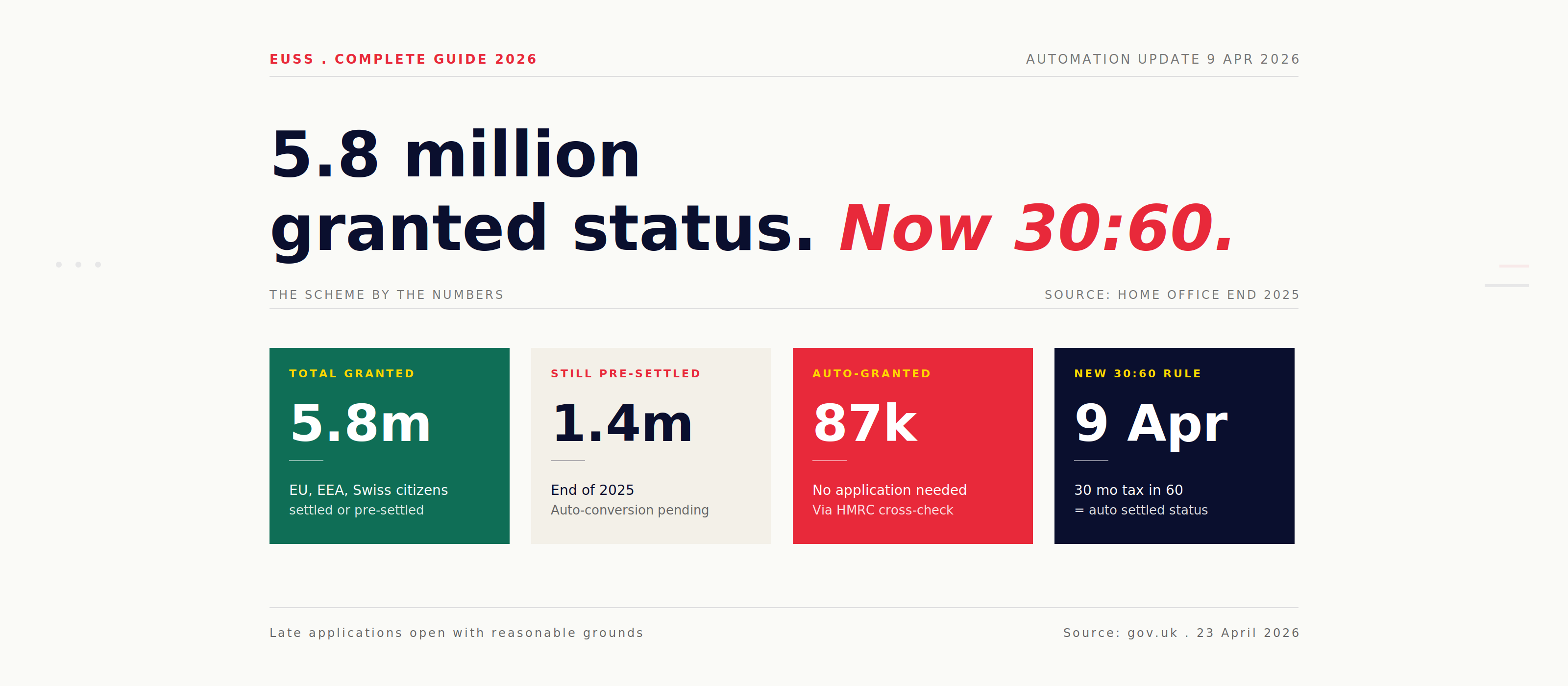
The EU Settlement Scheme (EUSS) remains the central immigration route for EU, EEA, and Swiss citizens who were living in the UK before 31 December 2020. Five years after the main deadline, the scheme has granted immigration status to 5.8 million people by the end of 2025, with 1.4 million still holding pre-settled status as of April 2026. Late applications are still accepted with reasonable grounds. From 9 April 2026 the Home Office expanded its automated conversion system so that pre-settled status holders with at least 30 months of UK tax or benefit records in the last 60 months can be upgraded to settled status without applying.
This complete guide covers everything EU, EEA, and Swiss citizens need to know about the EUSS in 2026: who qualifies, how settled versus pre-settled differs, how to convert from one to the other, how the new automatic conversion works, what late applications require, how to use the digital eVisa, and the path from settled status to British citizenship. All rules and figures reflect Home Office policy and caseworker guidance as published to gov.uk by 23 April 2026.
|
KEY FACTS (VERIFIED 23 APRIL 2026) Scheme scale: 5.8 million people granted EUSS status by end of 2025. 1.4 million still hold pre-settled status as of April 2026. New 30:60 rule (from 9 April 2026): automatic conversion from pre-settled to settled status if HMRC / DWP records show 30+ months of tax or benefit activity in the last 60 months. Automatic conversions so far: 87,000 people converted without applying by end of 2025. More expected as the April 2026 update widens the eligibility test. Late applications: still accepted with reasonable grounds (medical, abuse, administrative error, prior belief of lawful status). From 9 August 2023 the Home Office decides on grounds before validating the application. Status is digital: proved via a share code at gov.uk/view-prove-immigration-status, valid 90 days. Keep your UKVI account passport and contact details current. |
What the EU Settlement Scheme is and who it covers
The EUSS is the UK government's legal framework for protecting the rights of EU, EEA, and Swiss citizens who had started living in the UK before free movement ended on 31 December 2020. It was created under the UK-EU Withdrawal Agreement and gives one of two statuses: settled status (permanent) or pre-settled status (time-limited), depending on how long the applicant had been living in the UK at the time of applying.
Qualifying nationals are citizens of EU member states, EEA countries (Norway, Iceland, Liechtenstein), and Switzerland. Family members of qualifying nationals, including non-EU family members, can also apply under the scheme if the family relationship existed before 31 December 2020 (with exceptions for children born or adopted after this date). British and Irish citizens do not need to apply because they already hold right of abode or Common Travel Area rights.
The core eligibility test is residence by 23:00 on 31 December 2020. An applicant must have been physically in the UK by that date, either as a worker, student, self-employed person, or self-sufficient person exercising EU treaty rights. Unlike the old EEA Regulations route, the EUSS does not require comprehensive sickness insurance for students and self-sufficient people, which simplified eligibility considerably when the scheme opened.
EUSS status is entirely digital. Since January 2025 there is no physical document; status is stored as an eVisa linked to the holder's UK Visas and Immigration (UKVI) account, and proved to employers, landlords, and service providers by generating a share code at gov.uk/view-prove-immigration-status. The share code is valid for 90 days and gives read-only access to the holder's status.
Settled status versus pre-settled status
The fundamental split inside the EUSS is between settled and pre-settled status. The rights and duration attached to each are materially different.
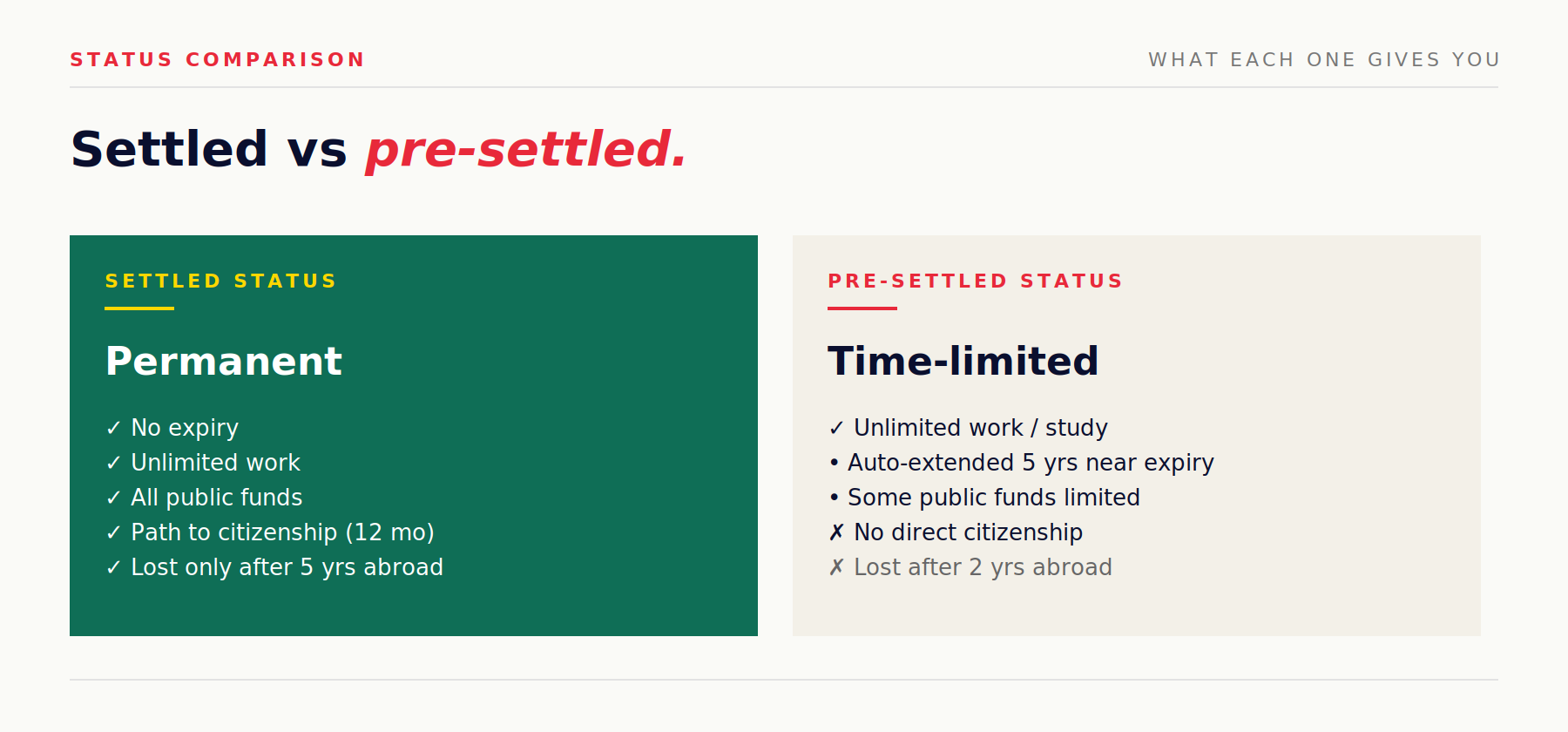
Settled status is permanent leave to remain in the UK. It provides unlimited employment and self-employment rights, access to public funds including Universal Credit, home fee status for university tuition based on habitual residence, and a clear path to British citizenship after 12 months of holding settled status (shorter if married to a British citizen). Settled status does not expire unless the holder spends five continuous years outside the UK, in which case the status lapses under the absence rules.
Pre-settled status is time-limited leave granted to applicants who had not yet completed five years of continuous residence when they applied. It originally lasted five years, with a pathway to convert to settled status once five years of UK residence were reached. It provides most of the same rights as settled status (work, study, most benefits) but with important differences: access to some public funds is more restricted, and pre-settled status does not by itself qualify for citizenship. It must be converted to settled status first.
In 2024, following litigation by the Independent Monitoring Authority for the Citizens' Rights Agreements, the Home Office introduced automatic five-year extensions of pre-settled status when it approached expiry, to ensure no one lost status through inaction. The extension is automatic and notified by email. It is not the same as being granted settled status and does not start the citizenship clock.
The 30-months-in-60 rule: the July 2025 simplification
Historically, settled status required five years of continuous residence, defined as no more than six months of absence in any 12-month period (with limited exceptions). Absences in excess broke continuity and restarted the five-year clock, which caught many applicants who had spent time abroad for work, family reasons, or the pandemic.
From 16 July 2025 the Home Office simplified the residence test. Applicants now qualify for settled status if they have been physically present in the UK for at least 30 months (2.5 years) in the most recent five years, regardless of how those months are distributed. They must also have arrived in the UK at least five years before the application.
The change applies to both manual applications and the automated conversion process. It was designed to remedy past unfairness where extended absences (for parental care abroad, pandemic-related returns to home countries, or work postings) had prevented otherwise eligible EU citizens from reaching settled status. The change also affects people whose earlier applications were refused under the stricter rule: many can now re-apply and succeed.
Automatic conversion from pre-settled to settled status
In 2025, the Home Office launched an automated system to convert eligible pre-settled status holders to settled status without a further application. To the end of 2025, the system had granted settled status to 87,000 people through automation.
On 9 April 2026, the Home Office improved the system further. The automated process now checks HMRC and DWP records for at least 30 months of tax payments or benefit receipt in the most recent 60-month window. Where this threshold is met and the applicant passes standard suitability checks (criminality, public policy), settled status is granted automatically. The holder is notified by email to the address on their UKVI account. The digital status updates in the UKVI account and the holder can immediately generate share codes proving the new status.
The Home Office does not review everyone at the same time. Cases are assessed as pre-settled status approaches its current expiry. Someone whose status has several years remaining may not be reviewed automatically for some time even if they already meet the five-year residence test. Holders in that position who want settled status sooner should apply manually rather than wait.
Certain groups cannot be converted automatically and must submit a manual application:
- EEA citizens who have not been paying UK tax or receiving benefits for at least 30 months in the last 60 months
- Non-EEA family members applying as dependants of a sponsor
- Joining family members where residence in the UK began after 31 December 2020
- Anyone whose criminality or suitability record would need caseworker review
If the automated system cannot grant settled status, the holder's pre-settled status continues to be extended by five years and they can apply manually at any time they become eligible.
Late applications: who can still apply in 2026
The main EUSS deadline was 30 June 2021. Applications lodged after that date are treated as "late" and require the applicant to show reasonable grounds for the delay. The Home Office's caseworker guidance sets out the categories of reasonable grounds it will accept.
The current accepted reasonable grounds include:
- A serious medical condition or significant medical treatment that prevented application
- Lack of mental capacity, a learning disability, age-related incapacity, or being in the care of the state
- Victims of domestic abuse, modern slavery, human trafficking, or controlling relationships
- Children whose parent, guardian, or local authority failed to apply on their behalf
- Administrative errors by legal representatives or official bodies
- Holders of existing EEA Permanent Residence documents or ILR under another route who reasonably believed they did not need to apply to the EUSS
- Other compelling practical or compassionate reasons, assessed case by case
Since 9 August 2023, the Home Office first decides whether the reasonable grounds are acceptable, and only then treats the application as valid and assigns a Certificate of Application. This is more restrictive than the pre-2023 approach. An application rejected as invalid on reasonable grounds has no right of appeal to the Immigration and Asylum Tribunal; the only remedy is judicial review. Strong preparation with legal representation is now effectively essential for late applications where the grounds are not clear-cut.
Late applicants do not get a Certificate of Application until the Home Office accepts reasonable grounds. This means they have no documentation to prove right to work, right to rent, or NHS eligibility while the reasonable-grounds decision is pending. The practical effect is that late applicants with weak grounds can fall into an unlawful status period during the review.
Scenario: the 30-month threshold that refuses a near-miss applicant
Elena holds pre-settled status granted in March 2021 after arriving in the UK in October 2019. She worked in a Madrid-headquartered consulting firm's London office from October 2019 until August 2022, then her employer offered her a 22-month secondment to their Barcelona office starting September 2022 through June 2024. She returned to the UK in July 2024 and restarted UK PAYE employment on 2 September 2024. As of April 2026 she has 20 months of UK PAYE in the last 60 months: October 2019 to August 2022 was before the 60-month look-back window opened; September 2024 to April 2026 gives her roughly 20 months of recent records.
The automated system checks HMRC and DWP records for at least 30 months in the last 60. Elena has 20. She does not meet the threshold. The automation system does not grant settled status to her case and does not contact her proactively; it simply does not fire. Her pre-settled status, originally expiring March 2026, is automatically extended by five years to March 2031 under the 2024 extension programme. She receives an email notifying her of the extension but no explanation of why she was not upgraded.
The question is what Elena should do. The answer is not to wait. Three options exist. First, she can apply manually right away under the old continuous-residence rule; her October 2019 UK arrival and the Barcelona secondment create a continuity question because the secondment exceeded six months in a 12-month rolling window. Old-rule continuous residence is broken. Second, she can apply under the new 30-in-60 rule, but manually rather than via automation; the manual process requires the same 30 months of evidence so she still falls short. Third, she can wait until she accumulates 10 more months of UK PAYE, reaching 30 months by around March 2027, then apply manually with HMRC records as her proof.
Option three is correct. Elena's pre-settled extension buys her until March 2031 to reach the threshold. She records her UK residence carefully, keeps UK tax records, renews her passport in good time, and plans to apply as soon as her 30-month count crosses the line. The Barcelona secondment does not count against her under the new rule; only UK presence in the 60-month window does. The 30-in-60 rule was designed precisely for cases like Elena's where extended absences broke old-rule continuity but the applicant has genuine UK ties.
The broader lesson is that automation is not universal. The 87,000 automated grants of settled status by end 2025 were for people with clean, continuous UK employment records. Anyone with a secondment, a sabbatical, a parental leave abroad, or a significant gap between EU departures and UK returns will sit below the threshold and must plan a manual application once the numbers are there.
Travel, absences, and the EES / ETIAS dimension
EUSS status holders retain free movement for entry to the UK but face new EU-side checks. The EU's Entry/Exit System (EES) went live on 12 October 2025 and became fully operational on 10 April 2026. EUSS holders travelling to the Schengen area will be registered biometrically on first entry after 12 October 2025, regardless of their UK status. Once registered, subsequent entries and exits are tracked automatically.
The EU's travel authorisation system (ETIAS) is expected to launch in Q4 2026. EUSS holders travelling on their EU passport do not need an ETIAS (they are EU citizens). EUSS holders who have naturalised to British citizenship and travel on a UK passport will need ETIAS like any other UK passport holder.
Absences from the UK matter for EUSS status. Pre-settled status holders who spend two years continuously outside the UK lose their status. Settled status holders who spend five years continuously outside the UK also lose it. From 9 April 2026, the Home Office began actively reviewing pre-settled status holders who appear to have ceased UK residence based on travel and HMRC data. Before removing status, the Home Office contacts the individual via the UKVI account and offers 28 days to provide evidence or explain the absence. Removal is not automatic and the Home Office considers proportionality, including personal and family ties to the UK, age, health, and vulnerability.
Holders who plan extended absences for work, study, family care, or retirement should document the reason and maintain UK ties where possible. Keeping a UK bank account, residential address, HMRC registration, and NHS record helps demonstrate ongoing residence.
The UKVI account: keeping it current
All EUSS status is proved through the UKVI account. Keeping the account details up to date is essential because from 25 February 2026, additional checks are being introduced to confirm immigration status when travelling to the UK.
The following should be current at all times: the passport or identity document number linked to the account, the registered email address and phone number, and the home address. Out-of-date account details can cause carrier denial of boarding (airlines and ferry operators check immigration status against the account before allowing travel), delays at UK border control, and difficulty renting a property or starting a new job.
Update the account at gov.uk/update-uk-visas-immigration-account-details. A new passport, for example after renewal, must be added within 14 days; carry a printed share code copy for international travel during that window as a precaution. The EU Exit: ID Document Check app is used only for initial identity verification during application; it does not update details afterwards.
Converting settled status to British citizenship
Settled status is a prerequisite for naturalisation as a British citizen for most routes. The standard timeline is: hold settled status for 12 months (not required if married to a British citizen), have lived in the UK for at least five years before the application, have no more than 450 days of absence in those five years and no more than 90 days in the final year, pass the Life in the UK Test, and meet English language requirements at CEFR B1 or above.
The application is Form AN on gov.uk. From 8 April 2026, the adult naturalisation fee is £1,709, plus a mandatory £130 citizenship ceremony fee. Children's naturalisation is now £1,000 (reduced from £1,214). The application is submitted online; biometrics are captured at a UKVCAS centre; standard decision time is six months.
The UK government announced in 2025 a proposed Earned Citizenship model that would extend the qualifying period and introduce new contribution-based requirements. As of April 2026 no start date has been confirmed and applications continue under existing rules. EU citizens close to meeting naturalisation criteria are applying now rather than waiting for the policy to change.
WHAT TO DO NEXT If you hold pre-settled status and meet the 30:60 rule: you may be converted automatically in 2026. Check your UKVI account email regularly. Applying manually is still valid and often faster if you need settled status for a specific reason (for example, British citizenship). If you missed the 30 June 2021 deadline: apply now under the late application route at gov.uk/settled-status-eu-citizens-families. Prepare your reasonable grounds evidence carefully; late applications are more restrictive since August 2023. If you hold settled status and want citizenship: wait 12 months from the grant of settled status, pass the Life in the UK Test, meet the CEFR B1 English requirement, and apply online via Form AN. From 8 April 2026 the adult fee is £1,709 plus a £130 ceremony fee. |
This article is for informational purposes only and does not constitute financial advice. Always verify rates with official sources before making any financial decision.
Frequently asked questions
Can I still apply to the EU Settlement Scheme in 2026?
Yes, late applications are still accepted if the applicant can show reasonable grounds for missing the 30 June 2021 deadline. Grounds include serious medical conditions, domestic abuse, being in the care of the state as a child, administrative errors, or having reasonably believed an earlier immigration status covered them. Since 9 August 2023, the Home Office decides on reasonable grounds before treating the application as valid.
What is the difference between settled and pre-settled status?
Settled status is permanent leave to remain, provides full access to public funds, and can lead to British citizenship after 12 months. Pre-settled status is time-limited (originally five years, now auto-extended), provides most of the same work and study rights but with more limited public fund access, and must be converted to settled status before citizenship is possible.
How do I switch from pre-settled to settled status?
Two paths. Many pre-settled status holders are now automatically converted by the Home Office when their records show at least 30 months of UK tax or benefit receipt in the last 60 months. Notification is by email. The other path is a manual application online through the UKVI account, proving either five years of continuous UK residence or 30 months in the last 60 under the July 2025 rule.
What is the new automatic conversion for pre-settled status in 2026?
From 9 April 2026, the Home Office's automated system checks HMRC and DWP records for at least 30 months of tax or benefit activity in the last 60 months. Where the threshold is met and suitability checks pass, settled status is granted without an application. By end of 2025, 87,000 people had been converted automatically.
What happens if my pre-settled status expires?
It is automatically extended by five years if you have not yet converted to settled status or applied manually. The extension is notified by email. You still need to convert to settled status to qualify for British citizenship; an extension is not the same as a grant of settled status.
Can I lose my EU settled status by spending time abroad?
Yes. Settled status is lost after five continuous years outside the UK. Pre-settled status is lost after two continuous years outside the UK. From 9 April 2026, the Home Office began actively reviewing pre-settled status holders who appear to have ceased UK residence. Before removal, the Home Office contacts the holder and offers 28 days to provide evidence.
How do I prove my EU settled status to an employer or landlord?
Generate a share code at gov.uk/view-prove-immigration-status. The share code lasts 90 days and allows the recipient to view your status digitally. Status is digital only; there is no physical document. Keep your UKVI account details current to ensure share codes work correctly.
Can EU citizens still bring family members to the UK under the EUSS?
Yes, certain family members can still apply. Spouses, civil partners, children, grandchildren, parents, and grandparents of an EUSS status holder can apply for a family permit if the relationship existed by 31 December 2020 (with exceptions for children born or adopted later). Non-EU family members face additional evidence requirements. The Home Office publishes separate caseworker guidance for family permits.
Sources and verification
All rules, figures, and policy updates reflect Home Office publications and the EUSS status automation update dated 9 April 2026, verified on 23 April 2026.
- Apply to the EU Settlement Scheme - gov.uk
- EUSS status automation update, April 2026 - gov.uk
- Convert pre-settled status to settled status - gov.uk
- View and prove your immigration status - gov.uk
- Update UKVI account details - gov.uk
- Apply for British citizenship by naturalisation - gov.uk
- Independent Monitoring Authority for the Citizens' Rights Agreements


