

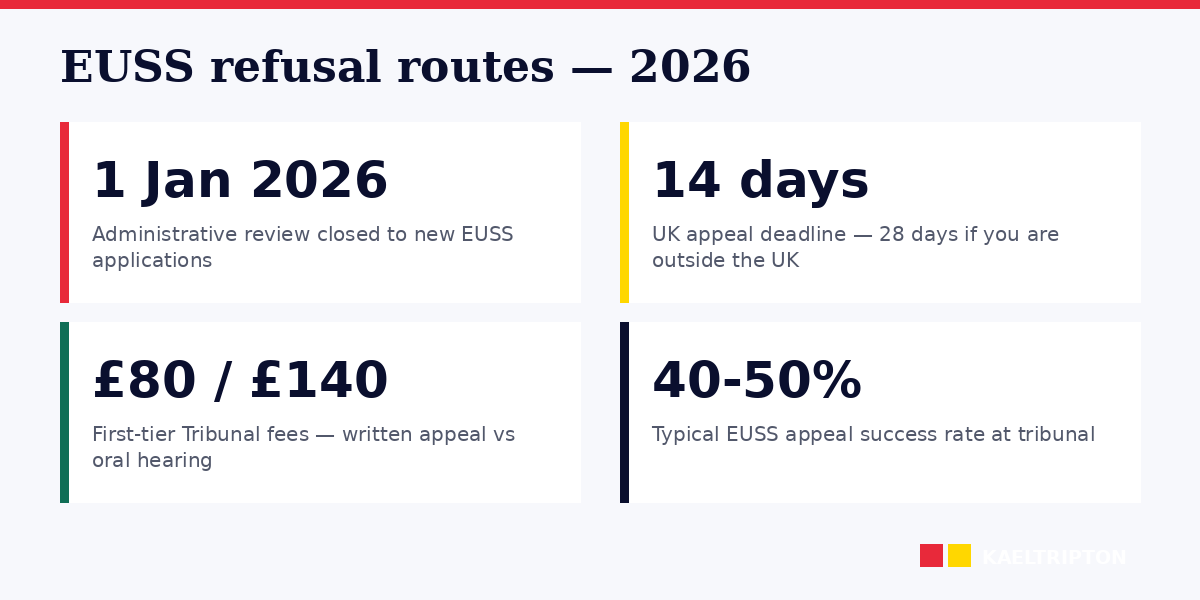
Your EU Settlement Scheme application was refused. What now? The routes to challenge the decision changed significantly on 1 January 2026. Administrative review is now closed to new applications. The only remaining options are appeal to the First-tier Tribunal (Immigration and Asylum Chamber), submitting a fresh application, or, in narrow circumstances, judicial review. This guide walks through each, the specific deadlines (14 days inside the UK, 28 days outside), the fees (£80 or £140 depending on hearing type), and the practical decision of which route actually fits your case.
| ★ EDITOR'S VERDICT Admin review is gone. Know your two real options. |
From 1 January 2026 new administrative review applications for EUSS decisions are rejected as invalid. The two routes left are appeal to the First-tier Tribunal (strict deadlines: 14 days in UK, 28 days outside; £80 or £140 fee) and a fresh application (free, unlimited). For most refusals on missing-evidence grounds, a fresh application is the faster and cheaper route. For suitability refusals, a tribunal appeal with legal representation gives the best odds. Judicial review is a last-resort backstop, not a routine step. |
The 2026 change: administrative review is closed
Under the Immigration Rules Statement of Changes HC 1491 taking effect from 1 January 2026, new administrative review applications for EU Settlement Scheme decisions are rejected as invalid. The legal basis was the closure of the Service Providers from Switzerland route on 31 December 2025 and a wider simplification of Appendix AR (EU). Applications submitted before 1 January 2026 may still be in the queue and will be decided, but no new admin review applications can be started.
This is a significant shift. For most of the scheme's history, admin review was the cheap first step - £80, Home Office reviewing their own decision internally, often resolving within months. The data that existed suggested it had a reasonably high success rate (one Freedom of Information response showed 89.5% of decided EUSS admin reviews succeeded). From 2026, that route is gone.
Three active routes remain:
- Appeal to the First-tier Tribunal - the main route for most refused applicants
- Fresh application - free, allows new evidence, sometimes the fastest route to resolution
- Judicial review - rare, expensive, only available as a last resort
Read your refusal letter first
Before choosing a route, read the refusal letter carefully. The Home Office must explain:
- The specific paragraph of Appendix EU on which the decision was based
- The evidence considered and, critically, where that evidence fell short
- Your right of appeal and the deadline to exercise it
- Whether you have an in-country or out-of-country right of appeal
The most common refusal reasons:
- Continuous residence not proved - gaps in evidence, periods of absence over 6 months, missing bank statements or tenancy records
- Suitability concerns - criminal convictions, deception in the application, immigration enforcement history
- Eligibility issues - not an EEA national, not in the UK before the relevant cut-off date, family-member relationship not accepted
- Late application without reasonable grounds - applied after 30 June 2021 without a valid late-application justification
The refusal type matters. "Continuous residence not proved" is typically resolvable with better evidence and is often better handled by a fresh application. "Suitability" refusals usually need an appeal with legal representation. "Eligibility" issues that are fundamental (you were never actually eligible) may not be winnable at all.
Appeal to the First-tier Tribunal
The appeal right is created by the Immigration (Citizens' Rights Appeals) (EU Exit) Regulations 2020, and applies to every EUSS decision made after 11pm on 31 January 2020. Appeals are heard by the First-tier Tribunal (Immigration and Asylum Chamber), which is independent of the Home Office.
Deadlines
- 14 days from the date on your decision letter, if you are in the UK
- 28 days from the date you received your decision letter, if you are outside the UK
These are strict deadlines. Late appeals need a specific reason and the tribunal decides whether to accept them. Unexplained lateness kills the appeal entirely.
Which form to use
Most appeals now go through the online MyHMCTS service at appeal-first-tier-tribunal.service.gov.uk. For paper applications, the forms are:
- IAFT-5 - appeals lodged from inside the UK against an EUSS decision
- IAFT-6 - appeals lodged from outside the UK against an EUSS decision
Fees
- £80 for a written appeal (decided on papers only, no hearing)
- £140 for an oral hearing (where you or your representative attends in person)
Both fees are refunded if your appeal succeeds. Fee waivers are available on hardship grounds - you apply for the waiver through the same online service by providing evidence of low income or benefits.
What the tribunal can do
Unlike admin review (which only checked whether the original caseworker made a technical error), a tribunal appeal is a full fresh consideration. You can submit new evidence, call witnesses, and the judge can substitute a different decision. Judges can allow the appeal (you win - Home Office must grant status), dismiss it (you lose), or remit the case back to the Home Office for fresh consideration with specific directions.
Appeal success rates for EUSS cases at tribunal hover around 40-50% depending on the year and refusal type, rising above 60% when the appellant has competent legal representation.
Fresh application: often the fastest route
Applying afresh to the EU Settlement Scheme is free, can be done at any time, and is unlimited in number - there is no cap on how many applications one person can submit. For many refused applicants this is the better route.
A fresh application makes sense when:
- Your refusal was because of missing evidence and you can now provide it
- You have new circumstances that change your eligibility (for example, 5 years' continuous residence now completed)
- You made a simple error the first time (claimed pre-settled when you qualified for settled)
- Your previous application was before 30 June 2021 and you can now include evidence that reaches the 5-year threshold for settled status
A fresh application does not make sense when:
- Your refusal was a suitability decision (criminal record, deception) - a fresh application will be refused on the same grounds unless the underlying issue has changed
- Your 2026 application would now be a late application (after 30 June 2021) and you do not have "reasonable grounds" - the post-August 2023 rules tightened late application handling significantly
- The issue is fundamental eligibility (for example, you were never actually resident in the UK before the cut-off date)
One thing to get right: applying afresh does not stop an existing appeal. If you appeal and separately reapply, both run in parallel. A successful fresh application can render an appeal moot; a dismissed appeal can reinforce a fresh refusal. Running both simultaneously only makes sense with specialist advice.
A real 2026 scenario: the pre-settled status holder who should have settled
A Latvian national has lived in the UK since 2016. She applied in 2021 and was granted pre-settled status. In April 2026 she discovers that at the time of her 2021 application she had already been continuously resident in the UK for over 5 years and should have been granted settled status.
Her options in 2026:
Option A - appeal the original grant. Not available. The appeal deadline expired 14 days after the 2021 decision. She cannot appeal now.
Option B - apply afresh for settled status. Free, unlimited reapplications allowed. She submits a new application providing evidence of her continuous 5-year residence. The Home Office considers it and, because the evidence now supports settled status, grants it. Processing time typically 4-6 weeks for a straightforward case.
Option C - nothing. Her pre-settled status (including the 5-year auto-extension announced in 2024) keeps her protected until 2029. She can apply for settled status any time before then. The only cost of delay is that it affects her eligibility clock for British citizenship (you need 12 months of settled status before the British citizenship application window opens).
For most applicants in this scenario, Option B is right. Free, low risk, meaningful upside. The misconception that "once I have pre-settled I cannot improve it" costs thousands of EU citizens faster access to citizenship each year.
Late applications in 2026
The EUSS deadline was 30 June 2021. Applications after that date are treated as late and require "reasonable grounds" to be accepted. The August 2023 guidance changes tightened the definition substantially.
Reasonable grounds that are typically accepted in 2026:
- Serious medical condition or mental capacity issues during the application window
- Being a child whose parent or carer failed to apply on their behalf
- Domestic abuse that prevented the victim from applying
- Being a victim of modern slavery or trafficking
- Language barriers combined with demonstrable practical inability to access help
Reasonable grounds that are typically not accepted:
- Not knowing about the scheme
- General COVID-19 disruption without specific evidence of impact
- Misunderstanding the deadline
- Waiting for a friend or family member to help
A late application without strong reasonable-grounds evidence is almost certain to be refused in 2026. If you are in this position, specialist immigration advice before applying is essential. Reapplying after a refusal on late-application grounds without changing the underlying evidence is not useful - the refusal will repeat.
Judicial review: the last resort
Judicial review is a challenge to the Home Office decision on the grounds that it was legally unlawful, irrational, or procedurally improper. It is not a rehearing of the merits. It is expensive (often £5,000-£15,000+ in legal costs), slow (12-18 months typical), and requires that you have exhausted other remedies first (so must be post-appeal or post-fresh-application in most cases).
Judicial review is realistic only when:
- The Home Office decision was manifestly contrary to the Withdrawal Agreement
- No other effective remedy exists
- Specialist immigration solicitors have confirmed the merits justify the cost
For 99 percent of refused EUSS applicants, appeal or fresh application are the correct routes. Judicial review is a final backstop, not a routine next step.
Frequently asked questions
Can I still apply for administrative review in 2026?
No. Administrative review applications for EUSS decisions submitted from 1 January 2026 are rejected as invalid. The only routes remaining are appeal to the First-tier Tribunal, a fresh application, or in narrow circumstances judicial review. Applications submitted before 1 January 2026 that are still pending will be decided on the old rules.
How long do I have to appeal an EUSS refusal?
14 days from the date on your decision letter if you are in the UK, 28 days if you are outside the UK. These deadlines are strict. Late appeals need specific justification accepted by the tribunal and cannot be assumed to succeed.
Does appealing cost anything?
Yes. £80 for a written appeal (decided on papers), £140 for an oral hearing. Fee waivers are available on income or benefits grounds. Successful appellants are refunded their fee by the Home Office.
Can I reapply if I am refused?
Yes, with no limit on the number of applications. Fresh applications are free and should include any additional evidence that addresses the refusal reason. However, if your original refusal was on suitability grounds (criminal record, deception), a fresh application is likely to be refused on the same basis.
If my partner was refused, does it affect my status?
Usually not, if your applications were assessed on their own merits. Refusal of one family member's application does not cancel another's. If your status depended on a retained right (derivative rights as a family member), the refusal can affect your own position - specialist advice needed in that case.
Can I work in the UK while my appeal is pending?
Your original status is preserved during the appeal process. If you had pre-settled status and applied for settled status, you keep pre-settled status until the appeal is decided. If you were refused outright (no status granted), you may not have a right to work or rent during the appeal - check your specific appeal acknowledgement letter, which sets out your current rights.
What if the refusal letter does not mention appeal rights?
Every EUSS refusal decision since 31 January 2020 carries a statutory right of appeal under the Citizens' Rights Appeals Regulations 2020. If your letter does not mention it, contact the First-tier Tribunal directly (customer.service@justice.gov.uk) with your Home Office reference number. The tribunal will confirm your appeal rights independently of the Home Office.
Sources
- Immigration Rules, Appendix EU and Appendix AR (EU) - as amended by Statement of Changes HC 1491 (effective 1 January 2026)
- Immigration (Citizens' Rights Appeals) (EU Exit) Regulations 2020
- GOV.UK, EU Settlement Scheme: administrative review (historic - closed to new applications)
- GOV.UK, Appeal against a visa or immigration decision and Immigration and asylum paper appeals
- First-tier Tribunal (Immigration and Asylum Chamber), MyHMCTS appeal service
- Citizens Advice, Problems with your settled status decision
- the3million.org.uk, Appealing an EUSS refusal and late applications FAQ
- Withdrawal Agreement (UK-EU), Part Two on Citizens' Rights


