

The EU Settlement Scheme isn’t just for EU citizens themselves. Non-EU family members - spouses, children, parents, grandparents - can join an EUSS status holder in the UK through specific routes. This guide covers who qualifies, what deadlines apply, and the retained rights that survive relationship breakdown or bereavement.
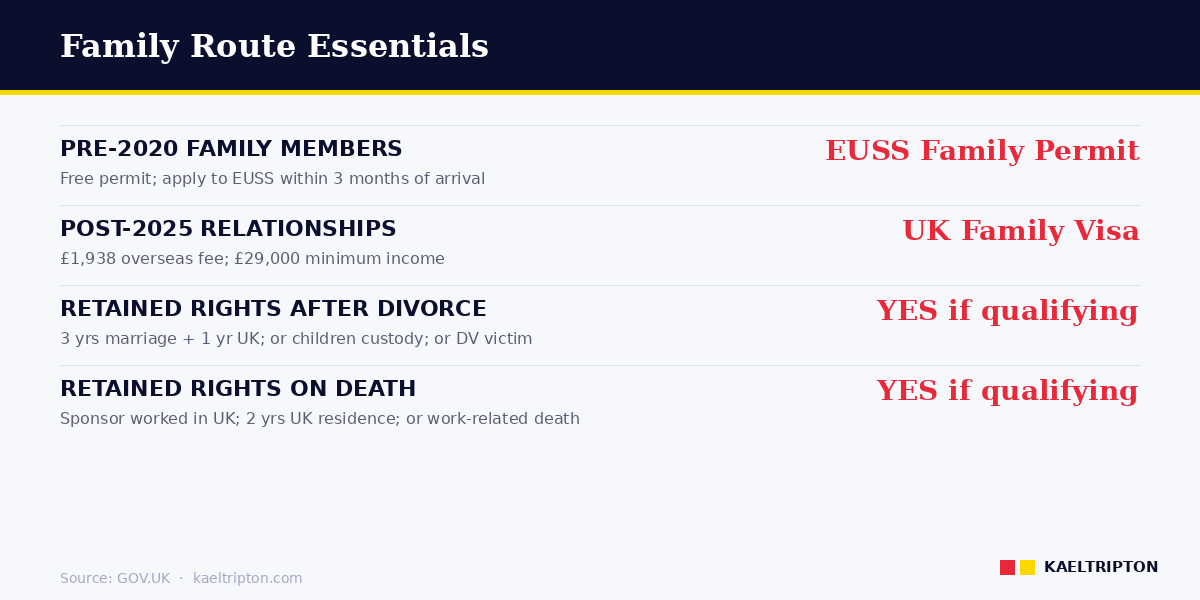
Non-EU family members of EU citizens can use the EUSS route if the relationship existed before 31 December 2020. Apply for a free EUSS Family Permit from abroad; apply to EUSS itself within 3 months of arrival. Retained rights protect family members after divorce (3-year marriage + 1 year UK), death of sponsor, or as victims of domestic violence. Post-2025 relationships use the standard Family Visa route at higher cost. |
Who can use the EUSS family route
The EU Settlement Scheme covers family members of EU, other EEA and Swiss citizens (and certain family of British citizens returning under Surinder Singh rules). As of 31 December 2025, the Home Office had granted 5.7 million EUSS statuses - the majority to EU citizens themselves, a significant share to family members. The family route remains open to specific categories after the original 30 June 2021 EUSS deadline.
Eligibility depends on whether your relationship to the EU citizen existed before or after 31 December 2020 (the end of the Brexit transition period).
Relationships established before 31 December 2020
If you are the non-EU family member of an EU citizen, and your relationship with the EU citizen existed before 31 December 2020, you can apply for an EUSS family permit to enter the UK and then apply for pre-settled or settled status.
Eligible family members include:
- Spouses and civil partners - relationship must be registered before 31 December 2020.
- Durable partners - unmarried partners who had been living together in a relationship akin to marriage for at least 2 years before 31 December 2020.
- Children and grandchildren - under 21, or over 21 if dependent.
- Parents and grandparents - if dependent on the EU citizen.
- Dependent family members more broadly - other dependent relatives in strict cases.
The EU citizen whose family member you are must hold settled or pre-settled status, or have acquired permanent residence rights under the Withdrawal Agreement.
Relationships established after 31 December 2020
Relationships formed after the Brexit transition period have tighter rules. For spouses and civil partners who married an EU citizen settled in the UK after 31 December 2020:
- A specific transitional route opened for relationships that began after 31 December 2020 but by 31 December 2025. This is now closed for new applications.
- Current post-2020 spouse cases typically use the standard UK Family Visa route (Spouse visa under Appendix FM), not the EUSS.
If your relationship began after 31 December 2025 and your partner is an EUSS status holder, you apply through the Family visa category with its higher fee (£1,938 from overseas) and financial requirement (£29,000 minimum income).
Joining family members - the EUSS Family Permit
Non-EU family members of EU citizens settled in the UK apply for an EUSS Family Permit to enter the UK from abroad. The family permit is free and takes about 15 working days to process.
Once in the UK, the family member applies to the EUSS itself within 3 months of arrival. This application is also free. Pre-settled or settled status is granted depending on how long the EU citizen sponsor has lived in the UK.
The Home Office EUSS Border Force Guidance (30 December 2025) confirms the 3-month post-arrival deadline. Applications after that deadline are assessed for “reasonable grounds” for delay, not automatically accepted.
Retained rights - when the relationship ends
A significant protection: non-EU family members who entered the UK through their EU-citizen sponsor can retain rights of residence in specific circumstances even if the underlying relationship ends.
After divorce or dissolution of civil partnership
If you divorce or dissolve a civil partnership from the EU-citizen sponsor, you can retain residence rights if:
- The marriage or civil partnership lasted at least 3 years, including at least 1 year in the UK, and you were related before 31 December 2020.
- You have custody of any children the EU citizen had parental responsibility for.
- Particularly difficult circumstances apply, such as being a victim of domestic violence.
After death of the EU citizen
If your EU-citizen sponsor dies, you retain residence rights if they were working or self-employed in the UK at the time of death, and:
- They lived in the UK, Channel Islands or Isle of Man continuously for at least 2 years before death; or
- Their death was the result of an accident at work or an occupational disease.
You must have been living with them in the UK immediately before their death.
Scenario - the late-arrival spouse
Consider a realistic case. An Italian chef moved to Manchester in 2016 and received settled status in 2021 after 5 years of residence. In 2019 she married her South African partner in Rome. He remained in South Africa to complete his master’s degree.
In March 2026, he applies for an EUSS Family Permit to join his wife in Manchester. The permit is approved because their relationship existed before 31 December 2020 and she holds settled status. He enters the UK in May 2026 and applies for EUSS pre-settled status within 3 months of arrival. Pre-settled status is granted; in 5 years he can apply for settled status.
Teaching point: the pre-2020 relationship rule is forgiving. Even with the EUSS application deadline long past for EU citizens themselves, pre-existing family members can still join. The key evidence is proof of the relationship’s start date before the Brexit transition ended.
Scenario - retained rights after domestic abuse
A second case. A German woman with settled status married her Pakistani husband in London in 2019. He received pre-settled status as her spouse in 2020. The relationship deteriorates and in 2024 she files for divorce after incidents of domestic abuse.
Under standard rules, the end of the relationship would threaten his residence rights. But the retained rights provisions apply: as a victim of domestic violence, he retains his pre-settled status independent of his marriage. He applies for a variation of his status through the Appendix Victim of Domestic Abuse route, providing evidence of the abuse (police reports, medical records, charity referrals). His status continues and he can proceed toward settled status in his own right.
Teaching point: the EUSS includes specific protections for domestic violence victims. These are separate from the standard relationship-breakdown rules. If you are in this situation, consult an OISC-regulated immigration adviser or a domestic violence charity like Southall Black Sisters or Women’s Aid urgently.
Children born to EUSS-holder parents
Children born in the UK to parents with settled status are automatically British citizens - no EUSS application needed. Children born in the UK to parents with pre-settled status are not automatically British, but can apply for registration as British once a parent gains settled status.
Children born abroad to EUSS-holder parents and brought to the UK need their own EUSS family permit and then an EUSS application. Dependents under 21 typically receive the same status (pre-settled or settled) as the parent sponsor.
The 31 December 2025 deadline that applied to some joining-family routes was for specific post-2020 relationship cases, not for children born later. Children born to EUSS holders continue to have application routes available indefinitely.
The 3-month post-arrival deadline
Family members who enter the UK on an EUSS Family Permit must apply to the EUSS within 3 months of arrival. This is a short window, and missing it can complicate your position.
If you miss the 3-month deadline, you can still apply - late applications are assessed for “reasonable grounds” for the delay. Reasonable grounds include:
- Serious illness of the applicant or a close family member.
- Being a victim of domestic abuse (specific protections apply).
- Existing support needs that prevented applying.
- Being a child whose parent failed to apply on their behalf.
- Mental health conditions affecting capacity to apply.
“Forgot” or “didn’t realise’ don’t typically qualify unless accompanied by other mitigating factors. If you missed the deadline, apply as soon as possible and explain your grounds fully - the longer the delay, the harder it becomes to establish reasonable grounds.
The EUSS Family Permit vs EUSS Travel Permit
Two different documents, often confused:
- EUSS Family Permit - for non-EU family members joining an EUSS status holder in the UK from abroad. Issued for 6 months.
- EUSS Travel Permit - for existing EUSS status holders who need to travel to the UK but have lost access to their UKVI account, had a passport change, or other issues. Allows entry to the UK when the digital status link is unavailable.
Both are free. The Family Permit is more common; the Travel Permit is an administrative fix for status-holders having trouble with the digital system.
Complex cases - when to get professional help
EUSS family cases can be unusually complex. Cases where professional immigration advice is recommended:
- Dependent family members other than spouses or children - parents, grandparents, siblings.
- Derivative rights cases - Zambrano, Chen, Ibrahim/Teixeira, where rights derive from the care of a British/EU citizen child.
- Surinder Singh cases - British citizens returning from the EU with non-British family.
- Retained rights cases after relationship breakdown where evidence is complex.
- Victims of domestic abuse.
- Applications after significant delay from the 3-month post-arrival deadline.
Find OISC-regulated immigration advisers through gov.uk/find-an-immigration-adviser. The Joint Council for the Welfare of Immigrants (JCWI) and Migrant Help also provide free advice in some cases.
Related guides
- How to Apply for Settled Status UK 2026
- Pre-Settled Status Explained 2026
- EU Settlement Scheme 2026: Complete Guide
- EU Settled Status Auto-Extension 2026
Disclaimer
This guide reflects Home Office EUSS guidance published on GOV.UK and in the Border Force Guidance (30 December 2025) as of April 2026. Family-member routes and deadlines can change. Always check the current position at gov.uk/settled-status-eu-citizens-families before applying. For complex family cases, consult an OISC-regulated immigration adviser. This article is not legal advice.
Frequently asked questions
Can my non-EU spouse join me in the UK through the EU Settlement Scheme?
Yes, if your relationship existed before 31 December 2020 and you hold pre-settled or settled status. Apply for an EUSS Family Permit from abroad; once in the UK, apply to the EUSS within 3 months of arrival. Both applications are free. For relationships formed after 31 December 2025, the standard UK Family Visa route applies instead.
What is an EUSS Family Permit?
A free travel document allowing a non-EU family member of an EUSS status holder to enter the UK from abroad. Valid for 6 months. After entering the UK, the family member applies to the EUSS itself within 3 months for pre-settled or settled status.
Do my children need to apply to the EUSS?
Children born in the UK to parents with settled status are automatically British citizens - no EUSS needed. Children born in the UK to pre-settled parents can register as British once a parent gains settled status. Children born abroad to EUSS holders need their own EUSS application after entering the UK on a family permit.
What happens to my UK status if I divorce my EU-citizen spouse?
You may retain residence rights under the EUSS retained-rights provisions if the marriage lasted at least 3 years (including 1 year in the UK), you have custody of qualifying children, or particularly difficult circumstances apply (such as being a victim of domestic violence). Apply for a variation of your status with evidence.
What if my EU-citizen sponsor dies?
You retain residence rights if your sponsor was working or self-employed in the UK at the time of death and either lived in the UK, Channel Islands or Isle of Man for at least 2 years before death, or their death was from an accident at work or occupational disease. You must have been living with them in the UK immediately before their death.
Can I still apply to the EUSS as a family member in 2026?
Yes, if your relationship to the EU-citizen sponsor existed before 31 December 2020. The EUSS application deadline for EU citizens themselves was 30 June 2021, but family routes remain open subject to reasonable-grounds tests for any delay. Apply for the Family Permit first if you’re abroad.
What if I missed the 3-month post-arrival deadline for my EUSS application?
You can still apply. Late applications are assessed for “reasonable grounds” for the delay. Reasonable grounds include serious illness, domestic abuse, mental health conditions, or being a child whose parent didn’t apply for them. Explain your circumstances fully in the application. The longer the delay, the harder it becomes to establish reasonable grounds.
Sources
- GOV.UK - Apply to the EU Settlement Scheme
- GOV.UK - EU Settlement Scheme Family Permit
- GOV.UK - What settled and pre-settled status means for family members
- Home Office EUSS Border Force Guidance (30 December 2025)
- Home Office - Appendix EU to the Immigration Rules
- GOV.UK - Find a registered immigration adviser


