

Missed the 30 June 2021 EU Settlement Scheme deadline? You need to show "reasonable grounds" for the delay to make a valid late application. The rules became substantially stricter on 9 August 2023 when Home Office guidance shifted to a two-stage assessment: first deciding whether reasonable grounds exist, then (only if accepted) considering eligibility. Rejections are now classified as "invalid" rather than refused, meaning no right of appeal - the only challenge is judicial review. Updated guidance on 16 January 2024 recognised specific circumstances (including residence card holders with "reasonable belief") but most general "didn't know" arguments now fail. This guide covers the grounds that succeed in 2026, the grounds that fail, and the process if your late application is rejected as invalid.
| ★ EDITOR'S VERDICT Late EUSS applications need evidence, not assertions, since August 2023. |
The 9 August 2023 rule change made late EUSS applications a two-stage process: first the Home Office decides reasonable grounds, then eligibility. Rejections are now 'invalid' - no right of appeal, only judicial review. Accepted grounds: children, medical incapacity, domestic abuse, modern slavery, reasonable belief under old residence cards, existing UK leave. Rejected grounds: general 'didn't know', COVID disruption alone, work or study busyness. Professional immigration advice is essential - well-prepared applications succeed, weak ones fail at high rates. |
The deadline that was missed
The original EU Settlement Scheme deadline was 30 June 2021 for most applicants - EU, EEA, and Swiss citizens resident in the UK by 31 December 2020, plus their family members. Different deadlines apply to specific categories:
- Joining family members arriving on EUSS Family Permit after 1 April 2021: 3 months from UK arrival
- Children born in the UK after 1 April 2021: 3 months from birth, adoption, or guardianship order
- Spouses of Swiss citizens arriving after 1 April 2021: 3 months from arrival, before 1 January 2026
- Those with existing UK leave (not visitor): can apply before that leave expires
- Persons exempt from immigration control: apply during or within 90 days of exemption ending
If any of these deadlines applied to you and you missed them, you are making a late application and must justify the delay.
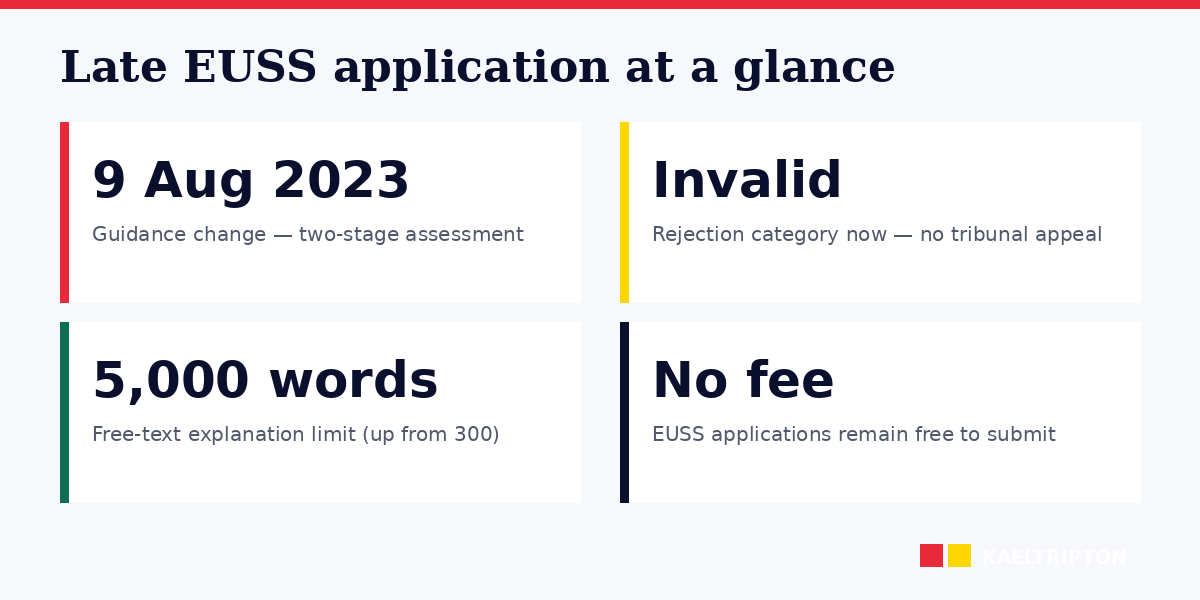
The 9 August 2023 two-stage rule change
Before 9 August 2023, late applicants received a Certificate of Application (CoA) on submission, which confirmed their right to work, rent, and access the NHS while the Home Office assessed both the reasonable grounds and the substantive eligibility together. This benefited vulnerable and genuinely-delayed applicants.
From 9 August 2023, the process became two distinct stages:
- Reasonable grounds assessment first. The Home Office decides separately whether you have sufficient reasons for the delay. If accepted, the application proceeds to stage 2.
- Eligibility assessment second. Only if stage 1 passes, the Home Office then considers whether you actually qualify for settled or pre-settled status.
If stage 1 fails: the application is "rejected as invalid", no Certificate of Application is issued, no right of appeal exists. The only challenge is judicial review (expensive, limited scope).
Under Home Office guidance, the more time that has elapsed since the deadline, the harder the reasonable grounds test becomes to pass. December 2023 increased the free-text word limit on the application from 300 to 5,000 words, acknowledging the increased evidence burden.
What counts as reasonable grounds in 2026
Home Office guidance sets out specific example scenarios. These are not exhaustive - each case is assessed on balance of probabilities on all the evidence presented.
Grounds that generally succeed
- Existing valid UK leave (not visitor status). If you had another form of leave to remain through a different immigration route, the deadline extends until that leave ends. Apply within a reasonable period after your other leave expires.
- EUSS Family Permit holders who arrived late. 3-month deadline from arrival applies; missing by a short margin with reasonable explanation typically accepted.
- Children under 18 whose parent or carer failed to apply. Recognised category. Applies to adults who were children on the original deadline if the context fits.
- Serious medical condition preventing application. Supported by medical evidence - hospital records, specialist reports, GP letters documenting the illness and its impact on the person's capacity to apply.
- Lack of mental capacity. Learning disabilities, severe mental illness, dementia, care home residence. Supported by medical or social worker evidence.
- Being a victim of domestic abuse. Evidence of the abuse having impaired the applicant's ability to access help and apply.
- Being a victim of modern slavery or trafficking. Confirmed by National Referral Mechanism decisions or specialist organisations.
- Reasonable belief that application was not needed (January 2024 addition). For individuals holding in-date residence cards or permanent residence documents issued under EEA regulations who reasonably believed these continued to provide status in the UK.
- Administrative error or official misinformation. Provable error by Home Office, local authority, or advisers who gave incorrect information about requirements.
Grounds that generally fail in 2026
- General "didn't know" lack of awareness. Since August 2023 this alone is typically rejected. The Home Office's position is that the scheme was extensively publicised and individuals should have been aware.
- COVID-19 disruption alone. Without specific evidence of how the pandemic materially prevented your individual application.
- Lack of internet access or computer literacy. Unless combined with other compelling factors (physical or mental capacity issues, significant care needs).
- Work or study commitments being busy is not reasonable grounds.
- Delay because of family complications without specific impact. General "family problems" not sufficient without concrete evidence of how they prevented the application.
- Previously refused application without new circumstances. If a prior attempt was refused, just waiting and reapplying is not itself reasonable grounds for further delay.
Evidence requirements in 2026
The Home Office approach since August 2023 requires objective evidence, not just assertion. Acceptable evidence by ground category:
- Medical conditions: hospital discharge summaries, GP records, consultant letters specifically addressing capacity and the delay period
- Caring responsibilities: Carer's Allowance records, social worker reports, medical records of the person cared for
- Domestic abuse: police reports, non-molestation orders, women's refuge records, specialist charity letters (Women's Aid, Refuge, Southall Black Sisters)
- Modern slavery: National Referral Mechanism reasonable grounds or conclusive grounds decisions
- Children's applications: social worker reports, local authority care records, school records confirming parental/carer failure
- Residence card holders: original residence card, evidence of when and how you discovered the document no longer provided status
Weak applications fail frequently. Comprehensive applications with multi-category evidence succeed even years after the deadline. Specialist immigration advice is strongly recommended for late applications - the stakes (rejection as invalid with no appeal) are significant.
What happens after a rejection as invalid
Invalid decisions cannot be appealed to the Immigration and Asylum Tribunal - this is the major procedural consequence of the August 2023 change. Options after rejection:
- Submit a new application with better evidence. Free, unlimited attempts. If previous application was poorly prepared, a properly argued fresh application often succeeds. Allow sufficient time between applications to genuinely address the reasons for initial rejection.
- Pre-action protocol letter for judicial review. Template available from the S.A.F.E project and Here for Good. Pre-action correspondence often resolves cases without needing full JR. Fees for JR proper are substantial (£5,000-£15,000+ in legal costs).
- Judicial review proceedings. Challenge the decision as unlawful, irrational, or procedurally improper. Only available where no other effective remedy exists.
Important: between August 2023 and a successful late application, you likely have no right to work, rent, or access NHS services as an EUSS applicant. This creates real hardship during the delay - fresh applications with comprehensive evidence before hitting rejection is the optimal strategy where possible.
A real 2026 scenario: mother applying on behalf of child
A Polish woman came to the UK in 2015, applied for and received settled status in 2020. Her daughter, born in Poland in 2014 and came to the UK in 2017, was not applied for by the mother before June 2021 - the mother didn't realise separate applications were needed for children.
2024: the daughter's school raises a right-to-rent query when the family moves house. The gap in documentation is identified.
February 2026: mother makes late application on behalf of daughter. Grounds: child under 18 whose carer failed to apply. Supporting evidence: daughter's birth certificate, the mother's settled status, 2017 travel records, school records 2018-present, medical records showing the daughter's UK residence throughout the qualifying period.
March 2026: Home Office accepts reasonable grounds at stage 1 (children's category is well-established). Stage 2 eligibility assessment concludes daughter qualifies for pre-settled status based on continuous residence. Status granted.
Total elapsed time: approximately 4 months from application to decision. No fee paid. The child category was the crucial factor in success.
Frequently asked questions
Can I still apply if I missed the 30 June 2021 deadline?
Yes, but only as a late application under reasonable grounds rules. Since 9 August 2023, you must demonstrate specific grounds for the delay before the Home Office considers your eligibility. Rejection is "invalid" - no appeal, only judicial review.
What is the success rate of late EUSS applications in 2026?
Varies significantly by quality of application and ground category. Well-prepared applications under accepted grounds (child, medical, abuse, modern slavery, residence card reasonable belief) have high success rates. General "didn't know" applications are now rejected at high rates. Professional legal help materially improves outcomes.
Is there a deadline by which late applications must be submitted?
No absolute cut-off, but Home Office guidance states "the more time elapsed since the deadline, the harder it becomes" to establish reasonable grounds. Practical implication: apply as soon as you realise the deadline was missed, not later. 5+ year delays require exceptional grounds supported by strong evidence.
What about the "reasonable belief" category added in January 2024?
Specifically addresses those who held residence cards or permanent residence documents under EEA regulations and reasonably believed these continued to provide UK status after Brexit. Submit the document itself as evidence plus explanation of when you realised it was no longer valid.
Can I work while my late application is being processed?
Generally no. Since 9 August 2023, Certificates of Application are not issued until the Home Office confirms reasonable grounds. During the pre-CoA period, you have no right to work, rent, or access NHS services based on the pending application. This is a major practical hardship for late applicants.
Does marriage to a British citizen help?
Not directly under EUSS late application rules. However, marriage to a British citizen opens an alternative Family Visa route. If EUSS late application fails, Family Visa may be a workable fallback, subject to the £29,000 income requirement and related rules.
Can I challenge a rejection of an invalid late application?
No right of appeal to the tribunal - this is the major change from pre-August 2023. You can submit a pre-action protocol letter followed by judicial review proceedings. Alternative: submit a fresh late application with improved evidence. Professional legal advice essential.
Sources
- Home Office, EU Settlement Scheme caseworker guidance: EU, other EEA and Swiss citizens and their family members (August 2023 and January 2024 amendments)
- Immigration Rules, Appendix EU
- Independent Monitoring Authority for the Citizens' Rights Agreements, EUSS Reasonable Grounds compliance case resolution
- S.A.F.E. project (Here For Good Law), Late Application Guidance and pre-action protocol templates
- the3million.org.uk, I have missed the EU Settlement Scheme deadline FAQ
- Withdrawal Agreement (UK-EU), Part Two on Citizens' Rights
- Bindmans LLP, EUSS late applications: what has changed


