

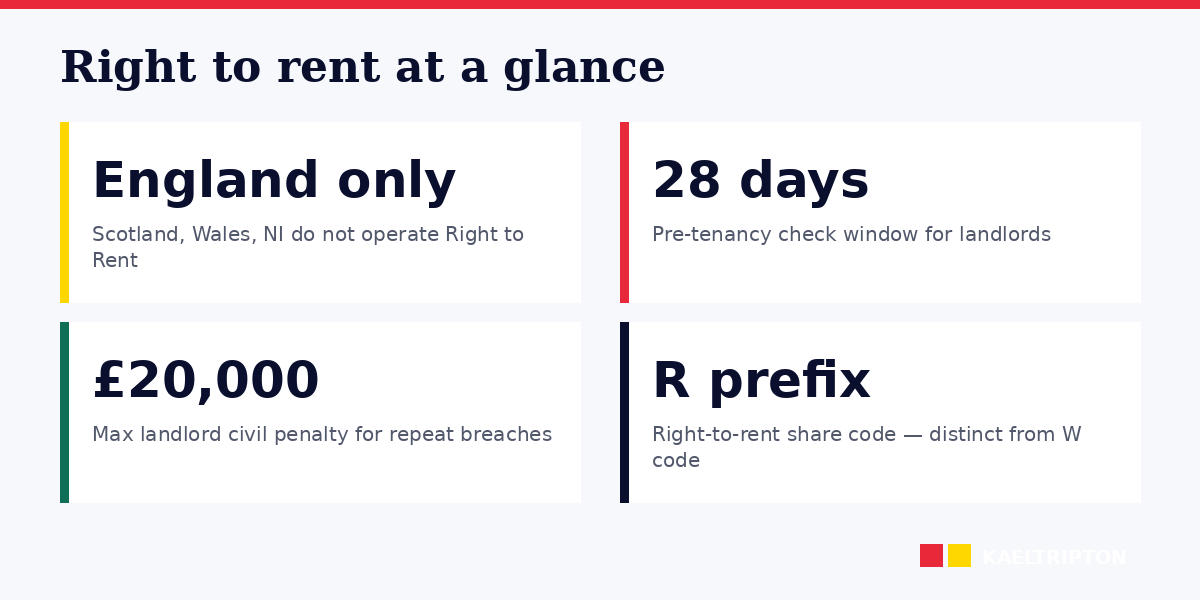
EUSS holders prove right to rent via a share code from their UKVI account - the "R" variant generated separately from the "W" work code. Landlords must check within 28 days before a tenancy starts (in England only). Scotland, Wales, and Northern Ireland do not operate Right to Rent. Landlord fines for renting to someone without right to rent reach £20,000 per tenant for repeat breaches in 2026. The scheme has been controversial since 2016 for its discrimination risks - landlords sometimes refuse EUSS holders or demand inappropriate proof, which is against the Code of Practice. This guide covers the 2026 process for EUSS tenants, landlord obligations, and the discrimination safeguards tenants can rely on.
| ★ EDITOR'S VERDICT Right to Rent is England only. Landlords must check, but discrimination is real. |
Right to Rent operates in England only - Scotland, Wales, and Northern Ireland don't have it. Landlords must check within 28 days before tenancy starts. Share code starts with 'R' for rent - different from the 'W' code for work. Code valid 90 days, reusable. Landlord enters code + date of birth into the Home Office service. 2024 civil penalty rises push first-breach fines to £10,000 and repeat breaches to £20,000 per tenant. Discrimination in the scheme is well-documented - if a landlord refuses a share code or demands specific formats beyond the rules, escalate to the Equality and Human Rights Commission or relevant ombudsman. |
Where Right to Rent applies
Right to Rent operates only in England - not Scotland, Wales, or Northern Ireland. It was introduced by the Immigration Act 2014 for all new tenancies from 1 February 2016. The scheme requires landlords (including letting agents acting on their behalf) to check prospective tenants' immigration status before granting a tenancy.
For EUSS status holders renting in England, the check is unavoidable - no workaround exists. The same tenant in Scotland would face no such check (Scotland uses separate anti-discrimination protections without Right to Rent).
The 28-day window
Landlords must complete the right to rent check within 28 days before the tenancy start date. Not earlier, not later. The check establishes a statutory excuse against civil penalties if the tenant later proves not to have right to rent.
In practice: the check is usually part of the tenancy application process, along with credit and reference checks. If tenancy is then delayed for weeks, a fresh check may be needed.
How EUSS tenants generate a right to rent share code
Same UKVI account system as right to work, but with a different code purpose:
- Log in to UKVI account at gov.uk/view-prove-immigration-status
- Select "Prove your status to someone"
- Choose "Prove your right to rent to a landlord in England"
- Receive a 9-character share code starting with "R" (for rent)
- Give the code and your date of birth to the landlord or letting agent
- Code is valid for 90 days, reusable multiple times during that window
Critical: a share code for right to work (starts "W") will not work for right to rent checks. Landlords who try to use a "W" code will see an error. Generate the correct code type each time.
How the landlord check works
Landlords use the dedicated government service at gov.uk/landlords-immigration-right-to-rent-checks. The process:
- Landlord receives the "R" share code and date of birth
- Enters both into the online checker
- Views the tenant's status profile - photograph, name, immigration status type, any time limits
- For settled status: no expiry shown, indefinite right to rent
- For pre-settled status: expiry date shown. Landlord typically needs to plan a follow-up check before expiry (see below)
- Landlord saves a clear copy of the profile page and records the check date
Best practice: save the profile as a downloaded PDF or print with the check date annotated. Store securely for duration of tenancy plus at least 1 year after it ends.
Follow-up checks for time-limited status
For pre-settled status holders, the landlord should plan a follow-up check before the tenant's status expires or the tenancy ends - whichever comes first. This is similar to other time-limited UK visas (Skilled Worker, Student) where right to rent requires re-verification.
If the follow-up shows the tenant no longer has right to rent (e.g. status expired and not converted to settled), the landlord must report to the Home Office. Continued letting without right to rent exposes the landlord to civil penalties.
Landlord penalties in 2026
Civil penalties for letting to tenants without right to rent rose sharply on 13 February 2024:
- First breach: up to £10,000 per tenant (up from £3,000)
- Repeat breach: up to £20,000 per tenant (up from £3,000)
- Deliberate unlawful letting: criminal prosecution - up to 5 years imprisonment
The statutory excuse against civil penalties requires:
- Correct check method used for the tenant's status type (share code for EUSS)
- Check completed within 28 days before tenancy start
- Clear record of online check result retained
- Check date recorded
- Follow-up checks for time-limited status
The discrimination problem
Right to Rent has been criticised since 2016 for increasing racial and ethnic discrimination in the rental market. A 2019 High Court judgment (the JCWI case) found the scheme did cause unlawful discrimination, though the Court of Appeal reversed on the wider remedy. Research consistently shows:
- Landlords sometimes refuse EUSS holders on assumption "it's more complicated"
- Some demand specific proof formats (original passport plus ID card plus share code printed - beyond what the rules require)
- Informal market rentals (friends-of-friends, small landlords, short-term lets) sometimes skip checks entirely, disadvantaging tenants who want proper tenancy documentation
The Code of Practice for Landlords on Avoiding Unlawful Discrimination requires landlords to:
- Treat all prospective tenants the same in terms of the check process
- Accept share codes without demanding additional proof formats
- Not refuse tenants based on nationality or perceived immigration status during checks
- Apply consistent criteria across all applications
Tenants experiencing discrimination can complain to the Equality and Human Rights Commission (EHRC), housing ombudsman, or local authority trading standards. High-profile cases are sometimes supported by charities like Shelter or Liberty.
Pending EUSS application: renting while waiting
If your EUSS application is pending, you may have right to rent based on the pending status:
- Share code if available. Some pending applicants can still generate share codes showing application-in-progress status.
- Certificate of Application. Present to landlord along with request to use the Landlord Checking Service.
- Landlord Checking Service (LCS). Separate route where landlord submits your details to Home Office. Response usually within 5 working days, valid for 12 months.
Practical challenge: between a late application submitted and a Certificate of Application being issued (which since August 2023 requires reasonable grounds acceptance first), you may have no rentable proof of right to rent. This is a known hardship created by the 2023 rule change.
A real 2026 scenario: Spanish teacher renting in Manchester
A Spanish secondary school teacher with pre-settled status (received 2020) finds a 1-bed rental in Manchester at £1,100/month. Landlord is a local letting agent.
Application stage: agent requests standard tenant checks - credit reference, employer reference, right to rent. Teacher is asked for share code.
Same day: teacher logs into UKVI account, generates right to rent share code R7K 2B8 N9P. Texts code + date of birth to agent.
Next morning: agent checks online. Profile shows pre-settled status with expiry date June 2030. Settled status conversion eligibility from late 2025. Agent saves PDF, records check date.
Tenancy start: 2 weeks later. Teacher moves in.
Year 4: teacher converts to settled status in early 2029 (reaches 5-year continuous residence threshold). Follow-up right to rent check shows settled status with no expiry. Agent updates records - no further checks needed.
Year 6: teacher decides to move to a new rental. Same process - generates fresh share code, new agent verifies, new tenancy begins.
If a landlord refuses to accept a share code
Some landlords and agents refuse share codes or demand additional proof, incorrectly thinking the physical passport is required. Steps to take:
- Explain the rule clearly - cite gov.uk/landlords-immigration-right-to-rent-checks and the Code of Practice
- Refer them to Landlord Advice Service - free Home Office advice line for landlords
- If refusal persists, escalate - complain to the letting agent's professional body (ARLA, NAEA), the Property Ombudsman, or the local authority housing team
- In severe cases, complain to the Equality and Human Rights Commission for potentially discriminatory treatment
Many landlord refusals reflect uncertainty rather than discrimination. Patient explanation and showing the Code of Practice often resolves issues without formal complaint.
Frequently asked questions
Does Right to Rent apply in Scotland or Wales?
No. Right to Rent is England-only. Scotland, Wales, and Northern Ireland do not operate the scheme. EUSS holders renting in those countries face no right to rent checks - though standard landlord reference checks still apply.
Can I rent while my EUSS late application is pending?
Only with evidence - either a share code (if still generatable during pending status) or a Certificate of Application. Since 9 August 2023, CoAs for late applications are delayed until reasonable grounds are accepted. During the pre-CoA period, landlords cannot establish statutory excuse and typically refuse the tenancy.
Do I need a new share code for each new landlord?
One share code can be used across multiple landlords during the 90-day validity window. After 90 days, generate a new one. No limit on how many you generate in total - free, fast process.
What if my pre-settled status expires during my tenancy?
The landlord should perform a follow-up check. You should convert to settled status before expiry. The 2024 automatic 2-year extension provides additional buffer but doesn't replace the eventual conversion requirement. If you don't convert, the landlord may terminate the tenancy after the required follow-up check shows no right to rent.
Can a landlord charge me for the right to rent check?
No. The Tenant Fees Act 2019 prohibits most upfront fees to tenants. Right to Rent checks are a landlord obligation, not a tenant fee. Any landlord charging for the check itself is likely breaching the Act.
What if I don't have a UKVI account?
All EUSS status holders should have a UKVI account created during their application. If you cannot access it (lost email, changed phone), contact the UKVI Resolution Centre on 0300 123 7379. Account recovery typically 3-5 working days.
Is my passport alone enough for right to rent?
Only if you are a British or Irish citizen. EUSS status holders must use share codes - passports alone are not accepted proof of EUSS status. Landlords who accept passports alone lose the statutory excuse against civil penalties.
Sources
- GOV.UK, Prove your right to rent - gov.uk/prove-right-to-rent
- GOV.UK, Landlords: carrying out right to rent checks - gov.uk/landlords-immigration-right-to-rent-checks
- Home Office, Landlord's guide to right to rent checks 2024 Code of Practice (13 February 2024)
- Immigration Act 2014 (as amended), Right to Rent provisions
- Tenant Fees Act 2019
- Joint Council for the Welfare of Immigrants v. Secretary of State for the Home Department [2019] EWHC 452 (Admin) and Court of Appeal judgment [2020] EWCA Civ 542
- Code of Practice for Landlords on Avoiding Unlawful Discrimination


