

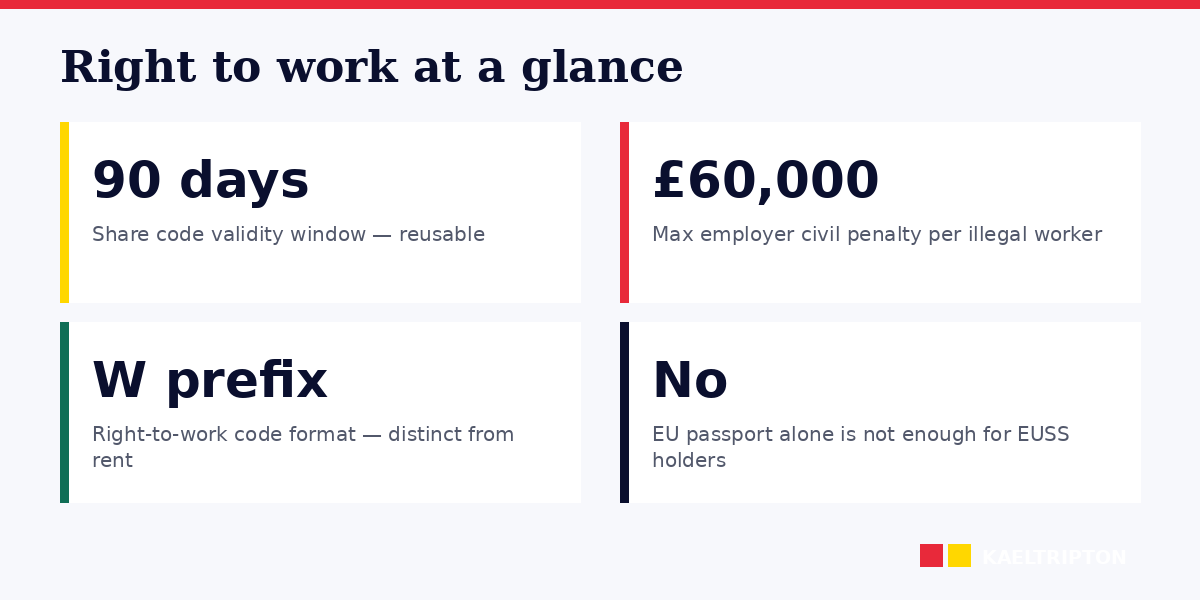
EU Settlement Scheme holders prove right to work in the UK via a share code from their UKVI account - not an EU passport alone, not a national ID card, not a Biometric Residence Card. This is the 2026 reality for all EUSS employees across settled and pre-settled status. The share code is a 9-character reference starting with "W" for work, valid 90 days, unlimited reuse during that window. Employers enter the share code plus the worker's date of birth into the Home Office online checking service, then download and retain a clear record. Failure to complete the correct check exposes employers to civil penalties up to £60,000 per illegal worker. This guide covers the 2026 process for EUSS workers, pending application edge cases, and what employers need to retain to establish a statutory excuse.
| ★ EDITOR'S VERDICT EU passports alone don't work for right-to-work anymore. Share code is mandatory. |
Since 1 July 2021, EU Settlement Scheme holders must prove right to work via a share code from their UKVI account - an EU passport, national ID card, or BRP alone is not sufficient proof. Employers use the Home Office online service with the share code plus date of birth. Screenshots aren't enough - the employer must access the live page and retain the profile download. Civil penalties reached £60,000 per illegal worker for repeat breaches from 13 February 2024. If a landlord or employer refuses to accept a share code, they are non-compliant with the Code of Practice - escalate through the proper channels. |
Why EU passports alone no longer work
Before 1 July 2021, EU citizens could prove UK right to work with an EU passport or national ID card - this was the pre-Brexit "free movement" arrangement. From 1 July 2021 onwards (once the EUSS deadline passed), this changed:
- EU passports alone no longer establish right to work in the UK
- EU national ID cards are no longer accepted for right to work purposes for most nationals
- EUSS status must be proved digitally via the UKVI account share code system
- BRPs and BRCs (physical residence cards) were phased out through 2024-2025; replaced entirely by eVisas
Employers who accept EU passports alone for new EUSS-status hires lose the statutory excuse against civil penalties. The Home Office has published multiple enforcement warnings confirming this position. 38% increase in illegal working visits since July 2024 has raised compliance stakes materially.
How a share code works for workers
- Log in to your UKVI account at gov.uk/view-prove-immigration-status. You'll need your UKVI account email and phone number for verification.
- Select "Prove your status to someone" - the service has separate options for right to work, right to rent, and general proof.
- Choose "Prove your right to work to an employer". This generates a share code starting with "W" specifically for right to work purposes.
- Receive the 9-character code immediately. Example format: W6A 7B8 C9D (with spaces for readability).
- Send the code to your employer along with your date of birth. Email, text, or verbal are all fine.
- Code is valid for 90 days and can be reused multiple times during that window. After 90 days, generate a new one.
Each share code is purpose-specific. A right to work code cannot be used for right to rent (landlord checks) because the underlying services display different information. If you need to prove status to a landlord separately, generate a separate right to rent code starting with "R".
How the employer check works
- Employer receives the share code and date of birth from the worker before or shortly after start date
- Employer goes to gov.uk/view-right-to-work (the dedicated employer service, different URL from the worker's prove service)
- Employer enters the share code and the worker's date of birth
- The service displays the worker's immigration status profile - name, photograph, immigration status type, any work conditions, expiry date if applicable
- Employer captures a clear record of the profile page. Screenshots or photos are not sufficient - the employer must access the live page, retain it via the service's download feature, and record the check date
For settled status holders: the profile shows unlimited right to work with no expiry. The initial check establishes statutory excuse for the full duration of employment - no repeat checks required.
For pre-settled status holders: the profile shows the expiry date of the pre-settled status. Under current policy, employers are not required to perform repeat checks purely because of the pre-settled expiry date - the initial check establishes statutory excuse. However, best practice suggests repeat checks before expiry given the status may need conversion to settled status or fresh pre-settled application.
Pending EUSS application: the Certificate of Application route
What if you've applied to EUSS but don't have a decision yet? Your legal right to work continues under Home Office policy while the application is pending (provided it was validly submitted). Two evidence routes:
- Share code via UKVI account. Some pending applicants can still generate a share code from their UKVI account showing the application-in-progress status.
- Certificate of Application (CoA). Issued by the Home Office once an application's validity is confirmed. Since 9 August 2023, CoAs for late applications are issued only after reasonable grounds are accepted - which can take months.
If the worker cannot generate a share code and has no CoA, the employer uses the Employer Checking Service (ECS) - a separate Home Office route where the employer submits the worker's details for status verification. The Home Office issues a Positive Verification Notice confirming right to work, valid for 6 months. ECS is backstop for edge cases only.
The civil penalty regime in 2026
UK illegal working fines rose sharply from 13 February 2024:
- First breach: up to £45,000 per illegal worker (up from £15,000 pre-February 2024)
- Repeat breach: up to £60,000 per illegal worker (up from £20,000)
- Criminal prosecution: where the employer knew or had reasonable cause to believe illegal working
- Sponsor licence revocation: if the employer holds one - separate severe consequence
Civil penalties escalate with compound breaches and are levied per worker, not per business. A restaurant found to have 4 illegal workers at a repeat inspection could face £240,000 in civil penalties.
The statutory excuse against these penalties requires:
- Correct method used for the worker's immigration status (share code for EUSS)
- Check completed before the worker started employment
- Clear copy of the online check result retained
- Check date recorded
- Records kept for duration of employment plus 2 years after
Common problems and solutions
Worker cannot access UKVI account - contact the UKVI Resolution Centre on 0300 123 7379. Common causes: changed email, changed phone number, forgotten password, account created in wrong name. Resolution typically 3-5 working days.
Share code doesn't work on employer service - confirm the code starts with "W" (right to work). Codes starting with "R" are for right to rent and won't work. If correctly formatted, check the date of birth entered is exactly as on the worker's original application.
Employer demanding specific proof formats - employers cannot mandate how a worker proves right to work. Accepting only PDFs, only passports, or refusing share codes is against the Employer Guide rules and can constitute discrimination. Workers facing these demands can escalate to HR or ACAS.
EU national ID card refused incorrectly - the worker's right to work is via EUSS status, not the ID card itself. Even if the ID card is refused, the share code route proves status correctly. The worker should insist on using the share code method.
A real 2026 scenario: Polish chef changing restaurants
A Polish chef with settled status under EUSS applies for a new role at a London restaurant. She received settled status in 2019 and has worked in UK hospitality throughout.
Interview day: offered the role, start date 2 weeks away. HR asks for right to work documentation.
Same evening: logs into UKVI account at gov.uk. Selects "Prove your right to work to an employer". Generates share code W4R 9T2 K8L. Emails code + date of birth to the restaurant HR.
Next morning: HR staff go to gov.uk/view-right-to-work. Enter the share code and her date of birth. Profile loads showing: photo, full name, settled status under EU Settlement Scheme, no expiry on right to work. HR saves the profile page as a PDF, records the check date as required.
Start date: starts work. Employer has statutory excuse established. No repeat check needed because settled status has no expiry.
Year 3 of employment: chef moves house. No re-check required. Only material changes in status (settled status removed, which is extremely rare) would require action - and those are proactively notified by UKVI.
Discrimination and the Right to Work Checks Code
UK equality law protects workers from discrimination in the right-to-work check process. The Code of Practice for Employers on Avoiding Unlawful Discrimination specifies:
- Employers cannot treat applicants differently based on nationality or perceived immigration status during checks
- Employers cannot require specific proof formats beyond what the worker's status type allows
- Employers must give the worker reasonable opportunity to prove status before starting employment
- Workers can submit formal complaints about discriminatory practices to ACAS or the Equality and Human Rights Commission
The3million charity reports that approximately 20-30% of EUSS holders have experienced some form of improper check - employers refusing share codes, demanding PDFs, or requesting "additional proof". Workers experiencing this should escalate and, if necessary, formally complain.
Frequently asked questions
Can I use my EU passport to prove right to work in the UK?
No, not if you rely on EUSS status. EU passports alone are not acceptable proof of right to work under EUSS since 1 July 2021. You must use the share code via your UKVI account. Employers who accept EU passports alone lose the statutory excuse against civil penalties.
Do I need to get a new share code every time I start a new job?
Yes, or reuse a valid unused code. Each share code is valid for 90 days and can be reused across multiple employers during that window. If a code expires, generate a new one - free, takes 2 minutes, no limit on how many you generate.
What if I have pre-settled status that's expiring?
Under current policy, employers do not need to perform repeat right-to-work checks just because pre-settled status is nearing expiry. However, you should convert to settled status before or at the 5-year point - or make a fresh pre-settled application if you haven't yet reached the 5-year mark. The 2024 automatic extension provides extra buffer but doesn't replace the need to convert eventually.
Can I work while my late EUSS application is pending?
Only if you have a Certificate of Application or can generate a share code. Since 9 August 2023, CoAs for late applications require the Home Office to first accept reasonable grounds. During the pre-CoA period, you typically cannot prove right to work and may need to stop working until status is confirmed.
Do I need to show a BRP?
No. Biometric Residence Permits are no longer acceptable proof of right to work as of 1 June 2025 (for BRPs that expired on 31 December 2024). All former BRP holders now use the share code system via UKVI account.
What happens if my employer refuses to accept a share code?
Employers cannot refuse share codes - the Home Office Employer Guide is clear that share codes are the mandatory method for digital-status workers. Refusal is non-compliant and potentially discriminatory. Escalate to HR, ACAS, or in severe cases the Equality and Human Rights Commission.
Can I use a share code to travel?
Yes, though at UK borders Border Force checks EUSS status via passport scan against DVLA/UKVI records automatically. The share code is primarily for employers, landlords, and other verification purposes. For international travel where your status must be proved, the share code provides evidence to airlines and foreign authorities.
Sources
- GOV.UK, Prove your right to work to an employer - gov.uk/prove-right-to-work
- GOV.UK, View a job applicant's right to work details - gov.uk/view-right-to-work (employer service)
- Home Office, Employer's guide to right to work checks: 2024 Code of Practice (13 February 2024)
- GOV.UK, View your eVisa and get a share code to prove your immigration status
- Home Office, Illegal working civil penalty rates 2024 onwards
- Immigration Act 2014 (as amended), illegal working provisions
- EU Settlement Scheme status holder guidance (UKVI)


