

UK employers hiring overseas workers need a Skilled Worker sponsor licence from the Home Office. The licence application fee is £536 for small or charitable sponsors (under 50 UK employees or charity status) and £1,476 for medium or large sponsors. Compliance duties are substantial: maintain HR records, report employee absences and role changes, notify changes to sponsored workers' employment within 10 working days, and cooperate with Home Office audits. The Immigration Skills Charge (ISC) adds £364/year (small sponsors) or £1,000/year (larger sponsors) per sponsored worker. This guide covers the 2026 application process, ongoing compliance, and the Home Office enforcement risks that can cost a business its licence.
| ★ EDITOR'S VERDICT Sponsor licence is ongoing compliance, not a one-off fee. |
Getting the licence costs £536-£1,476 plus 8 weeks of processing (or 10 days with £500 priority). The real cost comes after: record-keeping, 10-day reporting duties, Home Office audits, and risk of revocation. Each sponsored worker adds £525 CoS fee plus £364-£1,000/year Immigration Skills Charge, paid by the employer (not recoverable from the employee). Small businesses save on all fees. Large businesses pay more but get bigger CoS allocations. Non-compliance can end the licence - and every sponsored worker must leave within 60 days if that happens. |
UK visa fees: key facts (checked 16 October 2026) Current Home Office fees (most rose on 8 April 2026). Fees are per person and paid when you apply; the health surcharge is paid on top for each year of the visa.
|
When a business needs a sponsor licence
A sponsor licence is required before a UK company can issue a Certificate of Sponsorship (CoS) to a worker applying for:
- Skilled Worker visa (the main work route)
- Scale-up Visa
- Temporary Worker routes (Global Business Mobility, Minister of Religion, Creative Worker)
- Some other specialised routes
Exemption cases where no licence is needed:
- Hiring British or Irish citizens
- Hiring EEA nationals with UK settled or pre-settled status (EUSS)
- Hiring people on other visas with unrestricted work rights (Graduate visa holders, dependants of Skilled Workers, etc.)
- Hiring people under Youth Mobility Scheme (who don't need sponsorship)
If a business needs to hire someone who doesn't fall into one of these categories, a sponsor licence is mandatory before a visa application can be submitted.
The application process
Applications are submitted online through the Home Office Sponsorship Management System (SMS). Typical timeline: 8 weeks for standard processing; pre-licence priority service £500 reduces to 10 working days.
Fees for 2026
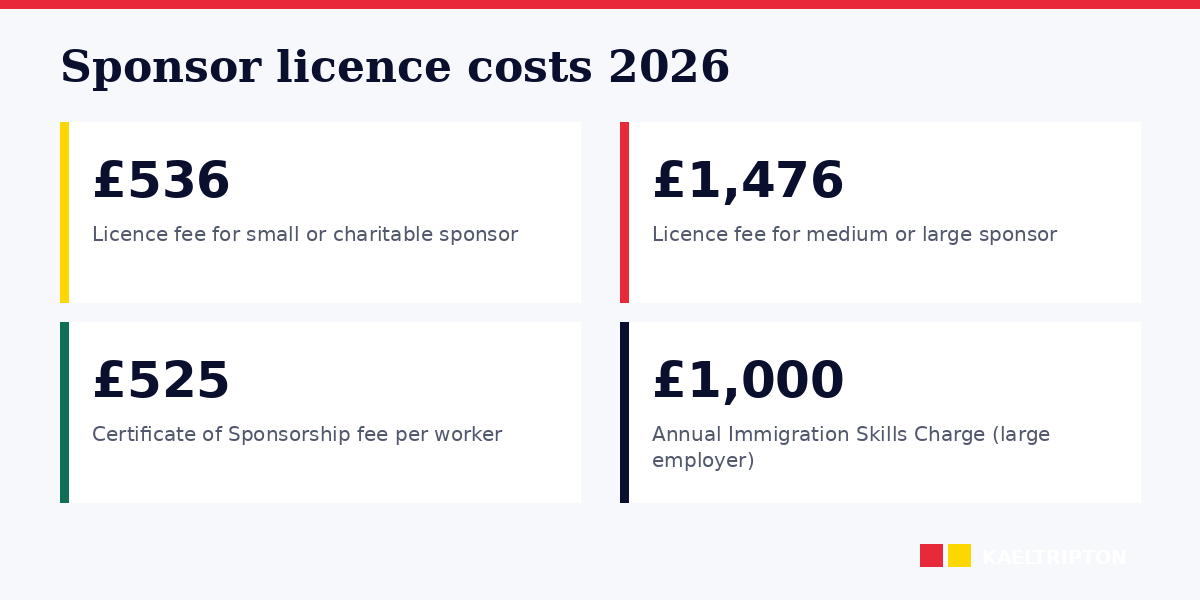
- Small or charitable sponsor: £536 for licence application. Eligibility: under 50 UK employees OR registered charity status.
- Medium or large sponsor: £1,476 for licence application.
- Priority service (optional): £500 to reduce processing to 10 working days.
- Action Plan review (if licence restricted): £1,476 to appeal restrictions.
Required documents and evidence
The specific evidence depends on the business structure and licence type. Common requirements:
- Companies House incorporation certificate (for UK-registered companies)
- VAT registration certificate (if VAT-registered)
- Most recent audited accounts or financial statements
- Employer's Liability Insurance certificate
- PAYE registration
- Commercial bank account details
- Evidence of HR systems and compliance procedures
- Proof of genuine vacancy and business need for sponsorship
New businesses without trading history have additional requirements - typically a detailed business plan, evidence of funding, and often enhanced scrutiny. Some new start-ups have successfully obtained licences within months of incorporation, but evidence must be substantial.
Key Personnel roles required
Every licence must name individuals in three key roles, though one person can hold multiple roles in small businesses:
- Authorising Officer: most senior person responsible for recruitment and managing the licence. Must be based in the UK.
- Key Contact: main day-to-day contact with the Home Office.
- Level 1 User: has full access to the Sponsorship Management System and can assign Certificates of Sponsorship.
All three roles must pass a suitability check - no unspent criminal convictions, no previous Home Office enforcement action against them personally. A licence can be refused or revoked if any key personnel fail suitability.
Certificate of Sponsorship (CoS)
Once the licence is granted, the sponsor can assign CoS to individual workers. A CoS is a unique 8-character reference generated in the Sponsorship Management System, not a physical document.
CoS details in 2026:
- Defined CoS (used for most Skilled Worker applications): £525 per CoS assignment fee
- Undefined CoS: used less commonly, for specific routes
- Annual CoS allocation: granted to the sponsor based on business need. New sponsors typically receive a small initial allocation (10-50 CoS/year) that grows with proven compliance.
- CoS validity: 3 months from assignment - the worker must apply for the visa within that window.
The £525 CoS fee is paid by the employer and cannot be recouped from the employee - a common mistake in employer contracts that makes clawback clauses unenforceable.
Immigration Skills Charge (ISC)
The ISC is a separate fee the employer pays per sponsored worker per year of the visa. Introduced in 2017 to fund UK skills training. Rates for 2026:
- Small or charitable sponsor: £364 per worker per year
- Medium or large sponsor: £1,000 per worker per year
For a 5-year Skilled Worker visa sponsored by a medium-large business: £1,000 × 5 = £5,000 ISC paid upfront at CoS assignment. Not recouped from the employee. This is employer cost, not employee cost.
ISC exemptions: Global Talent, Health and Care Worker visa, Intra-Company Transfer short-term (up to 36 months), and workers with PhDs in relevant subjects.
The compliance duties
Sponsor compliance is the real ongoing cost of holding a licence. Key duties:
- Record-keeping: maintain detailed HR records for every sponsored worker - contact details, employment contract, evidence of right to work, salary history, absences
- Reporting within 10 working days: any change in sponsored employment (role change, salary change, location change, termination), unauthorised absence of more than 10 working days
- Monitoring right to work: ongoing duty to check worker status, particularly at visa renewals and changes
- Home Office audits: sponsors can be audited at any time, scheduled or unannounced
- Preventing illegal working: right-to-work checks at every hire, documented and retained
A Home Office audit typically examines:
- A random sample of sponsored worker files (HR records, payroll, timesheet)
- Internal HR systems and processes
- Evidence of genuine vacancy (job descriptions, recruitment records)
- Compliance with CoS allocation rules (roles assigned correctly, salary at or above threshold)
Penalties for non-compliance
Home Office enforcement options escalate with severity:
- Licence downgrade (from A-rating to B-rating): requires expensive Action Plan and remediation
- CoS allocation reduction: limits further hiring
- Licence suspension: no new CoS can be issued; existing workers unaffected short-term
- Licence revocation: loss of licence entirely. Existing sponsored workers get 60 days to find new sponsorship or leave the UK.
- Civil penalties: up to £45,000 per illegal worker (first offence), £60,000 for repeat breaches
- Criminal prosecution: in serious fraud cases - up to 5 years imprisonment and unlimited fines
The biggest operational risk for a sponsored business is licence revocation. Losing the licence means every sponsored worker must find a new sponsor within 60 days or leave the UK - a severe operational and reputational hit.
2026 changes worth knowing
- Skilled Worker minimum salary threshold: £41,700 general rate from 22 July 2025 (raised from £26,200), applied to new applicants. Transitional protection for workers granted before April 2024 continues.
- Immigration Salary List: replaced the Shortage Occupation List in April 2024. Lower salary thresholds apply to specific roles on the list.
- Going rate increases: SOC code-specific going rates adjusted annually based on ONS earnings data. Check the current rate before issuing CoS.
- Increased enforcement: Home Office 2025-2026 increased compliance visits, particularly to newer sponsors in high-risk sectors (hospitality, care, construction).
A real 2026 scenario: UK tech startup sponsors first employee
A 40-person UK tech startup wants to hire an Indian senior engineer. They have never sponsored before.
Week 1-2: CEO confirms business size (under 50 employees → small sponsor category, £536 fee). Assembles documents: Companies House certificate, VAT registration, audited 2025 accounts, Employer's Liability Insurance, PAYE registration, HR policies.
Week 3: Nominates CTO as Authorising Officer, HR Lead as Key Contact and Level 1 User. Submits sponsor licence application via online portal with Priority Service (£500) to reduce to 10 working days.
Week 5: Home Office pre-licence compliance visit - 2-hour review of HR systems, discussion of business need, sample document review. No issues raised.
Week 6: Licence granted with A-rating. Initial CoS allocation of 10.
Weeks 7-8: Assigns Defined CoS to the Indian engineer (£525 fee, £364/year ISC × 3 years = £1,092 paid upfront). Engineer applies for Skilled Worker visa.
Total employer costs for first hire: £536 licence + £500 priority + £525 CoS + £1,092 ISC = £2,653. Plus ongoing compliance overhead.
First-year ongoing: monthly payroll auditing, documented right-to-work checks, quarterly HR record reviews. Home Office audit could arrive any time.
Frequently asked questions
How long does a sponsor licence take to obtain?
Typically 8 weeks for standard processing. Pre-licence Priority Service (£500) reduces this to 10 working days. New sponsors often face more scrutiny and pre-licence compliance visits - build buffer time into hiring timelines.
Can a small business get a sponsor licence?
Yes. The small sponsor category (under 50 UK employees or charity) pays the reduced £536 fee and lower ISC (£364/year vs £1,000/year for medium-large sponsors). Small businesses face similar compliance scrutiny but generally lower CoS allocations initially.
Can I sponsor myself for a visa if I set up a UK company?
Not for Skilled Worker via your own company. Genuine vacancy tests apply - the Home Office scrutinises self-sponsorship carefully. Innovator Founder Visa is a specific route for founders of innovative UK businesses, but has its own strict endorsement criteria.
What happens at a Home Office compliance audit?
Typically 1-3 hours on site. Review of sample sponsored worker files, HR systems demonstration, interview with key personnel, questions about specific employment decisions. Follow-up may request additional documentation within 28 days. Actions taken depend on findings - minor issues get written guidance; serious non-compliance leads to downgrade or suspension.
How long is a sponsor licence valid?
Originally 4 years, automatic renewal now applies so new sponsors from 2024 onwards don't need to actively renew. However, licences can be revoked at any time for non-compliance. Maintain vigilance regardless of no expiry pressure.
Can I recover visa costs from the employee?
No for some, yes for others. You cannot recover the Immigration Skills Charge, CoS fee, or sponsor licence costs from employees - these are legally employer-borne costs. You can ask employees to pay their own application fee and Immigration Health Surcharge (though many employers cover these as a competitive offer). Clawback clauses in employment contracts must be carefully drafted to comply with 2022 Home Office guidance.
What's the difference between Defined and Undefined CoS?
Defined CoS is used for most Skilled Worker applications - requested and granted before CoS issue. Undefined CoS was historically for extensions and some specific routes. The Home Office has phased out Undefined CoS for many routes through 2024-2025. Check current SMS guidance for your specific route.
Sources
- GOV.UK, Apply for a sponsor licence: Workers and Temporary Workers - gov.uk/apply-sponsor-licence
- Home Office, Workers and Temporary Workers: guidance for sponsors (Part 1, Part 2, Part 3) - updated regularly
- Immigration Rules, Part 1 (general sponsorship provisions) and relevant route-specific Appendices
- Home Office, Immigration Skills Charge guidance and fees 2026
- UK Visas and Immigration, Sponsorship Management System (SMS) guidance
- Immigration Act 2014 (as amended) - illegal working penalty provisions
- Nationality and Borders Act 2022 - sponsor licence enforcement amendments


