

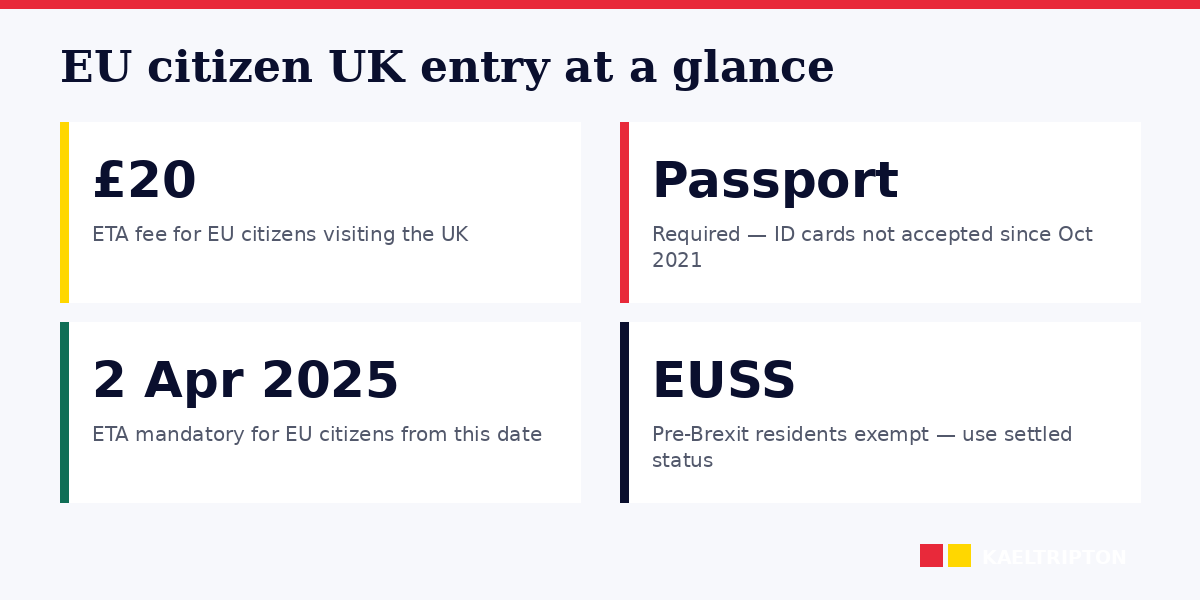
German, French, Spanish, Italian and other EU citizens visiting the UK now need an Electronic Travel Authorisation (ETA). The £20 ETA has been mandatory for EU nationals visiting the UK since 2 April 2025 and was fully enforced from 25 February 2026. Additionally, EU national identity cards are no longer accepted for UK entry from most EU nationals - valid passports are required (an exception remains for pre-Brexit EU residents with UK settled or pre-settled status). The ETA is not a visa. It's a digital pre-authorisation, similar to the US ESTA. This guide covers exactly what German and other EU citizens need to visit the UK in 2026 - the ETA, passport requirements, when a full visa is needed, and the rules for EU citizens living in the UK under the EU Settlement Scheme.
| ★ EDITOR'S VERDICT Post-Brexit UK entry for EU citizens: passport + ETA, not ID card. |
EU citizens visiting the UK face two post-Brexit requirements that didn't exist in 2019: a valid passport (ID cards no longer accepted since October 2021) and a £20 ETA (mandatory since April 2025, fully enforced since February 2026). The only EU citizens exempt are those with UK settled or pre-settled status under EUSS - they use their status to enter and can still use ID cards. The cost of a UK trip for an EU citizen is now £20 higher than pre-Brexit, but the process is simpler than a traditional visa. |
The two major post-Brexit changes for EU visitors
Two significant changes affect EU citizens travelling to the UK in 2026:
- Passport requirement (from 1 October 2021): EU national ID cards are no longer accepted for UK entry by most EU nationals. A valid passport is required. The only exception: EU citizens with UK settled or pre-settled status under the EU Settlement Scheme (EUSS) who entered the UK before 31 December 2020 can continue using ID cards.
- ETA requirement (mandatory from 2 April 2025, fully enforced from 25 February 2026): EU citizens now need an Electronic Travel Authorisation to enter the UK for any short visit up to 6 months.
Together these make UK entry for EU visitors noticeably more bureaucratic than the pre-Brexit era, when EU citizens could travel to the UK on an ID card without any advance permission. The practical impact for German travellers: check your passport is valid, apply for an ETA at least 72 hours before travel.
Who needs an ETA
From 2 April 2025, these EU/EEA citizens need an ETA for UK visits:
- All 27 EU member states (Germany, France, Spain, Italy, Netherlands, Belgium, Poland, and so on)
- Iceland, Liechtenstein, Norway
- Switzerland
Exempt from ETA (but still need a passport):
- British citizens (travel on UK passport)
- Irish citizens (use Common Travel Area rights - travel on Irish passport)
- EU citizens with UK settled status or pre-settled status under EUSS (their status acts as their permission to enter)
- EU citizens holding any other valid UK visa
- EU citizens lawfully resident in Ireland travelling within the Common Travel Area (they use the CTA exemption)
The ETA process for EU citizens
Same as for any other visa-exempt national. Application via the UK ETA app (iOS/Android) or at gov.uk/eta.
- Download UK ETA app or go to gov.uk/eta
- Scan your passport (not ID card - passport only)
- Take a selfie for biometric matching
- Answer questions about criminal history, immigration history, and the purpose of your visit
- Pay £20 (since 8 April 2026; previously £16) by debit or credit card
- Automatic decision typically in minutes; up to 3 working days for manual review
The ETA is valid for 2 years or until your passport expires, whichever is sooner. Multiple visits allowed during that period, each up to 6 months. If refused, no appeal - apply for a traditional visitor visa (£135) instead.
What the ETA allows
- Tourism and leisure
- Visiting family and friends
- Business meetings, conferences
- Short-term study (up to 6 months)
- Transit through UK airports (including airside transit, since 2 April 2025)
What the ETA does NOT allow
- Paid work for a UK employer
- Stays longer than 6 months
- Study courses over 6 months
- Marriage or civil partnership in the UK (specific Marriage Visitor Visa required)
- Settling permanently
When EU citizens need a full UK visa
For stays over 6 months, paid work, or permanent residence, a full visa is required. The main routes for EU citizens in 2026:
- Skilled Worker Visa - £41,700 minimum salary (threshold since 22 July 2025), sponsor licence required from UK employer, 5-year path to ILR
- Family Visa - for spouses, partners, parents, or children of UK citizens or settled persons. £29,000 minimum income for sponsoring spouse.
- Student Visa - for courses over 6 months at registered UK institutions
- Global Talent, Scale-up, Innovator Founder - specialised routes for high-skilled individuals
- Youth Mobility Scheme - extended to 2024 to include specific EU nationalities (check current eligibility); 2-year working holiday visa
Immigration Health Surcharge (IHS) applies to all visa routes: £1,035 per year of visa validity (£776 for students and Youth Mobility Scheme). A 5-year Skilled Worker visa therefore costs £5,175 in IHS alone on top of the application fee.
EU citizens already living in the UK: the EUSS scheme
EU citizens lawfully resident in the UK before 31 December 2020 can stay permanently under the EU Settlement Scheme (EUSS). Two statuses:
- Settled Status - for those with 5+ years continuous UK residence. Equivalent to Indefinite Leave to Remain. Keep for life (subject to rules on absences).
- Pre-settled Status - for those with less than 5 years' UK residence. Valid initially for 5 years (auto-extended by another 2 years under the 2024 reforms). Can upgrade to settled status once 5 years continuous residence is reached.
EUSS holders have the right to live, work, study, and access public services in the UK indefinitely. They don't need an ETA for travel - their EUSS status acts as permission to enter. They can continue using EU national ID cards for UK entry (the October 2021 passport requirement excludes EUSS holders).
For EU citizens who moved to the UK after 31 December 2020, EUSS is not available. They need the standard post-Brexit visa routes (Skilled Worker, Family, Student) to live in the UK.
A real 2026 scenario: German tech worker visiting UK colleagues
A 34-year-old software engineer from Munich needs to visit her company's London office for a 3-day workshop in June 2026.
Before travel. She checks her EU ID card is insufficient - needs a valid German passport. Hers expires in 2029, fine. Applies for UK ETA via the UK ETA app: scans German passport, takes selfie, answers questions, pays £20. Approved in 4 minutes.
Travel day. At Munich airport, airline's APIS system automatically checks her ETA status - approved. Boards flight to Heathrow. At UK border: her passport is scanned, ETA on file confirms her right to enter, she's admitted for up to 6 months.
After the trip. Her ETA remains valid for 2 years and covers unlimited future business trips. She won't need to apply again until June 2028 or her passport expiry, whichever is sooner.
Total cost: £20 per entry authorisation, versus pre-Brexit £0 for EU citizens. A small but real additional cost of doing business across the UK border.
Frequently asked questions
Can I use my German national ID card to enter the UK?
No, not since 1 October 2021 for most EU nationals. You need a valid passport. The only exceptions: EU citizens with UK settled or pre-settled status under EUSS, and EU citizens living in the UK under the CTA with special status. General EU visitors must use a passport.
Do I need a visa or an ETA as a German citizen?
An ETA for short visits up to 6 months (tourism, family, business meetings, short-term study, transit). A full visa for longer stays, paid work, permanent residence, or specific purposes like marriage. £20 ETA versus £127-£1,420 visa fees depending on type.
How long does an ETA take for an EU citizen?
Automatic decision typically in minutes via the UK ETA app. Manual review can take up to 3 working days. Apply at least 72 hours before travel to be safe. Same processing regardless of nationality.
Does an ETA let me work for my company's UK office?
Only for business activities that count as permitted - meetings, conferences, training, short-term negotiations. Extended work for a UK employer (even via secondment) generally requires a work visa. Check with UKVI for specific situations - the line between "permitted business" and "work" can be nuanced.
Can I drive in the UK on an EU licence?
Yes, for visits. Your EU driving licence is valid for driving in the UK during any visit up to 12 months. For longer stays or permanent relocation, you may need to exchange your EU licence for a UK one via form D1. The exchange is free for most EU licences under UK-EU agreements.
Do my children need separate ETAs?
Yes. Every EU citizen entering the UK needs their own ETA regardless of age, including babies. A parent can apply on a child's behalf through the UK ETA app using the child's passport. Fee is £20 per child.
What if I'm an EU citizen with UK settled status?
You don't need an ETA. Your EUSS settled or pre-settled status acts as your permission to enter. You can continue using your EU passport or ID card for UK entry - ID cards remain acceptable for EUSS holders. Keep your EUSS digital status accessible (via the UKVI app) to show at the UK border if requested.
Sources
- GOV.UK, Electronic Travel Authorisation (ETA) - gov.uk/eta
- Home Office, ETA factsheet April 2026 - homeofficemedia.blog.gov.uk
- GOV.UK, ID cards and passports for entering the UK
- EU Settlement Scheme - GOV.UK
- UK Visas and Immigration, Fees 2026
- GOV.UK, Apply for a UK Skilled Worker Visa
- Immigration (Electronic Travel Authorisations) Regulations 2023
- Common Travel Area - Ireland-UK arrangement


