

UK visa refused? You have three possible challenge routes in 2026: Administrative Review (£80, internal Home Office review of case-working errors), appeal to the First-tier Tribunal (£80-£140, for cases involving human rights), or a fresh application (no fee except the new application cost). The right choice depends on your visa category and the refusal reason - picking the wrong route wastes months of time and hundreds in fees. Deadlines are absolute: 14 days in-country, 28 days outside the UK from the date on the refusal notice. This guide covers the common refusal grounds, how to identify which route applies to you, and when to reapply instead of challenging.
| ★ EDITOR'S VERDICT Pick the right route first. Wrong route wastes months. |
Administrative Review only fixes Home Office caseworker errors - it cannot rescue applications that were missing evidence. Use it only when the caseworker clearly misapplied the Rules. First-tier Tribunal appeal is for family and human rights cases where new evidence can be introduced. Fresh application is often the fastest and most successful route when the original refusal was due to a fixable evidence gap. Read your refusal letter carefully - it tells you which route is available. Deadlines are absolute: 14 days in-country, 28 days outside UK. |
UK visa fees: key facts (checked 16 October 2026) Current Home Office fees (most rose on 8 April 2026). Fees are per person and paid when you apply; the health surcharge is paid on top for each year of the visa.
|
First priority: read the refusal letter carefully
Your refusal notice tells you three things that determine everything that follows:
- The specific legal grounds for refusal, citing the Immigration Rule paragraph
- Whether you have an Administrative Review right, a right of appeal, or neither
- The deadline to challenge the decision
The deadline starts from the date on the refusal notice, not when you read it. If the letter arrived late, UKVI does not extend the deadline. Act within 24-48 hours of receiving it. If you are outside the UK with a 28-day deadline and receive the notice 10 days after issue, you effectively have 18 days.
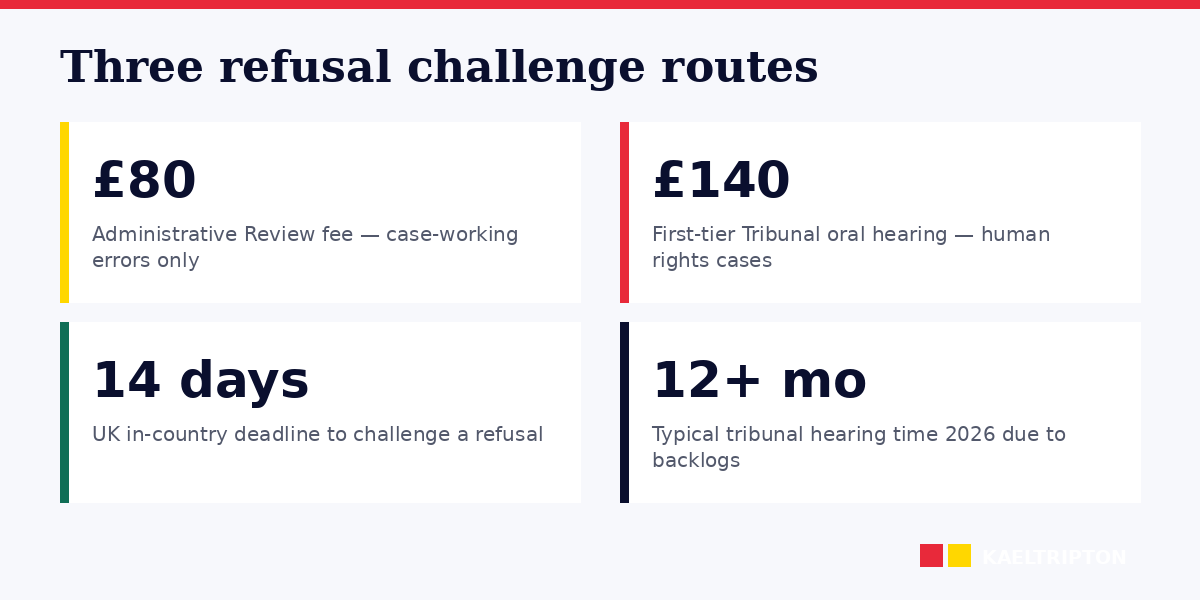
The three challenge routes compared
| Feature | Administrative Review | First-tier Tribunal Appeal | Fresh Application |
|---|---|---|---|
| Applies to | Work, study, most points-based routes | Human rights, family, EUSS | Any route |
| Fee | £80 | £80 paper / £140 oral hearing | New application fee (route-specific) |
| Deadline | 14 days in-country / 28 days outside | 14 days in-country / 28 days outside | None - reapply whenever ready |
| New evidence allowed? | No - case-working errors only | Yes - tribunal considers fresh evidence | Yes - full new application |
| Decision by | Different Home Office caseworker | Independent tribunal judge | Home Office caseworker (new) |
| Typical timeline 2026 | 3-6 months (backlogs in 2026) | 12+ months (tribunal backlogs) | Standard processing of the new route |
| Success rate with competent representation | Low-to-moderate (caseworker errors only) | Moderate-to-high when human rights genuinely engaged | High when original refusal is remediable |
Administrative Review: the internal Home Office route
Administrative Review (AR) is defined in Appendix Administrative Review of the Immigration Rules. It is not a full reconsideration - it is a narrow check for "case-working errors". A different Home Office caseworker reviews the file to confirm whether the original decision correctly applied the Rules to the evidence submitted.
AR is the only challenge route for most points-based visas:
- Skilled Worker visa refusals
- Student visa refusals
- Global Talent visa refusals (post-endorsement stage)
- Scale-up, Innovator Founder refusals
- Some Visitor visa refusals (limited circumstances)
- Certain EU Settlement Scheme decisions (under Appendix AR(EU), though this route is being phased out from 2026 - see the relevant section below)
AR is not available for:
- Family visa refusals engaging Article 8 (right to family life) - use Tribunal appeal instead
- Human rights and protection claims - use Tribunal appeal
- EUSS family permit refusals - use Tribunal appeal
- General Visitor visa refusals (in most cases) - typically no challenge right, reapply instead
What counts as a case-working error
AR can only correct specific types of error, strictly defined:
- Misapplication of the Immigration Rules to the evidence submitted
- Procedural error (wrong form used, incorrect calculation)
- Failure to consider evidence that was actually submitted
- Irrational refusal unsupported by the evidence
What AR cannot do:
- Consider new evidence you forgot to submit the first time
- Reweigh the discretion of the original caseworker
- Apply a different legal test than the Rules require
- Consider human rights or compassionate factors
The practical test: if the problem is "I should have sent more evidence", AR won't fix it - a fresh application will. If the problem is "the caseworker misread the evidence I did send", AR is the correct route.
First-tier Tribunal appeal: for human rights cases
Appeal to the First-tier Tribunal (Immigration and Asylum Chamber) is the correct route where the refusal engages human rights or a statutory appeal right exists. The most common scenarios:
- Family visa refusals (spouse, partner, parent, child) - engaging Article 8 right to family life
- EUSS refusals involving family members
- Refusals of protection claims (asylum) or humanitarian protection
- Certain long residence applications
- Cancellation or revocation of existing permission
Fees for First-tier Tribunal in 2026: £80 for a paper determination (no hearing - judge decides on the written evidence alone), £140 for an oral hearing (you or your representative attend and give evidence). Fee waivers available on hardship grounds.
The tribunal process:
- File appeal within 14 days (in-country) or 28 days (outside UK) via HMCTS appeals portal
- Home Office reviews the case; may withdraw refusal if error is obvious
- If maintained, case is listed for hearing - typically 12+ months from filing due to tribunal backlogs
- Independent judge hears evidence, considers Home Office submissions, makes a fresh decision
- Three possible outcomes: appeal allowed (Home Office must grant), appeal dismissed (refusal stands), remittance (case sent back for reconsideration with specific directions)
New evidence is admissible at tribunal - a key advantage over AR. Witness statements, supplementary documents, and updated circumstances can all be considered.
If you lose at the First-tier Tribunal
Onwards appeal routes: Upper Tribunal (on points of law only), then Court of Appeal (in narrow circumstances), then Supreme Court (extremely rare). Each stage has fees, deadlines, and increasing evidential bar. Most appeals end at First-tier; escalation is uncommon.
Fresh application: often the fastest route
A fresh application is a completely new visa application. Same process as the original submission, with revised evidence addressing the refusal reasons.
When fresh application is the best choice:
- Refusal reason: missing evidence. Gather the evidence and reapply.
- Refusal reason: technical/clerical error on your part. Fix and reapply.
- Refusal reason: changed circumstances not reflected in the first application (new job, higher salary, new qualifications).
- Refusal reason: simple threshold miss (salary too low, insufficient savings). Wait, meet threshold, reapply.
When fresh application is the wrong choice:
- Refusal reason: suitability grounds (criminal record, deception, fraud). Reapplication will be refused again unless underlying issue is resolved.
- Refusal reason: fundamental eligibility (wrong visa category entirely). Reapplication in the same category won't help - switch routes or address eligibility.
- Refusal reason: Home Office adverse findings (made-up documents, suspicious information). Reapplying with similar evidence will be refused again.
Fresh applications have no legal deadline - you can apply whenever. But strategic timing matters: if your current visa is close to expiring, you may lose Section 3C leave if the original application was out of time.
The 2026 EUSS change: administrative review closed
For EU Settlement Scheme decisions, new administrative review applications from 1 January 2026 are rejected as invalid under Statement of Changes HC 1491. The only remaining routes for EUSS refusals:
- Appeal to the First-tier Tribunal (statutory right under Immigration (Citizens' Rights Appeals) Regulations 2020)
- Fresh EUSS application (no fee, unlimited attempts)
- Judicial review in narrow legal-unlawfulness cases
AR applications for EUSS decisions submitted before 1 January 2026 are still being processed on old rules. New AR attempts from 2026 onwards are invalid.
A real 2026 scenario: Skilled Worker refusal for salary threshold
A Nigerian data engineer applies for a Skilled Worker visa in April 2026 with a sponsor paying £41,500/year. Refused: general Skilled Worker threshold is £41,700 but the specific role's "going rate" required £42,800. The caseworker correctly applied the Rules - no case-working error exists.
- AR? Will fail. Caseworker applied the Rules correctly. £80 wasted.
- Tribunal appeal? Not available. Skilled Worker refusals don't carry appeal rights (no human rights engaged).
- Fresh application? Correct route. Applicant negotiates £42,800 with employer, gets new Certificate of Sponsorship, submits fresh application. Typically approved 3-6 weeks.
Total cost of fresh application: £819 (work visa fee) + £3,105 (IHS) + £500 (Priority Service optional). Compared to AR + likely fresh application anyway: £80 + £719 + £3,105 = same ballpark, but 3-6 months longer. Fresh application is clearly the right call.
A real 2026 scenario: spouse visa refused on Article 8 grounds
A UK citizen's Peruvian wife has her spouse visa refused because UKVI questions whether the relationship is genuine (insufficient evidence of cohabitation in the home country before marriage).
- AR? Not available for family visas engaging human rights.
- Tribunal appeal? Correct route. Article 8 (right to family life) engaged. Couple can submit witness statements, photographs, correspondence, and testimony to the tribunal.
- Fresh application? Could work if evidence gap is addressed, but tribunal appeal is stronger because the Home Office has already formed a view that needs independent scrutiny.
Appeal filed within 28 days. Hearing listed 14 months later. Couple attends with legal representation, provides comprehensive relationship evidence. Judge allows appeal. Home Office grants visa. Total cost: £140 tribunal fee + legal fees (approximately £2,500-£4,000 for competent family immigration solicitor) + time investment.
Frequently asked questions
Can I appeal a UK Skilled Worker visa refusal?
Usually not directly. Skilled Worker refusals are eligible for Administrative Review but typically not for First-tier Tribunal appeal unless human rights are engaged. Most Skilled Worker refusals are best addressed via AR (if the issue is a case-working error) or fresh application (if the issue is evidence or threshold).
How long does an Administrative Review take in 2026?
The Home Office service standard is 28 days, but 2026 backlogs mean 3-6 months is common. Don't submit another application in parallel - this confuses processing and can delay both. Wait for the AR decision or use a fresh application route instead.
Do I need a lawyer for AR or appeal?
Not legally required, but strongly recommended. AR success often turns on precise legal argument identifying specific Immigration Rule paragraphs where the error occurred. Tribunal appeals almost always benefit from legal representation - self-represented appellants have significantly lower success rates. Citizens Advice, Law Centres, and OISC-registered advisers are the starting points for free or subsidised help.
What if I have no appeal rights and no AR rights?
Fresh application or judicial review. Fresh application is almost always the right choice first. Judicial review (in the High Court) is available where the decision was unlawful, irrational, or procedurally improper - expensive (£5,000-£20,000+ in legal costs) and used only as a last resort when other routes are exhausted.
Does an AR or appeal extend my leave to remain?
Yes - if you filed the original application in-time, Section 3C of the Immigration Act 1971 extends your leave while the AR or appeal is pending. This protects your right to work and remain in the UK. If the original application was out of time, no Section 3C protection applies.
Can I be removed from the UK while my appeal is pending?
Generally no, if you have an in-country right of appeal. Section 3C leave protects you until the appeal is decided (and any further onward appeals within statutory deadlines). If you have an out-of-country right of appeal, you must exercise it from abroad after leaving the UK.
What's the success rate of Administrative Review?
Low overall - typical published data suggests around 10-20% of AR applications succeed (the original decision is withdrawn). Success rates are higher when the refusal involved a clear case-working error (misread evidence, incorrect rule application). AR is not effective when the underlying application was weak - fresh application is usually faster and more likely to succeed in those cases.
Sources
- GOV.UK, Ask for an administrative review - gov.uk/ask-for-administrative-review
- Immigration Rules, Appendix Administrative Review (and Appendix AR(EU))
- Immigration (Citizens' Rights Appeals) (EU Exit) Regulations 2020
- Statement of Changes in Immigration Rules HC 1491 (closing EUSS administrative review from 1 January 2026)
- First-tier Tribunal (Immigration and Asylum Chamber) - appeal-first-tier-tribunal.service.gov.uk
- Home Office, Current rights of appeal - version September 2025
- Home Office, Administrative review guidance - October 2025


