

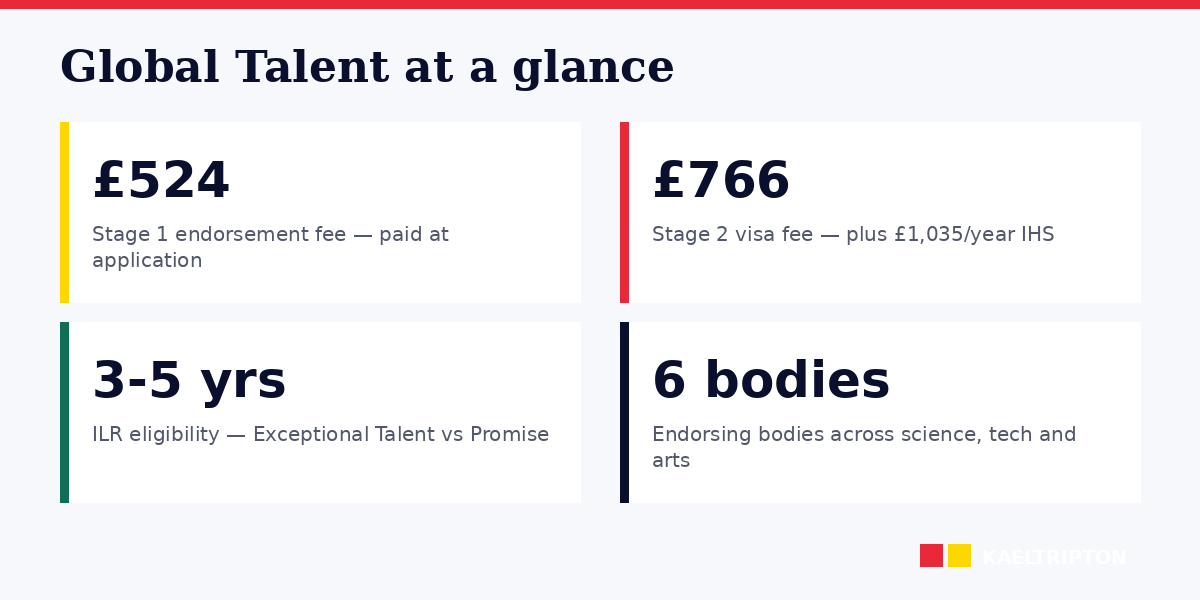
The UK Global Talent Visa is the most flexible UK immigration route for high-achievers in science, engineering, medicine, humanities, digital technology, or arts and culture. No sponsor required, no salary threshold, no English language test. The structure: obtain endorsement from one of 6 designated bodies (£524 fee), then apply for the visa itself (£766). Choose Exceptional Talent for established leaders (ILR in 3 years) or Exceptional Promise for early-career talent (ILR in 5 years). 2026 updates include expansion of prestigious prizes list, new design category from March 2026, and faster processing for AI and cybersecurity applications. This guide covers the full 2026 process with realistic expectations on evidence and processing times.
| ★ EDITOR'S VERDICT Global Talent is the cheapest flexible UK visa - if you can evidence excellence. |
No sponsor, no salary threshold, no English test. £524 endorsement plus £766 visa - materially cheaper than Skilled Worker. ILR in 3 years if Exceptional Talent, 5 for Promise. The bar is evidence of achievement - three substantive recommendation letters, 10-piece portfolio, and a sector-aligned endorsing body that recognises the work. AI and cybersecurity applications get fast-tracked to 3 weeks. Prestigious prizes let you skip endorsement entirely. For researchers, founders, and senior tech/arts leaders, this is the flexibility route - no employer dependency. |
UK visa fees: key facts (checked 16 October 2026) Current Home Office fees (most rose on 8 April 2026). Fees are per person and paid when you apply; the health surcharge is paid on top for each year of the visa.
|
Who can apply
The Global Talent Visa is open to individuals in six sectors, each assessed by a designated endorsing body:
- Science, medicine, engineering, humanities, social sciences - assessed by the Royal Society, Royal Academy of Engineering, British Academy, or UK Research and Innovation (UKRI)
- Digital technology - assessed through the Home Office Tech Nation endorsement process (simplified August 2025 - applications now use the standard Stage 1 endorsement form on GOV.UK)
- Arts and culture - assessed by Arts Council England (with sub-endorsements by the British Fashion Council for fashion, Royal Institute of British Architects for architecture, Producers Alliance for Cinema and Television for film and TV; design category added March 2026)
What makes Global Talent distinct from other UK work visas:
- No job offer needed. You can be self-employed, a founder, or work for any UK employer - or multiple employers simultaneously.
- No sponsor licence required. Employers don't need to hold a Skilled Worker sponsor licence. No Certificate of Sponsorship. No Immigration Skills Charge.
- No salary threshold. The Skilled Worker £41,700 minimum doesn't apply. You could work for a startup at £35,000 or be self-employed at £20,000 - still eligible.
- No English language test. Unlike most visa routes.
- Flexible visa length. Choose any duration from 1 to 5 years initially. Unlimited extensions possible.
- No maximum stay. Can extend indefinitely before reaching ILR.
Exceptional Talent vs Exceptional Promise
Endorsement applications are assessed at one of two levels, which determines ILR timing:
Exceptional Talent
For established leaders already recognised in their field. Typical evidence:
- Senior roles at reputable organisations
- International awards or prestigious prizes
- High-impact publications, patents, or widely-cited research
- Keynote speaking engagements at major events
- Significant contributions to successful products or initiatives
- Media coverage in respected international publications
Path to ILR: 3 years of continuous UK residence under the visa.
Exceptional Promise
For early-career individuals (typically less than 5 years post-initial career stage) showing potential to become leaders. Typical evidence:
- Emerging track record with strong trajectory
- Notable awards or recognition at early career level
- Growing impact in the field
- Letters demonstrating likely future leadership
Path to ILR: 5 years of continuous UK residence under the visa.
Critical note: you apply for one level. Endorsing bodies sometimes offer Promise when Talent was requested (not considered a rejection but a redirection), but not the other way round. Choose carefully - Talent's 3-year ILR is valuable, but failed Talent applications delay the whole process.
The application sequence
Stage 1: Endorsement
You apply to the Home Office, which refers your case to the relevant endorsing body. Fees for 2026:
- Endorsement fee: £524 (payable to Home Office at application)
- Processing time: 8 weeks typical; 3-4 weeks for AI/cybersecurity applications; 14 working days for fast-track routes at science bodies
Evidence required (varies by sector, common elements):
- Full CV covering career history
- 3 letters of recommendation from senior professionals - must be substantive, not copy-paste templates
- Personal statement explaining planned UK contribution
- Portfolio of 10 distinct achievements (media mentions, awards, patents, publications, citations, project outcomes)
- Identity documents and professional qualifications
Stage 2: Visa application
Once endorsed, you have 3 months to apply for the visa itself:
- Visa application fee: £192 standard (or £716 if applying via Prestigious Prize bypass route)
- Stage 1 + Stage 2 combined typical total: £524 + £192 = £716 in application fees (without IHS)
- Immigration Health Surcharge: £1,035 per year of visa (5 years = £5,175)
- Total 5-year Global Talent visa: roughly £5,900 in government fees - compared to £10,000+ for 5-year Skilled Worker
Prestigious prize route: skip the endorsement
If you hold one of the prestigious prizes listed in Appendix Global Talent of the Immigration Rules, you can skip Stage 1 entirely and apply directly for the visa at £716. Examples of qualifying prizes:
- Nobel Prize
- Fields Medal (mathematics)
- Turing Award (computer science)
- Academy Awards (film/TV)
- Grammy, Tony, Emmy awards
- Olivier Awards (theatre)
- Polar Music Prize
- Dozens more across science, arts, tech
October 2025 and March 2026 expansions broadened the list further, particularly in architecture, design, and creative awards. The full current list is at gov.uk/global-talent-prestigious-prize.
No time limit on when the prize was won - a scientist who won a relevant prize 15 years ago still qualifies. The Home Office verifies the prize award rather than reassessing your career portfolio.
The 6 endorsing bodies explained
Royal Society
Natural and medical sciences. Common disciplines: physics, chemistry, biology, neuroscience, medicine, clinical research. Fast-track for UK research institution appointments, eligible fellowships held within the last 5 years, or UKRI-endorsed funder grants.
Royal Academy of Engineering
Engineering in all its disciplines. Chemical, civil, electrical, mechanical, aerospace, software engineering (when academic rather than industry). Fast-track for academic/research appointments or individual fellowships.
British Academy
Humanities and social sciences. History, philosophy, economics, sociology, linguistics, literature, political science. Fast-track routes similar to the other academic bodies.
UK Research and Innovation (UKRI)
Cross-discipline. Fast-track only - applicants must be hosted or employed at a UKRI-approved research organisation and named in a successful grant application from an endorsed funder.
Tech Nation (Home Office digital technology endorsement)
Digital technology, AI, cybersecurity, fintech, gaming. Assessed through the standard Home Office Stage 1 endorsement form on GOV.UK since the August 2025 process simplification. Fast processing for AI and cybersecurity roles (3 weeks vs standard 5-8).
Arts Council England (with sub-endorsers)
Combined arts, dance, literature, music, theatre, visual arts. Sub-endorsements via the British Fashion Council (fashion), RIBA (architecture), PACT (film/TV). March 2026 changes added design industry professionals.
Processing times in 2026
- Endorsement standard (Tech Nation, Arts Council England): 5-8 weeks
- Endorsement fast-track (Royal Society, Royal Academy of Engineering, British Academy): 14 working days
- Endorsement priority (AI/cybersecurity): 3 weeks
- Visa application (Stage 2) standard: 3 weeks from biometric appointment
- Visa application Priority Service: £500 for 5-day decision
- Endorsement Review (if refused): 28 calendar days typical
Global Talent applications benefit from being the Home Office's showcase route - processing is generally faster and less bureaucratic than Skilled Worker. Endorsing bodies are specialist reviewers focused on the sector, not the Home Office's general case processing.
A real 2026 scenario: AI researcher from Stanford to Oxford
A 31-year-old Indian AI researcher at Stanford with 4 years post-PhD experience, 8 published papers on large language models, a fellowship from the Simons Foundation, and multiple conference keynotes. Offered a senior research role at Oxford's Department of Computer Science.
March 2026. Confirms Exceptional Promise is the appropriate level (4 years post-PhD = early career). Chooses Tech Nation route given AI focus and non-academic emphasis. Gathers evidence: CV, 3 letters from senior AI researchers at Stanford/DeepMind/MIT, personal statement, portfolio of 10 pieces (papers, citations, media coverage of papers, keynote videos, patent pending).
April 2026. Submits Stage 1 endorsement application via GOV.UK. Fee £524. Priority processing applies because AI discipline qualifies. Decision arrives in 22 days: endorsed under Exceptional Promise.
May 2026. Applies for Stage 2 visa. Chooses 5-year duration. Fee £192 + IHS £1,035 × 5 = £5,175. Total Stage 2 cost: £5,367. Biometric appointment at UKVCAS Croydon. Priority Service £500 for 5-day decision.
Late May 2026. Visa granted. 5 years to run. eVisa issued. No CoS, no sponsor, no ISC. Flexibility to work at Oxford, consult for industry, or found a UK company - no visa changes needed.
Total spent: £524 + £5,367 + £500 = £6,391. Comparable Skilled Worker 5-year visa: £1,420 + £525 CoS + £5,000 ISC + £5,175 IHS = £12,120. Global Talent saves approximately £5,700 and removes employer dependency. Path to ILR: April 2031 under Exceptional Promise rules.
When Global Talent might not be the right choice
Despite the advantages, Global Talent isn't always optimal:
- If the endorsement is unlikely: failed endorsements are a sunk cost. Applicants without strong objective evidence risk £524 and 8 weeks with nothing to show.
- If you already have a sponsor offer: Skilled Worker might be simpler even if more expensive. Depends on employer preference.
- If you're very early career: Exceptional Promise requires demonstrable emerging excellence. Truly junior applicants are better placed on Skilled Worker or specific specialist routes.
- If you need fast start: 8-week endorsement + 3-week visa = 11+ weeks minimum. Skilled Worker with priority can be faster.
Frequently asked questions
Can I apply for Global Talent without a UK job offer?
Yes. No job offer required. You can apply from abroad or in-country on any eligible current visa. Many applicants apply before even searching for UK work - once granted the visa, they're free to take any work, start a business, or be self-employed.
How long does endorsement take?
5-8 weeks standard. 14 working days for fast-track academic routes (Royal Society, Royal Academy of Engineering, British Academy). 3 weeks for AI and cybersecurity priority processing. Fast-track peer review by science bodies is typically the fastest route.
Can I work for any employer on Global Talent?
Yes. No sponsor required. You can work full-time, part-time, freelance, self-employed, or start a business. You can change employers freely. You can take unpaid work or volunteer roles. The visa is deliberately flexible to attract talent.
Is Global Talent cheaper than Skilled Worker?
Yes, usually. Global Talent 5-year total is around £5,900-£6,400 including endorsement, visa, and IHS. Skilled Worker 5-year total is around £10,000-£12,000 including sponsor costs. Global Talent also has no Immigration Skills Charge (£1,000/year for large employers on Skilled Worker).
Can I switch from Skilled Worker to Global Talent?
Yes, in-country switch is allowed. Apply for endorsement while on Skilled Worker; if successful, apply for Global Talent visa. The switch frees you from employer dependency and reduces total costs over long periods.
Do I need a PhD to apply?
No. Global Talent assesses achievement and impact, not qualifications. Tech Nation applications frequently succeed without PhDs for self-taught engineers and founders with demonstrable product impact. Arts applicants may have no formal qualifications - creative output and recognition are what matter.
What's the success rate of Global Talent endorsement?
Varies significantly by body and sector. Tech Nation historically around 40-60% success depending on application strength. Science bodies with fast-track routes are often higher (70%+). Arts Council varies by sub-endorser. Competent applications with strong evidence succeed at meaningfully higher rates than the average.
Sources
- GOV.UK, Global Talent visa - gov.uk/global-talent
- Immigration Rules, Appendix Global Talent
- Home Office, Global Talent caseworker guidance (February 2026)
- Royal Society, Royal Academy of Engineering, British Academy - endorsement guidance pages
- UK Research and Innovation (UKRI) - endorsed funder lists
- Arts Council England - Global Talent visa guidance
- Home Office, Prestigious prizes list for Global Talent (updated October 2025 and March 2026)


