UK Salary Calculator 2026: Take-Home Pay After Tax for Every Salary
Free UK salary calculator for 2026/27 plus a full table of take-home pay for every salary from £20,000 to £200,000, with Scotland and 2025/26 tabs, student loan and pension options. HMRC and Scottish Government rates.
307 pages indexed in this hub · core guides are listed below · updated automatically as new guides publish
UK SALARY · CALCULATOR AND TAKE-HOME TABLES 2026/27
In 2026/27 UK take-home pay is gross salary minus Income Tax (20% on the first £37,700 of taxable income, 40% to £125,140, 45% above, after a £12,570 personal allowance) and employee National Insurance (8% from £12,571 to £50,270, 2% above). A £35,000 salary takes home £28,720; £50,000 takes home £39,520. Scotland uses six bands. Source: HMRC.
TL;DR
Use the calculator for any salary, region, student loan plan and pension rate
The table below lists take-home for every salary from £20,000 to £200,000; each row links to a full breakdown
Scotland and 2025/26 tables are one tab away
Rates from HMRC and the Scottish Government; refreshed each April
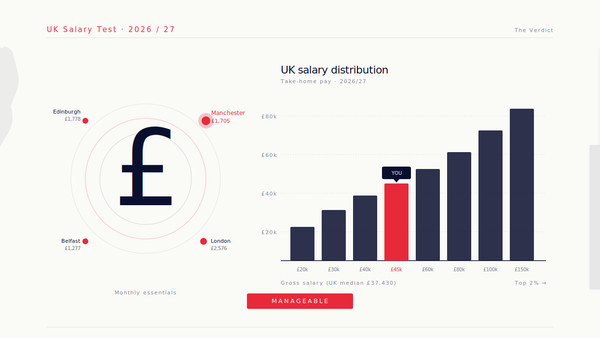
Salary calculator ·2026/27
Take-home pay for every salary, £20,000 to £200,000
Every row below is calculated from the 2026/27 HMRC rates on a 1257L tax code with no pension or student loan; click a salary for the monthly, weekly and hourly breakdown, the Scottish figure and the student-loan and pension scenarios.
Income Tax is charged on income above the personal allowance in bands, National Insurance is charged separately on earnings above the primary threshold, and student loan repayments and pension contributions come off through PAYE. The thresholds:
Element
Range (2026/27)
Rate
Personal Allowance
up to £12,570
0%
Basic rate
taxable income up to £37,700 (£50,270 gross on a standard code)
20%
Higher rate
taxable income £37,701 to £125,140
40%
Additional rate
taxable income over £125,140
45%
PA taper
£1 lost per £2 over £100,000
60% effective
Employee NI
£12,571 to £50,270
8%
Employee NI
over £50,270
2%
Scotland
Scottish taxpayers pay Income Tax in six bands set by the Scottish Parliament (19%, 20%, 21%, 42%, 45% and 48% in 2026/27), while National Insurance and the personal allowance are UK-wide. The Scotland tab above gives every salary; the difference at £50,000 is £-1,528 a year.
Student loans and pensions
Student loan deductions are 9% of pay above the plan threshold (6% for Postgraduate), and pension contributions reduce taxable pay, so both change the figures in the table. Each salary page shows all five plans and five pension rates. See the Plan 5 repayment guide for the newest plan.
Disclaimer. Figures are calculated from published 2026/27 rates on a standard tax code and are for information only; payslips vary with tax codes, benefits, salary sacrifice and other deductions. Not tax advice.
How much is £30,000 after tax?
£25,120 a year or £2,093 a month in England, Wales and Northern Ireland in 2026/27.
How much is £50,000 after tax?
£39,520 a year or £3,293 a month; £50,000 sits just under the 40% higher-rate threshold of £50,270.
How much is £100,000 after tax?
£68,557 a year; above £100,000 the personal allowance is withdrawn at £1 for every £2, producing a 60% effective rate up to £125,140.
Why is my take-home different from the table?
Tax codes other than 1257L, benefits in kind, salary sacrifice, multiple jobs and pension arrangements all change PAYE deductions; the table assumes none of these.
When do the rates change?
UK rates and thresholds are set at the Budget and apply from 6 April; Scottish rates are set in the Scottish Budget. This page is refreshed each April.
What is the take-home pay after tax on a 99k salary in the UK?
A £99,000 salary in England, Wales or Northern Ireland takes home £67,977 a year in 2026/27, after £27,032 Income Tax and £3,991 National Insurance. That is £5,665 per month and £1,307 per week, an effective rate of 31.3%. The page table uses HMRC rates on a 1257L tax code with no pension or student loan.
Almost 80,000 people started a job last November, according to HMRC, which is urging Christmas job starters to use its app to find the tax code and National Insurance details needed on new starter forms.
The minimum wage for 18 year olds is £10.85 an hour from 1 April 2026, up from £10.00. The rate covers ages 18 to 20. Apprentices aged 18 get £8.00 an hour.
The apprentice minimum wage is £8.00 an hour from 1 April 2026. Apprentices aged 19 or over who have finished their first year get the rate for their age: £10.85 at 19 to 20 and £12.71 at 21 and over.
JLR will cut around 4,000 roles over two years via voluntary redundancy, targeting £1.7bn of savings. How voluntary terms differ from statutory redundancy, and how the payment is taxed.
658 employers were named on 3 September 2026 for minimum wage underpayment, returning around £4m to over 27,000 workers. How to check your own pay and claim arrears.
HMRC is manually checking 107,000 tax calculations from 2025-26 after a five-year-old allowance ordering fault. Who is affected, how to check a calculation and how to reclaim an overpayment.
£199,000 after tax is £117,256 a year or £9,771 a month in England, Wales and Northern Ireland (2026/27), after £75,753 Income Tax and £5,991 National Insurance. In Scotland: £9,155 a month.
£198,000 after tax is £116,726 a year or £9,727 a month in England, Wales and Northern Ireland (2026/27), after £75,303 Income Tax and £5,971 National Insurance. In Scotland: £9,113 a month.
£197,000 after tax is £116,196 a year or £9,683 a month in England, Wales and Northern Ireland (2026/27), after £74,853 Income Tax and £5,951 National Insurance. In Scotland: £9,071 a month.
£196,000 after tax is £115,666 a year or £9,639 a month in England, Wales and Northern Ireland (2026/27), after £74,403 Income Tax and £5,931 National Insurance. In Scotland: £9,030 a month.
£194,000 after tax is £114,606 a year or £9,551 a month in England, Wales and Northern Ireland (2026/27), after £73,503 Income Tax and £5,891 National Insurance. In Scotland: £8,946 a month.
£193,000 after tax is £114,076 a year or £9,506 a month in England, Wales and Northern Ireland (2026/27), after £73,053 Income Tax and £5,871 National Insurance. In Scotland: £8,905 a month.
£192,000 after tax is £113,546 a year or £9,462 a month in England, Wales and Northern Ireland (2026/27), after £72,603 Income Tax and £5,851 National Insurance. In Scotland: £8,863 a month.
£191,000 after tax is £113,016 a year or £9,418 a month in England, Wales and Northern Ireland (2026/27), after £72,153 Income Tax and £5,831 National Insurance. In Scotland: £8,821 a month.
£189,000 after tax is £111,956 a year or £9,330 a month in England, Wales and Northern Ireland (2026/27), after £71,253 Income Tax and £5,791 National Insurance. In Scotland: £8,738 a month.
£188,000 after tax is £111,426 a year or £9,286 a month in England, Wales and Northern Ireland (2026/27), after £70,803 Income Tax and £5,771 National Insurance. In Scotland: £8,696 a month.
£187,000 after tax is £110,896 a year or £9,241 a month in England, Wales and Northern Ireland (2026/27), after £70,353 Income Tax and £5,751 National Insurance. In Scotland: £8,655 a month.
£186,000 after tax is £110,366 a year or £9,197 a month in England, Wales and Northern Ireland (2026/27), after £69,903 Income Tax and £5,731 National Insurance. In Scotland: £8,613 a month.
£184,000 after tax is £109,306 a year or £9,109 a month in England, Wales and Northern Ireland (2026/27), after £69,003 Income Tax and £5,691 National Insurance. In Scotland: £8,530 a month.
£183,000 after tax is £108,776 a year or £9,065 a month in England, Wales and Northern Ireland (2026/27), after £68,553 Income Tax and £5,671 National Insurance. In Scotland: £8,488 a month.
£182,000 after tax is £108,246 a year or £9,021 a month in England, Wales and Northern Ireland (2026/27), after £68,103 Income Tax and £5,651 National Insurance. In Scotland: £8,446 a month.
£181,000 after tax is £107,716 a year or £8,976 a month in England, Wales and Northern Ireland (2026/27), after £67,653 Income Tax and £5,631 National Insurance. In Scotland: £8,405 a month.
£179,000 after tax is £106,656 a year or £8,888 a month in England, Wales and Northern Ireland (2026/27), after £66,753 Income Tax and £5,591 National Insurance. In Scotland: £8,321 a month.
£178,000 after tax is £106,126 a year or £8,844 a month in England, Wales and Northern Ireland (2026/27), after £66,303 Income Tax and £5,571 National Insurance. In Scotland: £8,280 a month.
£177,000 after tax is £105,596 a year or £8,800 a month in England, Wales and Northern Ireland (2026/27), after £65,853 Income Tax and £5,551 National Insurance. In Scotland: £8,238 a month.
£176,000 after tax is £105,066 a year or £8,756 a month in England, Wales and Northern Ireland (2026/27), after £65,403 Income Tax and £5,531 National Insurance. In Scotland: £8,196 a month.
£174,000 after tax is £104,006 a year or £8,667 a month in England, Wales and Northern Ireland (2026/27), after £64,503 Income Tax and £5,491 National Insurance. In Scotland: £8,113 a month.
£173,000 after tax is £103,476 a year or £8,623 a month in England, Wales and Northern Ireland (2026/27), after £64,053 Income Tax and £5,471 National Insurance. In Scotland: £8,071 a month.
£172,000 after tax is £102,946 a year or £8,579 a month in England, Wales and Northern Ireland (2026/27), after £63,603 Income Tax and £5,451 National Insurance. In Scotland: £8,030 a month.
£171,000 after tax is £102,416 a year or £8,535 a month in England, Wales and Northern Ireland (2026/27), after £63,153 Income Tax and £5,431 National Insurance. In Scotland: £7,988 a month.
£169,000 after tax is £101,356 a year or £8,446 a month in England, Wales and Northern Ireland (2026/27), after £62,253 Income Tax and £5,391 National Insurance. In Scotland: £7,905 a month.
£168,000 after tax is £100,826 a year or £8,402 a month in England, Wales and Northern Ireland (2026/27), after £61,803 Income Tax and £5,371 National Insurance. In Scotland: £7,863 a month.
£167,000 after tax is £100,296 a year or £8,358 a month in England, Wales and Northern Ireland (2026/27), after £61,353 Income Tax and £5,351 National Insurance. In Scotland: £7,821 a month.
£166,000 after tax is £99,766 a year or £8,314 a month in England, Wales and Northern Ireland (2026/27), after £60,903 Income Tax and £5,331 National Insurance. In Scotland: £7,780 a month.
£164,000 after tax is £98,706 a year or £8,226 a month in England, Wales and Northern Ireland (2026/27), after £60,003 Income Tax and £5,291 National Insurance. In Scotland: £7,696 a month.
£163,000 after tax is £98,176 a year or £8,181 a month in England, Wales and Northern Ireland (2026/27), after £59,553 Income Tax and £5,271 National Insurance. In Scotland: £7,655 a month.
£162,000 after tax is £97,646 a year or £8,137 a month in England, Wales and Northern Ireland (2026/27), after £59,103 Income Tax and £5,251 National Insurance. In Scotland: £7,613 a month.
£161,000 after tax is £97,116 a year or £8,093 a month in England, Wales and Northern Ireland (2026/27), after £58,653 Income Tax and £5,231 National Insurance. In Scotland: £7,571 a month.
£159,000 after tax is £96,056 a year or £8,005 a month in England, Wales and Northern Ireland (2026/27), after £57,753 Income Tax and £5,191 National Insurance. In Scotland: £7,488 a month.
£158,000 after tax is £95,526 a year or £7,961 a month in England, Wales and Northern Ireland (2026/27), after £57,303 Income Tax and £5,171 National Insurance. In Scotland: £7,446 a month.
£157,000 after tax is £94,996 a year or £7,916 a month in England, Wales and Northern Ireland (2026/27), after £56,853 Income Tax and £5,151 National Insurance. In Scotland: £7,405 a month.
£156,000 after tax is £94,466 a year or £7,872 a month in England, Wales and Northern Ireland (2026/27), after £56,403 Income Tax and £5,131 National Insurance. In Scotland: £7,363 a month.
£154,000 after tax is £93,406 a year or £7,784 a month in England, Wales and Northern Ireland (2026/27), after £55,503 Income Tax and £5,091 National Insurance. In Scotland: £7,280 a month.
£153,000 after tax is £92,876 a year or £7,740 a month in England, Wales and Northern Ireland (2026/27), after £55,053 Income Tax and £5,071 National Insurance. In Scotland: £7,238 a month.
£152,000 after tax is £92,346 a year or £7,696 a month in England, Wales and Northern Ireland (2026/27), after £54,603 Income Tax and £5,051 National Insurance. In Scotland: £7,196 a month.
£151,000 after tax is £91,816 a year or £7,651 a month in England, Wales and Northern Ireland (2026/27), after £54,153 Income Tax and £5,031 National Insurance. In Scotland: £7,155 a month.
£149,000 after tax is £90,756 a year or £7,563 a month in England, Wales and Northern Ireland (2026/27), after £53,253 Income Tax and £4,991 National Insurance. In Scotland: £7,071 a month.
£148,000 after tax is £90,226 a year or £7,519 a month in England, Wales and Northern Ireland (2026/27), after £52,803 Income Tax and £4,971 National Insurance. In Scotland: £7,030 a month.
£147,000 after tax is £89,696 a year or £7,475 a month in England, Wales and Northern Ireland (2026/27), after £52,353 Income Tax and £4,951 National Insurance. In Scotland: £6,988 a month.
£146,000 after tax is £89,166 a year or £7,431 a month in England, Wales and Northern Ireland (2026/27), after £51,903 Income Tax and £4,931 National Insurance. In Scotland: £6,946 a month.
£144,000 after tax is £88,106 a year or £7,342 a month in England, Wales and Northern Ireland (2026/27), after £51,003 Income Tax and £4,891 National Insurance. In Scotland: £6,863 a month.
£143,000 after tax is £87,576 a year or £7,298 a month in England, Wales and Northern Ireland (2026/27), after £50,553 Income Tax and £4,871 National Insurance. In Scotland: £6,821 a month.
£142,000 after tax is £87,046 a year or £7,254 a month in England, Wales and Northern Ireland (2026/27), after £50,103 Income Tax and £4,851 National Insurance. In Scotland: £6,780 a month.
£141,000 after tax is £86,516 a year or £7,210 a month in England, Wales and Northern Ireland (2026/27), after £49,653 Income Tax and £4,831 National Insurance. In Scotland: £6,738 a month.
£139,000 after tax is £85,456 a year or £7,121 a month in England, Wales and Northern Ireland (2026/27), after £48,753 Income Tax and £4,791 National Insurance. In Scotland: £6,655 a month.
£138,000 after tax is £84,926 a year or £7,077 a month in England, Wales and Northern Ireland (2026/27), after £48,303 Income Tax and £4,771 National Insurance. In Scotland: £6,613 a month.
£137,000 after tax is £84,396 a year or £7,033 a month in England, Wales and Northern Ireland (2026/27), after £47,853 Income Tax and £4,751 National Insurance. In Scotland: £6,571 a month.
£136,000 after tax is £83,866 a year or £6,989 a month in England, Wales and Northern Ireland (2026/27), after £47,403 Income Tax and £4,731 National Insurance. In Scotland: £6,530 a month.
£134,000 after tax is £82,806 a year or £6,901 a month in England, Wales and Northern Ireland (2026/27), after £46,503 Income Tax and £4,691 National Insurance. In Scotland: £6,446 a month.
£133,000 after tax is £82,276 a year or £6,856 a month in England, Wales and Northern Ireland (2026/27), after £46,053 Income Tax and £4,671 National Insurance. In Scotland: £6,405 a month.
£132,000 after tax is £81,746 a year or £6,812 a month in England, Wales and Northern Ireland (2026/27), after £45,603 Income Tax and £4,651 National Insurance. In Scotland: £6,363 a month.
£131,000 after tax is £81,216 a year or £6,768 a month in England, Wales and Northern Ireland (2026/27), after £45,153 Income Tax and £4,631 National Insurance. In Scotland: £6,321 a month.
£129,000 after tax is £80,156 a year or £6,680 a month in England, Wales and Northern Ireland (2026/27), after £44,253 Income Tax and £4,591 National Insurance. In Scotland: £6,238 a month.
£128,000 after tax is £79,626 a year or £6,636 a month in England, Wales and Northern Ireland (2026/27), after £43,803 Income Tax and £4,571 National Insurance. In Scotland: £6,196 a month.
£127,000 after tax is £79,096 a year or £6,591 a month in England, Wales and Northern Ireland (2026/27), after £43,353 Income Tax and £4,551 National Insurance. In Scotland: £6,155 a month.
£126,000 after tax is £78,566 a year or £6,547 a month in England, Wales and Northern Ireland (2026/27), after £42,903 Income Tax and £4,531 National Insurance. In Scotland: £6,113 a month.
£124,000 after tax is £77,677 a year or £6,473 a month in England, Wales and Northern Ireland (2026/27), after £41,832 Income Tax and £4,491 National Insurance. In Scotland: £6,048 a month.
£123,000 after tax is £77,297 a year or £6,441 a month in England, Wales and Northern Ireland (2026/27), after £41,232 Income Tax and £4,471 National Insurance. In Scotland: £6,023 a month.
£122,000 after tax is £76,917 a year or £6,410 a month in England, Wales and Northern Ireland (2026/27), after £40,632 Income Tax and £4,451 National Insurance. In Scotland: £5,997 a month.
£121,000 after tax is £76,537 a year or £6,378 a month in England, Wales and Northern Ireland (2026/27), after £40,032 Income Tax and £4,431 National Insurance. In Scotland: £5,972 a month.
£119,000 after tax is £75,777 a year or £6,315 a month in England, Wales and Northern Ireland (2026/27), after £38,832 Income Tax and £4,391 National Insurance. In Scotland: £5,921 a month.
£118,000 after tax is £75,397 a year or £6,283 a month in England, Wales and Northern Ireland (2026/27), after £38,232 Income Tax and £4,371 National Insurance. In Scotland: £5,896 a month.
£117,000 after tax is £75,017 a year or £6,251 a month in England, Wales and Northern Ireland (2026/27), after £37,632 Income Tax and £4,351 National Insurance. In Scotland: £5,870 a month.
£116,000 after tax is £74,637 a year or £6,220 a month in England, Wales and Northern Ireland (2026/27), after £37,032 Income Tax and £4,331 National Insurance. In Scotland: £5,845 a month.
£114,000 after tax is £73,877 a year or £6,156 a month in England, Wales and Northern Ireland (2026/27), after £35,832 Income Tax and £4,291 National Insurance. In Scotland: £5,794 a month.
£113,000 after tax is £73,497 a year or £6,125 a month in England, Wales and Northern Ireland (2026/27), after £35,232 Income Tax and £4,271 National Insurance. In Scotland: £5,769 a month.
£112,000 after tax is £73,117 a year or £6,093 a month in England, Wales and Northern Ireland (2026/27), after £34,632 Income Tax and £4,251 National Insurance. In Scotland: £5,743 a month.
£111,000 after tax is £72,737 a year or £6,061 a month in England, Wales and Northern Ireland (2026/27), after £34,032 Income Tax and £4,231 National Insurance. In Scotland: £5,718 a month.
£109,000 after tax is £71,977 a year or £5,998 a month in England, Wales and Northern Ireland (2026/27), after £32,832 Income Tax and £4,191 National Insurance. In Scotland: £5,667 a month.
£108,000 after tax is £71,597 a year or £5,966 a month in England, Wales and Northern Ireland (2026/27), after £32,232 Income Tax and £4,171 National Insurance. In Scotland: £5,641 a month.
£107,000 after tax is £71,217 a year or £5,935 a month in England, Wales and Northern Ireland (2026/27), after £31,632 Income Tax and £4,151 National Insurance. In Scotland: £5,616 a month.
£106,000 after tax is £70,837 a year or £5,903 a month in England, Wales and Northern Ireland (2026/27), after £31,032 Income Tax and £4,131 National Insurance. In Scotland: £5,591 a month.
£104,000 after tax is £70,077 a year or £5,840 a month in England, Wales and Northern Ireland (2026/27), after £29,832 Income Tax and £4,091 National Insurance. In Scotland: £5,540 a month.
£103,000 after tax is £69,697 a year or £5,808 a month in England, Wales and Northern Ireland (2026/27), after £29,232 Income Tax and £4,071 National Insurance. In Scotland: £5,514 a month.
£102,000 after tax is £69,317 a year or £5,776 a month in England, Wales and Northern Ireland (2026/27), after £28,632 Income Tax and £4,051 National Insurance. In Scotland: £5,489 a month.
£101,000 after tax is £68,937 a year or £5,745 a month in England, Wales and Northern Ireland (2026/27), after £28,032 Income Tax and £4,031 National Insurance. In Scotland: £5,464 a month.
GCSE results day 2026 is 20 August. Key facts: resit rules, bursary, free school meals from 2026, and appeals. The 7,400 pounds threshold still matters for pupil premium.
HMRC app usage data shows 5.6 million users this tax year, checking pay before payday an average of 18 times, alongside sharp growth in State Pension forecast and Child Benefit checks.
30.3 million payrolled employees in May 2026, down 119,000 year on year. Median monthly pay GBP 2,626, up 4.6%. Health sector leads pay growth at +7.0%; finance lowest at +1.8%. Full breakdown by sector, age and region from ONS/HMRC June 2026 bulletin.
UK income tax personal allowance frozen at 12,570 pounds since April 2021 until April 2028. ~1.5m extra workers drawn into tax since 2021 (IFS). ~700,000 more into higher rate. If inflation-uprated, allowance would be ~15,750 pounds. HMRC and IFS sources.
UK nominal regular pay grew 3.4% in February to April 2026. Real regular pay is just +0.1% after CPIH inflation of 3.0%. Prices have risen 27.3% cumulatively since 2021. Frozen tax thresholds add further stealth pressure. Primary sources: ONS, HMRC.
UK nominal regular pay grew 3.4% in February to April 2026, lowest since Aug-Oct 2020. Real regular pay grew just 0.1% (CPIH-adjusted). AWE: 697 pounds/week regular. ONS data updated monthly.
Earned Wage Access lets employees draw a portion of already-earned wages before payday. The FCA concluded in 2022 these schemes are not consumer credit and fall outside FCA regulation, though Consumer Duty and CIPP Code of Practice apply. This guide covers how schemes work, costs, HMRC reporting, an
Marriage Allowance lets a non-taxpaying spouse transfer 1,260 pounds of Personal Allowance to their partner, saving up to 252 pounds a year in 2026/27. Backdate four years for over 1,000 pounds. Claim free on GOV.UK.
Self Assessment tax return deadlines for 2025/26: register by 5 October 2026, online return by 31 January 2027. Full guide to who must file, deadlines, penalties and Making Tax Digital.
How UK student loan repayments work once you start earning: repayment plans, the income threshold, how it is collected, and when the loan is written off.
The highest paying occupations in the UK by ONS ASHE 2024 median earnings data -- from medical consultants and pilots to lawyers, actuaries and IT directors.
Use the calculator to estimate your child s maintenance loan for 2025/26. Amounts by living situation, income thresholds and repayment after graduation explained.
Around 71,000 UK graduates with Plan 2 student loans received incorrect balance calculations after two technical errors involving HMRC income data. Some 41,000 were overcharged; 30,000 now face higher balances after being undercharged. No compensation will be paid.
AO World has moved 150 sales and call-centre roles to South Africa, with 50 more expected to follow. Founder John Roberts cited higher National Insurance contributions and minimum wage increases adding 8.5 million pounds to costs. The company reported record profits of 50.5 million pounds.
UK job vacancies fell to 707,000 in the March to May 2026 period, the lowest level since February to April 2021, according to ONS data published today. New hires tracked by HMRC dropped to 540,000 in April 2026, also the lowest since March 2021.
HMRC's Approved Mileage Allowance Payment rate for cars and vans has risen from 45p to 55p per mile for the first 10,000 business miles, backdated to 6 April 2026. The first increase in 15 years affects up to 3 million employees and self-employed people.
Pro rata salary is calculated by dividing the full-time equivalent salary by the number of full-time hours and multiplying by the hours actually worked. It applies equally to annual leave, pension contributions and other benefits.
The NHS Low Income Scheme helps people on low incomes get help with health costs including prescriptions, dental treatment, eye tests and hospital travel. Apply using form HC1 to receive an HC2 or HC3 certificate.
Around 2 million pensioners with income over £35,000 face automatic repayment of their Winter Fuel Payment through adjusted tax codes from April 2026. Here is how it works.
UK salary statistics sourced from ONS ASHE, ONS Average Weekly Earnings, HMRC personal incomes data and the statutory wage rates: median full-time pay, earnings growth, regional and sector breakdowns, income distribution and minimum wage.
Child Benefit rates for 2026, who qualifies, the High Income Child Benefit Charge threshold and taper, the importance of National Insurance credits for non-working parents and how to claim.
ONS ASHE data provides the most authoritative source on UK salary levels by occupation. This guide covers median salaries for major UK professions based on the latest available ONS data.
Living costs vary significantly across UK cities. This guide compares housing, transport and everyday costs across major UK cities using ONS and official data to show where salaries stretch furthest.
The UK National Living Wage and National Minimum Wage rates changed in April 2026. This guide covers current rates by age group, who qualifies, exemptions and how HMRC enforces compliance.
OECD forecasts 5.5 percent UK unemployment by end 2026, the steepest rise in the G7. The practical guide to your statutory redundancy entitlements and Universal Credit.
Ramit Sethi delivers a six-week programme for automating your finances, eliminating guilt about spending, and building wealth on any salary. The second edition updates the advice for the current interest rate and investment environment.
The approved mileage allowance payment rate for cars and vans has risen from 45p to 55p per mile, backdated to 6 April 2026. Here is what employees, employers and the self-employed need to know.
UK tax refunds arise from emergency tax codes, multiple jobs, leaving employment mid-year, pension drawdown, or work-related expense claims. This guide covers the main routes: PAYE auto-refund, P50, P55, Self-Assessment, and the four-year backdating window.
UK take-home pay is gross salary less income tax, National Insurance, pension, student loan and other deductions. This guide walks through each deduction with formulas, three worked examples, and the order in which payroll software applies them.
A UK payslip lists every deduction from gross pay to net pay. This guide walks through each common line: PAYE, NI, pension, student loan, salary sacrifice. Statutory requirements under section 8 Employment Rights Act 1996.
A UK payslip lists every deduction from gross to net pay. This guide explains each common line: PAYE, NI, pension, student loan, court orders, salary sacrifice, and benefits. Includes year-to-date columns and what to query.
PAYE is the system HMRC uses to collect income tax and NI from employed earnings at source. Employers calculate and deduct each pay period using tax codes, then remit to HMRC monthly. This guide covers RTI, tax codes, and end-of-year reconciliation.
A P45 is issued when you leave a job, a P60 by 31 May for anyone employed on 5 April, and a P11D by 6 July for company benefits. Each form supports refunds, loan applications and new jobs.
Basic-rate dividend tax went from 8.75% to 10.75% on 6 April 2026, higher rate from 33.75% to 35.75%. Worked examples for £30K, £50K, £80K and £120K dividend takers, with the cash impact spelled out and the planning levers that remain.
£175,000 after tax is £104,536 a year or £8,711 a month in England, Wales and Northern Ireland (2026/27), after £64,953 Income Tax and £5,511 National Insurance. In Scotland: £8,155 a month.
£140,000 after tax is £85,986 a year or £7,166 a month in England, Wales and Northern Ireland (2026/27), after £49,203 Income Tax and £4,811 National Insurance. In Scotland: £6,696 a month.
£58,000 after tax is £44,197 a year or £3,683 a month in England, Wales and Northern Ireland (2026/27), after £10,632 Income Tax and £3,171 National Insurance. In Scotland: £3,541 a month.
£56,000 after tax is £43,037 a year or £3,586 a month in England, Wales and Northern Ireland (2026/27), after £9,832 Income Tax and £3,131 National Insurance. In Scotland: £3,447 a month.
£54,000 after tax is £41,877 a year or £3,490 a month in England, Wales and Northern Ireland (2026/27), after £9,032 Income Tax and £3,091 National Insurance. In Scotland: £3,354 a month.
£52,000 after tax is £40,717 a year or £3,393 a month in England, Wales and Northern Ireland (2026/27), after £8,232 Income Tax and £3,051 National Insurance. In Scotland: £3,261 a month.
An estimated 1 in 3 UK employees has the wrong tax code at some point. A wrong code means overpaying or underpaying income tax -- HMRC can refund overpayments going back 4 years. Check yours free in 5 minutes at gov.uk/personal-tax-account.
With the May bank holidays upon us, millions of workers are unclear on their legal entitlement. There is no automatic right to paid bank holidays - but your contract and employment status determine what you are owed.
Salary sacrifice for pension contributions saves both you and your employer National Insurance. If you earn £35,000 and sacrifice £3,000 into your pension, you save £360 in NI contributions and your employer saves £414. This HMRC-validated guide explains the mechanics, the benefits and the catc
£195,000 after tax is £115,136 a year or £9,595 a month in England, Wales and Northern Ireland (2026/27), after £73,953 Income Tax and £5,911 National Insurance. In Scotland: £8,988 a month.
£190,000 after tax is £112,486 a year or £9,374 a month in England, Wales and Northern Ireland (2026/27), after £71,703 Income Tax and £5,811 National Insurance. In Scotland: £8,780 a month.
£185,000 after tax is £109,836 a year or £9,153 a month in England, Wales and Northern Ireland (2026/27), after £69,453 Income Tax and £5,711 National Insurance. In Scotland: £8,571 a month.
£180,000 after tax is £107,186 a year or £8,932 a month in England, Wales and Northern Ireland (2026/27), after £67,203 Income Tax and £5,611 National Insurance. In Scotland: £8,363 a month.
£170,000 after tax is £101,886 a year or £8,491 a month in England, Wales and Northern Ireland (2026/27), after £62,703 Income Tax and £5,411 National Insurance. In Scotland: £7,946 a month.
£165,000 after tax is £99,236 a year or £8,270 a month in England, Wales and Northern Ireland (2026/27), after £60,453 Income Tax and £5,311 National Insurance. In Scotland: £7,738 a month.
£160,000 after tax is £96,586 a year or £8,049 a month in England, Wales and Northern Ireland (2026/27), after £58,203 Income Tax and £5,211 National Insurance. In Scotland: £7,530 a month.
£155,000 after tax is £93,936 a year or £7,828 a month in England, Wales and Northern Ireland (2026/27), after £55,953 Income Tax and £5,111 National Insurance. In Scotland: £7,321 a month.
£145,000 after tax is £88,636 a year or £7,386 a month in England, Wales and Northern Ireland (2026/27), after £51,453 Income Tax and £4,911 National Insurance. In Scotland: £6,905 a month.
£135,000 after tax is £83,336 a year or £6,945 a month in England, Wales and Northern Ireland (2026/27), after £46,953 Income Tax and £4,711 National Insurance. In Scotland: £6,488 a month.
£115,000 after tax is £74,257 a year or £6,188 a month in England, Wales and Northern Ireland (2026/27), after £36,432 Income Tax and £4,311 National Insurance. In Scotland: £5,819 a month.
£105,000 after tax is £70,457 a year or £5,871 a month in England, Wales and Northern Ireland (2026/27), after £30,432 Income Tax and £4,111 National Insurance. In Scotland: £5,565 a month.
£300,000 after tax is £170,786 a year or £14,232 a month in England, Wales and Northern Ireland (2026/27), after £121,203 Income Tax and £8,011 National Insurance. In Scotland: £13,363 a month.
£250,000 after tax is £144,286 a year or £12,024 a month in England, Wales and Northern Ireland (2026/27), after £98,703 Income Tax and £7,011 National Insurance. In Scotland: £11,280 a month.
£130,000 after tax is £80,686 a year or £6,724 a month in England, Wales and Northern Ireland (2026/27), after £44,703 Income Tax and £4,611 National Insurance. In Scotland: £6,280 a month.
£95,000 after tax is £65,657 a year or £5,471 a month in England, Wales and Northern Ireland (2026/27), after £25,432 Income Tax and £3,911 National Insurance. In Scotland: £5,217 a month.
£85,000 after tax is £59,857 a year or £4,988 a month in England, Wales and Northern Ireland (2026/27), after £21,432 Income Tax and £3,711 National Insurance. In Scotland: £4,776 a month.
£49,000 after tax is £38,800 a year or £3,233 a month in England, Wales and Northern Ireland (2026/27), after £7,286 Income Tax and £2,914 National Insurance. In Scotland: £3,127 a month.
£47,000 after tax is £37,360 a year or £3,113 a month in England, Wales and Northern Ireland (2026/27), after £6,886 Income Tax and £2,754 National Insurance. In Scotland: £3,044 a month.
£46,000 after tax is £36,640 a year or £3,053 a month in England, Wales and Northern Ireland (2026/27), after £6,686 Income Tax and £2,674 National Insurance. In Scotland: £3,002 a month.
£41,000 after tax is £33,040 a year or £2,753 a month in England, Wales and Northern Ireland (2026/27), after £5,686 Income Tax and £2,274 National Insurance. In Scotland: £2,747 a month.
£39,000 after tax is £31,600 a year or £2,633 a month in England, Wales and Northern Ireland (2026/27), after £5,286 Income Tax and £2,114 National Insurance. In Scotland: £2,629 a month.
£34,000 after tax is £28,000 a year or £2,333 a month in England, Wales and Northern Ireland (2026/27), after £4,286 Income Tax and £1,714 National Insurance. In Scotland: £2,333 a month.
£31,000 after tax is £25,840 a year or £2,153 a month in England, Wales and Northern Ireland (2026/27), after £3,686 Income Tax and £1,474 National Insurance. In Scotland: £2,155 a month.
£21,000 after tax is £18,640 a year or £1,553 a month in England, Wales and Northern Ireland (2026/27), after £1,686 Income Tax and £674 National Insurance. In Scotland: £1,557 a month.
Is £300,000 a good salary in the UK? We break down take-home pay after tax, cost of living comparison, and what £300k means for your lifestyle in 2026.
Is £250,000 a good salary in the UK? We break down take-home pay after tax, cost of living comparison, and what £250k means for your lifestyle in 2026.
£99,000 after tax is £67,977 a year or £5,665 a month in England, Wales and Northern Ireland (2026/27), after £27,032 Income Tax and £3,991 National Insurance. In Scotland: £5,394 a month.
£98,000 after tax is £67,397 a year or £5,616 a month in England, Wales and Northern Ireland (2026/27), after £26,632 Income Tax and £3,971 National Insurance. In Scotland: £5,350 a month.
£97,000 after tax is £66,817 a year or £5,568 a month in England, Wales and Northern Ireland (2026/27), after £26,232 Income Tax and £3,951 National Insurance. In Scotland: £5,306 a month.
£96,000 after tax is £66,237 a year or £5,520 a month in England, Wales and Northern Ireland (2026/27), after £25,832 Income Tax and £3,931 National Insurance. In Scotland: £5,261 a month.
£94,000 after tax is £65,077 a year or £5,423 a month in England, Wales and Northern Ireland (2026/27), after £25,032 Income Tax and £3,891 National Insurance. In Scotland: £5,173 a month.
£93,000 after tax is £64,497 a year or £5,375 a month in England, Wales and Northern Ireland (2026/27), after £24,632 Income Tax and £3,871 National Insurance. In Scotland: £5,129 a month.
£92,000 after tax is £63,917 a year or £5,326 a month in England, Wales and Northern Ireland (2026/27), after £24,232 Income Tax and £3,851 National Insurance. In Scotland: £5,085 a month.
£91,000 after tax is £63,337 a year or £5,278 a month in England, Wales and Northern Ireland (2026/27), after £23,832 Income Tax and £3,831 National Insurance. In Scotland: £5,041 a month.
£89,000 after tax is £62,177 a year or £5,181 a month in England, Wales and Northern Ireland (2026/27), after £23,032 Income Tax and £3,791 National Insurance. In Scotland: £4,952 a month.
£87,000 after tax is £61,017 a year or £5,085 a month in England, Wales and Northern Ireland (2026/27), after £22,232 Income Tax and £3,751 National Insurance. In Scotland: £4,864 a month.
£86,000 after tax is £60,437 a year or £5,036 a month in England, Wales and Northern Ireland (2026/27), after £21,832 Income Tax and £3,731 National Insurance. In Scotland: £4,820 a month.
£84,000 after tax is £59,277 a year or £4,940 a month in England, Wales and Northern Ireland (2026/27), after £21,032 Income Tax and £3,691 National Insurance. In Scotland: £4,731 a month.
£83,000 after tax is £58,697 a year or £4,891 a month in England, Wales and Northern Ireland (2026/27), after £20,632 Income Tax and £3,671 National Insurance. In Scotland: £4,687 a month.
£82,000 after tax is £58,117 a year or £4,843 a month in England, Wales and Northern Ireland (2026/27), after £20,232 Income Tax and £3,651 National Insurance. In Scotland: £4,643 a month.
£81,000 after tax is £57,537 a year or £4,795 a month in England, Wales and Northern Ireland (2026/27), after £19,832 Income Tax and £3,631 National Insurance. In Scotland: £4,599 a month.
£79,000 after tax is £56,377 a year or £4,698 a month in England, Wales and Northern Ireland (2026/27), after £19,032 Income Tax and £3,591 National Insurance. In Scotland: £4,511 a month.
£78,000 after tax is £55,797 a year or £4,650 a month in England, Wales and Northern Ireland (2026/27), after £18,632 Income Tax and £3,571 National Insurance. In Scotland: £4,466 a month.
£77,000 after tax is £55,217 a year or £4,601 a month in England, Wales and Northern Ireland (2026/27), after £18,232 Income Tax and £3,551 National Insurance. In Scotland: £4,422 a month.
£76,000 after tax is £54,637 a year or £4,553 a month in England, Wales and Northern Ireland (2026/27), after £17,832 Income Tax and £3,531 National Insurance. In Scotland: £4,378 a month.
£74,000 after tax is £53,477 a year or £4,456 a month in England, Wales and Northern Ireland (2026/27), after £17,032 Income Tax and £3,491 National Insurance. In Scotland: £4,287 a month.
£73,000 after tax is £52,897 a year or £4,408 a month in England, Wales and Northern Ireland (2026/27), after £16,632 Income Tax and £3,471 National Insurance. In Scotland: £4,241 a month.
£72,000 after tax is £52,317 a year or £4,360 a month in England, Wales and Northern Ireland (2026/27), after £16,232 Income Tax and £3,451 National Insurance. In Scotland: £4,194 a month.
£71,000 after tax is £51,737 a year or £4,311 a month in England, Wales and Northern Ireland (2026/27), after £15,832 Income Tax and £3,431 National Insurance. In Scotland: £4,147 a month.
£69,000 after tax is £50,577 a year or £4,215 a month in England, Wales and Northern Ireland (2026/27), after £15,032 Income Tax and £3,391 National Insurance. In Scotland: £4,054 a month.
£68,000 after tax is £49,997 a year or £4,166 a month in England, Wales and Northern Ireland (2026/27), after £14,632 Income Tax and £3,371 National Insurance. In Scotland: £4,007 a month.
£67,000 after tax is £49,417 a year or £4,118 a month in England, Wales and Northern Ireland (2026/27), after £14,232 Income Tax and £3,351 National Insurance. In Scotland: £3,961 a month.
£66,000 after tax is £48,837 a year or £4,070 a month in England, Wales and Northern Ireland (2026/27), after £13,832 Income Tax and £3,331 National Insurance. In Scotland: £3,914 a month.
£64,000 after tax is £47,677 a year or £3,973 a month in England, Wales and Northern Ireland (2026/27), after £13,032 Income Tax and £3,291 National Insurance. In Scotland: £3,821 a month.
£63,000 after tax is £47,097 a year or £3,925 a month in England, Wales and Northern Ireland (2026/27), after £12,632 Income Tax and £3,271 National Insurance. In Scotland: £3,774 a month.
£62,000 after tax is £46,517 a year or £3,876 a month in England, Wales and Northern Ireland (2026/27), after £12,232 Income Tax and £3,251 National Insurance. In Scotland: £3,727 a month.
£61,000 after tax is £45,937 a year or £3,828 a month in England, Wales and Northern Ireland (2026/27), after £11,832 Income Tax and £3,231 National Insurance. In Scotland: £3,681 a month.
£59,000 after tax is £44,777 a year or £3,731 a month in England, Wales and Northern Ireland (2026/27), after £11,032 Income Tax and £3,191 National Insurance. In Scotland: £3,587 a month.
£57,000 after tax is £43,617 a year or £3,635 a month in England, Wales and Northern Ireland (2026/27), after £10,232 Income Tax and £3,151 National Insurance. In Scotland: £3,494 a month.
£53,000 after tax is £41,297 a year or £3,441 a month in England, Wales and Northern Ireland (2026/27), after £8,632 Income Tax and £3,071 National Insurance. In Scotland: £3,307 a month.
£51,000 after tax is £40,137 a year or £3,345 a month in England, Wales and Northern Ireland (2026/27), after £7,832 Income Tax and £3,031 National Insurance. In Scotland: £3,214 a month.
National Living Wage rose to £12.71 from 1 April 2026. Here's what you are owed, how to check your payslip and what to do if your employer is underpaying.
Kael TriptonPremium ResearchAll Reports ›
Premium Reports · Salaries · Career Planning
Most UK employees leave significant money on the table throughout their careers by
The National Living Wage is £12.71 an hour from 1 April 2026 for workers aged 21 and over. The rate is £10.85 for 18 to 20 year olds and £8.00 for under 18s and apprentices.
£200,000 after tax is £117,786 a year or £9,816 a month in England, Wales and Northern Ireland (2026/27), after £76,203 Income Tax and £6,011 National Insurance. In Scotland: £9,196 a month.
£150,000 after tax is £91,286 a year or £7,607 a month in England, Wales and Northern Ireland (2026/27), after £53,703 Income Tax and £5,011 National Insurance. In Scotland: £7,113 a month.
£125,000 after tax is £78,057 a year or £6,505 a month in England, Wales and Northern Ireland (2026/27), after £42,432 Income Tax and £4,511 National Insurance. In Scotland: £6,074 a month.
£120,000 after tax is £76,157 a year or £6,346 a month in England, Wales and Northern Ireland (2026/27), after £39,432 Income Tax and £4,411 National Insurance. In Scotland: £5,946 a month.
£110,000 after tax is £72,357 a year or £6,030 a month in England, Wales and Northern Ireland (2026/27), after £33,432 Income Tax and £4,211 National Insurance. In Scotland: £5,692 a month.
£90,000 after tax is £62,757 a year or £5,230 a month in England, Wales and Northern Ireland (2026/27), after £23,432 Income Tax and £3,811 National Insurance. In Scotland: £4,996 a month.
£75,000 after tax is £54,057 a year or £4,505 a month in England, Wales and Northern Ireland (2026/27), after £17,432 Income Tax and £3,511 National Insurance. In Scotland: £4,334 a month.
£65,000 after tax is £48,257 a year or £4,021 a month in England, Wales and Northern Ireland (2026/27), after £13,432 Income Tax and £3,311 National Insurance. In Scotland: £3,867 a month.
£55,000 after tax is £42,457 a year or £3,538 a month in England, Wales and Northern Ireland (2026/27), after £9,432 Income Tax and £3,111 National Insurance. In Scotland: £3,401 a month.
£48,000 after tax is £38,080 a year or £3,173 a month in England, Wales and Northern Ireland (2026/27), after £7,086 Income Tax and £2,834 National Insurance. In Scotland: £3,085 a month.
£44,000 after tax is £35,200 a year or £2,933 a month in England, Wales and Northern Ireland (2026/27), after £6,286 Income Tax and £2,514 National Insurance. In Scotland: £2,919 a month.
£43,000 after tax is £34,480 a year or £2,873 a month in England, Wales and Northern Ireland (2026/27), after £6,086 Income Tax and £2,434 National Insurance. In Scotland: £2,865 a month.
£42,000 after tax is £33,760 a year or £2,813 a month in England, Wales and Northern Ireland (2026/27), after £5,886 Income Tax and £2,354 National Insurance. In Scotland: £2,806 a month.
£38,000 after tax is £30,880 a year or £2,573 a month in England, Wales and Northern Ireland (2026/27), after £5,086 Income Tax and £2,034 National Insurance. In Scotland: £2,570 a month.
£37,000 after tax is £30,160 a year or £2,513 a month in England, Wales and Northern Ireland (2026/27), after £4,886 Income Tax and £1,954 National Insurance. In Scotland: £2,510 a month.
£36,000 after tax is £29,440 a year or £2,453 a month in England, Wales and Northern Ireland (2026/27), after £4,686 Income Tax and £1,874 National Insurance. In Scotland: £2,451 a month.
£33,000 after tax is £27,280 a year or £2,273 a month in England, Wales and Northern Ireland (2026/27), after £4,086 Income Tax and £1,634 National Insurance. In Scotland: £2,274 a month.
£32,000 after tax is £26,560 a year or £2,213 a month in England, Wales and Northern Ireland (2026/27), after £3,886 Income Tax and £1,554 National Insurance. In Scotland: £2,215 a month.
£29,000 after tax is £24,400 a year or £2,033 a month in England, Wales and Northern Ireland (2026/27), after £3,286 Income Tax and £1,314 National Insurance. In Scotland: £2,037 a month.
£28,000 after tax is £23,680 a year or £1,973 a month in England, Wales and Northern Ireland (2026/27), after £3,086 Income Tax and £1,234 National Insurance. In Scotland: £1,977 a month.
£27,000 after tax is £22,960 a year or £1,913 a month in England, Wales and Northern Ireland (2026/27), after £2,886 Income Tax and £1,154 National Insurance. In Scotland: £1,917 a month.
£26,000 after tax is £22,240 a year or £1,853 a month in England, Wales and Northern Ireland (2026/27), after £2,686 Income Tax and £1,074 National Insurance. In Scotland: £1,857 a month.
£24,000 after tax is £20,800 a year or £1,733 a month in England, Wales and Northern Ireland (2026/27), after £2,286 Income Tax and £914 National Insurance. In Scotland: £1,737 a month.
£23,000 after tax is £20,080 a year or £1,673 a month in England, Wales and Northern Ireland (2026/27), after £2,086 Income Tax and £834 National Insurance. In Scotland: £1,677 a month.
£22,000 after tax is £19,360 a year or £1,613 a month in England, Wales and Northern Ireland (2026/27), after £1,886 Income Tax and £754 National Insurance. In Scotland: £1,617 a month.
£20,000 after tax is £17,920 a year or £1,493 a month in England, Wales and Northern Ireland (2026/27), after £1,486 Income Tax and £594 National Insurance. In Scotland: £1,497 a month.
£18,000 after tax is £16,480 a year or £1,373 a month in England, Wales and Northern Ireland (2026/27), after £1,086 Income Tax and £434 National Insurance. In Scotland: £1,377 a month.
£15,000 after tax is £14,320 a year or £1,193 a month in England, Wales and Northern Ireland (2026/27), after £486 Income Tax and £194 National Insurance. In Scotland: £1,195 a month.
£100,000 after tax is £68,557 a year or £5,713 a month in England, Wales and Northern Ireland (2026/27), after £27,432 Income Tax and £4,011 National Insurance. In Scotland: £5,438 a month.
£80,000 after tax is £56,957 a year or £4,746 a month in England, Wales and Northern Ireland (2026/27), after £19,432 Income Tax and £3,611 National Insurance. In Scotland: £4,555 a month.
£70,000 after tax is £51,157 a year or £4,263 a month in England, Wales and Northern Ireland (2026/27), after £15,432 Income Tax and £3,411 National Insurance. In Scotland: £4,101 a month.
£60,000 after tax is £45,357 a year or £3,780 a month in England, Wales and Northern Ireland (2026/27), after £11,432 Income Tax and £3,211 National Insurance. In Scotland: £3,634 a month.
£50,000 after tax is £39,520 a year or £3,293 a month in England, Wales and Northern Ireland (2026/27), after £7,486 Income Tax and £2,994 National Insurance. In Scotland: £3,169 a month.
£45,000 after tax is £35,920 a year or £2,993 a month in England, Wales and Northern Ireland (2026/27), after £6,486 Income Tax and £2,594 National Insurance. In Scotland: £2,960 a month.
£40,000 after tax is £32,320 a year or £2,693 a month in England, Wales and Northern Ireland (2026/27), after £5,486 Income Tax and £2,194 National Insurance. In Scotland: £2,688 a month.
£35,000 after tax is £28,720 a year or £2,393 a month in England, Wales and Northern Ireland (2026/27), after £4,486 Income Tax and £1,794 National Insurance. In Scotland: £2,392 a month.
£30,000 after tax is £25,120 a year or £2,093 a month in England, Wales and Northern Ireland (2026/27), after £3,486 Income Tax and £1,394 National Insurance. In Scotland: £2,096 a month.
£25,000 after tax is £21,520 a year or £1,793 a month in England, Wales and Northern Ireland (2026/27), after £2,486 Income Tax and £994 National Insurance. In Scotland: £1,797 a month.
Home › Personal Finance › Average Insurance Broker Salary UK 2026: Full Pay Breakdown
📅 April 2026 · ✍️ Lead Editor · ⏱ 8 min read
Insurance Broker SalaryPersonal
Home › Personal Finance › Average Midwife Salary UK 2026: Full Pay Breakdown
📅 April 2026 · ✍️ Lead Editor · ⏱ 8 min read
Midwife SalaryPersonal FinanceCareerUK 2026
Home › Personal Finance › Average Web Developer Salary UK 2026: Full Pay Breakdown
📅 April 2026 · ✍️ Lead Editor · ⏱ 8 min read
Web Developer SalaryPersonal
Home › Personal Finance › Average Paramedic Salary UK 2026: Full Pay Breakdown
📅 April 2026 · ✍️ Lead Editor · ⏱ 8 min read
Paramedic SalaryPersonal FinanceCareerUK 2026
Home › Personal Finance › Average Business Analyst Salary UK 2026: Full Pay Breakdown
📅 April 2026 · ✍️ Lead Editor · ⏱ 8 min read
Business Analyst SalaryPersonal
Home › Personal Finance › Average Chef Salary UK 2026: Full Pay Breakdown
📅 April 2026 · ✍️ Lead Editor · ⏱ 8 min read
Chef SalaryPersonal FinanceCareerUK 2026
Home › Personal Finance › Average Social Worker Salary UK 2026: Full Pay Breakdown
📅 April 2026 · ✍️ Lead Editor · ⏱ 8 min read
Social Worker SalaryPersonal
Home › Personal Finance › Average Recruitment Consultant Salary UK 2026: Full Pay Breakdown
📅 April 2026 · ✍️ Lead Editor · ⏱ 8 min read
Recruitment Consultant SalaryPersonal
Home › Personal Finance › Average Estate Agent Salary UK 2026: Full Pay Breakdown
📅 April 2026 · ✍️ Lead Editor · ⏱ 8 min read
Estate Agent SalaryPersonal
Home › Personal Finance › Average Cybersecurity Analyst Salary UK 2026: Full Pay Breakdown
📅 April 2026 · ✍️ Lead Editor · ⏱ 8 min read
Cybersecurity Analyst SalaryPersonal
Home › Personal Finance › Average UX Designer Salary UK 2026: Full Pay Breakdown
📅 April 2026 · ✍️ Lead Editor · ⏱ 8 min read
UX Designer SalaryPersonal
Home › Personal Finance › Average Product Manager Salary UK 2026: Full Pay Breakdown
📅 April 2026 · ✍️ Lead Editor · ⏱ 8 min read
Product Manager SalaryPersonal
Home › Personal Finance › Average Vet Salary UK 2026: Full Pay Breakdown
📅 April 2026 · ✍️ Lead Editor · ⏱ 8 min read
Vet SalaryPersonal FinanceCareerUK 2026
Home › Personal Finance › Average Financial Advisor Salary UK 2026: Full Pay Breakdown
📅 April 2026 · ✍️ Lead Editor · ⏱ 8 min read
Financial Advisor SalaryPersonal
Home › Personal Finance › Average Quantity Surveyor Salary UK 2026: Full Pay Breakdown
📅 April 2026 · ✍️ Lead Editor · ⏱ 8 min read
Quantity Surveyor SalaryPersonal
Home › Personal Finance › Average Civil Engineer Salary UK 2026: Full Pay Breakdown
📅 April 2026 · ✍️ Lead Editor · ⏱ 8 min read
Civil Engineer SalaryPersonal
Home › Personal Finance › Average Pharmacist Salary UK 2026: Full Pay Breakdown
📅 April 2026 · ✍️ Lead Editor · ⏱ 8 min read
Pharmacist SalaryPersonal FinanceCareerUK 2026
Home › Personal Finance › Average Dentist Salary UK 2026: Full Pay Breakdown
📅 April 2026 · ✍️ Lead Editor · ⏱ 8 min read
Dentist SalaryPersonal FinanceCareerUK 2026
Home › Personal Finance › Average Architect Salary UK 2026: Full Pay Breakdown
📅 April 2026 · ✍️ Lead Editor · ⏱ 8 min read
Architect SalaryPersonal FinanceCareerUK 2026
Home › Personal Finance › Average Physiotherapist Salary UK 2026: Full Pay Breakdown
📅 April 2026 · ✍️ Lead Editor · ⏱ 8 min read
Physiotherapist SalaryPersonal FinanceCareerUK 2026
Home › Personal Finance › Average Plumber Salary UK 2026: Full Pay Breakdown
📅 April 2026 · ✍️ Lead Editor · ⏱ 8 min read
Plumber SalaryPersonal FinanceCareerUK 2026
Home › Personal Finance › Average Data Analyst Salary UK 2026: Full Pay Breakdown
📅 April 2026 · ✍️ Lead Editor · ⏱ 8 min read
Data Analyst SalaryPersonal
Home › Personal Finance › Average Marketing Manager Salary UK 2026: Full Pay Breakdown
📅 April 2026 · ✍️ Lead Editor · ⏱ 8 min read
Marketing Manager SalaryPersonal
Home › Personal Finance › Average Electrician Salary UK 2026: Full Pay Breakdown
📅 April 2026 · ✍️ Lead Editor · ⏱ 8 min read
Electrician SalaryPersonal FinanceCareerUK 2026
Home › Personal Finance › Average Solicitor Salary UK 2026: Full Pay Breakdown
📅 April 2026 · ✍️ Lead Editor · ⏱ 8 min read
Solicitor SalaryPersonal FinanceCareerUK 2026
Average UK salary 2026: median full-time pay was £40,911 a year in April 2026, up 4.5% (ONS, released 22 Oct 2026). Weekly £811.20, up 5.8%; real pay up 2.7%.