

Need to extend your UK visa or switch to a different route? Most applications must be submitted before your current visa expires - Section 3C of the Immigration Act 1971 automatically extends your leave while UKVI decides. Miss the deadline and you become an overstayer, losing the right to work, rent, and access services. The Skilled Worker route extends freely up to the 5-year ILR milestone. Student visas switch to Graduate route post-study (2 years for bachelor's and master's, 3 years for PhDs). Family visa holders can extend or switch based on circumstance changes. This guide covers the 2026 mechanics of extending, switching, Section 3C protection, and what to do if you've already overstayed.
| ★ EDITOR'S VERDICT Submit 6-8 weeks before expiry. Section 3C saves you if UKVI is slow. |
Apply 28 days to 8 weeks before your current visa expires. Submit too late and you become an overstayer; submit too early (before 28 days) and some routes reject the application. Section 3C leave protects your status on the same terms during in-country processing - right to work, right to rent, NHS access. Travel abroad during Section 3C is risky - your leave can end when you leave the UK. Visitor visas cannot switch in-country to long-term routes. Student-to-Graduate, Skilled Worker extensions, and family route extensions are the common in-country moves. |
UK visa fees: key facts (checked 16 October 2026) Current Home Office fees (most rose on 8 April 2026). Fees are per person and paid when you apply; the health surcharge is paid on top for each year of the visa.
|
Section 3C leave: the cornerstone of in-country applications
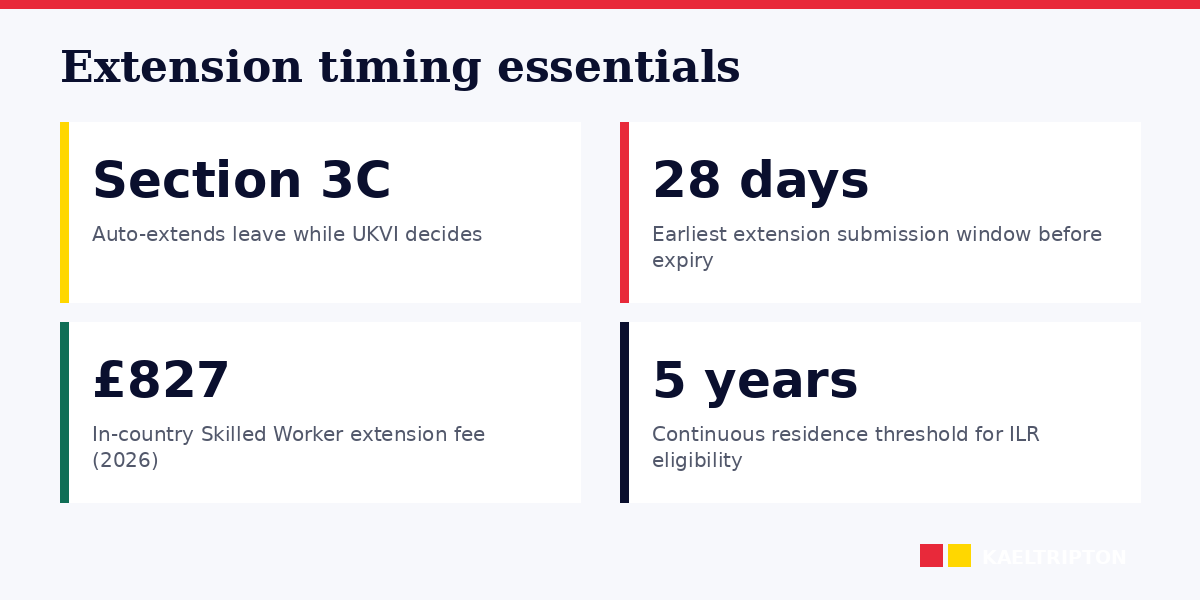
Section 3C of the Immigration Act 1971 is the legal mechanism that protects applicants during in-country visa processing. If you submit a valid application before your current leave expires, Section 3C automatically extends your leave on the same terms until the application is decided.
What Section 3C preserves:
- Right to work (if your current visa permits it)
- Right to rent (under landlord right-to-rent checks)
- Access to NHS services via Immigration Health Surcharge paid for the new application
- Eligibility for benefits where applicable
- Ability to travel outside the UK - but with caveats (see below)
What Section 3C does not protect:
- You cannot leave and re-enter the UK during 3C leave unless you have specific re-entry permission. Travel during 3C is high-risk.
- If your application is refused, 3C leave ends immediately. You must leave or appeal within deadlines.
- If you submit the application after your leave expires, 3C does not apply - you are an overstayer from day one.
When you can extend in-country
Most UK visa routes allow in-country extensions if you meet the ongoing eligibility criteria. Common extension scenarios:
- Skilled Worker extension: to continue with the same employer, or switch to a new sponsoring employer. Standard 3 or 5-year extensions available.
- Student visa extension: to continue studies at the same institution or progress to a higher level course.
- Family Visa extension: to continue the spouse/partner/parent relationship that originally grounded the visa.
- Global Talent extension: to continue the qualifying work or research.
- Innovator Founder extension: based on continued business activity and endorsement.
Extension applications follow the same process as initial applications - online form at gov.uk, biometric appointment at UKVCAS, payment of fees and IHS, decision usually within 8 weeks (faster with Priority).
When you can switch to a different route in-country
Switching means changing from one visa category to another without leaving the UK. 2026 in-country switch routes:
- Student → Graduate route: available after completing a degree at a Track Record of Compliance institution. 2 years for bachelor's/master's, 3 years for PhD. Cannot include dependants who didn't hold Student-dependent visas.
- Student → Skilled Worker: if you secure a qualifying job offer, you can switch without leaving. Common post-graduation route.
- Graduate → Skilled Worker: straightforward switch during the Graduate visa period when a qualifying job materialises.
- Skilled Worker → ILR: after 5 years of continuous Skilled Worker residence (subject to absence limits and other requirements).
- Youth Mobility → Skilled Worker: possible with a qualifying sponsored job.
- Spouse visa → ILR: after 5 years of continuous spouse visa residence with partner.
Routes that cannot be switched into in-country (must apply from abroad):
- Visitor visa cannot switch to any long-term route in-country - you must leave the UK and apply from abroad
- Some routes require a return to the country of nationality (specific to individual route rules)
Timing: when to submit an extension or switch
The rule: submit at least 28 days before your current visa expires. Not earlier than 28 days - some routes specifically limit how early you can apply.
Why 28 days matters:
- Under 28 days before expiry: you risk the application processing wrap-up overrunning your current visa, triggering Section 3C dependency
- Under 14 days: risk of deadline miss increases if biometric appointment takes time to book
- Under 7 days: significant risk of visa expiring before the Section 3C protection kicks in - last-resort territory
Practical timing: start gathering documents 12 weeks before expiry. Submit application 6-8 weeks before expiry. Have biometric appointment within 2 weeks of submission. Decision typically arrives 4-6 weeks later.
What happens if you overstay
Overstaying is a serious UK immigration offence. Consequences depend on duration and circumstances:
- Overstay by 1-14 days unintentionally: in some narrow circumstances, an overstay can be "overlooked" if a fresh application is submitted with good reason for the delay. This is discretionary and not guaranteed.
- Overstay by 14+ days: significant risk of a 1-year re-entry ban if you leave the UK voluntarily, or 5-year ban if you're removed.
- Longer overstays: compound consequences - removal proceedings, criminal prosecution in serious cases, ban on future UK visa applications of 5 to 10 years.
If you've already overstayed, take specialist immigration advice immediately - do not submit a new application blindly. The strategy varies significantly based on how long you've been overstaying and why.
Extension fees and IHS for 2026
| Route | In-country extension fee | IHS (per year) |
|---|---|---|
| Skilled Worker | £943 | £1,035 |
| Health and Care Worker | £284 | Exempt |
| Family Visa (spouse/partner) | £1,321 | £1,035 |
| Student | £524 | £776 |
| Graduate | £822 | £1,035 |
| Global Talent (visa stage) | £205 | £1,035 |
| Indefinite Leave to Remain | £3,226 | Not required for ILR |
For a 3-year Skilled Worker extension: £827 + (£1,035 × 3) = £3,932 per person. Dependants pay their own fees and IHS.
A real 2026 scenario: Skilled Worker extension
A 31-year-old Indian software engineer is on a 3-year Skilled Worker visa issued in June 2023, expiring June 2026. Her employer offers a further 3-year extension.
March 2026 (3 months before expiry): Employer's HR updates her Certificate of Sponsorship in the Sponsorship Management System. She checks her salary (£52,000) meets 2026 thresholds (well above £41,700 general).
April 2026 (8 weeks before expiry): She submits online Skilled Worker extension application via gov.uk. Pays £827 + £3,105 IHS (£1,035 × 3 years) = £3,932. Adds Priority Service (£500) to reduce to 5-day processing. Total £4,432.
April 2026: Books biometric appointment at UKVCAS London Croydon. Attends within 1 week of booking. Premium slot at £59 for same-week availability.
May 2026: Decision within 5 working days under Priority Service. Visa extended to May 2029. eVisa updated in UKVI account.
May 2028 (at 5 years total): She becomes eligible for Indefinite Leave to Remain. Can apply for ILR at £3,226 (IHS not required for ILR).
May 2029 (at 6 years total, once ILR granted): Eligible for British citizenship via naturalisation (£1,839 fee). 12 months post-ILR must have passed.
A real 2026 scenario: student to Graduate route
A Nigerian student completes a 1-year MSc at a UK university in September 2026. Her Student visa expires in November 2026.
September 2026 (course completion): University notifies Home Office of completion. Student receives a confirmation letter from the university confirming the award.
October 2026: Applies for Graduate route visa in-country. Fee £822 + IHS £1,035 × 2 years = £2,892.
November 2026: Graduate route visa granted for 2 years (master's level). Allows unrestricted work - no sponsor needed. Can look for work in any UK job.
October 2028: Graduate route expires. She must either secure Skilled Worker sponsorship or leave the UK. No further Graduate route extensions available.
Frequently asked questions
Can I travel abroad during an in-country visa extension?
Risky. Under Section 3C leave, your original visa technically expires while you wait. Leaving the UK can end 3C leave - you may not be able to re-enter without a decision. Check with UKVI before any travel during a pending application. Urgent cases can request passport return for specific trips.
How long before my visa expires should I apply for an extension?
28 days is the earliest most routes allow. 6-8 weeks before expiry is the safest practical window - gives time for biometric booking and standard processing without pressure. Don't apply earlier than 28 days; don't wait later than 14 days.
Can I switch from a Visitor visa to a work visa in-country?
No. Visitor visas cannot switch to any long-term route in-country. You must leave the UK and apply from abroad. This is a strict rule - attempted switches from Visitor to Skilled Worker in-country are rejected automatically.
What's the difference between extension and switching?
Extension is continuing the same visa type (Skilled Worker extension remains Skilled Worker). Switching is moving to a different category (Student to Skilled Worker, for example). Both are submitted via similar processes, but switching requires meeting the new route's specific eligibility. Not all routes can be switched into in-country.
Does my application status change on the day my old visa expires?
If you submitted a valid in-time application, no - Section 3C leave automatically kicks in and your permissions continue on the same terms until the application is decided. If you submitted after expiry, you are an overstayer and 3C does not protect you.
Can my employer pay for my visa extension?
Yes, on a contractual basis for application fee and IHS. Immigration Skills Charge is legally employer-only; Certificate of Sponsorship fee similarly. Many employers cover application fees and IHS for extensions as a retention benefit, particularly for senior hires.
What happens if my extension is refused?
Section 3C leave ends on the date of refusal. You have the same appeal/AR/fresh application routes as any refused applicant - 14 days to challenge (in-country) or 28 days (outside UK). If you do not challenge or reapply, you must leave the UK within a short timeframe, typically 30 days.
Sources
- Immigration Act 1971, Section 3C (continuation of leave pending variation decision)
- GOV.UK, Extend or switch your visa - gov.uk/extend-visa-switch-route
- Home Office, Visa and immigration services fees 2026
- Immigration Rules, various Appendices (route-specific extension and switch provisions)
- UK Visas and Immigration, Skilled Worker route caseworker guidance 2026
- GOV.UK, Graduate route - gov.uk/graduate-visa
- Nationality, Immigration and Asylum Act 2002 (overstaying provisions)


